Veterinary Autoclave
ProductOverview
Veterinary autoclaves are pressure steam sterilization systems essential for controlling surgical-site infection. They sterilize surgical instruments, drapes, gloves, and supplies by exposing items to saturated steam at 121–134 °C and elevated pressure (15–30 psi) for 10–30 minutes, killing all bacterial spores and viruses. The Veterinary Autoclave integrates a pressure Pressure Vessel Assembly with an internal or external Steam Generation System, safety Pressure and Safety System systems, and automated Cycle Timer and Controls controls.
Small-animal veterinary practices typically use benchtop autoclaves (15–23 L capacity); large-animal facilities use floor-standing units (30–40 L). Both operate on the same thermodynamic principles: saturated steam is the sterilizing agent because it transfers latent heat efficiently to proteins and denatures enzymes on microbial cell walls.
Pressure Vessel and Chamber Design
The Pressure Vessel Assembly is the core component: a cylindrical Autoclave Chamber Body made of 304 stainless steel (corrosion-resistant, non-reactive with steam), typically 1/4" wall thickness. The chamber is welded except for the front opening, which terminates in a flanged port. A Chamber Door (hinged stainless steel lid) closes this port via a Door Hinge piano hinge. The door seals against the chamber via a replaceable Door Gasket (rubber or silicone compression ring, 1–2 cm thick), which must be replaced every 1–2 years to maintain a tight seal.
Inside the chamber, two removable Instrument Basket stainless steel baskets (perforated sides, solid bottoms) support instruments, drapes, and wrapping materials. The perforations allow steam penetration to all surfaces. Items are loaded loosely (not compacted); dense packing prevents steam from reaching the center of the bundle, resulting in sterilization failure of items in the core.
At the chamber bottom is a Drain Valve (manual or solenoid-actuated) allowing removal of condensate (liquified steam) that accumulates during the cycle. Failure to drain condensate allows liquid water to remain on instruments, promoting rust and preventing drying.
Steam Generation System
The Steam Generation System comprises an integral or external Water Tank (3–10 L capacity, stainless steel), a Immersion Heater (electric immersion heater, 3–5 kW), and a Steam Line copper or stainless steel tubing delivering steam to the chamber.
The sequence is: distilled water (to minimize mineral buildup) fills the tank to a level marked on the Water Level Sensor (float switch). When the start button is pressed, the heating element energizes via a relay, raising water temperature to 100 °C. At 100 °C, steam forms above the water surface. Once pressure in the tank reaches 15–20 psi (saturation pressure at ~121 °C), a solenoid Solenoid Valve inlet valve opens, allowing steam to rush into the Pressure Vessel Assembly.
A Pressure Sensor continuously monitors chamber pressure. When pressure reaches the setpoint (typically 15 psi for 121 °C cycles or 30 psi for 134 °C), the heater switches to low-power maintenance mode, preventing overpressure. A Relief Valve spring-loaded safety valve (cracking at 32 psi) provides backup protection: if pressure exceeds 32 psi (overpressure due to sensor failure or valve malfunction), the relief valve vents excess steam, protecting the vessel from rupture.
Temperature and pressure are related via the steam saturation curve: at 1 atmosphere (sea level), water boils at 100 °C; at 15 psi (gauge) above atmospheric, saturation temperature is 121 °C; at 30 psi gauge, saturation is 134 °C. A Temperature Probe digital probe immersed inside the chamber (or in the exit steam line) confirms the actual chamber temperature.
Sterilization Cycles and Control
The Cycle Timer and Controls controls the sequence of chamber operations via a programmable logic controller (PLC) or electromechanical timer. Common cycles are:
Gravity Displacement (121 °C, 15–30 min): Steam enters at the top of the chamber; as it heats items, cooler air sinks and exits through a manually controlled vent valve at the chamber bottom. Once steam steadily flows from the vent, the vent is closed, and the timer begins the exposure period (typically 15 minutes for wrapped instruments, 30 minutes for dense packs). This is the slowest cycle but works well for most surgical instruments.
Vacuum-Assisted (134 °C, 3–10 min): Before steam enters, a vacuum pump evacuates most air from the chamber. Once a vacuum (−60 to −80 kPa) is achieved, the inlet solenoid opens and steam rapidly fills the chamber, penetrating to all surfaces almost instantaneously. The high temperature (134 °C) and rapid penetration reduce cycle time to 3–10 minutes. This cycle is preferred for wrapped items and hollow instruments.
Flash (132 °C, 3–4 min): Used for unwrapped instruments during a surgical case (e.g., a scalpel blade dropped during surgery). The instrument is placed directly in a flash pan (open-sided), steam rapidly heats the metal, and sterilization is achieved in 3–4 minutes. Flash-sterilized instruments must be used immediately (no time for drying) to prevent recontamination.
The Cycle Selector multi-position switch allows the operator to choose the appropriate cycle. After the exposure period, the timer initiates the Post-Cycle Drying: a Drying Vacuum Pump draws a mild vacuum (−40 to −60 kPa) through the chamber for 10–20 minutes, pulling residual moisture off wrapped items and baskets. Some autoclaves use warm-air drying instead (heated Immersion Heater circulating filtered air).
At the end of the drying phase, the Cycle Buzzer sounds (85 dB solenoid buzzer) and an Status Light (green light) indicates "cycle complete." Operator opens the door, and items are removed (carefully, as baskets and instruments may still be warm, ~60–80 °C).
Safety Interlocks and Monitoring
Safety is paramount: overpressure, over-temperature, or door opening during sterilization could cause scalding or explosion. The Door Lock is spring-loaded: during a cycle, a solenoid holds the door latched; if internal pressure exceeds atmospheric plus a safety margin, the lock mechanically releases, allowing the door to slightly crack and vent excess pressure.
The Pressure Sensor transducer provides digital feedback to the control module: if pressure deviates from the setpoint by more than 2 psi, the heater is adjusted. If pressure rises above the setpoint by >5 psi, a "high pressure" alarm sounds and the heater is de-energized.
The Water Level Sensor float switch prevents dry-firing: if water level drops below a minimum threshold, an alarm sounds and the heating element is disabled, preventing heater damage.
The Drain Valve must be opened at the end of each cycle; if the operator forgets, residual water corrodes the chamber over time. Many modern autoclaves automate the drain: a solenoid drain valve opens automatically during the drying phase.
Validation and Quality Assurance
The efficacy of sterilization is validated using biological indicators (BI): sealed test vials containing spore strips (e.g., Geobacillus stearothermophilus) resistant to steam sterilization. A BI is placed in the densest pack (typically the center of a large instrument bundle), the autoclave cycle is run, and the BI is removed and incubated at 55–60 °C for 24–48 hours. If the autoclave performed correctly, the spores are dead and no growth occurs (BI remains colorless). If growth occurs (BI changes color), the autoclave failed to sterilize, and the cycle is not validated.
Biological indicator testing is recommended monthly for quality assurance. If a BI fails, the autoclave should be serviced (checked for steam leaks, door gasket degradation, temperature calibration drift) before resuming use.
In addition to biological indicators, physical parameters are monitored: a chart recorder or digital data logger documents temperature and pressure throughout each cycle, providing a permanent record. Many facilities use integrator strips on item wrapping: these change color when exposed to steam + time + temperature meeting sterilization parameters, providing visible confirmation that an item experienced adequate sterilization conditions.
Maintenance and Operational Guidelines
Daily: visually inspect the autoclave for cracks, leaks, or deposits; empty the drain bottle if present; refill the water tank with distilled water (to prevent mineral scaling in the heating element).
Weekly: run a gravity displacement cycle (empty chamber) to purge the steam line of accumulated scale; inspect the door gasket for hardening, cracks, or uneven compression.
Monthly: remove and inspect the drain line and condenser for sediment or mineral deposits; perform a biological indicator test; check pressure gauge accuracy using a calibrated pressure tester (if gauge reads >2 psi off, recalibrate or replace).
Quarterly: inspect the heating element for scale buildup (some autoclaves have accessible heating elements that can be soaked in vinegar to dissolve mineral deposits); replace the door gasket if compressed or degraded (replacement cost ~$50–100, prevents leaks and pressure loss).
Annually: factory service for full pressure vessel hydrostatic test (confirms no micro-fractures); heater element resistance check (ensures electrical safety); and recalibration of temperature and pressure transducers.
Proper maintenance extends autoclave life to 10–15 years; neglect can reduce useful life to 3–5 years due to corrosion and seal degradation. Use of distilled or deionized water (not tap water) is critical: minerals in tap water form scale on the heating element and clog the steam line, reducing efficiency and forcing longer cycle times.
Clinical Impact
The autoclave is the bridge between a surgery (introduction of microbial contamination through the incision) and post-operative wound infection. Sterile instruments, drapes, and gowns, validated by proper autoclave function, reduce surgical site infection rates to <5% even in clean-contaminated cases. For this reason, routine validation of autoclave performance (via biological indicators) and strict adherence to sterilization protocols are considered standard of care in veterinary surgery. A malfunctioning autoclave can silently undermine years of strict sterile technique, making regular maintenance and validation non-negotiable.
Veterinary Autoclave parts and their functions
8 top-level parts · 26 parts in total · full bill of materials below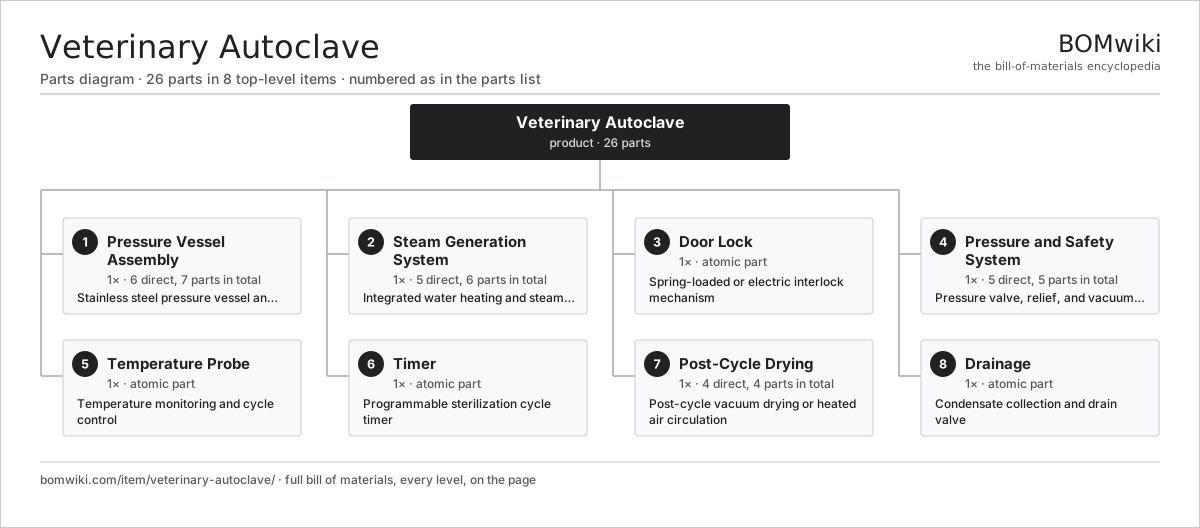
| # | Part | Qty | What it does |
|---|---|---|---|
| 1 | Pressure Vessel Assembly 6 parts | 1× | Stainless steel pressure vessel and door assembly |
| 2 | Steam Generation System 5 parts | 1× | Integrated water heating and steam production system |
| 3 | Door Lock | 1× | Spring-loaded or electric interlock mechanism |
| 4 | Pressure and Safety System 5 parts | 1× | Pressure valve, relief, and vacuum regulation |
| 5 | Temperature Probe | 1× | Temperature monitoring and cycle control |
| 6 | Timer | 1× | Programmable sterilization cycle timer |
| 7 | Post-Cycle Drying 4 parts | 1× | Post-cycle vacuum drying or heated air circulation |
| 8 | Drainage | 1× | Condensate collection and drain valve |
3D model
No 3D model yet. Have a CAD file of this? Add a 3D model. STL renders right on this page; STEP, FreeCAD, and OpenSCAD sources are welcome too (openly licensed, like all 3D models on BOMwiki).
Build & assembly graph
expand / collapse · shared sub-assemblies converge · links to related products · est. labourTap an assembly to expand/collapse · tap a part to open it · use “Open page” for any node · drag to pan, scroll to zoom.
Bill of materials for Veterinary Autoclave
8 top-level lines · 28 rows shown · 26 parts total · indented to 3 levels| # | Item / sub-assembly | Part no. | Qty/assy | Ext. qty | Parts | Type |
|---|---|---|---|---|---|---|
| 1 | Pressure Vessel Assembly 6 parts | veterinary-autoclave-chamber | 1× | 1 | 7 | assembly |
| 1.1 | Autoclave Chamber Body | veterinary-autoclave-body | 1× | 1 | · | part |
| 1.2 | Chamber Door | veterinary-autoclave-door | 1× | 1 | · | part |
| 1.3 | Door Hinge | veterinary-autoclave-door-hinge | 1× | 1 | · | part |
| 1.4 | Instrument Basket | veterinary-autoclave-basket | 2× | 2 | · | part |
| 1.5 | Door Gasket | veterinary-autoclave-gasket | 1× | 1 | · | part |
| 1.6 | Fastener Set | fastener-set | 1× | 1 | · | part |
| 2 | Steam Generation System 5 parts | veterinary-autoclave-steam-generator | 1× | 1 | 6 | assembly |
| 2.1 | Water Tank | veterinary-autoclave-water-tank | 1× | 1 | · | part |
| 2.2 | Immersion Heater | veterinary-autoclave-heating-element | 1× | 1 | · | part |
| 2.3 | Water Level Sensor | veterinary-autoclave-water-level-sensor | 1× | 1 | · | part |
| 2.4 | Steam Line | veterinary-autoclave-steam-intake-line | 1× | 1 | · | part |
| 2.5 | Solenoid Valve | veterinary-autoclave-valve-solenoid | 2× | 2 | · | part |
| 3 | Door Lock | veterinary-autoclave-door-lock | 1× | 1 | · | part |
| 4 | Pressure and Safety System 5 parts | veterinary-autoclave-pressure-control | 1× | 1 | 5 | assembly |
| 4.1 | Pressure Sensor | pressure-sensor | 1× | 1 | · | part |
| 4.2 | Pressure Gauge | veterinary-autoclave-pressure-gauge | 1× | 1 | · | part |
| 4.3 | Relief Valve | veterinary-autoclave-relief-valve | 1× | 1 | · | part |
| 4.4 | Vacuum Pump | veterinary-autoclave-vacuum-pump | 1× | 1 | · | part |
| 4.5 | Check Valve | veterinary-autoclave-check-valve | 1× | 1 | · | part |
| 5 | Temperature Probe | veterinary-autoclave-thermometer | 1× | 1 | · | part |
| 6 | Timer | veterinary-autoclave-timer | 1× | 1 | · | part |
| 7 | Post-Cycle Drying 4 parts | veterinary-autoclave-drying-system | 1× | 1 | 4 | assembly |
| 7.1 | Drying Vacuum Pump | veterinary-autoclave-vacuum-motor | 1× | 1 | · | part |
| 7.2 | Immersion Heater | veterinary-autoclave-heating-element | 1× | 1 | · | part |
| 7.3 | Drying Timer | veterinary-autoclave-drying-timer | 1× | 1 | · | part |
| 7.4 | Drying Valve | veterinary-autoclave-drying-valve | 1× | 1 | · | part |
| 8 | Drainage | veterinary-autoclave-drainage | 1× | 1 | · | part |
Something wrong in this list? Report a problem with this BOM.
Related products
same domain, ranked by shared parts Dental Oil-Free Compressor
208 parts · shares 1 with this page
Dental Oil-Free Compressor
208 parts · shares 1 with this page
 Dental Suction Pump
58 parts · shares 1 with this page
Equine Surgery Table
98 parts · shares 1 with this page
Dental Suction Pump
58 parts · shares 1 with this page
Equine Surgery Table
98 parts · shares 1 with this page
 Large Animal Anesthesia Machine
75 parts · shares 1 with this page
Veterinary Anesthesia Machine
357 parts · shares 1 with this page
Large Animal Anesthesia Machine
75 parts · shares 1 with this page
Veterinary Anesthesia Machine
357 parts · shares 1 with this page
Sourcing: possible vendors
Browse the supplier directory → Prices, MOQ, and lead times are algorithmic estimates, not quotes, and not claims about these companies. Company mappings are curated by keyword; est. price band $200–$200k. How estimates work| Vendor | HQ | Specialty | MOQ | Lead time |
|---|---|---|---|---|
| dentsplysirona.com ↗ | Charlotte, US | Dental equipment | 100 units | 10–16 wks |
|
🇺🇸Envista
envistaco.com ↗
|
Brea, US | Dental (KaVo, Nobel) | 100 units | 10–16 wks |
|
🇫🇮Planmeca
planmeca.com ↗
|
Helsinki, FI | Dental units & imaging | 100 units | 10–16 wks |
|
🇺🇸A-dec
a-dec.com ↗
|
Newberg, US | Dental chairs & delivery | 100 units | 10–16 wks |
|
🇺🇸Midmark
midmark.com ↗
|
Versailles, US | Medical & veterinary equipment | 100 units | 10–16 wks |
1,621-word article