Video Village Cart
ProductOverview
A video village cart is a self-contained mobile monitoring station used on film, television, and commercial production sets. The director, camera operator, focus puller, and VFX supervisor gather around it during takes and between setups to review footage, check focus, and confirm composition. The cart provides multiple monitor sizes and types for different purposes: color-critical monitors for grading decisions, confidence monitors for crew awareness, and wireless receivers to pull live feeds from cameras on set. It is powered by onboard batteries, allowing it to operate independently on location without tie-in to production power.
The cart integrates a Monitor Set of 4–6 displays, a Wireless Receiver Rack for real-time camera feeds, a Power Station for portable operation, and a Cart Frame with mobile casters. All components are organized on tiered Riser Shelving with integrated Cable Management for routing.
Monitor selection and setup
The Monitor Set is carefully selected. The two main monitors are typically 28 in. UHD 4K color-accurate displays (e.g., Dell P2823D or EIZO PA247CV) with 10-bit color depth and 300+ nits brightness, bright enough to be readable in outdoor daylight. These serve the director and DP for aesthetic and color decisions.
A secondary Reference Monitor (24 in., Rec.709 certified) ensures that the deliverable look matches broadcast standards. This monitor is factory-calibrated and regularly verified with DHC (Digital Hollywood Calibration) or similar tools; its color space must never drift.
Two smaller Compact Monitor displays (17 in., HDMI input) serve as confidence monitors for crew, focus puller checking eye focus, boom operator confirming frame headroom, etc. These do not require color accuracy, only sharp image and quick responsiveness.
Wireless receivers
The Wireless Receiver Rack houses 2–4 wireless video receiver modules. Each motion-capture-system-receiver-module decodes 5 GHz OFDM signal from on-set wireless camera transmitters, outputting HDMI or SDI. Standard 5 GHz receivers deliver <50 ms latency, suitable for real-time review during a take.
Typical workflow: a wireless transmitter on the camera (or a dedicated monitoring tap) streams the video signal to the receiver on the cart. Multiple cameras can transmit on different channels (frequency hopping avoids conflicts). The HDMI Matrix switcher allows routing any receiver output to any monitor, or splitting one camera feed to multiple monitors.
Antenna placement is critical: motion-capture-system-receiver-antenna units are positioned for line-of-sight to camera transmitters. Obstructions (walls, cranes, talent) degrade signal; experienced video village operators position antennas high (on a pole or cart mast) for optimal coverage.
Video distribution matrix
The Video Distribution subsystem enables flexible routing. A HDMI Matrix 4×4 HDMI matrix switcher allows any of four HDMI sources (camera A, B, C, plus playback device) to be routed to any of four outputs (main mon 1, main mon 2, reference, confidence 1, confidence 2). CEC (Consumer Electronics Control) integration allows the matrix to be controlled via a single remote.
A HDMI Splitter (1:4 amplified HDMI splitter) can split one camera feed to multiple monitors simultaneously, e.g., director and DP both watching the same camera on separate monitors. The splitter has independent output level controls, allowing one monitor to receive a brighter image if daylight glare is an issue.
Power system
The Power Station is the most distinctive element, enabling cordless operation. A Battery Module (LiFePO₄ 48V 200 Ah, 10 kWh capacity) provides energy for 8–12 hours of continuous operation depending on load. The BMS Controller manages cell balancing and load monitoring via CAN bus, protecting against overcharge and over-discharge.
A DC/AC Inverter (pure sine-wave 5 kW 48VDC to 230VAC) provides mains voltage for monitors and receivers. A PDU Board divides power into circuits: one for monitors (~1 kW typical), one for receivers (~200 W), one for cooling fans if needed. The system can also accept shore power (mains AC) via the Power Supply inlet, charging the battery while operating.
For extended productions, the cart can be charged overnight from generator or mains power, then operate standalone during filming. This eliminates the need for long extension cords and generator noise on set.
Frame and ergonomics
The Cart Frame is a welded steel or aluminum tube frame, powder-coated for durability. It's designed to be compact when moving (small footprint, <1.2 m width) but expands during use. The Riser Shelving is a three-tier arrangement: upper shelf holds the main monitors, middle shelf houses the receiver rack and matrix switcher, lower shelf provides operator workspace and cable routing.
All components are mounted on Monitor Mounts with ball-joint articulation, allowing the director to angle monitors for optimal viewing regardless of position. The cart handles casters are positioned for single-hand pushing, and Stabilizer Feet prevent tip-over when the cart is stationary.
Height is typically 1.8 m (assembled), putting main monitor centers at eye level for standing crew. Some carts include a fold-down operator seat for extended monitoring sessions.
Cable management
Professional cable management is essential, a disorganized cart is slow to set up and troubleshoot on set. The Cable Management system includes:
- Cable Tray aluminum or plastic snap-together trays routing cables vertically and horizontally
- Cable Sleeve expandable neoprene sleeves bundling cables to hide clutter
- Cable Labels printed labels identifying each cable (CAMERA A, PLAYBACK, etc.)
- Velcro Straps reusable hook-and-loop ties for quick cable routing
Typical cart carries 50–100 m of HDMI (2.0 preferred for 4K 60 Hz), SDI (optional), network (for wireless sync), and power cabling. Breakaway cables (standard HDMI, not proprietary) are preferred for portability, a crew member can quickly unplug a monitor and move it to a new position without breaking the entire system.
Setup and operation
A well-configured video cart takes 15–30 minutes to set up on set: position cart, extend monitor arms, power on battery (or connect mains), confirm wireless receiver signal lock with all cameras, and route feeds to monitors via the matrix. The cart operator (often the first AC or a dedicated video village tech) monitors signal quality, adjusts camera routing during takes, and records clips to the cart's video-village-cart-storage-ssd for immediate playback review.
Integration with on-set workflows
Modern video carts integrate with virtual-production systems (e.g., disguise, Notch) for pre-visualization playback and real-time compositing feedback. Some carts include a playback device (laptop, media server) capable of running editorial software (Premiere, Avid, or proprietary playback apps) for instant dailies review between takes.
Wireless syncing is increasingly important: timecode from the camera master clock (or timecode generator) is synced to cart monitors, ensuring that all crew see the same frame timing. This is essential for coordinated take reviews.
Video Village Cart parts and their functions
9 top-level parts · 106 parts in total · full bill of materials below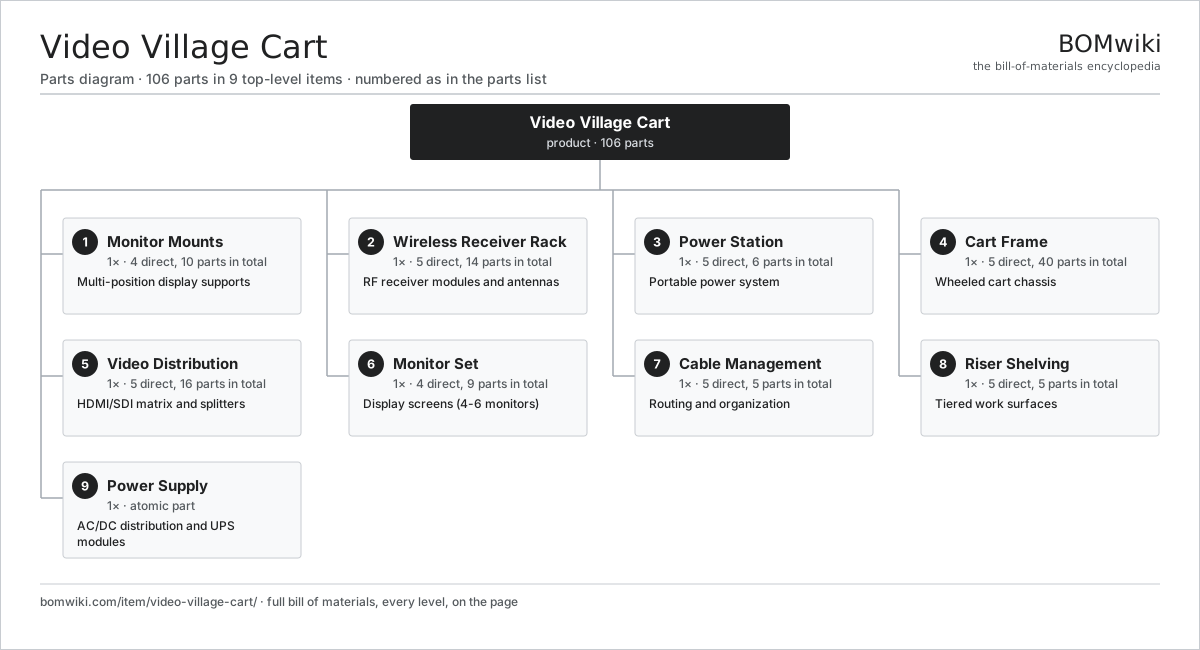
| # | Part | Qty | What it does |
|---|---|---|---|
| 1 | Monitor Mounts 4 parts | 1× | Multi-position display supports |
| 2 | Wireless Receiver Rack 5 parts | 1× | RF receiver modules and antennas |
| 3 | Power Station 5 parts | 1× | Portable power system |
| 4 | Cart Frame 5 parts | 1× | Wheeled cart chassis |
| 5 | Video Distribution 5 parts | 1× | HDMI/SDI matrix and splitters |
| 6 | Monitor Set 4 parts | 1× | Display screens (4-6 monitors) |
| 7 | Cable Management 5 parts | 1× | Routing and organization |
| 8 | Riser Shelving 5 parts | 1× | Tiered work surfaces |
| 9 | Power Supply | 1× | AC/DC distribution and UPS modules |
3D model
No 3D model yet. Have a CAD file of this? Add a 3D model. STL renders right on this page; STEP, FreeCAD, and OpenSCAD sources are welcome too (openly licensed, like all 3D models on BOMwiki).
Build & assembly graph
expand / collapse · shared sub-assemblies converge · links to related products · est. labourTap an assembly to expand/collapse · tap a part to open it · use “Open page” for any node · drag to pan, scroll to zoom.
Bill of materials for Video Village Cart
9 top-level lines · 52 rows shown · 106 parts total · indented to 3 levels| # | Item / sub-assembly | Part no. | Qty/assy | Ext. qty | Parts | Type |
|---|---|---|---|---|---|---|
| 1 | Monitor Mounts 4 parts | video-village-cart-monitor-mounts | 1× | 1 | 10 | assembly |
| 1.1 | Monitor Arm | video-village-cart-monitor-arm | 4× | 4 | · | part |
| 1.2 | VESA Plate | video-village-cart-vesa-plate | 4× | 4 | · | part |
| 1.3 | Cable Clips | video-village-cart-cable-clips | 1× | 1 | · | part |
| 1.4 | Fastener Set | fastener-set | 1× | 1 | · | part |
| 2 | Wireless Receiver Rack 5 parts | video-village-cart-wireless-receiver-rack | 1× | 1 | 14 | assembly |
| 2.1 | Wireless Receiver | video-village-cart-receiver-module | 2× | 2 | · | part |
| 2.2 | Antenna | video-village-cart-receiver-antenna | 2× | 2 | · | part |
| 2.3 | Receiver PSU | video-village-cart-receiver-power-distribution | 1× | 1 | · | part |
| 2.4 | Rack Frame | video-village-cart-rack-frame | 1× | 1 | · | part |
| 2.5 | Connector | connector | 8× | 8 | · | part |
| 3 | Power Station 5 parts | video-village-cart-battery-power-station | 1× | 1 | 6 | assembly |
| 3.1 | Battery Module | video-village-cart-battery-module | 1× | 1 | · | part |
| 3.2 | BMS Controller | video-village-cart-bms-controller | 1× | 1 | · | part |
| 3.3 | DC/AC Inverter | video-village-cart-inverter | 1× | 1 | · | part |
| 3.4 | PDU Board | video-village-cart-power-distribution-board | 1× | 1 | · | part |
| 3.5 | Connector | connector | 2× | 2 | · | part |
| 4 | Cart Frame 5 parts | video-village-cart-frame-structure | 1× | 1 | 40 | assembly |
| 4.1 | Frame Tubing | video-village-cart-frame-tube | 1× | 1 | · | part |
| 4.2 | Wheel Assembly 5 parts | wheel-assembly | 4× | 4 | 9 | assembly |
| 4.2.1 | Alloy Wheel | alloy-wheel | 1× | 4 | · | part |
| 4.2.2 | Tire | tire | 1× | 4 | · | part |
| 4.2.3 | TPMS Sensor | tpms-sensor | 1× | 4 | · | part |
| 4.2.4 | Lug Nut | lug-nut | 5× | 20 | · | part |
| 4.2.5 | Valve Stem | valve-stem | 1× | 4 | · | part |
| 4.3 | Base Plate | video-village-cart-base-plate | 1× | 1 | · | part |
| 4.4 | Stabilizer Feet | video-village-cart-stabilizer-feet | 1× | 1 | · | part |
| 4.5 | Fastener Set | fastener-set | 1× | 1 | · | part |
| 5 | Video Distribution 5 parts | video-village-cart-video-distribution | 1× | 1 | 16 | assembly |
| 5.1 | HDMI Matrix | video-village-cart-hdmi-matrix | 1× | 1 | · | part |
| 5.2 | HDMI Splitter | video-village-cart-splitter | 1× | 1 | · | part |
| 5.3 | Video Cabling | video-village-cart-distribution-cables | 1× | 1 | · | part |
| 5.4 | Cable Rack | video-village-cart-cable-management-rack | 1× | 1 | · | part |
| 5.5 | Connector | connector | 12× | 12 | · | part |
| 6 | Monitor Set 4 parts | video-village-cart-monitor-array | 1× | 1 | 9 | assembly |
| 6.1 | Main Monitor | video-village-cart-monitor-main | 2× | 2 | · | part |
| 6.2 | Reference Monitor | video-village-cart-monitor-reference | 1× | 1 | · | part |
| 6.3 | Compact Monitor | video-village-cart-monitor-compact | 2× | 2 | · | part |
| 6.4 | Monitor Arm | video-village-cart-monitor-arm | 4× | 4 | · | part |
| 7 | Cable Management 5 parts | video-village-cart-cable-management | 1× | 1 | 5 | assembly |
| 7.1 | Cable Tray | video-village-cart-cable-tray | 1× | 1 | · | part |
| 7.2 | Cable Sleeve | video-village-cart-cable-sleeve | 1× | 1 | · | part |
| 7.3 | Cable Labels | video-village-cart-cable-labels | 1× | 1 | · | part |
| 7.4 | Velcro Straps | video-village-cart-velcro-straps | 1× | 1 | · | part |
| 7.5 | Fastener Set | fastener-set | 1× | 1 | · | part |
| 8 | Riser Shelving 5 parts | video-village-cart-riser-shelving | 1× | 1 | 5 | assembly |
| 8.1 | Upper Shelf | video-village-cart-upper-shelf | 1× | 1 | · | part |
| 8.2 | Middle Shelf | video-village-cart-middle-shelf | 1× | 1 | · | part |
| 8.3 | Lower Platform | video-village-cart-lower-platform | 1× | 1 | · | part |
| 8.4 | Shelf Brackets | video-village-cart-shelf-brackets | 1× | 1 | · | part |
| 8.5 | Fastener Set | fastener-set | 1× | 1 | · | part |
| 9 | Power Supply | power-supply | 1× | 1 | · | part |
Something wrong in this list? Report a problem with this BOM.
Related products
same domain, ranked by shared parts Low Fog Machine
119 parts · shares 7 with this page
Snow Effect Machine
115 parts · shares 7 with this page
Low Fog Machine
119 parts · shares 7 with this page
Snow Effect Machine
115 parts · shares 7 with this page
 AV Matrix Switcher
112 parts · shares 1 with this page
AV Matrix Switcher
112 parts · shares 1 with this page
 AV Receiver
1,097 parts · shares 1 with this page
AV Receiver
1,097 parts · shares 1 with this page
 Broadcast Audio Console
1,111 parts · shares 1 with this page
Broadcast Audio Console
1,111 parts · shares 1 with this page
Sourcing: possible vendors
Browse the supplier directory → Prices, MOQ, and lead times are algorithmic estimates, not quotes, and not claims about these companies. Company mappings are curated by keyword; est. price band $50–$3k. How estimates work| Vendor | HQ | Specialty | MOQ | Lead time |
|---|---|---|---|---|
|
🇯🇵Sony
sony.com ↗
|
Tokyo, JP | Consumer electronics | 1,000 units | 8–12 wks |
| samsung.com ↗ | Suwon, KR | Electronics & displays | 1,000 units | 8–12 wks |
|
🇺🇸Harman
harman.com ↗
|
Stamford, US | Audio (JBL, AKG) | 1,000 units | 8–12 wks |
|
🇺🇸Bose
bose.com ↗
|
Framingham, US | Audio | 1,000 units | 8–12 wks |
| yamaha.com ↗ | Hamamatsu, JP | Audio & instruments | 1,000 units | 8–12 wks |
1,201-word article