Vinyl Cutting Plotter
ProductOverview
A vinyl-cutting plotter is a digitally controlled machine that cuts vinyl, fabric, and thin plastic films into precise shapes. Unlike printers that deposit ink, a plotter uses a thin carbide blade (drag knife) to sever material. Design files, typically SVG or PDFs, are loaded via USB or network, and the machine's stepper motors position the blade while a powered feed advances the vinyl. Pinch rollers grip the material without crushing it, enabling cuts as thin as decorative decals or as large as multi-metre signage.
Vinyl cutting dominates three market segments: sign-making (custom decals, window graphics), apparel decoration (heat-transfer vinyl for t-shirts), and technical cutting (prototyping, gaskets, stencils). A single 24-hour plotter can produce 100+ custom projects in a small print shop.
How It Works
Material is loaded horizontally onto the Pinch Roller Drive. The Drive Roller is powered by the Roller Motor, while Pinch Roller idlers press the vinyl down without crushing it. Spacing between pinch points is typically 5 mm, ensuring no wrinkles or slippage even at high feed speeds.
The Drag-Knife Carriage, mounted on the Gantry System, holds a rotating Drag Knife, a thin disc of tungsten carbide spinning at 300–800 rpm. The carriage is positioned in two axes:
- X-axis (width): The X Drive Motor and Ball Screw move the carriage left–right across the vinyl width.
- Y-axis (length): The Y Drive Motor and Ball Screw advance the carriage along the roll direction.
As the carriage traverses the programmed cutting path, the blade contacts and slices through the vinyl face without cutting the backing (carrier) layer. Depth is set by the Thickness Sensor, which auto-detects material thickness and adjusts blade pressure (typically 100–300 grams-force for standard vinyl, 400+ for thick materials like flex fabric).
The Swivel Arm, a self-aligning mechanism, rotates the blade so its edge is always tangent to the cutting direction, critical for clean curves without chattering. The rotation is servo'd by the Blade Motor.
After cutting, the design is "weeded", excess vinyl removed manually, leaving only the desired shapes. For application vinyl (outdoor signage), the finished design is transferred using heat and pressure to a substrate.
The Controller coordinates all motion. An operator loads an SVG or PDF via USB or SD card. The control software calculates step sequences for both X and Y motors, adjusts blade rotation for curve radius, and manages feed speed based on curve complexity (slower for tight turns, faster for straights).
Design Workflow and Software Integration
Most commercial plotters run proprietary firmware accepting design files in EPS, SVG, PDF, or native binary formats. Higher-end models include online design libraries and web-based job queuing. Feed-from-roll operation is standard; some machines add a second auto-rewind carriage for processing multiple rolls without manual intervention.
Blade pressure adjustment: Modern plotters include Thickness Sensor auto-detection. Operators scan material using the blade as a probe; the firmware adjusts pressure automatically. Manual adjustment via dial is also common for specialty materials (fabric, adhesive-backed paper).
Materials and Applications
Standard craft vinyl: 0.1–0.2 mm thick, cuts cleanly at 200–300 mm/s. Flex/Heat-transfer vinyl: 0.3–0.5 mm, requires 350+ g-force and slower speed (100–200 mm/s). Adhesive vinyl: 0.15–0.25 mm, medium pressure, 250 mm/s typical. Fabric (Cricut-compatible): 0.2–1.0 mm, low pressure (50–100 g), slow speed (50 mm/s). Mylar stencil stock: 0.15 mm, high precision, 300+ mm/s.
A single 30 m roll of 1.2 m wide craft vinyl yields approximately 500–1000 small decals (50×50 mm) or 50–100 large signs (500×300 mm), depending on design complexity.
Maintenance and Blade Life
Blade life: 5000–15000 linear metres before dulling (depends on material abrasiveness). Vinyl leaves a resinous buildup; weekly blade wiping with isopropyl alcohol extends life. Replacement blades cost €10–50.
Feed roller residue: Vinyl adhesive accumulates on the drive roller after 3–6 months; cleaning requires removal and careful scrubbing. Pinch rollers rarely require maintenance if pressure is set correctly (too high causes premature wear).
Plotter calibration: Done at commissioning and annually. Cutting a test grid ensures X and Y dimensions match design specification to ±0.2 mm across the full cutting bed.
Vinyl Cutting Plotter parts and their functions
6 top-level parts · 147 parts in total · full bill of materials below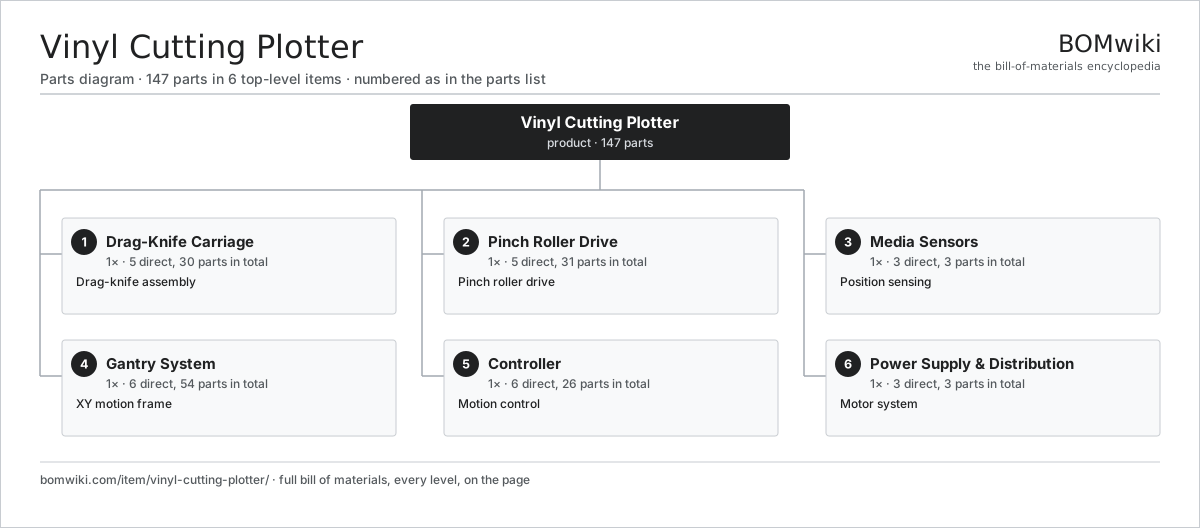
| # | Part | Qty | What it does |
|---|---|---|---|
| 1 | Drag-Knife Carriage 5 parts | 1× | Drag-knife assembly |
| 2 | Pinch Roller Drive 5 parts | 1× | Pinch roller drive |
| 3 | Media Sensors 3 parts | 1× | Position sensing |
| 4 | Gantry System 6 parts | 1× | XY motion frame |
| 5 | Controller 6 parts | 1× | Motion control |
| 6 | Power Supply & Distribution 3 parts | 1× | Motor system |
3D model
No 3D model yet. Have a CAD file of this? Add a 3D model. STL renders right on this page; STEP, FreeCAD, and OpenSCAD sources are welcome too (openly licensed, like all 3D models on BOMwiki).
Build & assembly graph
expand / collapse · shared sub-assemblies converge · links to related products · est. labourTap an assembly to expand/collapse · tap a part to open it · use “Open page” for any node · drag to pan, scroll to zoom.
Bill of materials for Vinyl Cutting Plotter
6 top-level lines · 54 rows shown · 147 parts total · indented to 3 levels| # | Item / sub-assembly | Part no. | Qty/assy | Ext. qty | Parts | Type |
|---|---|---|---|---|---|---|
| 1 | Drag-Knife Carriage 5 parts | vinyl-cutting-plotter-carriage | 1× | 1 | 30 | assembly |
| 1.1 | Drag Knife | vinyl-cutting-plotter-drag-knife | 1× | 1 | · | part |
| 1.2 | Knife Holder | vinyl-cutting-plotter-knife-holder | 1× | 1 | · | part |
| 1.3 | Swivel Arm | vinyl-cutting-plotter-swivel-arm | 1× | 1 | · | part |
| 1.4 | Blade Motor 3 parts | vinyl-cutting-plotter-carriage-motor | 1× | 1 | 23 | assembly |
| 1.4.1 | Stator Assembly 3 parts + deeper › | stator-assembly | 1× | 1 | 3 | assembly |
| 1.4.2 | Rotor Assembly 4 parts + deeper › | rotor-assembly | 1× | 1 | 19 | assembly |
| 1.4.3 | Encoder | encoder | 1× | 1 | · | part |
| 1.5 | Ball Bearing | ball-bearing | 4× | 4 | · | part |
| 2 | Pinch Roller Drive 5 parts | vinyl-cutting-plotter-feed-rollers | 1× | 1 | 31 | assembly |
| 2.1 | Drive Roller | vinyl-cutting-plotter-drive-roller | 1× | 1 | · | part |
| 2.2 | Pinch Roller | vinyl-cutting-plotter-pinch-roller | 2× | 2 | · | part |
| 2.3 | Roller Motor 3 parts | vinyl-cutting-plotter-roller-motor | 1× | 1 | 23 | assembly |
| 2.3.1 | Stator Assembly 3 parts + deeper › | stator-assembly | 1× | 1 | 3 | assembly |
| 2.3.2 | Rotor Assembly 4 parts + deeper › | rotor-assembly | 1× | 1 | 19 | assembly |
| 2.3.3 | Helical Gear Pair | gear-pair | 1× | 1 | · | part |
| 2.4 | Ball Bearing | ball-bearing | 4× | 4 | · | part |
| 2.5 | Encoder | encoder | 1× | 1 | · | part |
| 3 | Media Sensors 3 parts | vinyl-cutting-plotter-media-sensors | 1× | 1 | 3 | assembly |
| 3.1 | Edge Sensor | vinyl-cutting-plotter-edge-sensor | 1× | 1 | · | part |
| 3.2 | Gap Sensor | vinyl-cutting-plotter-gap-sensor | 1× | 1 | · | part |
| 3.3 | Thickness Sensor | vinyl-cutting-plotter-thickness-sensor | 1× | 1 | · | part |
| 4 | Gantry System 6 parts | vinyl-cutting-plotter-gantry | 1× | 1 | 54 | assembly |
| 4.1 | X Rail | vinyl-cutting-plotter-x-rail | 1× | 1 | · | part |
| 4.2 | Y Rail | vinyl-cutting-plotter-y-rail | 1× | 1 | · | part |
| 4.3 | X Drive Motor 3 parts | vinyl-cutting-plotter-x-motor | 1× | 1 | 23 | assembly |
| 4.3.1 | Stator Assembly 3 parts + deeper › | stator-assembly | 1× | 1 | 3 | assembly |
| 4.3.2 | Rotor Assembly 4 parts + deeper › | rotor-assembly | 1× | 1 | 19 | assembly |
| 4.3.3 | Encoder | encoder | 1× | 1 | · | part |
| 4.4 | Y Drive Motor 3 parts | vinyl-cutting-plotter-y-motor | 1× | 1 | 23 | assembly |
| 4.4.1 | Stator Assembly 3 parts + deeper › | stator-assembly | 1× | 1 | 3 | assembly |
| 4.4.2 | Rotor Assembly 4 parts + deeper › | rotor-assembly | 1× | 1 | 19 | assembly |
| 4.4.3 | Encoder | encoder | 1× | 1 | · | part |
| 4.5 | Ball Screw | ball-screw | 2× | 2 | · | part |
| 4.6 | Linear Bearing Block | vinyl-cutting-plotter-rail-bearing | 4× | 4 | · | part |
| 5 | Controller 6 parts | vinyl-cutting-plotter-controller | 1× | 1 | 26 | assembly |
| 5.1 | Control Board 4 parts | vinyl-cutting-plotter-control-board | 1× | 1 | 5 | assembly |
| 5.1.1 | Bare PCB | pcb-bare | 1× | 1 | · | part |
| 5.1.2 | Microcontroller | mcu | 1× | 1 | · | part |
| 5.1.3 | SMD Passive (R/C/L) | smd-passives | 1× | 1 | · | part |
| 5.1.4 | Relay | relay | 2× | 2 | · | part |
| 5.2 | Stepper Driver | vinyl-cutting-plotter-stepper-driver | 3× | 3 | · | part |
| 5.3 | HMI Panel 4 parts | vinyl-cutting-plotter-hmi | 1× | 1 | 4 | assembly |
| 5.3.1 | LCD Panel | lcd-panel | 1× | 1 | · | part |
| 5.3.2 | Touch Digitizer | touch-digitizer | 1× | 1 | · | part |
| 5.3.3 | Bare PCB | pcb-bare | 1× | 1 | · | part |
| 5.3.4 | Microcontroller | mcu | 1× | 1 | · | part |
| 5.4 | Microcontroller | mcu | 1× | 1 | · | part |
| 5.5 | SMD Passive (R/C/L) | smd-passives | 1× | 1 | · | part |
| 5.6 | Connector | connector | 12× | 12 | · | part |
| 6 | Power Supply & Distribution 3 parts | vinyl-cutting-plotter-power-drive | 1× | 1 | 3 | assembly |
| 6.1 | Power Supply | power-supply | 1× | 1 | · | part |
| 6.2 | Power Distribution | vinyl-cutting-plotter-power-distribution | 1× | 1 | · | part |
| 6.3 | E-Stop & Safety Relay | vinyl-cutting-plotter-emergency-stop | 1× | 1 | · | part |
Something wrong in this list? Report a problem with this BOM.
Related products
same domain, ranked by shared parts Cartoning Machine
280 parts · shares 3 with this page
Corrugated Case Maker
240 parts · shares 2 with this page
Cartoning Machine
280 parts · shares 3 with this page
Corrugated Case Maker
240 parts · shares 2 with this page
 Digital Inkjet Web Press
3,001 parts · shares 2 with this page
Digital Inkjet Web Press
3,001 parts · shares 2 with this page
 Dye-Sublimation Printer
414 parts · shares 2 with this page
Gravity Filling Machine
177 parts · shares 2 with this page
Dye-Sublimation Printer
414 parts · shares 2 with this page
Gravity Filling Machine
177 parts · shares 2 with this page
 Industrial Screen Printing Press
162 parts · shares 2 with this page
Industrial Screen Printing Press
162 parts · shares 2 with this page
Sourcing: possible vendors
Browse the supplier directory → Prices, MOQ, and lead times are algorithmic estimates, not quotes, and not claims about these companies. Company mappings are curated by keyword; est. price band $10k–$3M. How estimates work| Vendor | HQ | Specialty | MOQ | Lead time |
|---|---|---|---|---|
| heidelberg.com ↗ | Heidelberg, DE | Printing presses | 10 units | 12–22 wks |
|
🇨🇭Bobst
bobst.com ↗
|
Lausanne, CH | Packaging machinery | 10 units | 12–22 wks |
| koenig-bauer.com ↗ | Würzburg, DE | Printing presses | 10 units | 12–22 wks |
| wuh-group.com ↗ | Lengerich, DE | Flexible packaging machines | 10 units | 12–22 wks |
| markandy.com ↗ | Chesterfield, US | Label presses | 10 units | 12–22 wks |
758-word article