Rotational Viscometer
ProductOverview
A rotational viscometer measures the dynamic viscosity of liquids, pastes, and gels, their resistance to flow. It works by rotating a spindle immersed in the sample and measuring how strongly the fluid drags on it. Viscosity is reported in millipascal-seconds (mPa·s, equal to centipoise), and the instrument serves quality control across paints, coatings, foods, cosmetics, adhesives, polymers, and petroleum, where a product's flow behavior determines how it pumps, pours, spreads, or settles.
The governing idea is that a fluid resists shear, and the force needed to shear it scales with its viscosity. Spinning a spindle shears the fluid in the gap around it; the torque opposing the spindle is proportional to viscosity at a given speed. By rotating at a known speed and measuring that torque, the instrument computes viscosity directly through a constant set by the spindle geometry.
Construction
Rotation is produced by the Spindle Drive. A stepper motor turns through a Helical Gear Pair to a Pivot Shaft, with an Encoder confirming speed; the drive must hold its set rpm precisely because any speed error feeds straight into the viscosity result. The drive does not connect rigidly to the spindle. Instead it turns the upper end of the Torque Sensor, whose Torsion Spring, a calibrated beryllium-copper hairspring, links the drive to the spindle. When the sample resists, the spindle lags the drive and the spring twists. A Deflection Encoder reads this angular lag, which is directly proportional to viscous torque. A Pivot Jewel supports the spring shaft with almost no friction so the deflection reflects only the sample.
The spindle itself comes from the Spindle Set. Because one spring cannot span the full viscosity range at usable deflection, the operator selects a spindle to suit the sample: large Disc Spindle geometries present more surface area and read low viscosities, while small spindles read thick fluids. A Cone Spindle paired with a plate delivers a uniform shear rate for absolute measurements on small volumes, and a T-Bar Spindle swept through a non-flowing paste handles materials that will not settle around a fixed spindle. Each spindle clips on through the Spindle Coupling.
The whole measuring head rides on the Stand. Its Height Adjust lowers the head until the spindle reaches its etched immersion mark, and the Leveling Foot with the head's Level Bubble bring the assembly vertical so the spindle hangs true.
How it works
After leveling and immersing the chosen spindle, the operator sets a speed on the Display Module. The Controller Board commands the Motor Driver to hold that speed and reads the spring deflection through the Deflection ADC. Deflection is expressed as percent torque, the fraction of the spring's full-scale twist. Viscosity follows from the relation that it equals the percent torque multiplied by a factor depending on spindle and speed: a low speed and small spindle give a large multiplier and reach high viscosities, while a high speed and large spindle reach low viscosities. The controller stores these spindle constants and reports viscosity directly.
A valid reading requires the torque to fall in a usable window, conventionally between about 10% and 90% of full scale; outside that band the operator changes spindle or speed. Many materials are non-Newtonian, meaning their apparent viscosity changes with shear rate, so measurements are quoted with the spindle and speed used, and a controlled speed sweep can map the flow curve.
Temperature is the largest external influence, viscosity can change several percent per degree, so the Sample Jacket surrounds the Sample Cup with a Water Jacket fed from a circulating bath, and a Sample RTD reports the actual sample temperature with every result. The Head Housing protects the spring, encoder, and drive, the components on which the instrument's accuracy depends.
Rotational Viscometer parts and their functions
10 top-level parts · 69 parts in total · full bill of materials below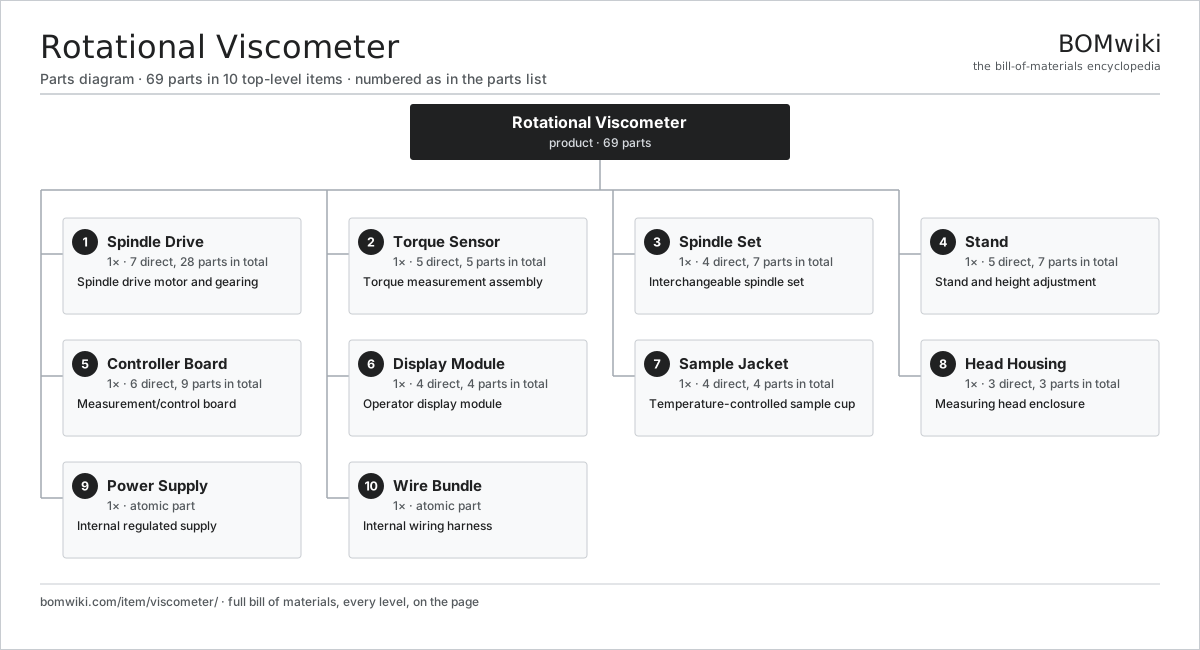
| # | Part | Qty | What it does |
|---|---|---|---|
| 1 | Spindle Drive 7 parts | 1× | Spindle drive motor and gearing |
| 2 | Torque Sensor 5 parts | 1× | Torque measurement assembly |
| 3 | Spindle Set 4 parts | 1× | Interchangeable spindle set |
| 4 | Stand 5 parts | 1× | Stand and height adjustment |
| 5 | Controller Board 6 parts | 1× | Measurement/control board |
| 6 | Display Module 4 parts | 1× | Operator display module |
| 7 | Sample Jacket 4 parts | 1× | Temperature-controlled sample cup |
| 8 | Head Housing 3 parts | 1× | Measuring head enclosure |
| 9 | Power Supply | 1× | Internal regulated supply |
| 10 | Wire Bundle | 1× | Internal wiring harness |
3D model
No 3D model yet. Have a CAD file of this? Add a 3D model. STL renders right on this page; STEP, FreeCAD, and OpenSCAD sources are welcome too (openly licensed, like all 3D models on BOMwiki).
Build & assembly graph
expand / collapse · shared sub-assemblies converge · links to related products · est. labourTap an assembly to expand/collapse · tap a part to open it · use “Open page” for any node · drag to pan, scroll to zoom.
Bill of materials for Rotational Viscometer
10 top-level lines · 55 rows shown · 69 parts total · indented to 3 levels| # | Item / sub-assembly | Part no. | Qty/assy | Ext. qty | Parts | Type |
|---|---|---|---|---|---|---|
| 1 | Spindle Drive 7 parts | viscometer-spindle-drive | 1× | 1 | 28 | assembly |
| 1.1 | Stator Assembly 3 parts | stator-assembly | 1× | 1 | 3 | assembly |
| 1.1.1 | Stator Core (laminations) | stator-core | 1× | 1 | · | part |
| 1.1.2 | Copper Winding | copper-winding | 1× | 1 | · | part |
| 1.1.3 | Slot Insulation | stator-insulation | 1× | 1 | · | part |
| 1.2 | Rotor Assembly 4 parts | rotor-assembly | 1× | 1 | 19 | assembly |
| 1.2.1 | Rotor Shaft | rotor-shaft | 1× | 1 | · | part |
| 1.2.2 | Rotor Core | rotor-core | 1× | 1 | · | part |
| 1.2.3 | Neodymium Magnet | neodymium-magnet | 16× | 16 | · | part |
| 1.2.4 | Ball Bearing | ball-bearing | 1× | 1 | · | part |
| 1.3 | Helical Gear Pair | gear-pair | 1× | 1 | · | part |
| 1.4 | Pivot Shaft | viscometer-pivot-shaft | 1× | 1 | · | part |
| 1.5 | Encoder | encoder | 1× | 1 | · | part |
| 1.6 | Ball Bearing | ball-bearing | 2× | 2 | · | part |
| 1.7 | Fastener Set | fastener-set | 1× | 1 | · | part |
| 2 | Torque Sensor 5 parts | viscometer-torque-sensor | 1× | 1 | 5 | assembly |
| 2.1 | Torsion Spring | viscometer-torsion-spring | 1× | 1 | · | part |
| 2.2 | Deflection Encoder | viscometer-deflection-encoder | 1× | 1 | · | part |
| 2.3 | Pivot Jewel | viscometer-pivot-jewel | 1× | 1 | · | part |
| 2.4 | Spindle Coupling | viscometer-coupling | 1× | 1 | · | part |
| 2.5 | Level Bubble | viscometer-level-bubble | 1× | 1 | · | part |
| 3 | Spindle Set 4 parts | viscometer-spindle-set | 1× | 1 | 7 | assembly |
| 3.1 | Disc Spindle | viscometer-disc-spindle | 4× | 4 | · | part |
| 3.2 | Cone Spindle | viscometer-cone-spindle | 1× | 1 | · | part |
| 3.3 | T-Bar Spindle | viscometer-tbar-spindle | 1× | 1 | · | part |
| 3.4 | Guard Leg | viscometer-guard-leg | 1× | 1 | · | part |
| 4 | Stand 5 parts | viscometer-stand | 1× | 1 | 7 | assembly |
| 4.1 | Base Plate | viscometer-base-plate | 1× | 1 | · | part |
| 4.2 | Support Column | viscometer-column | 1× | 1 | · | part |
| 4.3 | Height Adjust | viscometer-height-knob | 1× | 1 | · | part |
| 4.4 | Leveling Foot | viscometer-leveling-feet | 3× | 3 | · | part |
| 4.5 | Fastener Set | fastener-set | 1× | 1 | · | part |
| 5 | Controller Board 6 parts | viscometer-controller | 1× | 1 | 9 | assembly |
| 5.1 | Bare PCB | pcb-bare | 1× | 1 | · | part |
| 5.2 | Microcontroller | mcu | 1× | 1 | · | part |
| 5.3 | Motor Driver | viscometer-motor-driver | 1× | 1 | · | part |
| 5.4 | Deflection ADC | viscometer-deflection-adc | 1× | 1 | · | part |
| 5.5 | SMD Passive (R/C/L) | smd-passives | 1× | 1 | · | part |
| 5.6 | Connector | connector | 4× | 4 | · | part |
| 6 | Display Module 4 parts | viscometer-display | 1× | 1 | 4 | assembly |
| 6.1 | LCD Panel | lcd-panel | 1× | 1 | · | part |
| 6.2 | Touch Digitizer | touch-digitizer | 1× | 1 | · | part |
| 6.3 | Display Bezel | viscometer-display-bezel | 1× | 1 | · | part |
| 6.4 | Connector | connector | 1× | 1 | · | part |
| 7 | Sample Jacket 4 parts | viscometer-sample-jacket | 1× | 1 | 4 | assembly |
| 7.1 | Sample Cup | viscometer-sample-cup | 1× | 1 | · | part |
| 7.2 | Water Jacket | viscometer-water-jacket | 1× | 1 | · | part |
| 7.3 | Sample RTD | viscometer-sample-rtd | 1× | 1 | · | part |
| 7.4 | O-Ring Set | oring-set | 1× | 1 | · | part |
| 8 | Head Housing 3 parts | viscometer-head-housing | 1× | 1 | 3 | assembly |
| 8.1 | Head Shell | viscometer-head-shell | 1× | 1 | · | part |
| 8.2 | Head Cover | viscometer-head-cover | 1× | 1 | · | part |
| 8.3 | Fastener Set | fastener-set | 1× | 1 | · | part |
| 9 | Power Supply | power-supply | 1× | 1 | · | part |
| 10 | Wire Bundle | wire-bundle | 1× | 1 | · | part |
Something wrong in this list? Report a problem with this BOM.
Related products
same domain, ranked by shared parts X-Ray Diffractometer
705 parts · shares 15 with this page
Dissolution Tester
370 parts · shares 15 with this page
X-Ray Diffractometer
705 parts · shares 15 with this page
Dissolution Tester
370 parts · shares 15 with this page
 Spectrophotometer
124 parts · shares 15 with this page
Automatic Titrator
65 parts · shares 15 with this page
Spectrophotometer
124 parts · shares 15 with this page
Automatic Titrator
65 parts · shares 15 with this page
 Flow Cytometer
110 parts · shares 15 with this page
Flow Cytometer
110 parts · shares 15 with this page
Sourcing: possible vendors
Browse the supplier directory → Prices, MOQ, and lead times are algorithmic estimates, not quotes, and not claims about these companies. Company mappings are curated by keyword; est. price band $1k–$500k. How estimates work| Vendor | HQ | Specialty | MOQ | Lead time |
|---|---|---|---|---|
| thermofisher.com ↗ | Waltham, US | Lab instruments | 100 units | 10–18 wks |
|
🇺🇸Agilent
agilent.com ↗
|
Santa Clara, US | Analytical instruments | 100 units | 10–18 wks |
|
🇺🇸Bruker
bruker.com ↗
|
Billerica, US | Scientific instruments | 100 units | 10–18 wks |
|
🇯🇵Shimadzu
shimadzu.com ↗
|
Kyoto, JP | Analytical instruments | 100 units | 10–18 wks |
|
🇺🇸Waters
waters.com ↗
|
Milford, US | Chromatography & MS | 100 units | 10–18 wks |
650-word article