VoIP Gateway
ProductOverview
A VoIP gateway bridges the old telephone world and the IP network. On one side it speaks to analog phones, fax machines, and PSTN trunk lines, or to a digital E1/T1 span; on the other it carries those calls as RTP media streams set up by SIP. Inside, a host processor runs the call-control stack while a dedicated voice DSP does the per-channel signal work: encoding and decoding audio, cancelling echo, and detecting dial digits. The result lets an organization keep its existing handsets and trunks while connecting them to a modern IP PBX or carrier.
How it works
Analog and digital lines land on the Telephony Interface Module. Each FXS port drives a SLIC that supplies battery and ring voltage to an attached phone and senses when it goes off-hook, while FXO Port interfaces present a phone-like termination to a PSTN trunk. Every line couples through a Line Transformer for isolation and surge tolerance. A digital span instead enters the E1 Port and is decoded by the E1/T1 Framer, which recovers the individual voice timeslots.
Audio from these interfaces flows to the Mainboard, where the Voice DSP compresses each channel with the selected codec, removes echo, and packetizes the result. The Compute SoC Module runs the SIP/H.323 stack that negotiates calls and maps PSTN endpoints to IP destinations, with the Microcontroller handling supervision and the line-state housekeeping.
Packetized calls leave through the Ethernet Module, where magnetics-isolated ports carry the RTP and SIP traffic onto the LAN. The Front Panel Indicators shows per-channel status, and administrators configure dial plans and trunks through the Management Port, with the whole board powered from the internal Power Supply.
VoIP Gateway parts and their functions
7 top-level parts · 510 parts in total · full bill of materials below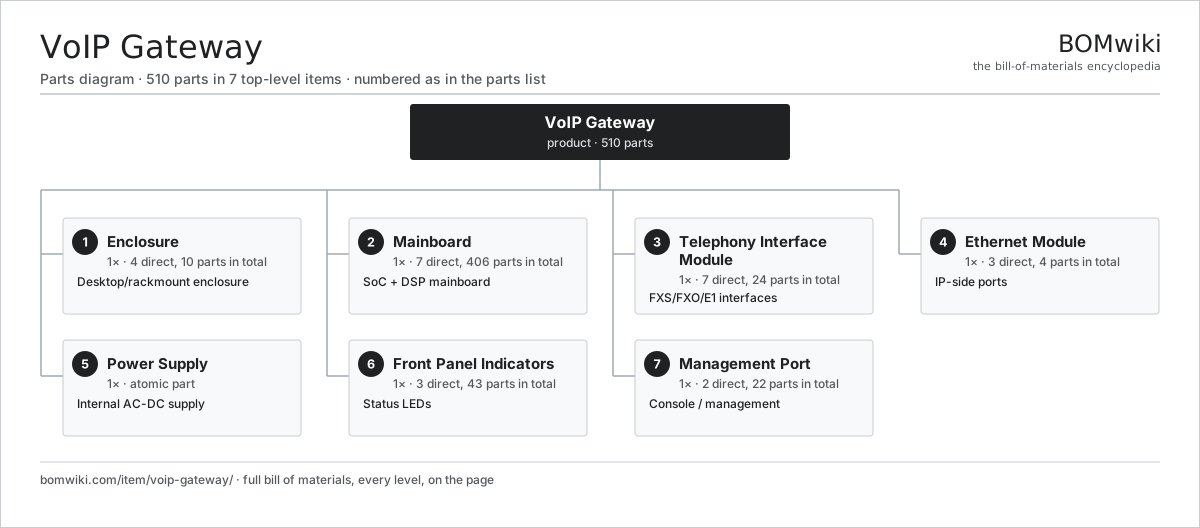
| # | Part | Qty | What it does |
|---|---|---|---|
| 1 | Enclosure 4 parts | 1× | Desktop/rackmount enclosure |
| 2 | Mainboard 7 parts | 1× | SoC + DSP mainboard |
| 3 | Telephony Interface Module 7 parts | 1× | FXS/FXO/E1 interfaces |
| 4 | Ethernet Module 3 parts | 1× | IP-side ports |
| 5 | Power Supply | 1× | Internal AC-DC supply |
| 6 | Front Panel Indicators 3 parts | 1× | Status LEDs |
| 7 | Management Port 2 parts | 1× | Console / management |
3D model
No 3D model yet. Have a CAD file of this? Add a 3D model. STL renders right on this page; STEP, FreeCAD, and OpenSCAD sources are welcome too (openly licensed, like all 3D models on BOMwiki).
Build & assembly graph
expand / collapse · shared sub-assemblies converge · links to related products · est. labourTap an assembly to expand/collapse · tap a part to open it · use “Open page” for any node · drag to pan, scroll to zoom.
Bill of materials for VoIP Gateway
7 top-level lines · 33 rows shown · 510 parts total · indented to 3 levels| # | Item / sub-assembly | Part no. | Qty/assy | Ext. qty | Parts | Type |
|---|---|---|---|---|---|---|
| 1 | Enclosure 4 parts | vg-enclosure | 1× | 1 | 10 | assembly |
| 1.1 | Sheet Metal Panel | sheet-panel | 3× | 3 | · | part |
| 1.2 | Rack Mount Ear | vg-rack-ear | 2× | 2 | · | part |
| 1.3 | Rubber Foot | vg-rubber-foot | 4× | 4 | · | part |
| 1.4 | Fastener Set | fastener-set | 1× | 1 | · | part |
| 2 | Mainboard 7 parts | vg-mainboard | 1× | 1 | 406 | assembly |
| 2.1 | Bare PCB | pcb-bare | 1× | 1 | · | part |
| 2.2 | Compute SoC Module | soc-module | 1× | 1 | · | part |
| 2.3 | Voice DSP | vg-voice-dsp | 1× | 1 | · | part |
| 2.4 | Microcontroller | mcu | 1× | 1 | · | part |
| 2.5 | Firmware Flash | vg-flash | 1× | 1 | · | part |
| 2.6 | Clock Oscillator | vg-clock-osc | 1× | 1 | · | part |
| 2.7 | SMD Passive (R/C/L) | smd-passives | 400× | 400 | · | part |
| 3 | Telephony Interface Module 7 parts | vg-telephony-module | 1× | 1 | 24 | assembly |
| 3.1 | FXS Port | vg-fxs-port | 4× | 4 | · | part |
| 3.2 | FXO Port | vg-fxo-port | 4× | 4 | · | part |
| 3.3 | SLIC | vg-slic | 4× | 4 | · | part |
| 3.4 | Line Transformer | vg-line-transformer | 8× | 8 | · | part |
| 3.5 | E1 Port | vg-e1-port | 1× | 1 | · | part |
| 3.6 | E1/T1 Framer | vg-e1-framer | 1× | 1 | · | part |
| 3.7 | Connector | connector | 2× | 2 | · | part |
| 4 | Ethernet Module 3 parts | vg-ethernet-module | 1× | 1 | 4 | assembly |
| 4.1 | RJ45 Jack | vg-rj45-jack | 2× | 2 | · | part |
| 4.2 | Ethernet Magnetics | vg-magnetics | 1× | 1 | · | part |
| 4.3 | Ethernet PHY | vg-ethernet-phy | 1× | 1 | · | part |
| 5 | Power Supply | power-supply | 1× | 1 | · | part |
| 6 | Front Panel Indicators 3 parts | vg-front-panel | 1× | 1 | 43 | assembly |
| 6.1 | Bare PCB | pcb-bare | 1× | 1 | · | part |
| 6.2 | Status LED | vg-status-led | 12× | 12 | · | part |
| 6.3 | SMD Passive (R/C/L) | smd-passives | 30× | 30 | · | part |
| 7 | Management Port 2 parts | vg-mgmt-port | 1× | 1 | 22 | assembly |
| 7.1 | Connector | connector | 2× | 2 | · | part |
| 7.2 | SMD Passive (R/C/L) | smd-passives | 20× | 20 | · | part |
Something wrong in this list? Report a problem with this BOM.
Related products
same domain, ranked by shared parts 5G Base Station
436 parts · shares 4 with this page
Data Center Switch (Spine)
3,264 parts · shares 4 with this page
5G Base Station
436 parts · shares 4 with this page
Data Center Switch (Spine)
3,264 parts · shares 4 with this page
 Firewall Appliance
82 parts · shares 4 with this page
Firewall Appliance
82 parts · shares 4 with this page
 Industrial Ethernet Switch
508 parts · shares 4 with this page
Load Balancer Appliance
911 parts · shares 4 with this page
Industrial Ethernet Switch
508 parts · shares 4 with this page
Load Balancer Appliance
911 parts · shares 4 with this page
 Network Switch
1,367 parts · shares 4 with this page
Network Switch
1,367 parts · shares 4 with this page
Sourcing: possible vendors
Browse the supplier directory → Prices, MOQ, and lead times are algorithmic estimates, not quotes, and not claims about these companies. Company mappings are curated by keyword; est. price band $30–$50k. How estimates work| Vendor | HQ | Specialty | MOQ | Lead time |
|---|---|---|---|---|
|
🇺🇸Cisco
cisco.com ↗
|
San Jose, US | Networking | 500 units | 8–14 wks |
|
🇺🇸Juniper
juniper.net ↗
|
Sunnyvale, US | Networking | 500 units | 8–14 wks |
| arista.com ↗ | Santa Clara, US | Networking | 500 units | 8–14 wks |
|
🇫🇮Nokia
nokia.com ↗
|
Espoo, FI | Telecom equipment | 500 units | 8–14 wks |
|
🇨🇳Huawei
huawei.com ↗
|
Shenzhen, CN | Networking & telecom | 500 units | 8–14 wks |
294-word article