Wall Chaser
ProductOverview
A wall chaser (or groove cutter) is a specialized handheld power tool designed to cut precise, parallel grooves (chases) in masonry, concrete, and stone walls. It uses two counter-rotating diamond-coated blades running at high speed to create a single channel, allowing routing of electrical conduit, water pipes, fiber-optic cables, and HVAC ducts while maintaining clean, predictable cuts and minimal masonry damage.
Professional installation standards often require chase widths of 5–10 mm and depths of 30–60 mm, cut along chalk lines or laser guides. Wall chasers deliver superior precision and surface finish compared to jackhammers or pneumatic chisels, reducing the labor required for subsequent conduit fitting and back-filling.
How It Works
The motor assembly drives the spindle at 4000–6000 rpm. Two diamond-coated blades are mounted side-by-side on the spindle, typically spaced 5–10 mm apart. As the tool is pushed along a marked guide line, both blades simultaneously cut parallel walls of the chase, with the gap between blades defining the final width.
The depth guide fence is a critical component that rides along the wall surface, preventing the tool from cutting deeper than the operator intends. The sliding fence adjusts on a precision rail and locks at the desired depth using a knob with depth-scale readout.
Operator control is achieved through the handle assembly, which includes a main pistol grip and secondary side handle. The power control offers variable-speed triggering and an electric brake that stops the spindle within 5 seconds after switch release, improving safety.
Dust Management
Wall chasing generates substantial dust, particularly when cutting concrete or masonry. The dust extraction system relies on a shroud surrounding the blades and brush contacts that direct particles into a central collection chamber. A 38–50 mm hose connects to a wet/dry vacuum (typically 50–80 L/min airflow capacity) for external containment.
Effective dust extraction is critical for:
- Operator respiratory health (concrete dust contains silica)
- Visibility during cutting
- Prolonging blade and bearing life
- Reducing cleanup labor
Modern commercial models achieve >95% dust collection efficiency with proper external vacuum pressure.
Diamond Blade Design
The dual blades are segmented diamond-coated discs with:
- Outer diameter: 115–180 mm (4.5–7 inches)
- Thickness: 3–4 mm
- Bond: Resin-metal composite holding diamond particles
- Core: Steel with laser-cut cooling slots
Blade selection depends on material:
- Dry cutting: Blades with narrower kerfs and fewer segments
- Wet cutting: Blades with wider kerfs and cooling holes (requires water pump attachment)
- Reinforced concrete: Segmented blades with aggressive diamond grading
- Asphalt: Turbo or sintered blades
Blade life typically ranges from 10–50 linear meters of cutting, depending on material hardness and dust extraction effectiveness.
Precision and Accuracy
The base plate and shoe provide stable work surface contact, with precision machining ensuring flatness to <0.1 mm. The depth guide rail is typically a T-slot aluminum extrusion with ground bearing surfaces, allowing the carriage to slide freely while maintaining consistent depth.
Laser guides or chalk lines are used to keep the tool aligned laterally. With proper technique and guide maintenance, wall chasers can achieve:
- Chase width tolerance: ±2 mm
- Depth consistency: ±3 mm over 1 meter run
- Surface finish: smooth, with minimal spalling
Safety and Vibration Control
Wall chasers operate at high speeds and can generate significant reaction torque. The secondary side handle provides two-point control, distributing loads across both arms and reducing repetitive strain injury. The handle assembly incorporates vibration isolators to reduce high-frequency vibration transmission.
The blade guard is transparent polycarbonate, allowing visibility while protecting the operator from:
- Blade ejection (in event of binding)
- Contact with spinning edges
- Debris ejection
An integral interlock prevents motor startup if the guard is open on some models.
Applications
- Electrical roughin: Running conduit and cable in vertical and horizontal chases
- Plumbing: Routing water and drain pipes in masonry walls
- HVAC: Cutting ductwork paths in concrete and stone
- Low-voltage systems: Structured cabling, alarm wire, fire suppression lines
- Restoration: Creating uniform grooves for grout injection or structural reinforcement
Material Compatibility
Wall chasers are suitable for:
- Concrete (reinforced and plain)
- Masonry (brick, block, natural stone)
- Asphalt and paving stones
- Tile
Not suitable for:
- Drywall (use conventional circular saws)
- Wood (severe binding risk)
- Plastic or vinyl (melting hazard)
Regulatory and Standards
Wall chasers comply with:
- IEC 61029-2-3: Electric tools for concrete and stone
- ISO 5349-1/-2: Hand-held vibration exposure limits
- OSHA Silica Rule: Dust control and respiratory protection requirements
- EN 12413: Segmented diamond blades for handheld saws
Wet cutting significantly reduces inhalation silica exposure and is mandated in many jurisdictions for work on concrete and masonry.
Wall Chaser parts and their functions
8 top-level parts · 53 parts in total · full bill of materials below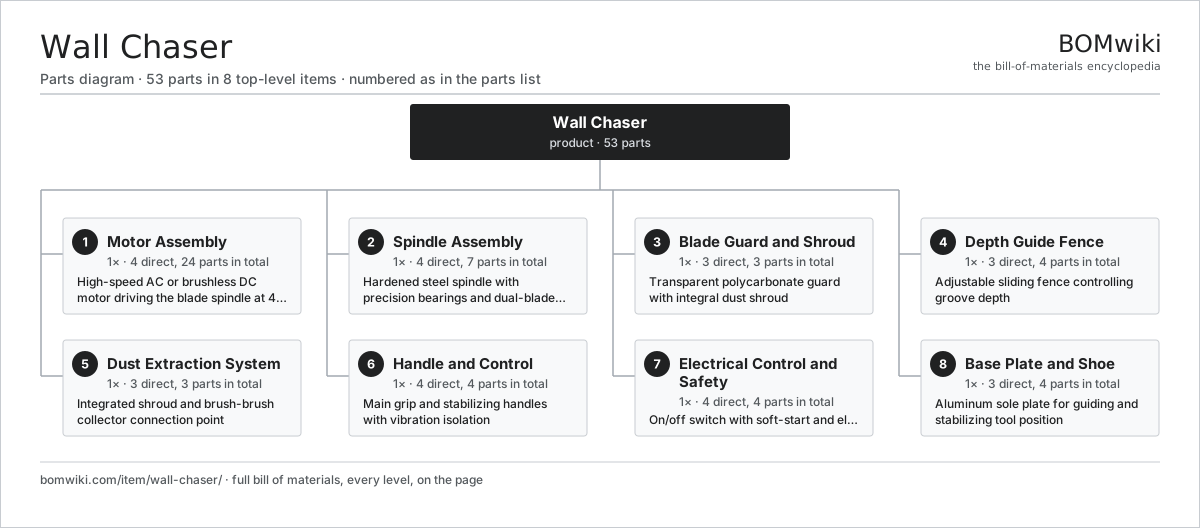
| # | Part | Qty | What it does |
|---|---|---|---|
| 1 | Motor Assembly 4 parts | 1× | High-speed AC or brushless DC motor driving the blade spindle at 4000–6000 rpm |
| 2 | Spindle Assembly 4 parts | 1× | Hardened steel spindle with precision bearings and dual-blade coupling |
| 3 | Blade Guard and Shroud 3 parts | 1× | Transparent polycarbonate guard with integral dust shroud |
| 4 | Depth Guide Fence 3 parts | 1× | Adjustable sliding fence controlling groove depth |
| 5 | Dust Extraction System 3 parts | 1× | Integrated shroud and brush-brush collector connection point |
| 6 | Handle and Control 4 parts | 1× | Main grip and stabilizing handles with vibration isolation |
| 7 | Electrical Control and Safety 4 parts | 1× | On/off switch with soft-start and electric brake |
| 8 | Base Plate and Shoe 3 parts | 1× | Aluminum sole plate for guiding and stabilizing tool position |
3D model
No 3D model yet. Have a CAD file of this? Add a 3D model. STL renders right on this page; STEP, FreeCAD, and OpenSCAD sources are welcome too (openly licensed, like all 3D models on BOMwiki).
Build & assembly graph
expand / collapse · shared sub-assemblies converge · links to related products · est. labourTap an assembly to expand/collapse · tap a part to open it · use “Open page” for any node · drag to pan, scroll to zoom.
Bill of materials for Wall Chaser
8 top-level lines · 40 rows shown · 53 parts total · indented to 3 levels| # | Item / sub-assembly | Part no. | Qty/assy | Ext. qty | Parts | Type |
|---|---|---|---|---|---|---|
| 1 | Motor Assembly 4 parts | wall-chaser-motor | 1× | 1 | 24 | assembly |
| 1.1 | Motor Housing | motor-housing | 1× | 1 | · | part |
| 1.2 | Copper Winding | copper-winding | 2× | 2 | · | part |
| 1.3 | Ball Bearing | ball-bearing | 2× | 2 | · | part |
| 1.4 | Rotor Assembly 4 parts | rotor-assembly | 1× | 1 | 19 | assembly |
| 1.4.1 | Rotor Shaft | rotor-shaft | 1× | 1 | · | part |
| 1.4.2 | Rotor Core | rotor-core | 1× | 1 | · | part |
| 1.4.3 | Neodymium Magnet | neodymium-magnet | 16× | 16 | · | part |
| 1.4.4 | Ball Bearing | ball-bearing | 1× | 1 | · | part |
| 2 | Spindle Assembly 4 parts | wall-chaser-spindle-assembly | 1× | 1 | 7 | assembly |
| 2.1 | Spindle Shaft | wall-chaser-spindle-shaft | 1× | 1 | · | part |
| 2.2 | Ball Bearing | ball-bearing | 2× | 2 | · | part |
| 2.3 | Blade Mounting Flange | wall-chaser-blade-flange | 2× | 2 | · | part |
| 2.4 | Fastener Set | fastener-set | 2× | 2 | · | part |
| 3 | Blade Guard and Shroud 3 parts | wall-chaser-blade-guard | 1× | 1 | 3 | assembly |
| 3.1 | Guard Cover | wall-chaser-guard-cover | 1× | 1 | · | part |
| 3.2 | Dust Shroud Body | wall-chaser-shroud-body | 1× | 1 | · | part |
| 3.3 | Dust Port Adapter | wall-chaser-dust-port | 1× | 1 | · | part |
| 4 | Depth Guide Fence 3 parts | wall-chaser-depth-guide | 1× | 1 | 4 | assembly |
| 4.1 | Guide Rail | wall-chaser-guide-rail | 1× | 1 | · | part |
| 4.2 | Depth Slider Carriage | wall-chaser-depth-slider | 1× | 1 | · | part |
| 4.3 | Fastener Set | fastener-set | 2× | 2 | · | part |
| 5 | Dust Extraction System 3 parts | wall-chaser-dust-extraction | 1× | 1 | 3 | assembly |
| 5.1 | Dust Shroud | wall-chaser-shroud-assembly | 1× | 1 | · | part |
| 5.2 | Brush Contact Ring | wall-chaser-brush-ring | 1× | 1 | · | part |
| 5.3 | Connector | connector | 1× | 1 | · | part |
| 6 | Handle and Control 4 parts | wall-chaser-handle-assembly | 1× | 1 | 4 | assembly |
| 6.1 | Main Grip Handle | wall-chaser-main-handle | 1× | 1 | · | part |
| 6.2 | Secondary Side Handle | wall-chaser-secondary-handle | 1× | 1 | · | part |
| 6.3 | Trigger Switch | wall-chaser-trigger-switch | 1× | 1 | · | part |
| 6.4 | Soft-Start Control Board | wall-chaser-soft-start-pcb | 1× | 1 | · | part |
| 7 | Electrical Control and Safety 4 parts | wall-chaser-power-control | 1× | 1 | 4 | assembly |
| 7.1 | On/Off Switch | wall-chaser-power-switch | 1× | 1 | · | part |
| 7.2 | Brake Relay | wall-chaser-brake-relay | 1× | 1 | · | part |
| 7.3 | Power MOSFET | mosfet | 1× | 1 | · | part |
| 7.4 | Thermal Fuse | thermal-fuse | 1× | 1 | · | part |
| 8 | Base Plate and Shoe 3 parts | wall-chaser-base-plate | 1× | 1 | 4 | assembly |
| 8.1 | Sole Plate | wall-chaser-sole-plate | 1× | 1 | · | part |
| 8.2 | Foot Pad | wall-chaser-foot-pad | 2× | 2 | · | part |
| 8.3 | Fastener Set | fastener-set | 1× | 1 | · | part |
Something wrong in this list? Report a problem with this BOM.
Related products
same domain, ranked by shared parts Industrial Hot Glue Gun
28 parts · shares 2 with this page
Industrial Hot Glue Gun
28 parts · shares 2 with this page
 Bench Power Supply
46 parts · shares 1 with this page
Dual-Action Polisher
62 parts · shares 1 with this page
Bench Power Supply
46 parts · shares 1 with this page
Dual-Action Polisher
62 parts · shares 1 with this page
 Electric Hand Planer
57 parts · shares 1 with this page
Electric Hand Planer
57 parts · shares 1 with this page
 Electronic Torque Wrench
42 parts · shares 1 with this page
Electronic Torque Wrench
42 parts · shares 1 with this page
 Heat Gun
183 parts · shares 1 with this page
Heat Gun
183 parts · shares 1 with this page
Sourcing: possible vendors
Browse the supplier directory → Prices, MOQ, and lead times are algorithmic estimates, not quotes, and not claims about these companies. Company mappings are curated by keyword; est. price band $30–$800. How estimates work| Vendor | HQ | Specialty | MOQ | Lead time |
|---|---|---|---|---|
| stanleyblackanddecker.com ↗ | New Britain, US | Tools (DeWalt, Craftsman) | 500 units | 6–12 wks |
| bosch-professional.com ↗ | Leinfelden, DE | Power tools | 500 units | 6–12 wks |
| ttigroup.com ↗ | Hong Kong, CN | Tools (Milwaukee, Ryobi) | 500 units | 6–12 wks |
|
🇯🇵Makita
makita.com ↗
|
Anjo, JP | Power tools | 500 units | 6–12 wks |
|
🇨🇭Hilti
hilti.com ↗
|
Schaan, CH | Construction tools | 500 units | 6–12 wks |
812-word article