Waste-to-Energy Boiler
ProductOverview
A waste-to-energy boiler is an industrial furnace specifically designed to safely and efficiently combust mixed municipal waste, converting the latent chemical energy into steam for power generation or district heating. The machine is the heart of a waste-to-energy (WtE) facility: it receives compacted refuse (paper, cardboard, plastics, food waste, textiles, glass, metals), burns it under controlled combustion conditions (>1000 °C, >2 second residence time), and recovers the heat via water-jacketed furnace walls and multiple downstream heat-exchanger sections.
A single modern WtE boiler can process 100–150 tonnes of waste daily, generating 40–50 tonnes of high-pressure steam per hour. That steam drives a turbine-generator producing 8–15 MW of electricity. The waste-to-energy approach converts waste disposal (a cost center) into electricity sales (a revenue stream), offsetting facility operating expenses and sometimes generating positive economics.
How it works
Waste Intake and Grate System
Shredded, compacted municipal waste arrives in refuse trucks and is dumped into an elevated furnace feed hopper. Waste slides down gravity chutes onto a mechanized moving-grate system at the furnace base. The grate drive motor (30 kW, variable speed) powers an eccentric crankshaft that causes cast-iron grate bars to reciprocate (move back-and-forth) with ~50 mm stroke at 10–30 rpm.
As the grate bars move, they advance waste toward the furnace discharge end. The alternating-width bar design creates gaps that allow fine ash to fall through into a water-cooled ash pit below, while larger unburned material is mechanically advanced. The grate design ensures thorough mixing and oxidation of waste throughout its residence time (typically 45–60 minutes).
Primary Combustion Chamber
Waste on the grate is heated by the primary combustion chamber, a refractory-lined steel furnace measuring 8 m tall × 6 m wide × 4 m deep. The furnace maintains 1000–1200 °C via exothermic combustion of waste material. A high-alumina refractory brick lining (300 mm thick, rated 1500 °C) protects the outer steel shell and prevents rapid heat loss.
Two auxiliary oil-fired burners (2.5 MW each) provide ignition during startup and supplemental heat during low-load periods when waste energy alone is insufficient.
Primary air (30% of total combustion air) is supplied underneath the grate through perforated nozzles. This air flows upward through the burning waste, providing oxygen for oxidation. Secondary air jets (70% of total) are injected above the grate at the upper furnace level, providing additional oxygen for complete burnout of volatile hydrocarbons and carbon monoxide. A forced-draft fan (150 kW, 800 m³/h @ 1.5 bar) supplies all combustion air.
A proportional pneumatic damper modulates total air flow; the boiler control PLC adjusts damper position to maintain target oxygen concentration in the flue gas (3–6% O2, monitored by a zirconia oxygen probe). Excess combustion air reduces thermal efficiency; insufficient air creates incomplete combustion and pollutants. The control loop actively maintains the optimal stoichiometric window.
A flame detector (infrared UV sensor) monitors flame presence. If flame is lost for >3 seconds, the control system immediately shuts down fuel feed and auxiliary burners, preventing furnace overpressure and toxic carbon monoxide accumulation.
Heat Recovery: Water Walls
Immediately surrounding the furnace chamber is a parallel bundle of steel tubes (500 m total length, 54 mm OD × 4 mm wall) forming the water walls. These tubes are welded to the furnace shell and filled with circulating hot water under pressure (20 bar). As waste burns inside the furnace, radiant heat and convection transfer energy to the tube walls. The water absorbs heat rapidly; circulating water temperature rises from 160 °C inlet to nearly 200 °C outlet.
A centrifugal circulation pump (150 m³/h, 75 kW) recirculates water between the furnace (generating steam) and a steam drum (collecting separated water). The furnace section operates at saturation conditions (~200 °C, ~20 bar), so heat input immediately converts a portion of the circulating water to steam bubbles. These bubbles rise and separate in the steam drum; saturated water drops back to the furnace for another pass, while saturated steam exits toward the superheater.
Superheater and Temperature Control
Raw saturated steam leaving the water walls is at ~200 °C and 20 bar. To generate high-quality steam suitable for turbine operation, a superheater section (200 m of T91 alloy-steel tubes) further heats this steam using hot flue gas. The superheater is positioned downstream of the water walls where flue-gas temperature is still 600–700 °C.
Steam entering the superheater is saturated (two-phase). As it flows through the alloy-steel tubes, it absorbs sensible heat from the surrounding flue gas, increasing temperature to 400–450 °C while remaining at high pressure (40 bar). This "superheated" steam has higher energy density than saturated steam and is ideal for driving turbines.
A steam-jet sootblower (periodic pulses of 50 kg/h steam at 2 bar) blows backwards through the superheater to prevent fouling from fly ash accumulation, maintaining clean tube surfaces and heat-transfer efficiency.
Economizer and Feedwater Preheating
Exiting flue gas (after superheater) still carries substantial heat (~300–350 °C). An economizer section (300 m of carbon-steel tubes) preheats incoming feedwater before it enters the furnace water walls. Cold feedwater (70–80 °C from external storage or condensed steam return) flows through the economizer, absorbing waste-heat from the flue gas, exiting at 150–180 °C. This preheating reduces the energy burden on the furnace and increases overall cycle efficiency.
Post-economizer flue gas is now ~250 °C, suitable for downstream scrubber and bag-filter treatment (off-site systems).
Ash Handling and Environmental
Ash falling through the grate drops into a water-cooled ash pit where contact with circulating water quenches hot ash to <50 °C. The water-cooled pit design prevents spontaneous reignition of unburned carbon in the ash. A wet-ash screw conveyor (100 tonne/day capacity, variable speed) evacuates ash from the pit, conveying it to an above-ground transfer hopper for periodic truck loading and disposal at landfill or beneficial reuse (road aggregate, cement clinker replacement).
Flue-gas treatment (scrubber and bag filter) is not integrated into the boiler itself but represents a separate downstream subsystem that neutralizes acidic gases (HCl, SO2) and removes fine particulate before stack release. Modern WtE facilities achieve >99.9% removal of pollutants, meeting stringent environmental regulations.
Control System and Safety
A programmable logic controller (industrial PLC) monitors and controls all boiler functions:
- Combustion control: Oxygen sensor feedback adjusts grate speed and air-damper position to maintain 3–6% O2.
- Steam pressure: Pressure transducers on steam and water sides feed back to the PLC, which adjusts grate speed and water circulation to balance heat generation with steam demand.
- Temperature monitoring: Type-K thermocouples at superheater outlet, economizer outlet, and furnace provide real-time diagnostics. Superheater outlet target is 400 °C; if exceeding 420 °C, the PLC reduces grate speed to cool combustion.
- Flame safety: The flame detector continuously monitors burner flames. Loss of flame for >3 seconds triggers automatic shutdown of fuel pumps and backup burners.
- Ash conveyor interlocks: If ash pit level rises above safe threshold (blocking falling ash), the PLC slows grate speed, reducing waste feed rate until ash is evacuated.
All control signals are hardwired or PLC-logic-based; critical safety functions use redundant sensors and dual-channel logic to meet machinery safety standards.
Emissions and Environmental Control
Modern WtE boilers meet stringent European (TA Luft) and North American (EPA MACT) emission limits:
- Particulate matter: <10 mg/Nm³ (downstream bag filter)
- SO2: <10 mg/Nm³ (limestone injection or scrubber)
- NOx: <100 mg/Nm³ (combustion staging: primary air alone, then secondary air for complete burnout)
- HCl: <5 mg/Nm³ (alkaline scrubber)
- Mercury: <0.03 mg/Nm³ (activated carbon injection)
The waste-to-energy boiler, by itself, achieves partial NOx and SO2 reduction through combustion control (fuel-rich primary zone reduces NOx; controlled-air-ratio combustion reduces SO2 formation). The downstream scrubber system and bag filter remove the bulk of pollutants before atmospheric release.
Performance and Economics
A 100 tonne/day WtE facility operating 330 days/year processes 33,000 tonnes of waste annually. Assuming:
- 10 MJ/kg average waste heating value
- 70% boiler efficiency → 2.33 tonne steam per tonne waste input
- 33,000 tonnes waste × 2.33 steam = 76,890 tonnes steam/year
- 76,890 tonne steam × 2 MW electricity per tonne steam flow = ~15 MW average
- 15 MW × 330 operating days × 24 hours = 118,800 MWh electricity/year
At typical electricity wholesale pricing ($60/MWh), annual revenue from power generation is ~$7.1 million. Tipping fees for waste disposal ($60–100/tonne) generate an additional $2.0–3.3 million. Total annual revenue of $9–10 million covers facility operating costs (labor, maintenance, utilities, ash disposal) and generates positive operating margins.
Maintenance and Operation
Daily: Verify flame detector response, check oxygen sensor reading (3–6% target), and visually inspect grate movement for smooth operation.
Weekly: Drain water from the air intake filter; check circulation pump outlet temperature (should be 190–200 °C). Inspect ash conveyor motor amperage for signs of bearing degradation.
Monthly: Replace oil burner spray nozzle and check oil filter condition. Perform combustion efficiency test (oxygen content, CO, NOx) comparing to baseline. Inspect water-side of water walls for scale or buildup via borescope.
Quarterly: Mechanically clean superheater tubes using manual soot lance or chemical descaling to maintain heat transfer. Replace forced-draft fan inlet air filter if clogged.
Annually: Conduct full boiler water chemistry analysis (hardness, alkalinity, pH, iron, copper content). Perform hydrostatic pressure test on water-side tubes (150% of design pressure, 30 bar test pressure). Inspect refractory lining via borescope for cracks; minor hairline cracks are expected, but spalling >1 cm requires repair.
The boiler is designed for 20–25 years of service with proper maintenance.
Waste-to-Energy Boiler parts and their functions
9 top-level parts · 62 parts in total · full bill of materials below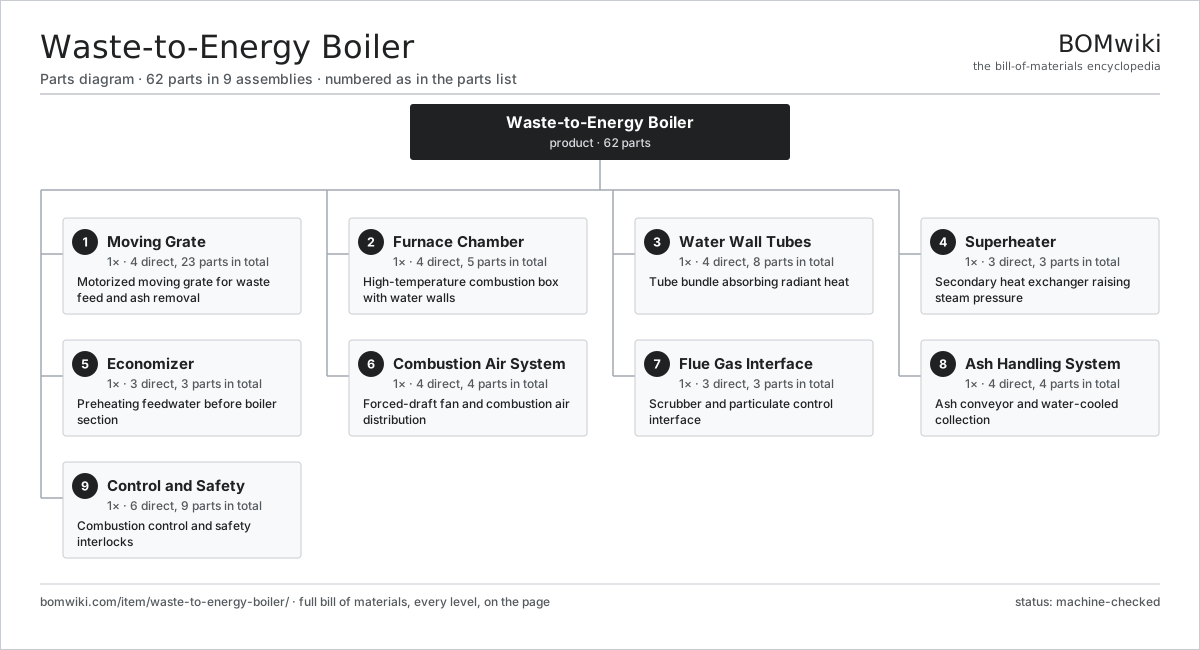
| # | Part | Qty | What it does |
|---|---|---|---|
| 1 | Moving Grate 4 parts | 1× | Motorized moving grate for waste feed and ash removal |
| 2 | Furnace Chamber 4 parts | 1× | High-temperature combustion box with water walls |
| 3 | Water Wall Tubes 4 parts | 1× | Tube bundle absorbing radiant heat |
| 4 | Superheater 3 parts | 1× | Secondary heat exchanger raising steam pressure |
| 5 | Economizer 3 parts | 1× | Preheating feedwater before boiler section |
| 6 | Combustion Air System 4 parts | 1× | Forced-draft fan and combustion air distribution |
| 7 | Flue Gas Interface 3 parts | 1× | Scrubber and particulate control interface |
| 8 | Ash Handling System 4 parts | 1× | Ash conveyor and water-cooled collection |
| 9 | Control and Safety 6 parts | 1× | Combustion control and safety interlocks |
3D model
No 3D model yet. Have a CAD file of this? Add a 3D model — STL renders right on this page; STEP, FreeCAD, and OpenSCAD sources are welcome too (openly licensed, like all 3D models on BOMwiki).
Build & assembly graph
expand / collapse · shared sub-assemblies converge · links to related products · est. labourTap an assembly to expand/collapse · tap a part to open it · use “Open page” for any node · drag to pan, scroll to zoom.
Bill of materials for Waste-to-Energy Boiler
9 top-level lines · 44 rows shown · 62 parts total · indented to 3 levels| # | Item / sub-assembly | Part no. | Qty/assy | Ext. qty | Parts | Type |
|---|---|---|---|---|---|---|
| 1 | Moving Grate 4 parts | waste-to-energy-boiler-grate-system | 1× | 1 | 23 | assembly |
| 1.1 | Grate Drive Motor | waste-to-energy-boiler-grate-motor | 1× | 1 | · | part |
| 1.2 | Grate Bar | waste-to-energy-boiler-grate-bar | 20× | 20 | · | part |
| 1.3 | Grate Drive Crank | waste-to-energy-boiler-grate-drive-crank | 1× | 1 | · | part |
| 1.4 | Grate Frame | waste-to-energy-boiler-grate-support-frame | 1× | 1 | · | part |
| 2 | Furnace Chamber 4 parts | waste-to-energy-boiler-furnace-chamber | 1× | 1 | 5 | assembly |
| 2.1 | Furnace Shell | waste-to-energy-boiler-furnace-shell | 1× | 1 | · | part |
| 2.2 | Refractory Lining | waste-to-energy-boiler-refractory-lining | 1× | 1 | · | part |
| 2.3 | Auxiliary Burner | waste-to-energy-boiler-burner-nozzle | 2× | 2 | · | part |
| 2.4 | Observation Port | waste-to-energy-boiler-observation-port | 1× | 1 | · | part |
| 3 | Water Wall Tubes 4 parts | waste-to-energy-boiler-water-walls | 1× | 1 | 8 | assembly |
| 3.1 | Water-Wall Tube Bundle | waste-to-energy-boiler-tube-bundle | 1× | 1 | · | part |
| 3.2 | Tube Support Band | waste-to-energy-boiler-tube-support-band | 4× | 4 | · | part |
| 3.3 | Circulation Pump | waste-to-energy-boiler-circulation-pump | 1× | 1 | · | part |
| 3.4 | Pressure Sensor | pressure-sensor | 2× | 2 | · | part |
| 4 | Superheater 3 parts | waste-to-energy-boiler-superheater | 1× | 1 | 3 | assembly |
| 4.1 | Superheater Tube Bundle | waste-to-energy-boiler-superheater-tubes | 1× | 1 | · | part |
| 4.2 | Superheater Support | waste-to-energy-boiler-superheater-support | 1× | 1 | · | part |
| 4.3 | Sootblower | waste-to-energy-boiler-sootblower | 1× | 1 | · | part |
| 5 | Economizer 3 parts | waste-to-energy-boiler-economizer | 1× | 1 | 3 | assembly |
| 5.1 | Economizer Tube Bundle | waste-to-energy-boiler-economizer-tubes | 1× | 1 | · | part |
| 5.2 | Economizer Support | waste-to-energy-boiler-economizer-support | 1× | 1 | · | part |
| 5.3 | Thermostatic Bypass Valve | waste-to-energy-boiler-bypass-valve | 1× | 1 | · | part |
| 6 | Combustion Air System 4 parts | waste-to-energy-boiler-air-system | 1× | 1 | 4 | assembly |
| 6.1 | Forced-Draft Fan | waste-to-energy-boiler-draft-fan | 1× | 1 | · | part |
| 6.2 | Primary Air Distribution | waste-to-energy-boiler-primary-air | 1× | 1 | · | part |
| 6.3 | Secondary Air Jets | waste-to-energy-boiler-secondary-air | 1× | 1 | · | part |
| 6.4 | Air Flow Damper | waste-to-energy-boiler-air-damper | 1× | 1 | · | part |
| 7 | Flue Gas Interface 3 parts | waste-to-energy-boiler-flue-gas-treatment | 1× | 1 | 3 | assembly |
| 7.1 | Gas Outlet Manifold | waste-to-energy-boiler-gas-outlet | 1× | 1 | · | part |
| 7.2 | Backdraft Relief | waste-to-energy-boiler-gas-pressure-relief | 1× | 1 | · | part |
| 7.3 | Flue Gas Thermometer | waste-to-energy-boiler-gas-thermometer | 1× | 1 | · | part |
| 8 | Ash Handling System 4 parts | waste-to-energy-boiler-ash-handling | 1× | 1 | 4 | assembly |
| 8.1 | Ash Collection Pit | waste-to-energy-boiler-ash-pit | 1× | 1 | · | part |
| 8.2 | Ash Conveyor | waste-to-energy-boiler-ash-conveyor | 1× | 1 | · | part |
| 8.3 | Ash Conveyor Motor | waste-to-energy-boiler-ash-conveyor-motor | 1× | 1 | · | part |
| 8.4 | Ash Discharge Hopper | waste-to-energy-boiler-ash-discharge-hopper | 1× | 1 | · | part |
| 9 | Control and Safety 6 parts | waste-to-energy-boiler-control-system | 1× | 1 | 9 | assembly |
| 9.1 | Control PLC | waste-to-energy-boiler-plc | 1× | 1 | · | part |
| 9.2 | Flame Detector | waste-to-energy-boiler-flame-detector | 1× | 1 | · | part |
| 9.3 | Oxygen Probe | waste-to-energy-boiler-oxygen-sensor | 1× | 1 | · | part |
| 9.4 | Pressure Transmitter | waste-to-energy-boiler-pressure-transmitter | 2× | 2 | · | part |
| 9.5 | Temperature Sensor | waste-to-energy-boiler-temperature-sensor | 3× | 3 | · | part |
| 9.6 | Control Cabinet | waste-to-energy-boiler-control-cabinet | 1× | 1 | · | part |
Related products
same domain, ranked by shared parts Autotransformer
7,784 parts · shares 1 with this page
Biogas Generator (CHP)
338 parts · shares 1 with this page
Autotransformer
7,784 parts · shares 1 with this page
Biogas Generator (CHP)
338 parts · shares 1 with this page
 Biogas Upgrader
29 parts · shares 1 with this page
Bottom Ash Handling System
1,782 parts · shares 1 with this page
Carbon Capture Skid
40 parts · shares 1 with this page
Biogas Upgrader
29 parts · shares 1 with this page
Bottom Ash Handling System
1,782 parts · shares 1 with this page
Carbon Capture Skid
40 parts · shares 1 with this page
 CNG Dispenser
44 parts · shares 1 with this page
CNG Dispenser
44 parts · shares 1 with this page
Sourcing: possible vendors
Prices, MOQ, and lead times are algorithmic estimates, not quotes, and not claims about these companies. Company mappings are curated by keyword; est. price band $5k–$50M. How estimates work| Vendor | HQ | Specialty | MOQ | Lead time |
|---|---|---|---|---|
| gevernova.com ↗ | Cambridge, US | Power generation | made to order | 20–40 wks |
| siemens-energy.com ↗ | Munich, DE | Power & grid | made to order | 20–40 wks |
| hitachienergy.com ↗ | Zurich, CH | Grid & transformers | made to order | 20–40 wks |
|
🇨🇭ABB
abb.com ↗
|
Zurich, CH | Electrification & automation | made to order | 20–40 wks |
| se.com ↗ | Rueil-Malmaison, FR | Electrical & automation | made to order | 20–40 wks |
1,859-word article