Watch Winder
ProductOverview
A watch winder keeps an automatic (self-winding) watch running while it is not being worn. An automatic watch winds its mainspring from wrist motion; left in a drawer it stops within two or three days, losing its time, date, and any slower indications such as moon phase. The winder substitutes for the wrist: a motorized drum rotates the watch slowly through a programmed number of turns per day, enough for the watch's own winding rotor to keep the mainspring near full charge.
The machine is simple in outline: the Rotation Assembly carries the watch, the Drive Train turns it, the Programmer Board decides when and which way, the Watch Holder grips the watch, and the Enclosure and Power System system make it furniture rather than a bench rig.
How it works
The watch mounts on the Watch Cushion, a compressible pillow that the bracelet or strap closes around. The cushion's Cushion Frame telescopes against a Coil Spring so one cushion fits everything from a 16 mm leather strap to a large steel bracelet, and the whole holder snaps into the Retainer Cup at the centre of the Winder Drum. Centring matters: with the watch on the rotation axis, gravity swings its internal rotor once per drum revolution with minimal motor load. A small Counterweight opposite the watch keeps the drum balanced so the motor sees nearly constant torque.
Drive comes from a DC Gear Motor, a brushed unit running on 3–5 V and drawing well under 100 mA. Its several-thousand-RPM output passes through the Reduction Gearbox and an intermediate Helical Gear Pair down to roughly 4–8 RPM at the Drive Pinion, which meshes with the Ring Gear on the drum hub. The Drum Spindle runs in two Ball Bearings, and the motor hangs from a rubber-isolated Motor Mount, which together keep the running noise below about 30 dB(A), quiet enough for a nightstand.
The turns-per-day program
Watches differ in how much winding they need. Most modern automatics are satisfied by 650–800 turns per day; some high-beat or heavily complicated movements specify up to 1,900. Overwinding is not dangerous, every automatic has a slipping bridle in its barrel, but continuous rotation wastes the winding mechanism's service life, so winders run intermittently.
The Programmer Board is built around an Microcontroller on a small Bare PCB with SMD Passive (R/C/L). It runs a duty-cycle program: a few minutes of rotation, then a long rest, repeated so the daily total matches the setting on the Mode Switch. Two Power MOSFETs form the legs of an H-bridge so the motor can run in either direction; bidirectional mode alternates clockwise and counterclockwise blocks, which suits the reverser gearing of most modern movements and avoids one-sided wear in older ones. A Hall Sensor facing a magnet on the drum hub counts actual revolutions, so the turns-per-day figure is closed-loop rather than estimated from time. The LED Indicator shows run, rest, and low-battery states, and Connector headers join the board to motor and power wiring.
Power and enclosure
Mains operation uses an external 5 V Power Supply feeding the DC Input Jack; inserting the plug mechanically switches out the Battery Tray. On its two D cells the winder runs for three to six months at typical duty cycles, which is the point of the battery option: winders are often kept inside a safe where no outlet exists. A Wire Bundle ties the jack, tray, board, and motor together on the Base Plate.
The Cabinet Shell is MDF or ABS finished in lacquer or leatherette, about 120 × 120 × 150 mm for a single drum. The Viewing Window keeps dust off the watch while leaving it visible, on Door Hinges that hold any opening angle, and four Rubber Foot pads stop the cabinet wandering as the drum turns. Everything assembles with a standard Fastener Set.
Usage notes
A winder maintains a running watch; it does not wind a stopped one efficiently. Practice is to wind a stopped automatic 20–30 crown turns by hand, set it, then place it on the winder. Watches with weakly magnetic-shielded movements should be kept clear of the drive motor's stray field, which is one reason the motor sits behind the drum rather than beside the watch. Multi-watch winders repeat the drum-motor-cushion unit per position, usually sharing one controller and supply.
Watch Winder parts and their functions
6 top-level parts · 39 parts in total · full bill of materials below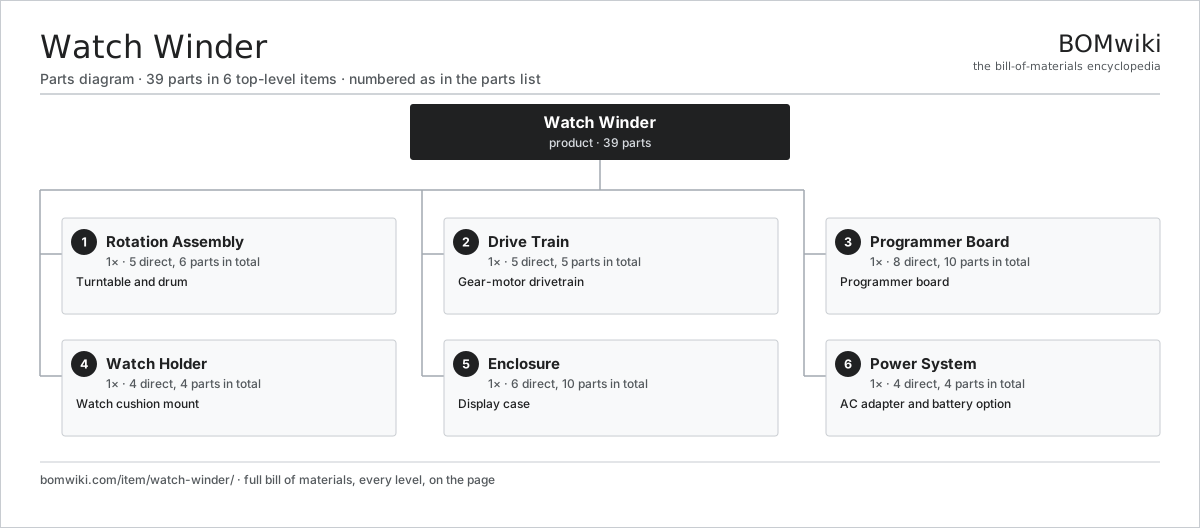
| # | Part | Qty | What it does |
|---|---|---|---|
| 1 | Rotation Assembly 5 parts | 1× | Turntable and drum |
| 2 | Drive Train 5 parts | 1× | Gear-motor drivetrain |
| 3 | Programmer Board 8 parts | 1× | Programmer board |
| 4 | Watch Holder 4 parts | 1× | Watch cushion mount |
| 5 | Enclosure 6 parts | 1× | Display case |
| 6 | Power System 4 parts | 1× | AC adapter and battery option |
3D model
No 3D model yet. Have a CAD file of this? Add a 3D model. STL renders right on this page; STEP, FreeCAD, and OpenSCAD sources are welcome too (openly licensed, like all 3D models on BOMwiki).
Build & assembly graph
expand / collapse · shared sub-assemblies converge · links to related products · est. labourTap an assembly to expand/collapse · tap a part to open it · use “Open page” for any node · drag to pan, scroll to zoom.
Bill of materials for Watch Winder
6 top-level lines · 38 rows shown · 39 parts total · indented to 3 levels| # | Item / sub-assembly | Part no. | Qty/assy | Ext. qty | Parts | Type |
|---|---|---|---|---|---|---|
| 1 | Rotation Assembly 5 parts | watch-winder-rotation-assembly | 1× | 1 | 6 | assembly |
| 1.1 | Winder Drum | watch-winder-drum | 1× | 1 | · | part |
| 1.2 | Drum Spindle | watch-winder-drum-spindle | 1× | 1 | · | part |
| 1.3 | Ring Gear | watch-winder-ring-gear | 1× | 1 | · | part |
| 1.4 | Ball Bearing | ball-bearing | 2× | 2 | · | part |
| 1.5 | Counterweight | watch-winder-counterweight | 1× | 1 | · | part |
| 2 | Drive Train 5 parts | watch-winder-drive | 1× | 1 | 5 | assembly |
| 2.1 | DC Gear Motor | watch-winder-dc-motor | 1× | 1 | · | part |
| 2.2 | Reduction Gearbox | watch-winder-reduction-gearbox | 1× | 1 | · | part |
| 2.3 | Drive Pinion | watch-winder-drive-pinion | 1× | 1 | · | part |
| 2.4 | Helical Gear Pair | gear-pair | 1× | 1 | · | part |
| 2.5 | Motor Mount | watch-winder-motor-mount | 1× | 1 | · | part |
| 3 | Programmer Board 8 parts | watch-winder-controller | 1× | 1 | 10 | assembly |
| 3.1 | Bare PCB | pcb-bare | 1× | 1 | · | part |
| 3.2 | Microcontroller | mcu | 1× | 1 | · | part |
| 3.3 | SMD Passive (R/C/L) | smd-passives | 1× | 1 | · | part |
| 3.4 | Power MOSFET | mosfet | 2× | 2 | · | part |
| 3.5 | Hall Sensor | hall-sensor | 1× | 1 | · | part |
| 3.6 | Mode Switch | watch-winder-mode-switch | 1× | 1 | · | part |
| 3.7 | LED Indicator | watch-winder-led-indicator | 1× | 1 | · | part |
| 3.8 | Connector | connector | 2× | 2 | · | part |
| 4 | Watch Holder 4 parts | watch-winder-holder | 1× | 1 | 4 | assembly |
| 4.1 | Watch Cushion | watch-winder-cushion | 1× | 1 | · | part |
| 4.2 | Cushion Frame | watch-winder-cushion-frame | 1× | 1 | · | part |
| 4.3 | Coil Spring | coil-spring | 1× | 1 | · | part |
| 4.4 | Retainer Cup | watch-winder-retainer-cup | 1× | 1 | · | part |
| 5 | Enclosure 6 parts | watch-winder-enclosure | 1× | 1 | 10 | assembly |
| 5.1 | Cabinet Shell | watch-winder-shell | 1× | 1 | · | part |
| 5.2 | Viewing Window | watch-winder-window | 1× | 1 | · | part |
| 5.3 | Door Hinge | watch-winder-hinge | 2× | 2 | · | part |
| 5.4 | Base Plate | watch-winder-base-plate | 1× | 1 | · | part |
| 5.5 | Rubber Foot | watch-winder-foot | 4× | 4 | · | part |
| 5.6 | Fastener Set | fastener-set | 1× | 1 | · | part |
| 6 | Power System 4 parts | watch-winder-power | 1× | 1 | 4 | assembly |
| 6.1 | Power Supply | power-supply | 1× | 1 | · | part |
| 6.2 | DC Input Jack | watch-winder-dc-jack | 1× | 1 | · | part |
| 6.3 | Battery Tray | watch-winder-battery-tray | 1× | 1 | · | part |
| 6.4 | Wire Bundle | wire-bundle | 1× | 1 | · | part |
Something wrong in this list? Report a problem with this BOM.
Related products
same domain, ranked by shared parts Railway Station Clock
43 parts · shares 6 with this page
Railway Station Clock
43 parts · shares 6 with this page
 Radio-Controlled Atomic Clock
130 parts · shares 6 with this page
GPS NTP Time Server
37 parts · shares 5 with this page
Radio-Controlled Atomic Clock
130 parts · shares 6 with this page
GPS NTP Time Server
37 parts · shares 5 with this page
 Chess Clock
47 parts · shares 5 with this page
Chess Clock
47 parts · shares 5 with this page
 Flip Clock
119 parts · shares 4 with this page
Flip Clock
119 parts · shares 4 with this page
Sourcing: possible vendors
Browse the supplier directory → Prices, MOQ, and lead times are algorithmic estimates, not quotes, and not claims about these companies. Company mappings are curated by keyword; est. price band $20–$50k. How estimates work| Vendor | HQ | Specialty | MOQ | Lead time |
|---|---|---|---|---|
|
🇯🇵Seiko
seikowatches.com ↗
|
Tokyo, JP | Watches | 500 units | 8–14 wks |
|
🇯🇵Citizen
citizenwatch-global.com ↗
|
Tokyo, JP | Watches | 500 units | 8–14 wks |
|
🇯🇵Casio
casio.com ↗
|
Tokyo, JP | Watches & electronics | 500 units | 8–14 wks |
| swatchgroup.com ↗ | Biel, CH | Watches (Omega, Tissot) | 500 units | 8–14 wks |
| titancompany.in ↗ | Bengaluru, IN | Watches & timepieces | 500 units | 8–14 wks |
785-word article