Watchmaker Lathe
ProductOverview
A watchmaker lathe is a precision machine tool designed specifically for turning and threading small parts used in watches, clocks, and fine mechanical instruments. Unlike general-purpose machine shop lathes, watchmaker lathes are engineered for extreme accuracy (±0.001 inch), minimal spindle runout, and the ability to work on parts as small as 0.5 mm diameter.
The lathe fits on a jeweler's workbench and operates at spindle speeds from 100 to 3000 rpm. The Headstock houses a precision Spindle Shaft with angular-contact ball bearings, spinning in a hardened steel jacket. A Collet Nose accepts precision collets from 0.5 to 8 mm, providing work-holding with runout better than 0.001 inch.
The Bed and Ways are precision-ground cast-iron V and flat surfaces, ground to 0.0005 inch flatness or better. The Carriage slides on these ways, carrying a Cross-Slide with a micrometer dial for radial feed, and a Compound Slide for taper work and threading. A Tailstock with Live Center supports the free end of the workpiece.
Control is entirely manual: the operator spins handwheels to position the Tool Rest, advances the Cross-Slide for depth of cut, and engages the belt drive to start the spindle. A Coolant System delivers mist or flood coolant to the cutting point, extending tool life and improving finish on small diameters where heat generation is significant.
The Headstock and Spindle System
The Headstock is the mechanical heart of the machine. The Spindle Shaft is hardened and ground to within 0.001 inch of true cylindrical form. It rides on typically four angular-contact ball bearings, preloaded and stacked to share radial and thrust loads.
The bearings are of exceptionally high quality: Japanese NSK or FAG bearings are common, rated for 5,000–10,000 rpm and preloaded to eliminate radial play. Despite their cost (often $20–50 each), they are essential: a spindle with excessive runout cannot produce the precision geometry that horology demands. Typical watchmaker lathes achieve 0.0005–0.001 inch spindle runout (one-tenth the tolerance of a general machine shop lathe).
The Collet Nose is a tapered form (typically 1:20 or 1:10 taper) onto which the collet seats. As the collet is drawn back by a Collet Draw Bar, it contracts, gripping the workpiece with tremendous holding power, often 500+ pounds of clamping force for a tiny workpiece. This draw-back mechanism is mechanical: a threaded rod attached to a handwheel pulls the collet rearward.
Speed control is achieved by moving the Drive Belt between different-sized grooves on the Motor Pulley and Spindle Pulley. A typical setup offers three speeds per lathe: perhaps 500, 1200, and 2500 rpm by moving the belt to different steps. This simple system is 95%+ efficient and requires no electronics, making it reliable for decades of use.
Precision Bed and Carriage
The Bed Casting is a precision-ground gray-iron casting weighing 80–150 pounds. Its V and flat ways are ground to 0.0005 inch flatness or better, a level of precision achieved only with a precision grinding machine and careful thermal control during grinding. Small wear marks, rust spots, or nicks on these ways can degrade accuracy; watchmakers carefully cover unused portions and wipe ways clean before each use.
The Carriage rides on these ways, held centered by Gibs and Slides that are adjusted with set-screws to eliminate backlash without binding. The carriage carries two feed mechanisms:
The Cross-Slide is a handwheel-driven screw perpendicular to the spindle axis. A ball-bearing or ball-screw reduces friction; the handwheel is fitted with a micrometer dial marked in 0.001 inch divisions, allowing the operator to feed precise amounts with one hand while holding a tool with the other.
The Compound Slide is angled (typically 45 degrees) and mounted on top of the cross-slide. It allows taper turning without repositioning the bed, and single-point thread cutting by disengaging the lead-screw and advancing the compound manually. The compound also carries the Tool Rest, which holds the Cutting Tools.
Tool Holding and Cutting
The Tool Post Base is a cast-iron block bolted to the Carriage, providing a rigid foundation. The Tool Holder Block is an adjustable clamp that grips a ground HSS or carbide tool bit, holding it at the correct height (on spindle centerline) and angle (typically 15–30 degrees relief).
Cutting tools are ground by hand on a bench grinder. A turning tool has a rounded nose (0.1–0.3 mm radius); a facing tool has a flat nose; a threading tool is V-shaped. Feeds are light: often 0.001–0.005 inch per revolution for finishing cuts on small diameters, and speeds are high (1200–3000 rpm) to maintain a good surface finish and chip formation.
The Coolant System is critical. A small Coolant Reservoir holds 1–2 gallons of ISO 32 or 46 cutting oil or a water-soluble coolant. A Coolant Pump driven by a small electric motor delivers coolant either as a mist (for general turning) or as a flood onto the cutting point. For HSS tools, this extends tool life by 50%; for carbide, which is brittle, mist cooling is gentler than interrupted cooling, preventing chipping.
The Tailstock and Live Center
The Tailstock is a cast-iron sliding block, movable along the bed to accommodate different workpiece lengths. The Quill Mechanism, a handwheel-driven screw, advances a Center Carrier that pushes a live center into the workpiece.
The Live Center is a small rotating center (often 0.125–0.25 inch diameter) that spins freely on ball bearings. Unlike a dead center, which scrapes and generates heat, the live center rotates with the work, introducing minimal friction and heat. This is critical for small workpieces: a dead center on a 2 mm diameter part would overheat and seize quickly.
The tapered tip of the center fits into a matching conical hole drilled in the workpiece end. The Quill Mechanism allows the operator to advance the center slowly into the work, feeling for the correct seating force, typically 10–50 pounds for a tiny part. Over-forcing can distort the work; under-forcing allows it to slip.
Typical Workflow
A watchmaker turning an escape wheel balance or a clock wheel arbor typically follows this sequence:
- Select the appropriate collet from the 8–12 available, insert it into the Spindle Shaft.
- Mount the workpiece (a 2–4 mm diameter steel blank) in the collet, drawing the Collet Draw Bar to seat it.
- Position the Tailstock along the bed using the workpiece length, and seat the live center.
- Select spindle speed by moving the Drive Belt (say, 1500 rpm for steel).
- Set the cutting tool in the Tool Post Base on spindle centerline.
- Start the spindle motor.
- Advance the Cross-Slide dial by 0.001–0.003 inch per revolution, turning the handwheel smoothly.
- Coolant mist flows continuously onto the tool from the Coolant System.
- The tool produces a fine spiral chip; the surface finish is mirror-like, suitable for precision fit.
- After the roughing pass, reduce feed, polish with a fine-grit tool, and finish.
Historical Context and Variants
Watchmaker lathes have been in use since the 1700s, refined continuously by German, Swiss, and American makers (Levin, Boley, Schaublin are famous names). The fundamental design, spindle, collets, precision bed, carriage with cross-slide, has changed little in 150 years, testament to the perfection of the design.
Some modern versions use air-driven spindles (faster, cooler) or electronic spindle speed control, but traditional friction-drive designs remain preferred by many horologers for their reliability and lack of vibration. A well-maintained watchmaker lathe from the 1920s will still achieve 0.001 inch accuracy and outlast machines made in the 21st century, provided the bed has not been damaged.
Watchmaker Lathe parts and their functions
7 top-level parts · 39 parts in total · full bill of materials below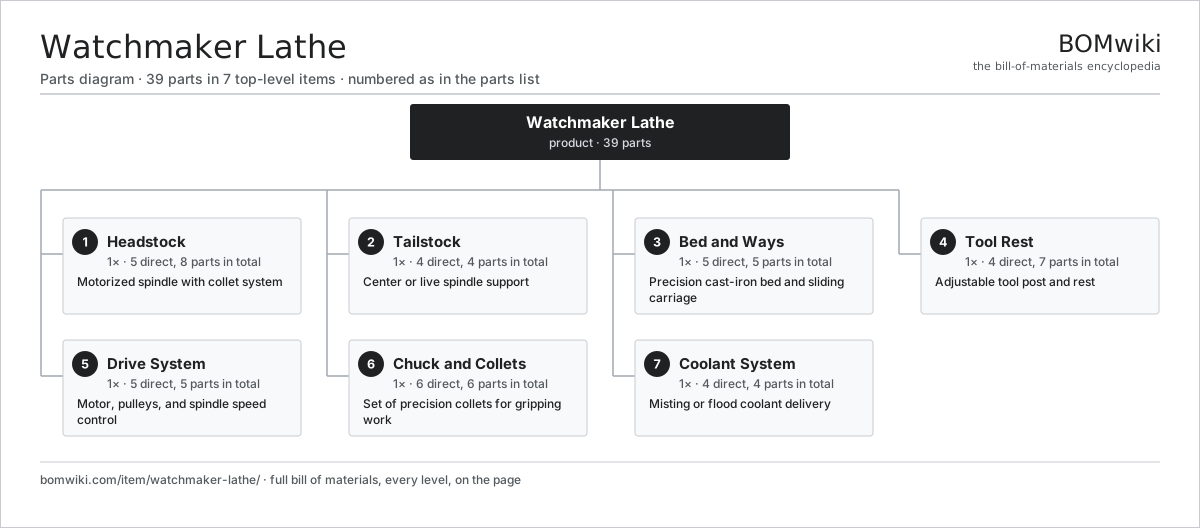
| # | Part | Qty | What it does |
|---|---|---|---|
| 1 | Headstock 5 parts | 1× | Motorized spindle with collet system |
| 2 | Tailstock 4 parts | 1× | Center or live spindle support |
| 3 | Bed and Ways 5 parts | 1× | Precision cast-iron bed and sliding carriage |
| 4 | Tool Rest 4 parts | 1× | Adjustable tool post and rest |
| 5 | Drive System 5 parts | 1× | Motor, pulleys, and spindle speed control |
| 6 | Chuck and Collets 6 parts | 1× | Set of precision collets for gripping work |
| 7 | Coolant System 4 parts | 1× | Misting or flood coolant delivery |
3D model
No 3D model yet. Have a CAD file of this? Add a 3D model. STL renders right on this page; STEP, FreeCAD, and OpenSCAD sources are welcome too (openly licensed, like all 3D models on BOMwiki).
Build & assembly graph
expand / collapse · shared sub-assemblies converge · links to related products · est. labourTap an assembly to expand/collapse · tap a part to open it · use “Open page” for any node · drag to pan, scroll to zoom.
Bill of materials for Watchmaker Lathe
7 top-level lines · 40 rows shown · 39 parts total · indented to 3 levels| # | Item / sub-assembly | Part no. | Qty/assy | Ext. qty | Parts | Type |
|---|---|---|---|---|---|---|
| 1 | Headstock 5 parts | watchmaker-lathe-headstock | 1× | 1 | 8 | assembly |
| 1.1 | Spindle Shaft | watchmaker-lathe-spindle-shaft | 1× | 1 | · | part |
| 1.2 | Spindle Bearing | watchmaker-lathe-spindle-bearing | 4× | 4 | · | part |
| 1.3 | Collet Nose | watchmaker-lathe-collet-nose | 1× | 1 | · | part |
| 1.4 | Spindle Pulley | watchmaker-lathe-spindle-pulley | 1× | 1 | · | part |
| 1.5 | Motor Mount | watchmaker-lathe-motor-mount | 1× | 1 | · | part |
| 2 | Tailstock 4 parts | watchmaker-lathe-tailstock | 1× | 1 | 4 | assembly |
| 2.1 | Tailstock Body | watchmaker-lathe-tailstock-body | 1× | 1 | · | part |
| 2.2 | Center Carrier | watchmaker-lathe-center-carrier | 1× | 1 | · | part |
| 2.3 | Live Center | watchmaker-lathe-live-center | 1× | 1 | · | part |
| 2.4 | Quill Mechanism | watchmaker-lathe-quill-mechanism | 1× | 1 | · | part |
| 3 | Bed and Ways 5 parts | watchmaker-lathe-bed-ways | 1× | 1 | 5 | assembly |
| 3.1 | Bed Casting | watchmaker-lathe-bed-casting | 1× | 1 | · | part |
| 3.2 | Carriage | watchmaker-lathe-carriage | 1× | 1 | · | part |
| 3.3 | Cross-Slide | watchmaker-lathe-cross-slide | 1× | 1 | · | part |
| 3.4 | Compound Slide | watchmaker-lathe-compound-slide | 1× | 1 | · | part |
| 3.5 | Gibs and Slides | watchmaker-lathe-gibs-and-slides | 1× | 1 | · | part |
| 4 | Tool Rest 4 parts | watchmaker-lathe-tool-rest | 1× | 1 | 7 | assembly |
| 4.1 | Tool Post Base | watchmaker-lathe-tool-post-base | 1× | 1 | · | part |
| 4.2 | Tool Holder Block | watchmaker-lathe-tool-holder-block | 1× | 1 | · | part |
| 4.3 | Cutting Tools | watchmaker-lathe-cutting-tools | 4× | 4 | · | part |
| 4.4 | Tool Bit Holder | watchmaker-lathe-tool-bit-holder | 1× | 1 | · | part |
| 5 | Drive System 5 parts | watchmaker-lathe-drive-system | 1× | 1 | 5 | assembly |
| 5.1 | Motor | watchmaker-lathe-motor | 1× | 1 | · | part |
| 5.2 | Motor Pulley | watchmaker-lathe-motor-pulley | 1× | 1 | · | part |
| 5.3 | Spindle Pulley | watchmaker-lathe-spindle-pulley | 1× | 1 | · | part |
| 5.4 | Drive Belt | watchmaker-lathe-drive-belt | 1× | 1 | · | part |
| 5.5 | Spindle Coupling | watchmaker-lathe-spindle-coupling | 1× | 1 | · | part |
| 6 | Chuck and Collets 6 parts | watchmaker-lathe-chuck-collets | 1× | 1 | 6 | assembly |
| 6.1 | Collet 1 | watchmaker-lathe-collet-1 | 1× | 1 | · | part |
| 6.2 | Collet 2 | watchmaker-lathe-collet-2 | 1× | 1 | · | part |
| 6.3 | Collet 3 | watchmaker-lathe-collet-3 | 1× | 1 | · | part |
| 6.4 | Collet 4 | watchmaker-lathe-collet-4 | 1× | 1 | · | part |
| 6.5 | Collet 5 | watchmaker-lathe-collet-5 | 1× | 1 | · | part |
| 6.6 | Collet Draw Bar | watchmaker-lathe-collet-draw-bar | 1× | 1 | · | part |
| 7 | Coolant System 4 parts | watchmaker-lathe-coolant-system | 1× | 1 | 4 | assembly |
| 7.1 | Coolant Reservoir | watchmaker-lathe-coolant-reservoir | 1× | 1 | · | part |
| 7.2 | Coolant Pump | watchmaker-lathe-coolant-pump | 1× | 1 | · | part |
| 7.3 | Coolant Tube | watchmaker-lathe-coolant-tube | 1× | 1 | · | part |
| 7.4 | Coolant Filter | watchmaker-lathe-coolant-filter | 1× | 1 | · | part |
Something wrong in this list? Report a problem with this BOM.
Sourcing: possible vendors
Browse the supplier directory → Prices, MOQ, and lead times are algorithmic estimates, not quotes, and not claims about these companies. Company mappings are curated by keyword; est. price band $10k–$1M. How estimates work| Vendor | HQ | Specialty | MOQ | Lead time |
|---|---|---|---|---|
|
🇩🇪DMG MORI
dmgmori.com ↗
|
Bielefeld, DE | Machine tools | 5 units | 12–20 wks |
|
🇯🇵Mazak
mazak.com ↗
|
Oguchi, JP | Machine tools | 5 units | 12–20 wks |
| haascnc.com ↗ | Oxnard, US | CNC machine tools | 5 units | 12–20 wks |
|
🇯🇵Okuma
okuma.com ↗
|
Niwa, JP | Machine tools | 5 units | 12–20 wks |
|
🇩🇪Trumpf
trumpf.com ↗
|
Ditzingen, DE | Laser & sheet-metal machines | 5 units | 12–20 wks |
1,443-word article