Wave Swinger
ProductOverview
A wave swinger is a gravity-driven thrill ride combining centrifugal swinging with progressive tilting. The ride features a large rotating ring suspended from a central tower, with 16–24 chairs hanging from the ring on heavy-duty chains. As the ring rotates, centrifugal force pushes chairs outward. Simultaneously, a hydraulic or pneumatic tilt mechanism progressively tilts the entire rotating ring to 20–35° from vertical. This dual motion, rotation combined with tilting, creates g-forces of 2–3.5 g and a disorienting sensation of swinging while the entire ride tilts beneath passengers.
Wave swingers emerged in the 1990s as an evolution of traditional chair swings. The addition of the tilt mechanism distinguishes them from simpler rotating chair swings and provides a more intense and immersive experience.
How It Works
Centrifugal Swinging Action
As the rotating ring accelerates from rest to 20–30 rpm, each suspended chair experiences centrifugal acceleration radially outward from the ring's center. If the ring is vertical (no tilt), the chair would swing outward like a traditional chair swing, with chains angling outward at up to 45–60° from vertical.
The centrifugal acceleration at the chair is: a_c = ω² × r
Where ω is angular velocity (rad/s) and r is the radius of the chair swing (typically 3–5 meters). At 25 rpm (2.6 rad/s) and r = 4 m, the centrifugal acceleration is approximately 27 m/s² or 2.7 g. Passengers feel pressed into their seats as the chair swings upward and outward.
Progressive Tilt Mechanism
The key innovation is the tilt mechanism: as the ring rotates faster, the entire ring tilts progressively from vertical. Hydraulic cylinders or pneumatic actuators are mounted between the ring and the central tower. A proportional solenoid valve modulates hydraulic (or pneumatic) flow to the cylinders, controlling tilt angle.
The tilt angle is typically:
- At 0 rpm: 0° (vertical).
- At 50 % rpm (e.g., 12.5 rpm): 10–15°.
- At 100 % rpm (e.g., 25 rpm): 20–35°.
The relationship is typically programmed as a smooth curve (not a sharp step), so tilt increases gradually as speed increases. This creates a continuous sensation of the ride "leaning in" as excitement builds.
Combined G-Force Sensation
With the ring tilted at 30° and rotating at 25 rpm, passengers experience:
- Centripetal acceleration: 2.7 g radially outward (pushing chair outward).
- Gravity component along the tilt axis: 0.5–1 g additional (due to ring tilt).
- Resultant vector: Combined g-force of approximately 3–3.5 g at an angle between radial and tangential.
The sensation is one of being pressed against the outside of the chair while simultaneously feeling the entire ride lean and tilt, creating a sense of loss of control and intense thrills.
Control Synchronization
The master PLC synchronizes:
Rotation speed: The main motor accelerates the ring smoothly over 10–20 seconds via a variable-frequency drive. Ramp profile is typically sigmoid (S-curve), providing smooth acceleration without sudden jerks.
Tilt angle feedback: An encoder on the ring measures rotation speed. The proportional solenoid valve receives a command proportional to rotation speed, modulating hydraulic pressure to the tilt cylinders.
Restraint verification: Before dispatch, all restraint bars must report "latched" via limit switches. If any restraint is open, the dispatch solenoid does not energize and the motor does not start.
Emergency stop: If a fault (tilt pressure loss, encoder signal lost, restraint sensor failure) is detected, the PLC de-energizes the motor contactor and opens the tilt proportional valve, allowing the ring to slow and return to vertical.
Mechanical Design
Chair Suspension and Chains
Each chair is suspended from the ring by a heavy-duty steel chain (typically Grade 80 or higher, 16–20 mm diameter links). The chain has a proof-load rating (breaking strength) of 3–5 tons, which provides a safety factor of 3:1 to 5:1 over expected peak loads.
The chain connects to the ring at a ball-bearing swivel, allowing the chair to hang naturally as centrifugal force pulls it outward. At rest, the chair hangs vertically below the ring. At maximum speed and tilt, the chair may be displaced 3–5 meters radially outward and angled up at 30–50° from the ring surface.
Each chair is a welded steel frame with a molded plastic or cushioned seat. Typical weight is 40–60 kg, allowing a single adult (up to 120–150 kg) to use the ride. Dual-seating chairs for parent-child rides are available but less common, as two passengers double the load on the chain and bearing.
Restraint System
The restraint bar is a hinged or fixed lap bar that lowers over the passenger's legs and locks in place. Locking is typically via:
- Mechanical latch: A hook or pawl that engages a fixed pin on the chair frame, held closed by a spring.
- Solenoid latch: An electromagnet that holds the bar closed; de-energizing the solenoid releases it when the ride stops.
Dual-redundant latches are standard for safety, even if one latch fails, the other holds. A limit switch senses when the bar is fully latched and reports status to the control system.
Some wave swingers use seat belts instead of lap bars, allowing more flexibility for different body sizes and ages. Seat belts clip or latch together and are verified closed by a load cell under the seat.
Ring Structure and Support
The rotating ring is a large (8–12 m diameter) box-beam steel structure, welded together from plate and tube stock. It is mounted on a massive slew bearing (10–15 m diameter) at the top of the central tower. The slew bearing accommodates radial loads (ring weight, chair weight, centrifugal inertial forces), thrust loads (tilt mechanism), and moment loads (off-center chair distribution).
The ring can be tilted 20–35° from vertical by hydraulic cylinders bolted between the ring and the tower base. The tilt pivot is a ball bearing that allows smooth rotation of the ring about the tilt axis (typically horizontal and perpendicular to the natural swing direction).
Central Tower and Foundations
The central tower is a tubular steel structure, typically 10–15 meters tall, anchored to concrete footings. Four or more corner legs transfer load into pile caps or spread footings, each with multiple threaded anchor rods. The tower also houses the rotation motor and gearbox at the base and provides mounting points for the tilt hydraulic cylinders.
The tower must be rigid enough to prevent swaying (which would cause uneven tilt on opposite sides of the ring) while flexible enough to accommodate the thermal expansion and contraction of metal over seasonal temperature changes.
Electrical and Hydraulic Systems
Rotation Drive
The rotation motor is a large AC induction motor (10–20 kW, 480 V 3-phase) with a variable-frequency drive (VFD). The VFD allows smooth speed ramping and energy regeneration during braking. Power is transmitted via a helical gearbox (reduction ratio 20:1 to 40:1) and flexible coupling to the ring slew bearing.
An encoder on the motor output shaft provides rotational speed feedback to the control system. Typical resolution is 2,048 counts per revolution, allowing speed regulation to within ±1 %.
Hydraulic Tilt System
The tilt mechanism uses a closed-loop hydraulic system:
- Pump: A fixed-displacement gear pump (5–10 cc/rev) driven by a separate electric motor (~3 kW), providing continuous flow to the proportional solenoid valve.
- Proportional solenoid valve: A 4-3 spool valve that directs pump flow to the right or left hydraulic cylinder. The solenoid current is proportional to tilt angle error, creating a smooth proportional control.
- Hydraulic cylinders: Two double-acting cylinders (bore 80–150 mm, stroke 1–2 meters) mounted symmetrically on opposite sides of the ring, tilting it about the pivot bearing.
- Pressure relief: Set at 50–100 bar, protecting the system if a cylinder stalls or hoses rupture.
- Return filter: Ensures hydraulic fluid remains clean and free of particulates.
Tilt angle is measured by a linear potentiometer or laser displacement sensor on one of the cylinders, providing feedback to the proportional valve controller. The feedback loop maintains tilt angle accuracy within ±2°.
Standards and Safety
Wave swingers are designed to ASTM F24 (F2374) and international EN 13814 standards. Key requirements:
- Chain load testing: New chains are proof-tested to 150 % of rated load before installation. Chains are inspected visually every 500 operating hours and replaced every 3–5 years (or sooner if any links show cracks).
- Restraint forces: Lap bars must exert 2–4 kN restraint force, sufficient to prevent passenger ejection during peak g-force and sudden deceleration.
- Ring structural analysis: The ring is analyzed for fatigue under cyclic loading (centrifugal, tilt, and dynamic imbalance). Design life is typically 30–50 years with 10 million+ cycles.
- Tilt mechanism redundancy: Loss of hydraulic pressure must not cause uncontrolled ring tilt. A mechanical lock or spring-applied brake holds the ring at its current angle if pressure is lost.
- Emergency procedures: Riders must be able to exit chairs within 10 minutes from any ring position using manual hand-crank (if electric tilt fails) or operator assist.
Operational Maintenance
Key maintenance items:
- Chain inspection: Visual check every 100 operating hours; replacement if any cracks or excessive wear are observed.
- Hydraulic fluid: Sampling and analysis every 500 hours (viscosity, acidity, water content); complete fluid change every 2–3 years.
- Slew bearing: Lubrication inspection every 500 hours; bearing replacement every 10–20 years if damage is found.
- Motor and gearbox: Oil change every 1,000 hours; bearing inspection every 3 years.
- Restraint latches: Functional test every 50 operating hours; latch replacement if wear reduces holding force.
Wave swingers typically achieve 95–98 % uptime during the operating season. Seasonal shutdown includes full chain and bearing inspection, hydraulic system flush, and motor overhaul.
Variants and Evolution
Ring-on-Ring Design
Some modern wave swingers add a second outer ring that rotates at a different speed than the inner ring. Chairs swing from the inner ring but are also influenced by the outer ring's motion, creating triple-axis dynamics.
Flying Chair with Tilt
A variation suspends chairs from a central rotor (like a flying chair) but tilts the entire rotor platform. This creates similar sensations to the traditional wave swinger but allows more dramatic tilt angles (up to 60°).
Advanced Proportional Control
Newer systems use electronic proportional solenoid valves with real-time feedback, allowing:
- Dynamic tilt profiles (e.g., "slow tilt for first 30 seconds, then rapid tilt for climax").
- Compensation for chair distribution (if passengers are unevenly distributed around the ring, the system adjusts tilt to maintain balance).
- G-force regulation (sensor measures actual g-force experienced by riders, and feedback loop adjusts tilt to prevent exceeding 3.5 g limit).
Economics and Market
A typical wave swinger with 20-chair capacity costs $5–15 million including design, fabrication, and installation. Annual operating costs are $300,000–$1 million (primarily labor, electricity, and hydraulic fluid/maintenance).
Revenue potential is $1–3 million per season, driven by high throughput (800–1,500 riders per hour) and strong thrill appeal. Wave swingers attract teens and adult riders, typically commanding premium ticket prices.
Wave swingers are popular in:
- Regional and destination amusement parks (primary thrill attraction).
- Theme parks (standalone or as part of a thrill area).
- Travel carnivals and seasonal parks (modular design allows some disassembly).
The wave swinger category has seen recent innovation, with manufacturers adding VR headsets to riders (creating a synchronized virtual-reality experience that complements the physical sensations) and integrating social media capture (onboard cameras streaming rider reactions to social platforms).
Wave Swinger parts and their functions
7 top-level parts · 244 parts in total · full bill of materials below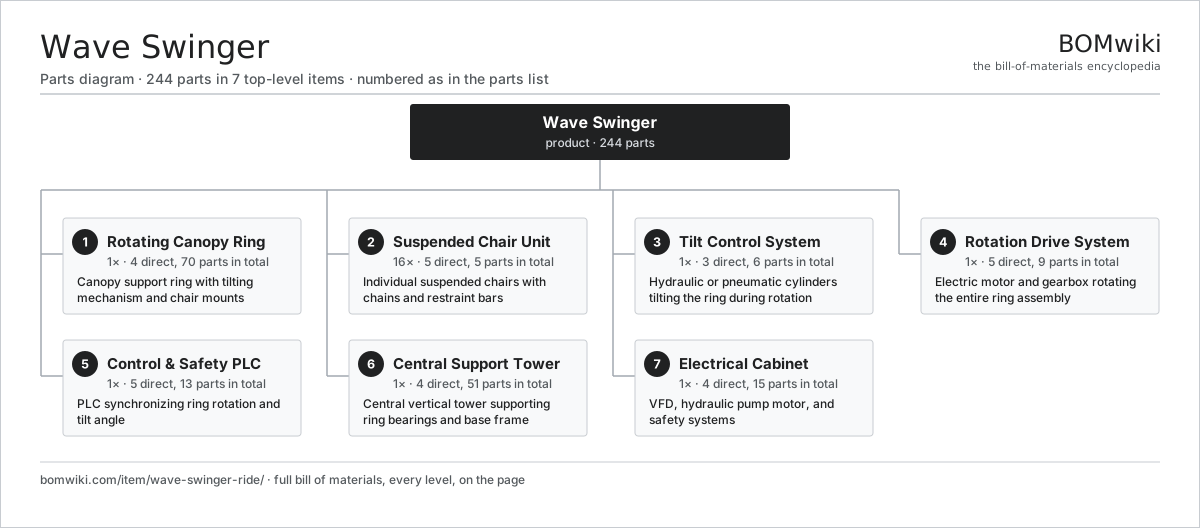
| # | Part | Qty | What it does |
|---|---|---|---|
| 1 | Rotating Canopy Ring 4 parts | 1× | Canopy support ring with tilting mechanism and chair mounts |
| 2 | Suspended Chair Unit 5 parts | 16× | Individual suspended chairs with chains and restraint bars |
| 3 | Tilt Control System 3 parts | 1× | Hydraulic or pneumatic cylinders tilting the ring during rotation |
| 4 | Rotation Drive System 5 parts | 1× | Electric motor and gearbox rotating the entire ring assembly |
| 5 | Control & Safety PLC 5 parts | 1× | PLC synchronizing ring rotation and tilt angle |
| 6 | Central Support Tower 4 parts | 1× | Central vertical tower supporting ring bearings and base frame |
| 7 | Electrical Cabinet 4 parts | 1× | VFD, hydraulic pump motor, and safety systems |
3D model
No 3D model yet. Have a CAD file of this? Add a 3D model. STL renders right on this page; STEP, FreeCAD, and OpenSCAD sources are welcome too (openly licensed, like all 3D models on BOMwiki).
Build & assembly graph
expand / collapse · shared sub-assemblies converge · links to related products · est. labourTap an assembly to expand/collapse · tap a part to open it · use “Open page” for any node · drag to pan, scroll to zoom.
Bill of materials for Wave Swinger
7 top-level lines · 37 rows shown · 244 parts total · indented to 3 levels| # | Item / sub-assembly | Part no. | Qty/assy | Ext. qty | Parts | Type |
|---|---|---|---|---|---|---|
| 1 | Rotating Canopy Ring 4 parts | wave-swinger-rotating-ring | 1× | 1 | 70 | assembly |
| 1.1 | Sheet Metal Panel | sheet-panel | 50× | 50 | · | part |
| 1.2 | Fastener Set | fastener-set | 10× | 10 | · | part |
| 1.3 | Ball Bearing | ball-bearing | 8× | 8 | · | part |
| 1.4 | Cable Bundle | cable-bundle | 2× | 2 | · | part |
| 2 | Suspended Chair Unit 5 parts | wave-swinger-chair-assembly | 16× | 16 | 5 | assembly |
| 2.1 | Chair Frame | wave-swinger-chair-frame | 1× | 16 | · | part |
| 2.2 | Suspension Chain | wave-swinger-chair-chain | 1× | 16 | · | part |
| 2.3 | Restraint Bar | wave-swinger-restraint-bar | 1× | 16 | · | part |
| 2.4 | Fastener Set | fastener-set | 1× | 16 | · | part |
| 2.5 | Ball Bearing | ball-bearing | 1× | 16 | · | part |
| 3 | Tilt Control System 3 parts | wave-swinger-tilt-mechanism | 1× | 1 | 6 | assembly |
| 3.1 | Pressure Sensor | pressure-sensor | 2× | 2 | · | part |
| 3.2 | Solenoid Valve | solenoid-valve | 2× | 2 | · | part |
| 3.3 | Fastener Set | fastener-set | 2× | 2 | · | part |
| 4 | Rotation Drive System 5 parts | wave-swinger-center-drive | 1× | 1 | 9 | assembly |
| 4.1 | Blower Motor | blower-motor | 1× | 1 | · | part |
| 4.2 | Gearbox Housing | gearbox-housing | 1× | 1 | · | part |
| 4.3 | Ball Bearing | ball-bearing | 4× | 4 | · | part |
| 4.4 | Fastener Set | fastener-set | 2× | 2 | · | part |
| 4.5 | Encoder | encoder | 1× | 1 | · | part |
| 5 | Control & Safety PLC 5 parts | wave-swinger-control-system | 1× | 1 | 13 | assembly |
| 5.1 | Microcontroller | mcu | 1× | 1 | · | part |
| 5.2 | Relay | relay | 6× | 6 | · | part |
| 5.3 | Bare PCB | pcb-bare | 2× | 2 | · | part |
| 5.4 | LCD Panel | lcd-panel | 1× | 1 | · | part |
| 5.5 | Connector | connector | 3× | 3 | · | part |
| 6 | Central Support Tower 4 parts | wave-swinger-support-tower | 1× | 1 | 51 | assembly |
| 6.1 | Sheet Metal Panel | sheet-panel | 40× | 40 | · | part |
| 6.2 | Fastener Set | fastener-set | 8× | 8 | · | part |
| 6.3 | Ball Bearing | ball-bearing | 2× | 2 | · | part |
| 6.4 | Cable Bundle | cable-bundle | 1× | 1 | · | part |
| 7 | Electrical Cabinet 4 parts | wave-swinger-electrical-cabinet | 1× | 1 | 15 | assembly |
| 7.1 | Relay | relay | 8× | 8 | · | part |
| 7.2 | Power Supply | power-supply | 2× | 2 | · | part |
| 7.3 | Connector | connector | 4× | 4 | · | part |
| 7.4 | Fastener Set | fastener-set | 1× | 1 | · | part |
Something wrong in this list? Report a problem with this BOM.
Related products
same domain, ranked by shared parts Drop Tower Ride
308 parts · shares 9 with this page
Drop Tower Ride
308 parts · shares 9 with this page
 Roller Coaster
657 parts · shares 9 with this page
Roller Coaster
657 parts · shares 9 with this page
 Dark Ride System
1,005 parts · shares 8 with this page
Dark Ride System
1,005 parts · shares 8 with this page
 Alpine Coaster
1,850 parts · shares 7 with this page
Alpine Coaster
1,850 parts · shares 7 with this page
 Pirate Ship Ride
478 parts · shares 9 with this page
Pirate Ship Ride
478 parts · shares 9 with this page
 Teacup Ride
660 parts · shares 9 with this page
Teacup Ride
660 parts · shares 9 with this page
Sourcing: possible vendors
Browse the supplier directory → Prices, MOQ, and lead times are algorithmic estimates, not quotes, and not claims about these companies. Company mappings are curated by keyword; est. price band $20–$3k. How estimates work| Vendor | HQ | Specialty | MOQ | Lead time |
|---|---|---|---|---|
|
🇩🇰LEGO
lego.com ↗
|
Billund, DK | Construction toys | 2,000 units | 6–10 wks |
|
🇺🇸Mattel
mattel.com ↗
|
El Segundo, US | Toys | 2,000 units | 6–10 wks |
|
🇺🇸Hasbro
hasbro.com ↗
|
Pawtucket, US | Toys & games | 2,000 units | 6–10 wks |
| bandainamco.co.jp ↗ | Tokyo, JP | Toys & amusement | 2,000 units | 6–10 wks |
| spinmaster.com ↗ | Toronto, CA | Toys | 2,000 units | 6–10 wks |
1,994-word article