Pipe Welding Rotator
ProductOverview
A pipe welding rotator spins a cylindrical workpiece (pipe, tube, vessel shell) under a fixed welding gun. Instead of the gun moving along the joint, the rotator brings the joint to the gun, dramatically reducing travel distance, improving torch reach, and allowing the operator to weld in the most comfortable position (typically flat or downhand). The drive roller presses the pipe against a passive idler roller; friction between tire and pipe surface transmits torque without slipping.
Rotators are essential in pressure vessel shops, steel structural fabrication, and oil and gas pipeline yards where long circumferential welds must be completed with consistent quality. They handle pipe from 50 mm (instrument tubing) to 600+ mm OD (large headers and drums) by adjusting roller spacing.
How it works
Drive and Idler Rollers: The drive roller is powered by a 2 kW DC motor through a soft-start controller. The idler roller is held under pressure (15–30 kN) by springs or a pneumatic cylinder, pressing it against the drive roller. The pipe is placed into the V-shaped saddles at each end, resting between the two rollers.
When the motor spins, friction between the molded tires and the pipe surface grips and rotates the pipe. Because the tires are elastomer (Shore 60–70A), they flex slightly, conforming to pipe ovality and minor surface imperfections, and provide slip-free torque transmission up to the slip limit (typically 2000–3000 kg).
Speed Control: A DC soft-start circuit accepts a 0–10 VDC signal from the operator's speed potentiometer. The controller ramps motor voltage smoothly from 0–180V, avoiding mechanical shock and keeping the pipe accelerating gradually. No sudden jerks that would cause weld puddle disturbance or operator whiplash.
Adjustment: The screw or pneumatic mechanism changes roller spacing to accommodate different pipe diameters. A manual handwheel or air valve lets the operator dial in the correct gap in under 2 minutes. Springs under the idler lever are pre-tuned; the pneumatic cylinder (if fitted) allows further pressure adjustment without disassembly.
Feedback: An Encoder on the motor shaft signals tachometer display, letting the operator and quality control confirm rotation speed. Some systems log this to document weld procedure compliance.
Grip and Slip
The friction coefficient between urethane tire and steel pipe surface is typically 0.8–1.0 (dry and rust-free). The grip force is proportional to idler pressure and roller contact area. If the pipe surface is oily or scale-covered, grip is lost and the pipe spins inside the rollers without advancing, a condition called slip.
Preventive maintenance includes wiping pipe ends with a cloth before clamping, and regularly cleaning the roller tires with a solvent-soaked rag. Some operators apply a light coating of rosin-core solder flux to the contact zones to improve adhesion. Worn or glazed tires lose grip and must be replaced.
Support Saddles
The V-block saddles at each pipe end prevent lateral wobble as the rotator spins. They have a 90-degree V profile, allowing the pipe to nestle naturally and resist side-to-side motion. The saddles are adjustable in height and angle, so the welder can dial in exact alignment: the pipe must run true at the joint, with the seam presenting flat to the gun.
Misaligned saddles cause the pipe to wobble, introducing arc length variation and weld bead inconsistency. A dial indicator check every 200 operating hours ensures saddle and roller alignment stays within 0.3 mm runout.
Speed Selection
Rotation speed is chosen based on travel speed and the desired number of weld passes. A typical rule of thumb:
- Single-pass root (fast travel): 60–100 rpm
- Multi-pass circumferential: 30–60 rpm
- Heavy wall or high-duty pipe: 10–30 rpm (slow, precise penetration)
Fast rotation minimizes heat input per revolution, useful for thin-wall and stainless. Slow rotation gives the puddle more time to cool and settle, preferred for thick wall and carbon steel.
Soft-Start Advantage
Without soft-start ramp, a DC motor at full voltage jumps to peak torque instantly, jerking the pipe and disturbing the weld puddle. The soft-start circuit uses a thyristor (SCR) to phase-control the DC voltage. Voltage rises linearly over 2–5 seconds, allowing the motor to accelerate smoothly and the welding current to stabilize before the rotator reaches target speed.
This ramp also reduces inrush current on the 380V 3-phase supply, saving the shop's electrical system from voltage sag and protecting other equipment.
Maintenance
Tires: Molded tires wear at a predictable rate: every 5000–10000 operating hours, depending on pressure and surface roughness. Bald or crazed tires lose grip and must be replaced as a set (both drive and idler) to maintain even contact pressure. Replacement involves dissolving the old epoxy adhesive with heat and solvent, then bonding new tires with fresh epoxy.
Bearings: Sealed ball bearings on both roller shafts are lubricated for life and require no maintenance. After 10,000 hours, if noise or runout increases, bearings are replaced as a cartridge.
Controller: The soft-start control relays and contactor contacts may pit and require cleaning or replacement every 5–10 years, depending on switch frequency and load current. The SCR thyristor has indefinite life if kept below 65 °C junction temperature (monitored by heatsink temperature).
Alignment: Every 100 operating hours, a quick runout check with a dial indicator at mid-pipe ensures rollers and saddles remain parallel. Thermal expansion and vibration can gradually misalign the frame; shimming the roller mounts or saddle adjusters takes 20 minutes and prevents cascading wear.
Dual-Motor Systems
Larger shops use two-motor designs, with independent drive and idler motors (or a single motor with a slip-ring transfer to the idler). This allows active pressure control: the idler motor can reduce grip pressure during the weld to lower heat input, or increase it during tool changes. More complex, but enables tighter process control.
Single-motor fixed-pressure is simpler and more reliable, preferred for production lines and smaller shops.
Pipe Welding Rotator parts and their functions
8 top-level parts · 50 parts in total · full bill of materials below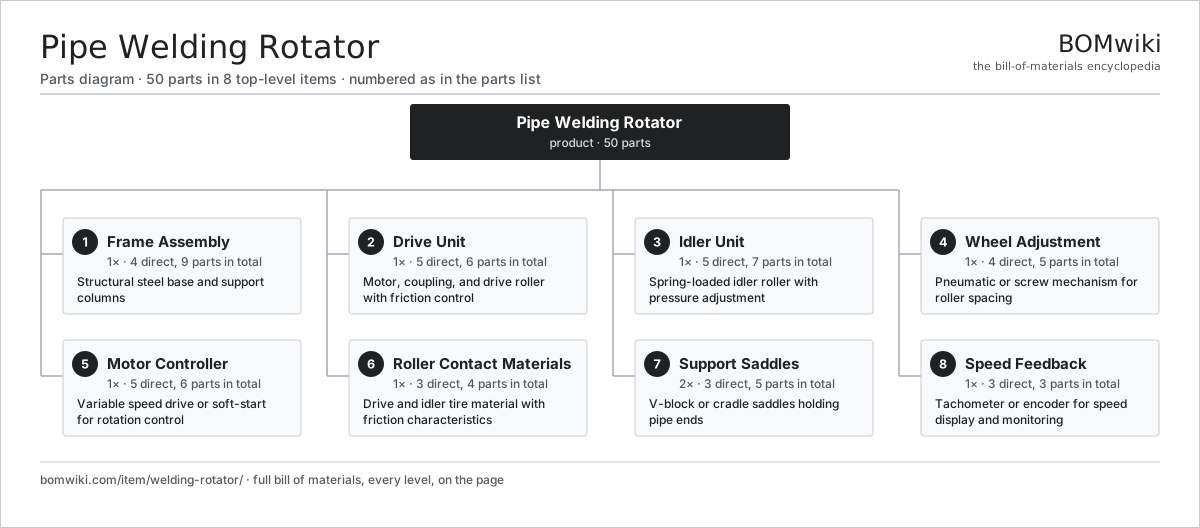
| # | Part | Qty | What it does |
|---|---|---|---|
| 1 | Frame Assembly 4 parts | 1× | Structural steel base and support columns |
| 2 | Drive Unit 5 parts | 1× | Motor, coupling, and drive roller with friction control |
| 3 | Idler Unit 5 parts | 1× | Spring-loaded idler roller with pressure adjustment |
| 4 | Wheel Adjustment 4 parts | 1× | Pneumatic or screw mechanism for roller spacing |
| 5 | Motor Controller 5 parts | 1× | Variable speed drive or soft-start for rotation control |
| 6 | Roller Contact Materials 3 parts | 1× | Drive and idler tire material with friction characteristics |
| 7 | Support Saddles 3 parts | 2× | V-block or cradle saddles holding pipe ends |
| 8 | Speed Feedback 3 parts | 1× | Tachometer or encoder for speed display and monitoring |
3D model
No 3D model yet. Have a CAD file of this? Add a 3D model. STL renders right on this page; STEP, FreeCAD, and OpenSCAD sources are welcome too (openly licensed, like all 3D models on BOMwiki).
Build & assembly graph
expand / collapse · shared sub-assemblies converge · links to related products · est. labourTap an assembly to expand/collapse · tap a part to open it · use “Open page” for any node · drag to pan, scroll to zoom.
Bill of materials for Pipe Welding Rotator
8 top-level lines · 40 rows shown · 50 parts total · indented to 3 levels| # | Item / sub-assembly | Part no. | Qty/assy | Ext. qty | Parts | Type |
|---|---|---|---|---|---|---|
| 1 | Frame Assembly 4 parts | welding-rotator-frame | 1× | 1 | 9 | assembly |
| 1.1 | Sheet Metal Panel | sheet-panel | 3× | 3 | · | part |
| 1.2 | Base Plate | welding-rotator-base-plate | 1× | 1 | · | part |
| 1.3 | Column Beam | welding-rotator-column-beam | 2× | 2 | · | part |
| 1.4 | Fastener Set | fastener-set | 3× | 3 | · | part |
| 2 | Drive Unit 5 parts | welding-rotator-drive-unit | 1× | 1 | 6 | assembly |
| 2.1 | DC Motor | welding-rotator-dc-motor | 1× | 1 | · | part |
| 2.2 | Motor Coupling | welding-rotator-motor-coupling | 1× | 1 | · | part |
| 2.3 | Drive Roller | welding-rotator-drive-roller | 1× | 1 | · | part |
| 2.4 | Roller Bearing | welding-rotator-roller-bearing | 2× | 2 | · | part |
| 2.5 | Ball Bearing | ball-bearing | 1× | 1 | · | part |
| 3 | Idler Unit 5 parts | welding-rotator-idler-unit | 1× | 1 | 7 | assembly |
| 3.1 | Idler Roller | welding-rotator-idler-roller | 1× | 1 | · | part |
| 3.2 | Idler Bearing | welding-rotator-idler-bearing | 2× | 2 | · | part |
| 3.3 | Spring Arm | welding-rotator-spring-arm | 1× | 1 | · | part |
| 3.4 | Coil Spring | coil-spring | 2× | 2 | · | part |
| 3.5 | Fastener Set | fastener-set | 1× | 1 | · | part |
| 4 | Wheel Adjustment 4 parts | welding-rotator-wheel-adjustment | 1× | 1 | 5 | assembly |
| 4.1 | Adjustment Screw | welding-rotator-adjustment-screw | 1× | 1 | · | part |
| 4.2 | Adjustment Bracket | welding-rotator-adjustment-bracket | 2× | 2 | · | part |
| 4.3 | Handwheel | welding-rotator-handwheel | 1× | 1 | · | part |
| 4.4 | Fastener Set | fastener-set | 1× | 1 | · | part |
| 5 | Motor Controller 5 parts | welding-rotator-motor-controller | 1× | 1 | 6 | assembly |
| 5.1 | Speed Potentiometer | welding-rotator-speed-potentiometer | 1× | 1 | · | part |
| 5.2 | Control Board | welding-rotator-control-board | 1× | 1 | · | part |
| 5.3 | Contactor | welding-rotator-contactor | 1× | 1 | · | part |
| 5.4 | Relay | relay | 2× | 2 | · | part |
| 5.5 | Power Supply | power-supply | 1× | 1 | · | part |
| 6 | Roller Contact Materials 3 parts | welding-rotator-roller-contact | 1× | 1 | 4 | assembly |
| 6.1 | Rubber Tire | welding-rotator-rubber-tire | 2× | 2 | · | part |
| 6.2 | Tire Adhesive | welding-rotator-tire-adhesive | 1× | 1 | · | part |
| 6.3 | Contact Cleaner | welding-rotator-contact-cleaner | 1× | 1 | · | part |
| 7 | Support Saddles 3 parts | welding-rotator-support-saddles | 2× | 2 | 5 | assembly |
| 7.1 | V-Block Saddle | welding-rotator-vblock-saddle | 2× | 4 | · | part |
| 7.2 | Saddle Mount | welding-rotator-saddle-mount | 2× | 4 | · | part |
| 7.3 | Fastener Set | fastener-set | 1× | 2 | · | part |
| 8 | Speed Feedback 3 parts | welding-rotator-speed-feedback | 1× | 1 | 3 | assembly |
| 8.1 | Encoder | encoder | 1× | 1 | · | part |
| 8.2 | Speed Display | welding-rotator-speed-display | 1× | 1 | · | part |
| 8.3 | Connector | connector | 1× | 1 | · | part |
Something wrong in this list? Report a problem with this BOM.
Related products
same domain, ranked by shared parts Centrifugal Disc Finishing Machine
326 parts · shares 2 with this page
Chain Link Welding Machine
440 parts · shares 2 with this page
CNC Wire Forming Machine
1,438 parts · shares 2 with this page
Centrifugal Disc Finishing Machine
326 parts · shares 2 with this page
Chain Link Welding Machine
440 parts · shares 2 with this page
CNC Wire Forming Machine
1,438 parts · shares 2 with this page
Sourcing: possible vendors
Browse the supplier directory → Prices, MOQ, and lead times are algorithmic estimates, not quotes, and not claims about these companies. Company mappings are curated by keyword; est. price band $10k–$1M. How estimates work| Vendor | HQ | Specialty | MOQ | Lead time |
|---|---|---|---|---|
|
🇩🇪DMG MORI
dmgmori.com ↗
|
Bielefeld, DE | Machine tools | 5 units | 12–20 wks |
|
🇯🇵Mazak
mazak.com ↗
|
Oguchi, JP | Machine tools | 5 units | 12–20 wks |
| haascnc.com ↗ | Oxnard, US | CNC machine tools | 5 units | 12–20 wks |
|
🇯🇵Okuma
okuma.com ↗
|
Niwa, JP | Machine tools | 5 units | 12–20 wks |
|
🇩🇪Trumpf
trumpf.com ↗
|
Ditzingen, DE | Laser & sheet-metal machines | 5 units | 12–20 wks |
1,062-word article