Wheel Alignment Machine
ProductOverview
The wheel alignment machine is a computer-assisted measurement system that precisely quantifies suspension geometry, camber, caster, and toe angles, on all four wheels simultaneously. It enables technicians to diagnose suspension wear, alignment drift, and steering response issues, then guide adjustments to vehicle specifications. The system uses stereo or structured-light 3D cameras mounted on vertical towers beside each wheel, tracking retroreflective target markers adhered to the rims. A motorized turntable under each front wheel allows the technician to simulate steering angles during measurement, enabling caster and kingpin angle determination. The computing console processes the 3D camera frames in real time, comparing measured wheel positions to factory alignment specifications and displaying the results on a large touchscreen.
The measurement accuracy of modern 3D-camera-based aligners is ±0.1° in camber and ±0.05° in toe, approaching the precision of older laser-based systems while offering superior speed and ease of use. Unlike laser bounces (which can be blocked by brake dust or shop clutter), the retroreflective dot targets are always visible to the IR-illuminated cameras, and the software can identify them even with minor dust. The system is particularly valuable for vehicles with non-standard geometry (lowered suspension, aftermarket wheels) because it measures actual vehicle angles, not relying on preset models.
How it Works
The technician drives the vehicle onto the alignment rack and performs a wheel runout check, ensuring each tire is balanced and the wheels are centered. The vehicle's Reflective Target Marker (four dots of retroreflective tape in a known geometric pattern, adhered to each wheel rim) are then illuminated by the Infrared LED Array LEDs on each Camera Sensor Tower. Each 3D Camera Module captures stereo or structured-light depth images at 30 fps, allowing the console software to calculate the 3D position and angular orientation of each wheel within 1–2 millimeters accuracy.
For front-wheel measurements, the technician positions each Motorized Turn Plate Assembly under the front wheels and engages the Wheel Rim Clamp Assembly to secure the tire rims. The console controls the Turn Plate Motor via the Rotary Encoder to rotate the turntable through a known angle (e.g., 20° left, center, 20° right), capturing wheel angle data at each position. The software triangulates the target dots from both left and right camera towers, calculating the spatial relationship and deriving camber angle (wheel tilt in the vertical plane), caster angle (pivot axis tilt in the longitudinal plane), and toe angle (wheel heading relative to vehicle centerline).
For rear wheels (often non-adjustable on independent suspension), the cameras measure static toe and camber without turntable motion. The console compiles all four-wheel measurements and displays them against the vehicle's factory specifications, typically color-coded green (within tolerance), yellow (marginal), or red (out of spec). The technician then proceeds to adjust suspension components, tie-rod ends (toe), camber plates or shims (camber), or caster wedges, re-measuring after each adjustment until all angles fall within tolerance.
Throughout the measurement session, the Computing and Display Console displays real-time angle data, calculates corrections needed, and guides the technician through the procedure. When measurements are finalized, the software generates a PDF printout or digital report showing before/after angles, customer-visible graphics, and technician notes.
Optical Principles and Calibration
The 3D reconstruction relies on pinhole camera calibration. Each Optical Lens Assembly has a known intrinsic parameter set (focal length, principal point, distortion coefficients) determined during manufacturing or in-field calibration. The two camera towers form a stereo pair with a known baseline separation (typically 1–2 meters). When software identifies the same retroreflective dot in both left and right camera frames, it triangulates the 3D position using epipolar geometry, achieving depth accuracy of ±5–10 mm at typical working distances (1–6 feet).
Optical drift over months of heavy use is corrected through an annual Calibration Reference Frame procedure. The technician positions the Master Target Block, a precision-machined aluminum frame with retroreflective dots at known spacings (±0.1 mm), in front of the cameras and captures measurement data. The console compares measured positions to the master reference and applies a correction matrix to future measurements, restoring accuracy to factory specifications.
Integration and Workflow
The Computing and Display Console runs proprietary alignment software, typically communicating with a shop management system via network or USB. Vehicle specifications are looked up using VIN decoding or manual selection (year, make, model, suspension type), and the target alignment angles are automatically populated. Some systems support over-the-air software updates, adding new vehicle models and refining algorithms. The Touchscreen Display provides an intuitive workflow: vehicle selection, pre-measurement walk-around, four-wheel capture, results display, and report generation, all without requiring technician training beyond basic operation.
Technicians appreciate the speed gain: a full four-wheel alignment takes 3–5 minutes of machine time (after vehicle positioning), versus 15–20 minutes with older string-line or laser methods. The visual feedback on the console screen also prevents over-corrections; technicians can see real-time angle changes as they loosen or tighten suspension fasteners, reducing trial-and-error adjustment cycles.
Maintenance and Service Life
The 3D Camera Module sensor modules are durable but subject to dust ingress; annual cleaning of the Optical Lens Assembly window with lens tissue and isopropyl alcohol maintains optical clarity. The Infrared LED Array LEDs degrade slowly over 10,000+ hours of operation; replacement is inexpensive but requires a small calibration run after installation. The Motorized Turn Plate Assembly Turntable Bearing assemblies are sealed and rated for 100,000+ rotations; beyond that, they may develop slight play requiring re-calibration or bearing replacement. The Alignment Software is typically perpetual but tied to the hardware; upgrading the console CPU may require re-licensing. The Master Target Block is a precision reference and should be protected from drops and impacts; verification is recommended before each use to ensure continued accuracy.
Wheel Alignment Machine parts and their functions
7 top-level parts · 79 parts in total · full bill of materials below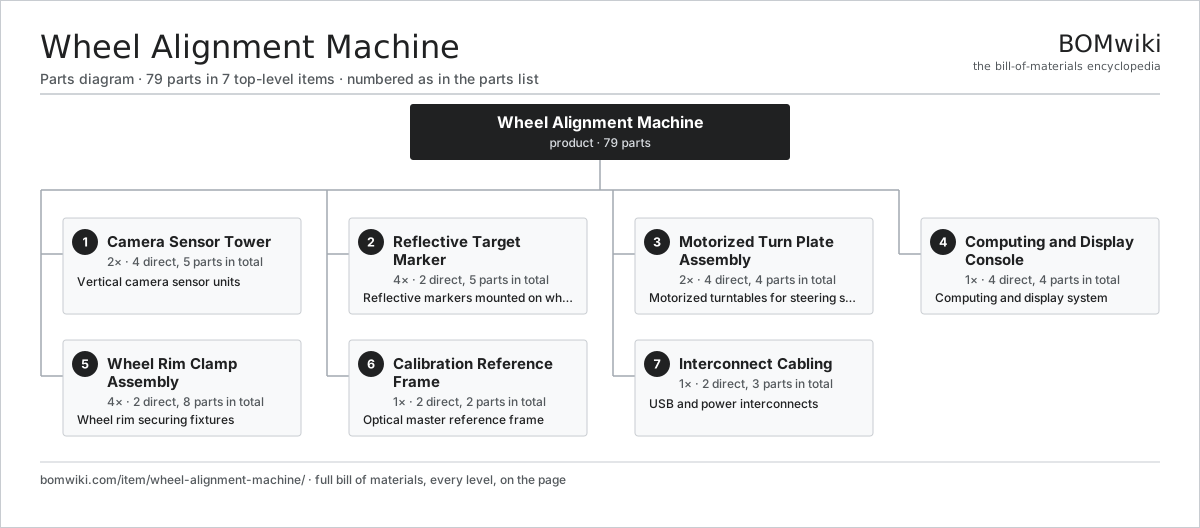
| # | Part | Qty | What it does |
|---|---|---|---|
| 1 | Camera Sensor Tower 4 parts | 2× | Vertical camera sensor units |
| 2 | Reflective Target Marker 2 parts | 4× | Reflective markers mounted on wheel rims |
| 3 | Motorized Turn Plate Assembly 4 parts | 2× | Motorized turntables for steering simulation |
| 4 | Computing and Display Console 4 parts | 1× | Computing and display system |
| 5 | Wheel Rim Clamp Assembly 2 parts | 4× | Wheel rim securing fixtures |
| 6 | Calibration Reference Frame 2 parts | 1× | Optical master reference frame |
| 7 | Interconnect Cabling 2 parts | 1× | USB and power interconnects |
3D model
No 3D model yet. Have a CAD file of this? Add a 3D model. STL renders right on this page; STEP, FreeCAD, and OpenSCAD sources are welcome too (openly licensed, like all 3D models on BOMwiki).
Build & assembly graph
expand / collapse · shared sub-assemblies converge · links to related products · est. labourTap an assembly to expand/collapse · tap a part to open it · use “Open page” for any node · drag to pan, scroll to zoom.
Bill of materials for Wheel Alignment Machine
7 top-level lines · 27 rows shown · 79 parts total · indented to 3 levels| # | Item / sub-assembly | Part no. | Qty/assy | Ext. qty | Parts | Type |
|---|---|---|---|---|---|---|
| 1 | Camera Sensor Tower 4 parts | wheel-alignment-camera-tower | 2× | 2 | 5 | assembly |
| 1.1 | 3D Camera Module | wheel-alignment-camera-head | 1× | 2 | · | part |
| 1.2 | Infrared LED Array | wheel-alignment-ir-emitter | 2× | 4 | · | part |
| 1.3 | Aluminum Tower Column | wheel-alignment-tower-stand | 1× | 2 | · | part |
| 1.4 | Optical Lens Assembly | wheel-alignment-camera-lens | 1× | 2 | · | part |
| 2 | Reflective Target Marker 2 parts | wheel-alignment-targets | 4× | 4 | 5 | assembly |
| 2.1 | Retroreflective Dot | wheel-alignment-target-sticker | 4× | 16 | · | part |
| 2.2 | Target Geometry | wheel-alignment-target-pattern | 1× | 4 | · | part |
| 3 | Motorized Turn Plate Assembly 4 parts | wheel-alignment-turn-plates | 2× | 2 | 4 | assembly |
| 3.1 | Turn Plate Motor | wheel-alignment-plate-motor | 1× | 2 | · | part |
| 3.2 | Rotary Encoder | wheel-alignment-plate-encoder | 1× | 2 | · | part |
| 3.3 | Turntable Bearing | wheel-alignment-plate-bearing | 1× | 2 | · | part |
| 3.4 | Plate Lock Mechanism | wheel-alignment-plate-lock | 1× | 2 | · | part |
| 4 | Computing and Display Console 4 parts | wheel-alignment-console | 1× | 1 | 4 | assembly |
| 4.1 | Industrial PC Unit | wheel-alignment-industrial-pc | 1× | 1 | · | part |
| 4.2 | Touchscreen Display | wheel-alignment-touchscreen | 1× | 1 | · | part |
| 4.3 | Alignment Software | wheel-alignment-software-license | 1× | 1 | · | part |
| 4.4 | USB Hub Module | wheel-alignment-usb-hub | 1× | 1 | · | part |
| 5 | Wheel Rim Clamp Assembly 2 parts | wheel-alignment-clamps | 4× | 4 | 8 | assembly |
| 5.1 | Clamp Jaw Pad | wheel-alignment-clamp-jaw | 4× | 16 | · | part |
| 5.2 | Clamp Fastener | wheel-alignment-clamp-screw | 4× | 16 | · | part |
| 6 | Calibration Reference Frame 2 parts | wheel-alignment-calibration-stand | 1× | 1 | 2 | assembly |
| 6.1 | Master Target Block | wheel-alignment-calib-target-block | 1× | 1 | · | part |
| 6.2 | Calibration Mount Bracket | wheel-alignment-calib-mount | 1× | 1 | · | part |
| 7 | Interconnect Cabling 2 parts | wheel-alignment-cabling | 1× | 1 | 3 | assembly |
| 7.1 | USB 3.0 Cable Shielded | wheel-alignment-cable-usb | 2× | 2 | · | part |
| 7.2 | Power Distribution Cord | wheel-alignment-cable-power | 1× | 1 | · | part |
Something wrong in this list? Report a problem with this BOM.
Sourcing: possible vendors
Browse the supplier directory → Prices, MOQ, and lead times are algorithmic estimates, not quotes, and not claims about these companies. Company mappings are curated by keyword; est. price band $10–$400. How estimates work| Vendor | HQ | Specialty | MOQ | Lead time |
|---|
1,001-word article