Wheel Balancer
ProductOverview
A wheel balancer is an electronic test machine that detects and measures imbalance in a mounted tire-wheel assembly. Imbalance occurs when the mass distribution around the wheel is uneven, such as when a wheel casting has a dense section, or when a tire's rubber compound varies from one side to the other. When the unbalanced wheel rotates at highway speeds, centrifugal force creates a time-varying force vector that shakes the steering and suspension, causing pulsation, vibration, and (at extreme levels) shimmy.
The machine spins the wheel at increasing speeds, monitoring force pulses with Force Sensing Bearingss. A Control Processor & Electronics analyzes the pulse pattern using fast Fourier transform (FFT), calculating the imbalance magnitude and angular location. The Data Display Unit guides the technician to add precise weights at the exact location and depth (inner or outer edge) to cancel the imbalance.
Professional tire shops balance every new tire installation. Properly balanced wheels improve ride quality, extend tire life, and reduce wear on suspension and bearing components.
Spindle and rotation
The Motorized Spin Spindle is a precision horizontal spindle running on angular contact or cylindrical roller Spindle Bearings. The Drive Motor is a 0.5–1.5 kW variable-speed electric motor that accelerates the spindle to 2,000–2,500 rpm. A Variable Frequency Drive or DC controller allows smooth speed ramping from rest to full speed in 20–40 seconds.
A Rotary Encoder (3,600–7,200 pulses per revolution) provides phase reference, the processor uses this to know the exact rotational position of the wheel at each measurement instant.
The Centering Cone (tapered, typically 50 mm) grips the wheel center hole. Multiple Wheel Centering Cone Set sizes (50, 54, 60 mm) accommodate most wheels; adapter rings extend coverage to non-standard sizes.
Force measurement and sensing
The Force Sensing Bearings consists of two precision wheel-balancer-bearing-housing assemblies on the left and right of the spindle. Each housing contains Strain Gauges (typically two per housing) bonded to the bearing support structure.
As the unbalanced wheel rotates, centrifugal forces push and pull on the spindle. These forces are transmitted through the bearings and cause minute deflections (micrometers) of the housing. The strain gauges detect these deflections as changes in electrical resistance. A Main PCB with signal conditioning amplifies the strain gauge signals (millivolts) to usable levels.
The ADC Module samples these signals at 5–10 kHz, capturing multiple sine waves as the wheel spins. The Control Processor & Electronics performs FFT on this data to extract the fundamental frequency (one per wheel revolution) and higher harmonics.
Processor and analysis
The Control Processor & Electronics is typically an ARM Cortex-M or x86 microprocessor running balancing algorithms. The physics is straightforward: an imbalance creates a rotating force vector at 1X (one per revolution). The processor measures this force in two perpendicular directions (radial and axial), calculates its magnitude and phase, and determines the equivalent mass and location.
The calculation assumes a two-plane model: imbalance at the inner edge (near the rim mounting) and imbalance at the outer edge (near the tire sidewall). Most wheels need weights at both planes. The processor calculates the gram value and angular position for each plane.
The Firmware ROM contains the balancing model and calibration data specific to the machine. Factory calibration accounts for spindle residual imbalance, bearing stiffness, and sensor sensitivity. Good machines repeat measurements to within ±0.05 oz (±1.4 grams).
Display and weight guidance
The Data Display Unit shows imbalance data and weight placement instructions. A typical readout:
- Inner plane: 45 grams at 3 o'clock
- Outer plane: 30 grams at 9 o'clock
The Position Indicator is an LED arrow or video arrow showing the wheel's rotational position. As the wheel spins, the arrow points to the location on the rim where the technician should apply the weight. LED Indicators often flash green when the wheel reaches the correct angular position.
The Weight Amount shows the required weight in ounces or grams. The technician adds lead or tungsten adhesive weights, then presses a button to re-spin and verify balance. Most machines display a residual imbalance after weight application, typically 0.1–0.3 oz, which is acceptable.
Testing modes
Standard machines offer two balancing planes (inner and outer). This covers dynamic imbalance on most passenger cars and light trucks. Some machines offer 4-plane balancing or "road force" simulation, which attempts to account for tire stiffness variation and wheel runout combined.
Road force balancing uses a roller pressing against the tire as it spins, simulating the force a road applies. This detects harmonics that pure spin balancing might miss, improving comfort on sensitive vehicles. Road force is optional and costs significantly more.
Safety hood and interlock
The Safety Enclosure Hood encloses the spinning wheel, protecting operators from contact. The Hood Shield is polycarbonate or expanded metal, allowing visibility while confining any debris from a wheel failure.
A Safety Interlock cuts motor power if the hood is opened during spin, preventing unsafe access to the spinning wheel. This is a critical safety feature; a spinning 50 kg wheel can cause serious injury.
Motor drive and control
The Electric Motor Drive uses a Variable Frequency Drive or DC PWM controller to vary motor speed. A Soft-Start Ramp ramps the motor smoothly from rest to full speed, reducing mechanical shock and extending bearing life.
The Emergency Stop button cuts power immediately, stopping the wheel within seconds.
Weight application and material
Balance weights are typically lead (cheap, dense, reliable) or tungsten (non-toxic, denser than lead, preferred in some regions). Weights come in two styles:
- Adhesive: Self-adhesive lead or tungsten strips that stick to the wheel inner surface. Fastest to apply but may fall off on aggressive wheels.
- Clip-on: Weights with a clip that hooks the rim edge. Slower to install but more secure.
Weights range from 0.25 oz (7 grams) to 3 oz (85 grams) in standard increments. After weight application, the technician re-spins the wheel and iterates until residual imbalance is acceptable (typically ≤ 0.3 oz or 8 grams).
Typical balancing workflow
(1) Mount the tire-wheel assembly on the chuck cone. (2) Close hood. (3) Select wheel size and width on display (or press auto-detect). (4) Press start. Machine spins wheel to ~2,500 rpm, measuring imbalance over 20–40 seconds. (5) Machine displays weight amounts and positions. (6) Remove wheel from chuck. (7) Technician applies weights (adhesive or clip-on) at the specified positions. (8) Remount wheel on chuck. (9) Press re-check. Machine spins again and displays residual imbalance. (10) If residual ≤ 0.3 oz, job is complete; otherwise, add more weight and repeat.
Total time per wheel: 2–4 minutes for experienced technicians.
Limitations and edge cases
Severely out-of-round wheels cannot be balanced: the imbalance changes as the wheel rotates (not 1X only), and it cannot be eliminated by weight alone. Such wheels usually require truing on a lathe or replacement.
Bent rims also cannot be balanced if the bend is structural. Some rims can be cold-bent back into shape, but this is risky.
Tires with internal lumps or uneven sidewall thickness are difficult to balance; the imbalance is distributed throughout the tire mass, making it impossible to achieve perfect balance with simple weights. High-speed balancing (road force) can help mitigate this by finding the best rotational position for the worst imbalance spot.
Wheel Balancer parts and their functions
8 top-level parts · 47 parts in total · full bill of materials below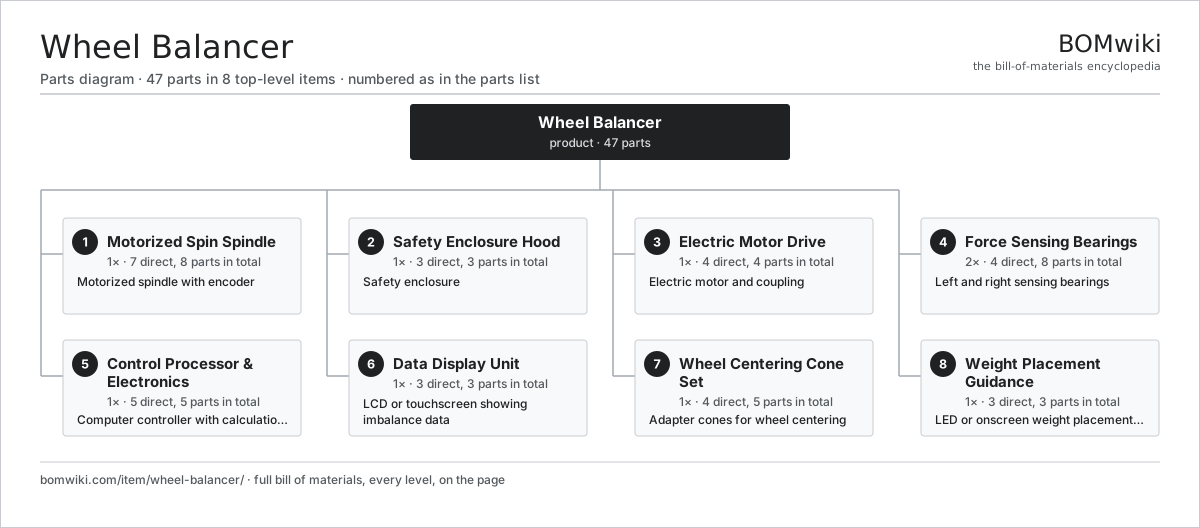
| # | Part | Qty | What it does |
|---|---|---|---|
| 1 | Motorized Spin Spindle 7 parts | 1× | Motorized spindle with encoder |
| 2 | Safety Enclosure Hood 3 parts | 1× | Safety enclosure |
| 3 | Electric Motor Drive 4 parts | 1× | Electric motor and coupling |
| 4 | Force Sensing Bearings 4 parts | 2× | Left and right sensing bearings |
| 5 | Control Processor & Electronics 5 parts | 1× | Computer controller with calculations |
| 6 | Data Display Unit 3 parts | 1× | LCD or touchscreen showing imbalance data |
| 7 | Wheel Centering Cone Set 4 parts | 1× | Adapter cones for wheel centering |
| 8 | Weight Placement Guidance 3 parts | 1× | LED or onscreen weight placement instructions |
3D model
No 3D model yet. Have a CAD file of this? Add a 3D model. STL renders right on this page; STEP, FreeCAD, and OpenSCAD sources are welcome too (openly licensed, like all 3D models on BOMwiki).
Build & assembly graph
expand / collapse · shared sub-assemblies converge · links to related products · est. labourTap an assembly to expand/collapse · tap a part to open it · use “Open page” for any node · drag to pan, scroll to zoom.
Bill of materials for Wheel Balancer
8 top-level lines · 41 rows shown · 47 parts total · indented to 3 levels| # | Item / sub-assembly | Part no. | Qty/assy | Ext. qty | Parts | Type |
|---|---|---|---|---|---|---|
| 1 | Motorized Spin Spindle 7 parts | wheel-balancer-spin-shaft | 1× | 1 | 8 | assembly |
| 1.1 | Spindle Shaft | wheel-balancer-spindle-shaft | 1× | 1 | · | part |
| 1.2 | Spindle Bearing | wheel-balancer-spindle-bearing | 2× | 2 | · | part |
| 1.3 | Drive Motor | wheel-balancer-motor | 1× | 1 | · | part |
| 1.4 | Rotary Encoder | wheel-balancer-encoder | 1× | 1 | · | part |
| 1.5 | Drive Belt | wheel-balancer-pulley-belt | 1× | 1 | · | part |
| 1.6 | Centering Cone | wheel-balancer-chuck-cone | 1× | 1 | · | part |
| 1.7 | Spindle Flange | wheel-balancer-spindle-flange | 1× | 1 | · | part |
| 2 | Safety Enclosure Hood 3 parts | wheel-balancer-hood | 1× | 1 | 3 | assembly |
| 2.1 | Hood Frame | wheel-balancer-hood-frame | 1× | 1 | · | part |
| 2.2 | Hood Shield | wheel-balancer-hood-shield | 1× | 1 | · | part |
| 2.3 | Safety Interlock | wheel-balancer-interlock-switch | 1× | 1 | · | part |
| 3 | Electric Motor Drive 4 parts | wheel-balancer-motor-drive | 1× | 1 | 4 | assembly |
| 3.1 | Variable Frequency Drive | wheel-balancer-vfd | 1× | 1 | · | part |
| 3.2 | Soft-Start Ramp | wheel-balancer-soft-start | 1× | 1 | · | part |
| 3.3 | Motor Contactor | wheel-balancer-motor-contactor | 1× | 1 | · | part |
| 3.4 | Emergency Stop | wheel-balancer-emergency-stop | 1× | 1 | · | part |
| 4 | Force Sensing Bearings 4 parts | wheel-balancer-force-transducer | 2× | 2 | 8 | assembly |
| 4.1 | Left Bearing Housing | wheel-balancer-bearing-housing-left | 1× | 2 | · | part |
| 4.2 | Right Bearing Housing | wheel-balancer-bearing-housing-right | 1× | 2 | · | part |
| 4.3 | Strain Gauge | wheel-balancer-strain-gauge | 4× | 8 | · | part |
| 4.4 | Bearing Preload | wheel-balancer-bearing-preload | 2× | 4 | · | part |
| 5 | Control Processor & Electronics 5 parts | wheel-balancer-processor | 1× | 1 | 5 | assembly |
| 5.1 | Processor | wheel-balancer-cpu | 1× | 1 | · | part |
| 5.2 | Main PCB | wheel-balancer-main-pcb | 1× | 1 | · | part |
| 5.3 | ADC Module | wheel-balancer-adc | 1× | 1 | · | part |
| 5.4 | Power Supply | wheel-balancer-power-supply | 1× | 1 | · | part |
| 5.5 | Firmware ROM | wheel-balancer-firmware | 1× | 1 | · | part |
| 6 | Data Display Unit 3 parts | wheel-balancer-display | 1× | 1 | 3 | assembly |
| 6.1 | LCD Panel | wheel-balancer-display-lcd | 1× | 1 | · | part |
| 6.2 | Touch Interface | wheel-balancer-touch-interface | 1× | 1 | · | part |
| 6.3 | LED Indicators | wheel-balancer-indicator-leds | 1× | 1 | · | part |
| 7 | Wheel Centering Cone Set 4 parts | wheel-balancer-cone-set | 1× | 1 | 5 | assembly |
| 7.1 | 50 mm Cone | wheel-balancer-cone-50mm | 1× | 1 | · | part |
| 7.2 | 54 mm Cone | wheel-balancer-cone-54mm | 1× | 1 | · | part |
| 7.3 | 60 mm Cone | wheel-balancer-cone-60mm | 1× | 1 | · | part |
| 7.4 | Adapter Ring | wheel-balancer-cone-adapter | 2× | 2 | · | part |
| 8 | Weight Placement Guidance 3 parts | wheel-balancer-weight-guidance | 1× | 1 | 3 | assembly |
| 8.1 | Position Indicator | wheel-balancer-position-indicator | 1× | 1 | · | part |
| 8.2 | Weight Amount | wheel-balancer-amount-display | 1× | 1 | · | part |
| 8.3 | Audio Beep | wheel-balancer-audio-feedback | 1× | 1 | · | part |
Something wrong in this list? Report a problem with this BOM.
Sourcing: possible vendors
Browse the supplier directory → Prices, MOQ, and lead times are algorithmic estimates, not quotes, and not claims about these companies. Company mappings are curated by keyword; est. price band $10–$400. How estimates work| Vendor | HQ | Specialty | MOQ | Lead time |
|---|
1,273-word article