Diamond-Cut Wheel Lathe
ProductOverview
An alloy wheel can be scuffed, curbed, or even slightly bent during impact or hard parking. A dent in the brake surface can cause pulsing or uneven brake feel; a bent barrel can cause vibration; a scuffed face is cosmetically unacceptable on a show car. Many wheels can be straightened via careful hand-forming and heating, but professional shops use a diamond-cut wheel lathe for precision restores. The lathe rotates the wheel at low speed and passes a carbide or diamond cutting tool across the face, lip, and brake surface, removing 0.5–2 mm of material and re-establishing OEM geometry within 0.05 mm. The result is a wheel that looks factory-new and balances true. High-end shops (and detail-obsessed owners) use diamond inserts instead of carbide for an ultra-smooth, reflective finish that makes the wheel look freshly polished.
The Spindle Motor rotates the wheel at 50–500 rpm, slow enough that the operator can safely work near the spinning wheel and fast enough that the Cutting Tool and Inserts makes light, efficient cuts. A Touch-Probe Digitizer touch-probes the wheel before cutting, measuring its actual geometry and run-out, and the controller computes the cutting program to correct any deviation. The Linear Axes and Slides position the Cutting Tool and Inserts in the X (radial) and Z (axial) directions with stepper motors, following a path that removes just enough material to true the wheel. A Tool Turret holds 4–8 different cutting inserts (rough cutting, finishing, brake-surface reaming), and a CNC Controller Cabinet program selects the right tool and feeds the path automatically. Total time is typically 20–60 minutes per wheel.
How it works
The process begins with wheel setup. The operator places the wheel on the Wheel Chuck, securing the center hub or barrel. The controller activates the Spindle Motor and lowers the Touch-Probe Digitizer to touch four or five key points: the outer rim edge, the brake-surface diameter, the barrel (side) surface, and the center hub. These touch points define the actual geometry of the wheel. Software compares the measured points to the OEM specification (data stored in a database or manually entered) and computes a cutting path that removes the minimum material needed to restore specification.
Cutting then proceeds in stages. A rough-cutting insert (typically CCGT geometry, a positive-rake insert for aluminum) removes most of the damaged material, typically 0.5–1.5 mm. The tool advances radially (via the X-axis) while the wheel spins, creating a spiral cutting path. Feed rate is typically 0.05–0.20 mm per spindle revolution (measured in inches per revolution). The tool is positioned 0.1–0.5 mm below the nominal surface, allowing for a finishing pass.
Once the rough pass is complete, the turret indexes to a finishing insert, often a diamond or ultra-fine carbide insert with a 45° or 55° lead angle, creating a smooth, polished surface as it removes the last 0.05–0.10 mm. Diamond inserts create a reflective, mirror-finish that lasts (and costs more). Carbide inserts leave a fine machined texture, excellent for wheel faces that will be painted or powder-coated.
Specialized cutting surfaces
Modern multi-axis lathes can cut different wheel surfaces with specialized paths:
- Wheel face (the visible inner surface facing the car): Cut to original contour, restoring radial runout < 0.05 mm.
- Outer lip (the edge of the face): Cut at a slight angle to match the original lip design.
- Brake surface (the inner drum where the brake rotor sits): Cut flat and perpendicular to the spin axis, critical for brake rotor seating.
- Barrel (the side of the wheel): Cut to correct lateral runout and straighten bends.
- Bead seat (the tapered surface where the tire bead contacts the rim): Cut to restore the precise 5° or 15° taper, ensuring the tire seats properly.
The Tool Turret holds different inserts, and the CNC Controller Cabinet program selects the right tool and feed rate for each surface. A finishing pass on the bead seat with a conical reamer ensures perfect tire seating and prevents the tire from slipping sideways during hard cornering.
Thermal management and surface finish
Aluminum wheels dissipate heat well, so overheating is less of a concern than with steel parts. However, cutting too fast or with a dull insert can generate enough heat to discolor the aluminum or harden the surface, affecting tire bead seating. Modern lathes use cutting fluid (a light machine oil or mist spray) to cool the tool and wheel, reducing friction and improving finish. Some shops use a water-based coolant, which cools better but requires careful flushing to prevent corrosion.
A good finish on a carbide insert is 1–2 µm Ra (center line average roughness), mirror-like to the naked eye. Diamond inserts achieve 0.2–0.5 µm Ra, visibly shinier. This surface quality affects tire seating: a rough bead seat can cause the tire to creep slightly during hard acceleration, a concern for high-performance cars. Professional shops measure surface finish with a profilometer to verify specification.
Magnesium wheels
Magnesium wheels are common on sports cars and high-end vehicles. Magnesium is softer and less dense than aluminum, so it machines faster and generates less heat, but it requires a different insert geometry and coolant. Magnesium dust is also flammable, so shops cutting magnesium often use a mist-coolant system and avoid high-speed finishing that generates fine particles. The lathe must be configured (tool geometry, speeds, coolant) specifically for magnesium, or tool breakage and poor finish will result.
Limitations
The lathe cannot repair wheels bent beyond ~1 mm radial runout, as correcting such bends requires removing 3–5 mm of material, leaving insufficient meat at the barrel or brake surface. Similarly, wheels with cracked material or separation cannot be safely repaired; the stress concentration will cause re-cracking during braking. Some wheels have internal rims or lips that cannot be accessed by a lathe (rare, but a concern on some modern designs), limiting the surfaces that can be cut. Finally, special finishes like brushed, polished, or anodized coatings are destroyed by the cutting and must be reapplied post-lathe, adding cost and time.
Diamond-Cut Wheel Lathe parts and their functions
8 top-level parts · 82 parts in total · full bill of materials below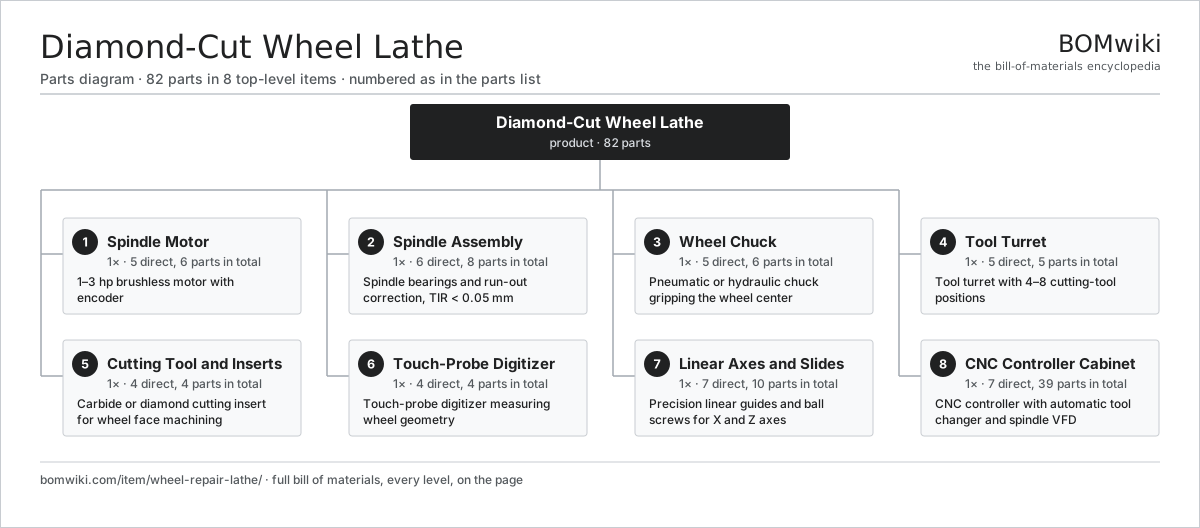
| # | Part | Qty | What it does |
|---|---|---|---|
| 1 | Spindle Motor 5 parts | 1× | 1–3 hp brushless motor with encoder |
| 2 | Spindle Assembly 6 parts | 1× | Spindle bearings and run-out correction, TIR < 0.05 mm |
| 3 | Wheel Chuck 5 parts | 1× | Pneumatic or hydraulic chuck gripping the wheel center |
| 4 | Tool Turret 5 parts | 1× | Tool turret with 4–8 cutting-tool positions |
| 5 | Cutting Tool and Inserts 4 parts | 1× | Carbide or diamond cutting insert for wheel face machining |
| 6 | Touch-Probe Digitizer 4 parts | 1× | Touch-probe digitizer measuring wheel geometry |
| 7 | Linear Axes and Slides 7 parts | 1× | Precision linear guides and ball screws for X and Z axes |
| 8 | CNC Controller Cabinet 7 parts | 1× | CNC controller with automatic tool changer and spindle VFD |
3D model
No 3D model yet. Have a CAD file of this? Add a 3D model. STL renders right on this page; STEP, FreeCAD, and OpenSCAD sources are welcome too (openly licensed, like all 3D models on BOMwiki).
Build & assembly graph
expand / collapse · shared sub-assemblies converge · links to related products · est. labourTap an assembly to expand/collapse · tap a part to open it · use “Open page” for any node · drag to pan, scroll to zoom.
Bill of materials for Diamond-Cut Wheel Lathe
8 top-level lines · 51 rows shown · 82 parts total · indented to 3 levels| # | Item / sub-assembly | Part no. | Qty/assy | Ext. qty | Parts | Type |
|---|---|---|---|---|---|---|
| 1 | Spindle Motor 5 parts | wrl-spindle-motor | 1× | 1 | 6 | assembly |
| 1.1 | Brushless Motor | wrl-motor-brushless | 1× | 1 | · | part |
| 1.2 | Motor Encoder | wrl-motor-encoder | 1× | 1 | · | part |
| 1.3 | VFD | wrl-vfd-drive | 1× | 1 | · | part |
| 1.4 | Motor Coupling | wrl-motor-coupling | 1× | 1 | · | part |
| 1.5 | Ball Bearing | ball-bearing | 2× | 2 | · | part |
| 2 | Spindle Assembly 6 parts | wrl-spindle-assembly | 1× | 1 | 8 | assembly |
| 2.1 | Spindle Shaft | wrl-spindle-shaft | 1× | 1 | · | part |
| 2.2 | Spindle Bearing | wrl-spindle-bearings | 2× | 2 | · | part |
| 2.3 | Preload Adjuster | wrl-preload-adjuster | 1× | 1 | · | part |
| 2.4 | Spindle Housing | wrl-spindle-housing | 1× | 1 | · | part |
| 2.5 | Wrl Runout Correction | wheel-repair-lathe-wrl-runout-correction | 1× | 1 | · | part |
| 2.6 | Ball Bearing | ball-bearing | 2× | 2 | · | part |
| 3 | Wheel Chuck 5 parts | wrl-wheel-chuck | 1× | 1 | 6 | assembly |
| 3.1 | Chuck Body | wrl-chuck-body | 1× | 1 | · | part |
| 3.2 | Chuck Jaws | wrl-chuck-jaws | 2× | 2 | · | part |
| 3.3 | Clamp Cylinder | wrl-pneumatic-cylinder | 1× | 1 | · | part |
| 3.4 | Wrl Chuck Pressure Gauge | wheel-repair-lathe-wrl-chuck-pressure-gauge | 1× | 1 | · | part |
| 3.5 | Jaw Adapter | wrl-jaw-adapter | 1× | 1 | · | part |
| 4 | Tool Turret 5 parts | wrl-turret-assembly | 1× | 1 | 5 | assembly |
| 4.1 | Turret Body | wrl-turret-body | 1× | 1 | · | part |
| 4.2 | Turret Motor | wrl-turret-motor | 1× | 1 | · | part |
| 4.3 | Tool Holder | wrl-tool-holders | 1× | 1 | · | part |
| 4.4 | Turret Encoder | wrl-turret-encoder | 1× | 1 | · | part |
| 4.5 | Wrl Tool Changer Arm | wheel-repair-lathe-wrl-tool-changer-arm | 1× | 1 | · | part |
| 5 | Cutting Tool and Inserts 4 parts | wrl-cutting-tool | 1× | 1 | 4 | assembly |
| 5.1 | Carbide Insert | wrl-insert-carbide | 1× | 1 | · | part |
| 5.2 | Diamond Insert | wrl-insert-diamond | 1× | 1 | · | part |
| 5.3 | Insert Holder | wrl-insert-holder | 1× | 1 | · | part |
| 5.4 | Coolant Supply | wrl-tool-coolant | 1× | 1 | · | part |
| 6 | Touch-Probe Digitizer 4 parts | wrl-probe-arm | 1× | 1 | 4 | assembly |
| 6.1 | Probe Tip | wrl-probe-ruby-tip | 1× | 1 | · | part |
| 6.2 | Probe Arm | wrl-probe-cantilever | 1× | 1 | · | part |
| 6.3 | Contact Switch | wrl-probe-switch | 1× | 1 | · | part |
| 6.4 | Probe Bracket | wrl-probe-bracket | 1× | 1 | · | part |
| 7 | Linear Axes and Slides 7 parts | wrl-lathe-slides | 1× | 1 | 10 | assembly |
| 7.1 | X-Axis Rail | wrl-xaxis-rail | 1× | 1 | · | part |
| 7.2 | X-Axis Screw | wrl-xaxis-screw | 1× | 1 | · | part |
| 7.3 | X-Axis Motor | wrl-xaxis-motor | 1× | 1 | · | part |
| 7.4 | Z-Axis Rail | wrl-zaxis-rail | 1× | 1 | · | part |
| 7.5 | Z-Axis Screw | wrl-zaxis-screw | 1× | 1 | · | part |
| 7.6 | Z-Axis Motor | wrl-zaxis-motor | 1× | 1 | · | part |
| 7.7 | Ball Bearing | ball-bearing | 4× | 4 | · | part |
| 8 | CNC Controller Cabinet 7 parts | wrl-controller-cabinet | 1× | 1 | 39 | assembly |
| 8.1 | Control PC | wrl-control-pc | 1× | 1 | · | part |
| 8.2 | Stepper Driver | wrl-stepper-driver | 3× | 3 | · | part |
| 8.3 | VFD Cabinet | wrl-vfd-cabinet | 1× | 1 | · | part |
| 8.4 | Touchscreen | wrl-touchscreen-hmi | 1× | 1 | · | part |
| 8.5 | Solenoid Valve | wrl-pneumatic-valve | 1× | 1 | · | part |
| 8.6 | SMD Passive (R/C/L) | smd-passives | 30× | 30 | · | part |
| 8.7 | Relay | relay | 2× | 2 | · | part |
Something wrong in this list? Report a problem with this BOM.
Related products
same domain, ranked by shared parts Undercoating Sprayer
59 parts · shares 2 with this page
Two-Post Vehicle Lift
44 parts · shares 1 with this page
Undercoating Sprayer
59 parts · shares 2 with this page
Two-Post Vehicle Lift
44 parts · shares 1 with this page
 Paint Thickness Gauge
88 parts · shares 1 with this page
Paint Thickness Gauge
88 parts · shares 1 with this page
Sourcing: possible vendors
Browse the supplier directory → Prices, MOQ, and lead times are algorithmic estimates, not quotes, and not claims about these companies. Company mappings are curated by keyword; est. price band $10–$400. How estimates work| Vendor | HQ | Specialty | MOQ | Lead time |
|---|
1,044-word article