Window Vacuum
ProductOverview
A window vacuum solves the last step of window cleaning: getting the dirty water off the glass. A manual squeegee strips the film but sheds it down the pane and onto the sill; this tool vacuums the stripped liquid into a sealed tank as the blade wipes, leaving no drips and no towelling. The format was established by Kärcher's WV series in 2008 and the architecture has barely changed since: a pistol-grip handheld of about 0.6 kg with a wide Squeegee Suction Head, a small Suction Motor Unit, a 100 ml Dirty-Water Tank, and a single lithium-ion cell in the handle.
Washing itself still happens manually. The kit's separate Spray Applicator, a 250 ml Spray Bottle with a Trigger Pump and a Microfibre Pad on a Pad Frame, sprays diluted solution and scrubs the dirt loose. The vacuum then does the recovery pass.
How it works
The working edge is the 280 mm silicone Squeegee Blade, held at a constant attack angle by the Blade Carrier. Drawn down the pane, the blade strips the liquid film exactly as a manual squeegee does. Immediately behind the lip, the full-width Suction Slot sits in the airflow generated by the motor; the stripped water has nowhere to go but into the slot, entrained in air moving fast enough to carry droplets upward even when the tool works overhead. Two Head Latch clips swap the standard head for a 170 mm one for glazing bars and shower panels.
Inside, the DC Suction Motor, a brushed 3.7 V unit drawing about 10 W, spins the Suction Impeller to create the suction. Ten watts sounds trivial next to a floor vacuum's kilowatt, but the tool only lifts a thin water film through a short path, so the duty is mild and the runtime long: about 35 minutes, or 105 m² of glass, per charge.
The critical engineering is keeping that water away from the electronics. Air and water enter the Dirty-Water Tank together, where the Air-Water Separator baffle spins the mixture so droplets coalesce on the tank wall and drain down while only air continues to the impeller. The Motor Seal backs this up at the motor boundary, and the Anti-Spill Valve holds the contents in when the tool is tilted, laid flat, or worked upside down on a skylight. The translucent Tank Shell holds 100 ml, roughly 35 m² of windows, and empties through the Drain Plug or by unclipping the tank over a sink.
Power and electronics
The handle houses a single Li-ion Cell, 18650 cell with a BMS Board providing over-discharge and short-circuit protection, charged through a Charge Port at 5 V over USB-C in about 165 minutes. The Control Electronics board is minimal: an Microcontroller supervising the cell, one Power MOSFET switching the motor, and a two-colour LED Indicator for run, charge, and low-battery states. There is one control, the Power Switch slide on the handle spine.
Technique and use
The tool works best top-down in overlapping vertical strokes with the blade flat to the glass; the suction recovers the edge bead that manual squeegee work has to chase with a cloth. Besides windows it handles any smooth wet surface, shower screens, tiles, mirrors, car glass, and doubles as a condensation collector on single-glazed windows in winter, where a morning pass recovers the overnight condensate before it reaches the frame.
Maintenance
The silicone blade is the only consumable, replaced when its edge nicks or streaks appear, typically once or twice a season. The tank and separator rinse under a tap; the microfibre pad is machine washable. The cell is sized for several hundred charge cycles, and on most current models the tank, blade, and pad are sold as standard spares so the tool outlives all three.
Window Vacuum parts and their functions
7 top-level parts · 32 parts in total · full bill of materials below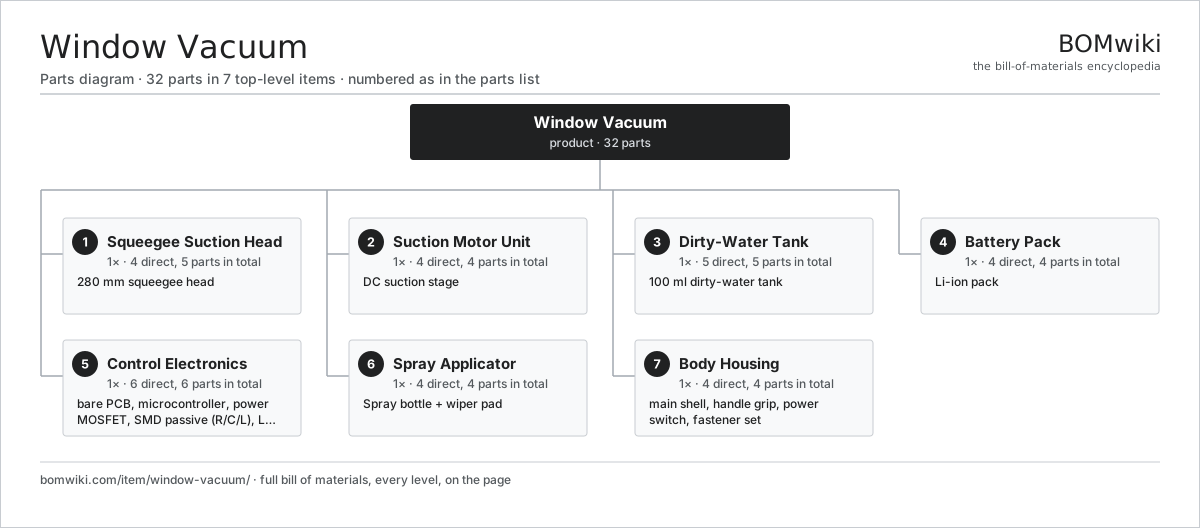
| # | Part | Qty | What it does |
|---|---|---|---|
| 1 | Squeegee Suction Head 4 parts | 1× | 280 mm squeegee head |
| 2 | Suction Motor Unit 4 parts | 1× | DC suction stage |
| 3 | Dirty-Water Tank 5 parts | 1× | 100 ml dirty-water tank |
| 4 | Battery Pack 4 parts | 1× | Li-ion pack |
| 5 | Control Electronics 6 parts | 1× | Small board that switches the motor, supervises the cell, and drives the charge-state LED. |
| 6 | Spray Applicator 4 parts | 1× | Spray bottle + wiper pad |
| 7 | Body Housing 4 parts | 1× | Pistol-grip body shell, about 0.6 kg complete, sized for one-handed overhead work. |
3D model
No 3D model yet. Have a CAD file of this? Add a 3D model. STL renders right on this page; STEP, FreeCAD, and OpenSCAD sources are welcome too (openly licensed, like all 3D models on BOMwiki).
Build & assembly graph
expand / collapse · shared sub-assemblies converge · links to related products · est. labourTap an assembly to expand/collapse · tap a part to open it · use “Open page” for any node · drag to pan, scroll to zoom.
Bill of materials for Window Vacuum
7 top-level lines · 38 rows shown · 32 parts total · indented to 3 levels| # | Item / sub-assembly | Part no. | Qty/assy | Ext. qty | Parts | Type |
|---|---|---|---|---|---|---|
| 1 | Squeegee Suction Head 4 parts | window-vacuum-suction-head | 1× | 1 | 5 | assembly |
| 1.1 | Squeegee Blade | window-vacuum-squeegee-blade | 1× | 1 | · | part |
| 1.2 | Suction Slot | window-vacuum-suction-slot | 1× | 1 | · | part |
| 1.3 | Head Latch | window-vacuum-head-latch | 2× | 2 | · | part |
| 1.4 | Blade Carrier | window-vacuum-blade-carrier | 1× | 1 | · | part |
| 2 | Suction Motor Unit 4 parts | window-vacuum-motor-unit | 1× | 1 | 4 | assembly |
| 2.1 | DC Suction Motor | window-vacuum-dc-motor | 1× | 1 | · | part |
| 2.2 | Suction Impeller | window-vacuum-impeller | 1× | 1 | · | part |
| 2.3 | Motor Seal | window-vacuum-motor-seal | 1× | 1 | · | part |
| 2.4 | Ball Bearing | ball-bearing | 1× | 1 | · | part |
| 3 | Dirty-Water Tank 5 parts | window-vacuum-tank | 1× | 1 | 5 | assembly |
| 3.1 | Tank Shell | window-vacuum-tank-shell | 1× | 1 | · | part |
| 3.2 | Air-Water Separator | window-vacuum-separator | 1× | 1 | · | part |
| 3.3 | Anti-Spill Valve | window-vacuum-tank-valve | 1× | 1 | · | part |
| 3.4 | Drain Plug | window-vacuum-drain-plug | 1× | 1 | · | part |
| 3.5 | O-Ring Set | oring-set | 1× | 1 | · | part |
| 4 | Battery Pack 4 parts | window-vacuum-battery | 1× | 1 | 4 | assembly |
| 4.1 | Li-ion Cell, 18650 | li-cell-18650 | 1× | 1 | · | part |
| 4.2 | BMS Board | bms-board | 1× | 1 | · | part |
| 4.3 | Charge Port | window-vacuum-charge-port | 1× | 1 | · | part |
| 4.4 | Battery Holder | window-vacuum-battery-holder | 1× | 1 | · | part |
| 5 | Control Electronics 6 parts | window-vacuum-electronics | 1× | 1 | 6 | assembly |
| 5.1 | Bare PCB | pcb-bare | 1× | 1 | · | part |
| 5.2 | Microcontroller | mcu | 1× | 1 | · | part |
| 5.3 | Power MOSFET | mosfet | 1× | 1 | · | part |
| 5.4 | SMD Passive (R/C/L) | smd-passives | 1× | 1 | · | part |
| 5.5 | LED Indicator | window-vacuum-led-indicator | 1× | 1 | · | part |
| 5.6 | Wire Bundle | wire-bundle | 1× | 1 | · | part |
| 6 | Spray Applicator 4 parts | window-vacuum-spray-applicator | 1× | 1 | 4 | assembly |
| 6.1 | Spray Bottle | window-vacuum-spray-bottle | 1× | 1 | · | part |
| 6.2 | Trigger Pump | window-vacuum-trigger-pump | 1× | 1 | · | part |
| 6.3 | Microfibre Pad | window-vacuum-microfibre-pad | 1× | 1 | · | part |
| 6.4 | Pad Frame | window-vacuum-pad-frame | 1× | 1 | · | part |
| 7 | Body Housing 4 parts | window-vacuum-housing | 1× | 1 | 4 | assembly |
| 7.1 | Main Shell | window-vacuum-main-shell | 1× | 1 | · | part |
| 7.2 | Handle Grip | window-vacuum-handle-grip | 1× | 1 | · | part |
| 7.3 | Power Switch | window-vacuum-power-switch | 1× | 1 | · | part |
| 7.4 | Fastener Set | fastener-set | 1× | 1 | · | part |
Something wrong in this list? Report a problem with this BOM.
Related products
same domain, ranked by shared parts Floor Scrubber
279 parts · shares 7 with this page
Floor Scrubber
279 parts · shares 7 with this page
 Robotic Vacuum
244 parts · shares 5 with this page
Robotic Vacuum
244 parts · shares 5 with this page
 Cordless Stick Vacuum
180 parts · shares 7 with this page
Cordless Stick Vacuum
180 parts · shares 7 with this page
 Robotic Mop
179 parts · shares 6 with this page
Ride-On Industrial Sweeper
179 parts · shares 6 with this page
Robotic Mop
179 parts · shares 6 with this page
Ride-On Industrial Sweeper
179 parts · shares 6 with this page
Sourcing: possible vendors
Browse the supplier directory → Prices, MOQ, and lead times are algorithmic estimates, not quotes, and not claims about these companies. Company mappings are curated by keyword; est. price band $50–$1.5k. How estimates work| Vendor | HQ | Specialty | MOQ | Lead time |
|---|---|---|---|---|
| sharkninja.com ↗ | Needham, US | Floorcare & kitchen | 1,000 units | 8–12 wks |
|
🇬🇧Dyson
dyson.com ↗
|
Malmesbury, GB | Vacuums & hair care | 1,000 units | 8–12 wks |
|
🇺🇸Bissell
bissell.com ↗
|
Grand Rapids, US | Floorcare | 1,000 units | 8–12 wks |
|
🇺🇸iRobot
irobot.com ↗
|
Bedford, US | Robot vacuums | 1,000 units | 8–12 wks |
|
🇩🇪Kärcher
karcher.com ↗
|
Winnenden, DE | Cleaning equipment | 1,000 units | 8–12 wks |
680-word article