Windrow Compost Turner
ProductOverview
A windrow compost turner is a self-propelled machine that aerates and mixes large elongated piles of decomposing organic material. The machine straddles the windrow (an extended heap of wood chips, yard waste, food scraps, or manure) and uses a rotating horizontal drum with internal flailing elements to lift, mix, and redistribute material, introducing oxygen necessary for aerobic decomposition. Turning also homogenizes temperature variation within the pile and redistributes heat-loving microbes.
Windrow composting is the primary method used by municipalities and large commercial composting facilities to process tons of material daily. By mechanically turning windrows every 3–5 days, facilities accelerate decomposition (reducing time from 6 months to 6–12 weeks) and improve final compost quality. A single turner can process 400–600 cubic meters per hour and turn multiple windrows in a shift.
How it works
Machine Overview and Operation
The windrow compost turner is an articulated piece of heavy mobile equipment. The operator sits in a climate-controlled enclosed cab with all-around visibility, controls, and lighting. The cab is mounted on a ROPS-rated (rollover-protective structure) frame that straddles the windrow like an inverted U.
The machine is powered by an 85 kW diesel engine (six-cylinder turbocharged, 2000 rpm). The engine drives a variable displacement vane pump that supplies pressurized fluid to the entire machine.
Propulsion System
Four independent hydraulic wheel motors (45 cc/rev each) drive the pneumatic tires (520/85 R42 agricultural tires, 40 psi pressure, 40 mph rated). Each motor receives flow from a solenoid directional valve, allowing forward, neutral, or reverse control.
A proportional flow-divider maintains synchronized flow to left and right wheel motors, ensuring straight-line travel and preventing differential turning unless the operator commands it. The operator uses a joystick to issue proportional travel commands; the system responds smoothly without jerky motion.
Hydraulic disk brakes (330 mm diameter, hydraulic calipers) provide fail-safe braking via spring-applied force and hydraulic release.
Turning Drum and Mixing
At the center top of the straddle frame sits the primary turning drum assembly. The drum is 1200 mm in diameter and 1800 mm wide (spanning the width of the windrow). Internally, 12 hardened manganese-steel swing flails are attached to the drum body; they rotate with the drum and impact material as they swing.
The drum is driven by a fixed-displacement hydraulic piston motor (45 cc/rev, 3000 rpm max speed) coupled through a reduction gearbox (8:1 ratio) that outputs approximately 100 rpm drum speed. The operator controls drum speed proportionally using a second joystick lever; the proportional valve adjusts motor flow, varying drum speed from idle (20 rpm) to full speed (100+ rpm) depending on material texture.
As the operator drives the machine forward over a windrow, the rotating drum lifts material upward via the flailing action. Material tumbles out the top and rear of the drum, landing back on the ground approximately 1–2 meters behind the machine, creating a newly turned pile. Simultaneously, fresh material at ground level is drawn into the drum from the front, lifted, and ejected. Two fixed counter blades (stainless-steel cutting edges) positioned opposite the drum rotation shear bulky material, breaking up clumps and accelerating decomposition.
Aeration Benefit
The turning action achieves two critical goals:
- Oxygen introduction: As material is lifted and falls, it is exposed to air, introducing dissolved oxygen critical for aerobic microbes.
- Temperature homogenization: The center of a large windrow can reach 60–65 °C while edges stay cooler; turning distributes heat and populations of thermophilic (heat-loving) bacteria throughout.
Hydraulic Power System
The variable pump (65 cc/rev, load-sensing compensator) consumes 85 kW from the diesel engine. Under load (turning operation), the pump delivers full displacement at 2000 rpm engine speed, producing approximately 130 liters/minute at 280 bar. Under idle or low-demand conditions, the pump displacement automatically reduces via compensator, saving fuel and heat generation.
The NG25 manifold block integrates:
- The two 4/3 directional valves for left/right propulsion control.
- The proportional flow-divider maintaining wheel sync.
- Two relief valves (280 bar setting each) protecting the propulsion circuit and drum circuit separately.
- A spring-applied hydraulic-release brake preventing unintended machine creep when idling.
The 5 L accumulator (nitrile bladder, 280 bar rated) stores energy during lower-demand periods and supplies a reserve for brief peak flows (e.g., sudden heavy material encounter during turning).
All return flow, internal leakage, and case drains return to the 400 L reservoir where a integral return-filter (25 micron) protects the system from wear particles. The tank has baffle separators reducing turbulence and settling fines, ensuring clean supply to the pump suction inlet.
Operator Interface and Comfort
The enclosed cab is mounted on ROPS structure (meeting safety standard ISO 3471) to protect the operator in case of tip-over. The cab includes:
- Laminated safety glass (heated and wipered) providing 180° visibility.
- An adjustable vinyl suspension seat with three-point seatbelt.
- Dual LED work lights (400 lux each) for visibility during low-light turning operations.
- Proportional joystick levers for intuitive travel and drum-speed command.
- Engine gauges (RPM, fuel level, water temperature) visible from the seat.
The cab is sealed and weather-tight, allowing operation in rain or extreme heat (composting generates steam in humid conditions).
Safety and Environmental
A safety enclosure surrounds the drum with perforated steel guards preventing operator contact with rotating flails. Hinged access doors allow periodic maintenance; each door is interlocked with safety-rated switches that immediately halt the drum motor if the door opens. A backup warning horn (97 dB) alerts nearby workers when the machine reverses.
The diesel engine is equipped with a muffler assembly reducing exhaust noise to <85 dB@1 meter, meeting typical municipal noise ordinances.
Maintenance Schedule
Daily: Check the fuel level before starting. Visually inspect the tires for punctures or bulges; composting material can contain sharp metal fragments. Test the backup horn and work lights. Verify drum bearing temperature (should be <50 °C); if exceeding 60 °C, shut down and check bearing grease.
Weekly: Drain condensation from the hydraulic tank by opening the manual drain valve for 10 s. Inspect all hydraulic hoses for leaks or abrasion; replace any hose showing cracks or missing cover. Check the windshield wipers and ensure wiper fluid is topped up. Drain any fuel-water from the fuel-water separator.
Monthly: Change the engine air filter (or check if clogged with compost dust). Inspect the flail bars for wear; if worn down >5 mm from original dimension, replace the set (flail replacement is a common wear item). Check all frame fasteners for looseness, especially drum-bearing pedestals. Clean the cabin windows and lights of mineral deposits from composting aerosols.
Quarterly: Change the hydraulic return-filter element. Grease all wheel hub and drum bearing zerk fittings if present (use #2 NLGI multipurpose grease). Inspect the brake disks for wear (pad thickness should be >3 mm); replace pads if thinner. Test the flow-divider response by driving forward in a slight arc; wheels should maintain sync within ±10 mm lateral deviation.
Annually: Perform a complete hydraulic fluid flush and fill. Change the engine oil and filter (typically 10 L oil capacity). Have the engine compression tested; values should be within 10% of manufacturer specification. Inspect the ROPS frame for cracks (critical for operator safety); any cracks require structural repair or frame replacement. Recalibrate the proportional joystick if response becomes sluggish or jerky (proportional valve solenoids can accumulate debris).
Composting Process Timeline
Days 0–3: Fresh windrow assembled (typically 2–4 meters tall, 3–4 meters wide at base). Initial thermophilic (heat-loving) bacteria colonize the pile; temperature rises rapidly to 55–65 °C.
Days 3–5: First turn. The turner processes the entire windrow, mixing material, introducing oxygen, and redistributing heat. Temperature spikes to peak 70–75 °C post-turn.
Days 5–10: Cooling phase. As readily available carbon is depleted, thermophilic activity decreases. Temperature drops to 45–55 °C.
Days 10–14: Second turn. Fresh material (if being added incrementally) is mixed in. Mesophilic (moderate-temperature) bacteria become dominant.
Days 14–28: Final turning phase. Additional turns every 5–7 days, with declining temperature drop after each turn. By day 28, temperature stabilizes at 30–40 °C, approaching ambient.
Days 28–42: Maturation phase. Material begins to darken and develop earthy odor. No further turning required; pile is left to stabilize.
Day 42+: Finished compost. Material is dark brown, crumbly, and free of recognizable feedstock. Ready for screening, bagging, and sale.
A well-managed windrow compost operation achieves finished product in 6–8 weeks, enabling a 5-turn-per-year facility to process 50,000+ tonnes/year with a single turner operating 5 days/week.
Environmental and Regulatory
Modern composting facilities must manage:
- Odor: Anaerobic pockets generate volatile fatty acids (rotten-egg smell). Frequent turning via turner maintains aerobic conditions, eliminating odor.
- Leachate: Rainwater percolating through windrows becomes nutrient-rich liquid. Facilities construct concrete pads with collection sumps; the turner is positioned to prevent runoff.
- Emissions: The turning process can release volatile organic compounds (VOCs); modern facilities are designing operator cabs with air filtration to minimize exposure.
Proper turning frequency (every 3–5 days) is the single most important operational lever for controlling these impacts.
Windrow Compost Turner parts and their functions
8 top-level parts · 131 parts in total · full bill of materials below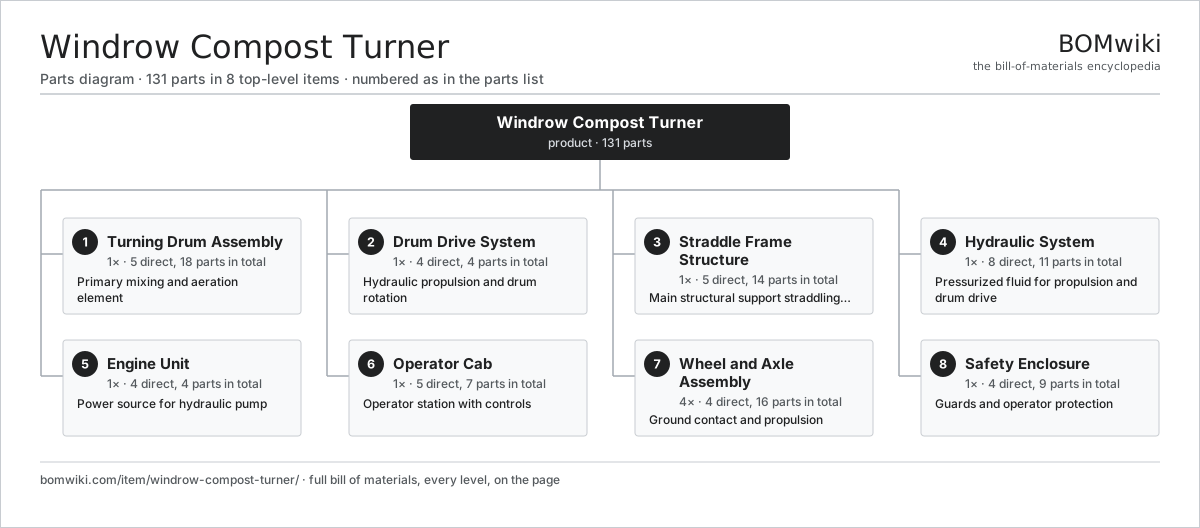
| # | Part | Qty | What it does |
|---|---|---|---|
| 1 | Turning Drum Assembly 5 parts | 1× | Primary mixing and aeration element |
| 2 | Drum Drive System 4 parts | 1× | Hydraulic propulsion and drum rotation |
| 3 | Straddle Frame Structure 5 parts | 1× | Main structural support straddling windrow |
| 4 | Hydraulic System 8 parts | 1× | Pressurized fluid for propulsion and drum drive |
| 5 | Engine Unit 4 parts | 1× | Power source for hydraulic pump |
| 6 | Operator Cab 5 parts | 1× | Operator station with controls |
| 7 | Wheel and Axle Assembly 4 parts | 4× | Ground contact and propulsion |
| 8 | Safety Enclosure 4 parts | 1× | Guards and operator protection |
3D model
No 3D model yet. Have a CAD file of this? Add a 3D model. STL renders right on this page; STEP, FreeCAD, and OpenSCAD sources are welcome too (openly licensed, like all 3D models on BOMwiki).
Build & assembly graph
expand / collapse · shared sub-assemblies converge · links to related products · est. labourTap an assembly to expand/collapse · tap a part to open it · use “Open page” for any node · drag to pan, scroll to zoom.
Bill of materials for Windrow Compost Turner
8 top-level lines · 47 rows shown · 131 parts total · indented to 3 levels| # | Item / sub-assembly | Part no. | Qty/assy | Ext. qty | Parts | Type |
|---|---|---|---|---|---|---|
| 1 | Turning Drum Assembly 5 parts | windrow-compost-turner-turning-drum | 1× | 1 | 18 | assembly |
| 1.1 | Drum Cylinder | windrow-compost-turner-drum-body | 1× | 1 | · | part |
| 1.2 | Flail Element | windrow-compost-turner-flail-bar | 12× | 12 | · | part |
| 1.3 | Drum Bearing | windrow-compost-turner-drum-bearing | 2× | 2 | · | part |
| 1.4 | Drum Shaft | windrow-compost-turner-drum-shaft | 1× | 1 | · | part |
| 1.5 | Counter Blade | windrow-compost-turner-counter-blade | 2× | 2 | · | part |
| 2 | Drum Drive System 4 parts | windrow-compost-turner-drive-system | 1× | 1 | 4 | assembly |
| 2.1 | Hydraulic Motor | windrow-compost-turner-hydraulic-motor | 1× | 1 | · | part |
| 2.2 | Drive Gearbox | windrow-compost-turner-drive-gearbox | 1× | 1 | · | part |
| 2.3 | Motor Coupling | windrow-compost-turner-motor-coupling | 1× | 1 | · | part |
| 2.4 | Spring-Applied Brake | windrow-compost-turner-brake-assembly | 1× | 1 | · | part |
| 3 | Straddle Frame Structure 5 parts | windrow-compost-turner-straddle-frame | 1× | 1 | 14 | assembly |
| 3.1 | Frame Beam | windrow-compost-turner-frame-beam | 4× | 4 | · | part |
| 3.2 | Drum Pedestal | windrow-compost-turner-drum-mount | 2× | 2 | · | part |
| 3.3 | Diagonal Bracing | windrow-compost-turner-frame-bracing | 2× | 2 | · | part |
| 3.4 | Sheet Metal Panel | sheet-panel | 3× | 3 | · | part |
| 3.5 | Fastener Set | fastener-set | 3× | 3 | · | part |
| 4 | Hydraulic System 8 parts | windrow-compost-turner-hydraulic-system | 1× | 1 | 11 | assembly |
| 4.1 | Variable Pump | windrow-compost-turner-hydraulic-pump | 1× | 1 | · | part |
| 4.2 | Directional Valve | windrow-compost-turner-directional-valve | 2× | 2 | · | part |
| 4.3 | Flow Divider | windrow-compost-turner-flow-control | 1× | 1 | · | part |
| 4.4 | Relief Valve | windrow-compost-turner-pressure-relief | 2× | 2 | · | part |
| 4.5 | Accumulator | windrow-compost-turner-accumulator | 1× | 1 | · | part |
| 4.6 | Manifold Block | windrow-compost-turner-manifold | 1× | 1 | · | part |
| 4.7 | Hydraulic Tank | windrow-compost-turner-reservoir | 1× | 1 | · | part |
| 4.8 | Pressure Sensor | pressure-sensor | 2× | 2 | · | part |
| 5 | Engine Unit 4 parts | windrow-compost-turner-engine | 1× | 1 | 4 | assembly |
| 5.1 | Diesel Engine | windrow-compost-turner-diesel-engine | 1× | 1 | · | part |
| 5.2 | Air Filter | windrow-compost-turner-air-filter | 1× | 1 | · | part |
| 5.3 | Fuel Tank | windrow-compost-turner-fuel-tank | 1× | 1 | · | part |
| 5.4 | Muffler Assembly | windrow-compost-turner-engine-silencer | 1× | 1 | · | part |
| 6 | Operator Cab 5 parts | windrow-compost-turner-cab | 1× | 1 | 7 | assembly |
| 6.1 | Cabin Structure | windrow-compost-turner-cabin-frame | 1× | 1 | · | part |
| 6.2 | Operator Seat | windrow-compost-turner-cabin-seat | 1× | 1 | · | part |
| 6.3 | Cabin Window | windrow-compost-turner-cabin-windshield | 2× | 2 | · | part |
| 6.4 | Control Console | windrow-compost-turner-control-console | 1× | 1 | · | part |
| 6.5 | Work Light | windrow-compost-turner-cabin-light | 2× | 2 | · | part |
| 7 | Wheel and Axle Assembly 4 parts | windrow-compost-turner-wheels | 4× | 4 | 16 | assembly |
| 7.1 | Wheel Motor | windrow-compost-turner-axle-motor | 4× | 16 | · | part |
| 7.2 | Pneumatic Tire | windrow-compost-turner-tire | 4× | 16 | · | part |
| 7.3 | Wheel Hub | windrow-compost-turner-wheel-hub | 4× | 16 | · | part |
| 7.4 | Brake Disk | windrow-compost-turner-brake-disk | 4× | 16 | · | part |
| 8 | Safety Enclosure 4 parts | windrow-compost-turner-safety-system | 1× | 1 | 9 | assembly |
| 8.1 | Sheet Metal Panel | sheet-panel | 4× | 4 | · | part |
| 8.2 | Access Guard Door | windrow-compost-turner-guard-door | 2× | 2 | · | part |
| 8.3 | Interlock Switch | windrow-compost-turner-interlock-switch | 2× | 2 | · | part |
| 8.4 | Backup Warning Horn | windrow-compost-turner-horn | 1× | 1 | · | part |
Something wrong in this list? Report a problem with this BOM.
Related products
same domain, ranked by shared parts Candle Making Machine
73 parts · shares 2 with this page
Coil Coating Line
1,767 parts · shares 2 with this page
Candle Making Machine
73 parts · shares 2 with this page
Coil Coating Line
1,767 parts · shares 2 with this page
 Continuous Galvanizing Line
1,296 parts · shares 2 with this page
Continuous Galvanizing Line
1,296 parts · shares 2 with this page
Sourcing: possible vendors
Browse the supplier directory → Prices, MOQ, and lead times are algorithmic estimates, not quotes, and not claims about these companies. Company mappings are curated by keyword; est. price band $5k–$2M. How estimates work| Vendor | HQ | Specialty | MOQ | Lead time |
|---|---|---|---|---|
| atlascopco.com ↗ | Stockholm, SE | Compressors & industrial | 10 units | 12–20 wks |
|
🇦🇹Andritz
andritz.com ↗
|
Graz, AT | Process plants & machinery | 10 units | 12–20 wks |
| buhlergroup.com ↗ | Uzwil, CH | Food & materials processing | 10 units | 12–20 wks |
| gea.com ↗ | Düsseldorf, DE | Process technology | 10 units | 12–20 wks |
| mhi.com ↗ | Tokyo, JP | Heavy machinery | 10 units | 12–20 wks |
1,814-word article