Windsurf Board
ProductOverview
A windsurf board is a small sailing platform combining a buoyant Board Core, fibreglass Shell Laminate and a Mast Track that allows the sailor to reposition a sail boom laterally and fore-aft. The sailor stands on the Deck Surface, controlling a Daggerboard for upwind sailing and Footstrap System to stay connected in waves and strong wind. A Fin Box accepts interchangeable fins for directional control.
Windsurfing is fundamentally different from traditional sailing: there is no fixed rudder and no sitting down. The sailor's weight and position shift the board's balance fore-aft and side-to-side, performing all directional and speed control functions. A skilled windsurfer can generate propulsive power in as little as 7 knots of wind and can control a 6 m² sail in 20+ knot gusts by shifting weight and depowering the sail.
The board itself is entirely unpowered; the wind energy captured by the sail is the only source of thrust.
Board design and flotation
The Board Core is typically closed-cell expanded polystyrene (EPS) or polyurethane (PU) foam, shaped to a tapered profile narrower at the nose and tail. The foam provides buoyancy (65–130 litres depending on size) and is light (5–9 kg total board weight). The core is reinforced by embedded Stringers, wood or carbon strips running the length, and concentrated Internal Reinforcement around high-stress areas like the mast track and fin box.
The Shell Laminate encases the foam in upper (deck) and lower (bottom) fibreglass or carbon/fibreglass plies infused with epoxy. The Deck Surface is textured with grip material or embossed texture, allowing the sailor to stand barefoot and pivot. The Bottom Laminate is usually slightly thicker for impact resistance during beach launches and shallow-water riding.
The Concave Shaping of the deck forms a natural foot pocket amidships, giving the sailor a comfortable stance. Wider boards (70+ cm) are more stable and float larger sailors; narrower boards (55–65 cm) are lighter and more manoeuvrable for advanced sailors.
Mast track
The Mast Track is the defining feature distinguishing a windsurf board from other small craft. It is a linear slot running the length of the board (typically 70–90 cm, most of it positioned forward of the middle). The Track Groove is precision-machined aluminium or UHMWPE plastic. A Base Plate slides along the track via a Track Car (sealed ball bearing), holding the boom-jaw that grips the boom. By pushing or pulling the base plate, the sailor moves the sail's effort centre fore-aft, trimming the board's pitch. Moving the base plate laterally (sideways) along the track angles the mast and sail side-to-side for better balance in gusty wind.
The track Track Plug at either end prevents the base-plate from falling off. The entire track is Track Bolt bolted to the deck through the foam, requiring carefully positioned reinforcement to avoid water ingress.
Fin box and daggerboard
The Fin Box is a moulded plastic Box Housing embedded in the board bottom, typically near the stern. Modern fin boxes accept standard interchangeable fins (FCSII or similar quick-release systems) secured by a Fin Screw. The Fin Slot is lined with UHMWPE plastic for smooth gliding and durability. A Box Top Plate covers the fin opening; a Drag Strap nylon tab allows easy extraction.
Many boards also feature a Daggerboard, a Daggerboard Blade that slides vertically through a Daggerboard Case amidships. The daggerboard provides lateral resistance when sailing upwind in light wind; it is retracted (raised) when riding waves or sailing downwind. A Daggerboard Spring returns the blade to the raised position when released. A Daggerboard Latch holds the blade extended when needed. Wave-specific boards often omit the daggerboard entirely, as wave sailors rarely sail upwind.
Footstraps
The Footstrap System consists of 4 Footstrap loops, typically arranged in pairs (a forward pair and an aft pair). Each is a rigid loop of nylon or composite, fitting over the sailor's instep and toe, anchored to the deck by Strap Mounting Point bolted eyes. The Adjustable Buckle (velcro or snap) allows per-sailor fit: the footstrap is tightened snugly around the foot so that quick release (a forward push of the foot) disengages the sailor instantly if the board capsizes or if the sailor loses balance.
Proper footstrap fit is critical: too loose and the feet slide; too tight and the sailor cannot exit quickly in a fall. Most sailors adjust footstraps for each session based on wind conditions and personal preference.
Deck and hardware
The Grab Handle (one or two recessed or raised grips) allows the sailor to carry the board to and from the water. The Deck Surface includes Foot Pad extra grip patches applied to high-wear areas. Vent Holes (small drilled apertures) allow air to escape if the foam is damaged, preventing pressure buildup and further damage.
The Bumper Strip is adhesive polyurethane foam tape applied to the rails (edges) for protection during storage and transport. Deck Plugs cover unused insert points, and Storage Ring reinforced eyes allow hanging or tie-down.
Sail connection
The mast-track boom-jaw interface is simple but critical. The boom-jaw (part of the Base Plate) has two arms that grip the boom from above and below; a rope or velcro strap tightens the jaw, locking the boom in place. When the sailor wants to reposition the boom (shift the sail forward or aft), they loosen the strap, slide the boom along the track to the desired position, and re-tighten. This requires no tools and takes seconds.
Maintenance and durability
Fibreglass boards last 10–20 years with reasonable care. The main wear mechanisms are UV exposure (the gel coat yellows and cracks), impacts (pressure dings in the foam), and osmotic blistering (in older polyester-resin boards). Modern epoxy-resin boards are much more resistant to blistering. Small pressure dings are cosmetic; cracks exposing the foam require repair (sanding, filling with epoxy putty, and repainting) to prevent water ingress and delamination.
The mast track requires periodic cleaning and lubrication to ensure smooth sliding. Fin-box threads strip over time; replacement fin-box inserts can be glued in without professional repairs. Footstraps fray and eventually need replacement; this is a 5-minute job with a sharp knife and a new strap.
Storage should be in shade (UV protection), without pressure racks (dings), and ideally with the mast track exposed to air to prevent mould in the slots. Winter storage in an unheated garage is fine; the board is waterproof once sealed, so freeze-thaw cycles are not a concern.
Performance and variation
A 90-litre board floats a 70 kg sailor with roughly 20 litres of reserve buoyancy, enough for paddling to the break when waves are small or recovering from a wipeout. Heavier sailors need proportionally larger boards; lighter sailors can ride smaller boards. The board's width and thickness determine primary stability (initial buoyancy and capsizing resistance); length and foil (bottom shape) determine secondary stability (lean and carving response).
Wave boards (narrow, short, thick) prioritize manoeuvrability and response in steep seas. Freestyle boards (wider, thinner) prioritize stability and light-wind performance. Freeride boards split the difference. Boards designed for strong-wind slalom racing are narrow and light; boards for beginners are wide and floaty.
Windsurf Board parts and their functions
8 top-level parts · 67 parts in total · full bill of materials below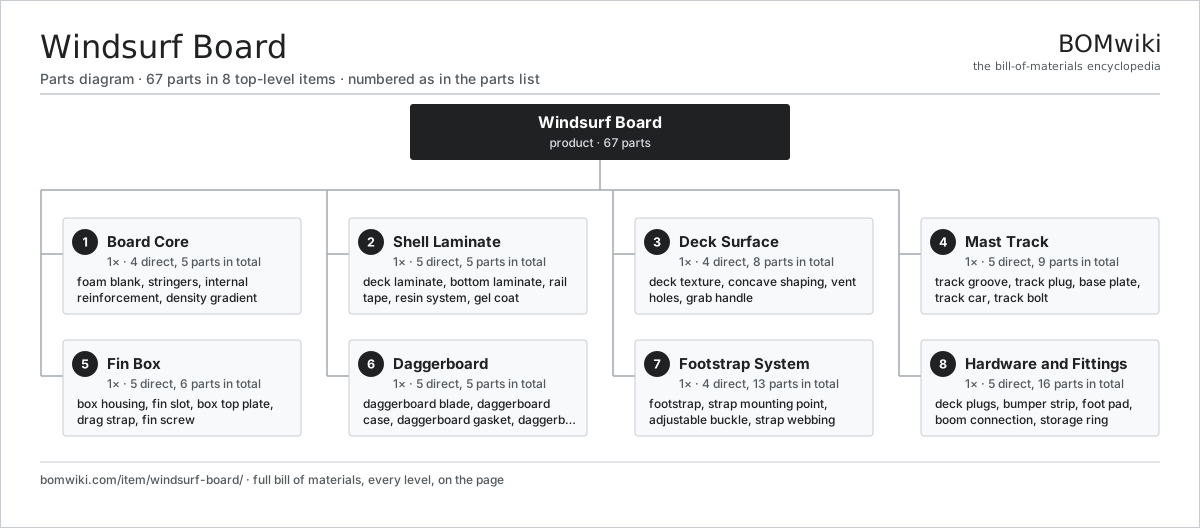
| # | Part | Qty | What it does |
|---|---|---|---|
| 1 | Board Core 4 parts | 1× | Lightweight buoyant material providing flotation and structural strength. |
| 2 | Shell Laminate 5 parts | 1× | Fibreglass or carbon fibre reinforced plastic encasing the core in upper and lower skins. |
| 3 | Deck Surface 4 parts | 1× | Textured grip area and non-slip protection for barefoot standing and maneuvers. |
| 4 | Mast Track 5 parts | 1× | Linear slot and moving boom-jaw baseplate allowing fore-aft and lateral sail positioning. |
| 5 | Fin Box 5 parts | 1× | Slot and baseplate assembly for mounting interchangeable fins. |
| 6 | Daggerboard 5 parts | 1× | Retracting foil board providing lateral resistance in light winds and upwind sailing. |
| 7 | Footstrap System 4 parts | 1× | Multiple adjustable nylon foot loops securing the sailor to the board. |
| 8 | Hardware and Fittings 5 parts | 1× | Deck plugs, UV protection strip and cosmetic hardware. |
3D model
No 3D model yet. Have a CAD file of this? Add a 3D model. STL renders right on this page; STEP, FreeCAD, and OpenSCAD sources are welcome too (openly licensed, like all 3D models on BOMwiki).
Build & assembly graph
expand / collapse · shared sub-assemblies converge · links to related products · est. labourTap an assembly to expand/collapse · tap a part to open it · use “Open page” for any node · drag to pan, scroll to zoom.
Bill of materials for Windsurf Board
8 top-level lines · 45 rows shown · 67 parts total · indented to 3 levels| # | Item / sub-assembly | Part no. | Qty/assy | Ext. qty | Parts | Type |
|---|---|---|---|---|---|---|
| 1 | Board Core 4 parts | windsurf-board-core | 1× | 1 | 5 | assembly |
| 1.1 | Foam Blank | windsurf-board-foam-blank | 1× | 1 | · | part |
| 1.2 | Stringers | windsurf-board-stringers | 2× | 2 | · | part |
| 1.3 | Internal Reinforcement | windsurf-board-internal-reinforcement | 1× | 1 | · | part |
| 1.4 | Density Gradient | windsurf-board-density-gradient | 1× | 1 | · | part |
| 2 | Shell Laminate 5 parts | windsurf-board-shell-laminate | 1× | 1 | 5 | assembly |
| 2.1 | Deck Laminate | windsurf-board-deck-laminate | 1× | 1 | · | part |
| 2.2 | Bottom Laminate | windsurf-board-bottom-laminate | 1× | 1 | · | part |
| 2.3 | Rail Tape | windsurf-board-rail-tape | 1× | 1 | · | part |
| 2.4 | Resin System | windsurf-board-resin-system | 1× | 1 | · | part |
| 2.5 | Gel Coat | windsurf-board-gel-coat | 1× | 1 | · | part |
| 3 | Deck Surface 4 parts | windsurf-board-deck-surface | 1× | 1 | 8 | assembly |
| 3.1 | Deck Texture | windsurf-board-deck-texture | 1× | 1 | · | part |
| 3.2 | Concave Shaping | windsurf-board-concave-shaping | 1× | 1 | · | part |
| 3.3 | Vent Holes | windsurf-board-vent-holes | 4× | 4 | · | part |
| 3.4 | Grab Handle | windsurf-board-grab-handle | 2× | 2 | · | part |
| 4 | Mast Track 5 parts | windsurf-board-mast-track | 1× | 1 | 9 | assembly |
| 4.1 | Track Groove | windsurf-board-track-groove | 1× | 1 | · | part |
| 4.2 | Track Plug | windsurf-board-track-plug | 2× | 2 | · | part |
| 4.3 | Base Plate | windsurf-board-base-plate | 1× | 1 | · | part |
| 4.4 | Track Car | windsurf-board-track-car | 1× | 1 | · | part |
| 4.5 | Track Bolt | windsurf-board-track-bolt | 4× | 4 | · | part |
| 5 | Fin Box 5 parts | windsurf-board-fin-box | 1× | 1 | 6 | assembly |
| 5.1 | Box Housing | windsurf-board-box-housing | 1× | 1 | · | part |
| 5.2 | Fin Slot | windsurf-board-fin-slot | 1× | 1 | · | part |
| 5.3 | Box Top Plate | windsurf-board-box-top-plate | 1× | 1 | · | part |
| 5.4 | Drag Strap | windsurf-board-drag-strap | 1× | 1 | · | part |
| 5.5 | Fin Screw | windsurf-board-fin-screw | 2× | 2 | · | part |
| 6 | Daggerboard 5 parts | windsurf-board-daggerboard | 1× | 1 | 5 | assembly |
| 6.1 | Daggerboard Blade | windsurf-board-daggerboard-blade | 1× | 1 | · | part |
| 6.2 | Daggerboard Case | windsurf-board-daggerboard-case | 1× | 1 | · | part |
| 6.3 | Daggerboard Gasket | windsurf-board-daggerboard-gasket | 1× | 1 | · | part |
| 6.4 | Daggerboard Spring | windsurf-board-daggerboard-spring | 1× | 1 | · | part |
| 6.5 | Daggerboard Latch | windsurf-board-daggerboard-latch | 1× | 1 | · | part |
| 7 | Footstrap System 4 parts | windsurf-board-footstrap-system | 1× | 1 | 13 | assembly |
| 7.1 | Footstrap | windsurf-board-footstrap | 4× | 4 | · | part |
| 7.2 | Strap Mounting Point | windsurf-board-strap-mounting-point | 4× | 4 | · | part |
| 7.3 | Adjustable Buckle | windsurf-board-adjustable-buckle | 4× | 4 | · | part |
| 7.4 | Strap Webbing | windsurf-board-strap-webbing | 1× | 1 | · | part |
| 8 | Hardware and Fittings 5 parts | windsurf-board-hardware | 1× | 1 | 16 | assembly |
| 8.1 | Deck Plugs | windsurf-board-deck-plugs | 8× | 8 | · | part |
| 8.2 | Bumper Strip | windsurf-board-bumper-strip | 1× | 1 | · | part |
| 8.3 | Foot Pad | windsurf-board-foot-pad | 4× | 4 | · | part |
| 8.4 | Boom Connection | windsurf-board-boom-connection | 1× | 1 | · | part |
| 8.5 | Storage Ring | windsurf-board-storage-ring | 2× | 2 | · | part |
Something wrong in this list? Report a problem with this BOM.
Sourcing: possible vendors
Browse the supplier directory → Prices, MOQ, and lead times are algorithmic estimates, not quotes, and not claims about these companies. Company mappings are curated by keyword; est. price band $20–$2k. How estimates work| Vendor | HQ | Specialty | MOQ | Lead time |
|---|---|---|---|---|
|
🇺🇸Coleman
coleman.com ↗
|
Chicago, US | Camping gear | 1,000 units | 6–10 wks |
| thenorthface.com ↗ | Denver, US | Outdoor apparel & gear | 1,000 units | 6–10 wks |
|
🇺🇸YETI
yeti.com ↗
|
Austin, US | Coolers & drinkware | 1,000 units | 6–10 wks |
| decathlon.com ↗ | Villeneuve-d'Ascq, FR | Sporting goods | 1,000 units | 6–10 wks |
|
🇺🇸Garmin
garmin.com ↗
|
Olathe, US | GPS & wearables | 1,000 units | 6–10 wks |
1,300-word article