Pneumatic Wine Press
ProductOverview
The pneumatic wine press automates juice extraction from grape pomace and fermented fruit, delivering 70–85 % yield from input volume through a combination of gravity drainage (free-run) and controlled pneumatic compression. A 500 L horizontal membrane drum expands pneumatically via an internal elastomer bladder, compressing fruit against the outer housing. Perforated inner walls allow juice to weep outward into collection channels and gravity to the tray system. The PLC controller sequences multiple pressing cycles, initial vacuum (loosening), gentle pressure ramp (extracting fine juice), sustained hold (maximum yield), and slow deflate (releasing), all without operator intervention beyond load/unload.
This machine replaces manual basket presses (labor-intensive, 4+ hours per batch, inconsistent yield) with a 15–20 minute fully automated cycle. It is indispensable for wineries processing 50–200 tons of grapes per season, achieving consistent juice quality and cost-effective operation.
The Membrane Drum Architecture
The heart of the press is the rotating membrane drum: a stainless steel shaft (0.9 m diameter) surrounded by a food-grade elastomer tube (natural rubber or butyl, 3 mm wall). When depressurized, the membrane sits loosely against the shaft. When pneumatic pressure (0–6 bar) is admitted to the internal air chamber (via a rotary coupler), the membrane expands radially outward, pressing fruit against the fixed outer housing cylinder walls.
The pressure gradient across the membrane is crucial:
- At 0 bar: Membrane just touches fruit, zero compression
- At 2 bar: Gentle contact, free-run juice begins weeping
- At 4 bar: Significant compression, pressed juice flows at 10–20 L/min
- At 6 bar: Maximum yield phase, pressing at peak force; continued beyond 6 bar risks membrane rupture
The safety relief valve cracks at 6 bar, protecting the membrane from dangerous over-expansion. If the rupture sensor detects pressure differential (air-side pressure not matching liquid-side back-pressure), it triggers immediate shutdown and alarm, preventing juice loss and membrane hazard.
Juice Extraction Mechanism
Grapes arrive at the press as whole clusters or crushed pomace (skins, seeds, pulp, stems mixed). The charging door opens via pneumatic clamp, allowing 500 L of pomace to be shoveled or pump-transferred into the drum. The door locks. The cycle begins:
Step 1: Vacuum Phase (0–2 min) A mild vacuum (0.3–0.5 bar absolute) is applied via the vacuum pump. This loosens pomace structure, separating juice from solids. The juice is drawn out via perforated sidewalls and weeps into the collection tray. Typical yield: 60–70 L free-run juice (60–70 % of charge volume). The PLC measures this draining; when flow rate drops below 1 L/min (equilibrium reached), vacuum releases.
Step 2: Pressure Ramp (2–12 min) The proportional solenoid regulator gradually increases membrane pressure at 0.1–0.5 bar/second (rate programmable). As pressure increases:
- 1 bar: Initial fruit compression, juice begins flowing at 5–10 L/min
- 2 bar: Steady state, 10–20 L/min juice flow
- 3 bar: Progressive extraction, 15–25 L/min
- 4–5 bar: Peak yield phase, 20–30 L/min
The pressure gauges and PLC monitor in real-time. An optional soft-press program reduces ramp rate to 0.05 bar/second, extracting juice so gently that tannin rupture from seed breakage is minimized, important for producing delicate white wines or rosés.
Step 3: Hold Phase (12–15 min) Once peak pressure is reached (typically 4–5 bar for reds, 2–3 bar for whites), the pressure holds steady. Juice flow slowly decreases as pomace structure compresses to equilibrium. The PLC monitors flow; when it drops below 0.5 L/min, the hold phase ends.
Step 4: Deflation & Discharge (15–20 min) The pneumatic pressure is vented slowly. As the membrane contracts, pomace expands slightly, releasing trapped juice. Once deflated, the discharge spindle rotates, pushing spent pomace (pulp, skins, seeds) toward the exit port. The pomace tumbles out onto a conveyor or cart for compost. The cycle completes.
Total juice yield: typically 70–85 % of input mass. A 500 L charge of 70 % juice-content pomace yields 350–425 L extracted juice (free-run + pressed).
Juice Quality & Tannin Management
One critical advantage of the pneumatic press over basket/screw presses is gentle, controlled extraction. Aggressive pressing ruptures grape seeds, releasing harsh green tannins that require years of barrel aging to soften. A skilled winemaker uses the programmable cycle to:
- Free-run only (quick 5-min program): Vacuum + brief 1 bar pressure, collecting only gentle juice for premium rosé or delicate white wine
- Balanced press (standard 15-min program): Ramp to 3–4 bar, yielding rich extraction without excessive tannin
- Full extraction (dry 20+ min program): Extended hold at 5 bar for maximum yield, acceptable for sturdy red wines (Cabernet, Tannat) where tannins are desired
The HMI touchscreen stores 5–10 custom programs. A winemaker might have profiles for Pinot Noir (gentle), Cabernet Sauvignon (firm), and Chardonnay (delicate), selectable by pressing a button.
Integration with Fermentation & Aging
A typical winery workflow:
- Harvest: Grapes arrive, are crushed and destemmed into open fermenters
- Primary fermentation: 7–14 days at controlled temperature; yeast converts sugar to alcohol
- Pressing: Once fermentation ends or desired dryness is achieved, fermenting grapes/pomace are transferred to the pneumatic press
- Free-run collection: First 60–70 % of juice is the highest quality, goes to first-fill barrels
- Pressed juice collection: Remaining 10–20 % is slightly tannic, goes to neutral barrels or blending
- Pomace discharge: Spent solids (skins, seeds) are composted or sold to brandy distilleries
- Barrel aging: Collected wine ages 6–24 months
The collection tray system often feeds into a conical fermenter or tank where pressed juice settles overnight before transfer to barrel. This allows separation of coarse particles (residual seeds, skin fragments) from clear juice.
Membrane Elastomer & Maintenance
The elastomer membrane is a wear item; it experiences 50–200 pressing cycles per season, gradually losing elasticity and thickness. Typical lifespan: 2–4 years of continuous use. Signs of degradation:
- Uneven expansion: Membrane balloons unevenly, reducing contact pressure on one side
- Juice leakage: Micro-tears weep juice internally, reducing extraction efficiency
- Slow response: Membrane takes longer to inflate/deflate, lengthening cycle time
Maintenance:
- Daily: Rinse press interior with hot water post-pressing, inspecting for damage
- Weekly: Check membrane surface for visible cracks or blistering
- Annual: Pressure-test the system to 8 bar (1.33 × working pressure) to verify structural integrity
- Replacement: When leakage becomes visible or expansion uneven, the membrane must be replaced, a 4–6 hour job requiring partial press disassembly
Replacement membrane kits cost $3K–5K USD, a manageable maintenance expense for a $50K–80K press asset.
Compressed Air Supply & Energy
The 2 kW air compressor and 1 kW vacuum pump consume roughly 3 kW average during a 15-minute pressing cycle, or 0.75 kW·h per batch. For 100 cycles per season (50-ton crush), annual air energy ≈ 75 kW·h, a minor operational cost ($10 USD annually at $0.13/kW·h).
Facility air requirements:
- Dry, oil-free air: Residual compressor oil or moisture can contaminate wine and degrade the elastomer
- Dew point: Must be ≤ -20°C (−4°F), requiring air dryers downstream of compressor
- Line filters: 0.5 µm particulate filter + activated charcoal odor filter ensure clean pneumatic signal
Most wineries integrate the press onto an existing central air system with compressor, drying, and filtration already in place. Dedicated systems add $5K–10K capital investment.
Regulatory & Hygiene
Wine presses must comply with:
- NSF/ANSI Standard 51: Food Equipment materials (stainless food-grade contact surfaces, membrane FDA CFR 21.177 approved)
- ASME BPV Code Section VIII: Pressure vessel design and safety (though custom presses often use Section VIII Division 2 rules for experimental equipment)
- Sanitation: All internal surfaces must be CIP-cleanable or manually washable with hot 80°C water + caustic rinse
The collection tray drains directly to a stainless fermenter or tank; typical CIP procedure:
- Spray hot water through membrane interior (backflush)
- Circulate 2 % NaOH caustic for 20 minutes
- Acidify with 1 % citric acid for 10 minutes
- Final hot water rinse
- Drain and air-dry
Total CIP time: 1 hour, hands-free operation via plumbing integration.
This equipment represents a cornerstone of quality winemaking: consistent extraction, gentle handling, full automation, and scalability from boutique 30-ton producers to cooperative 200+ ton operations.
Pneumatic Wine Press parts and their functions
6 top-level parts · 52 parts in total · full bill of materials below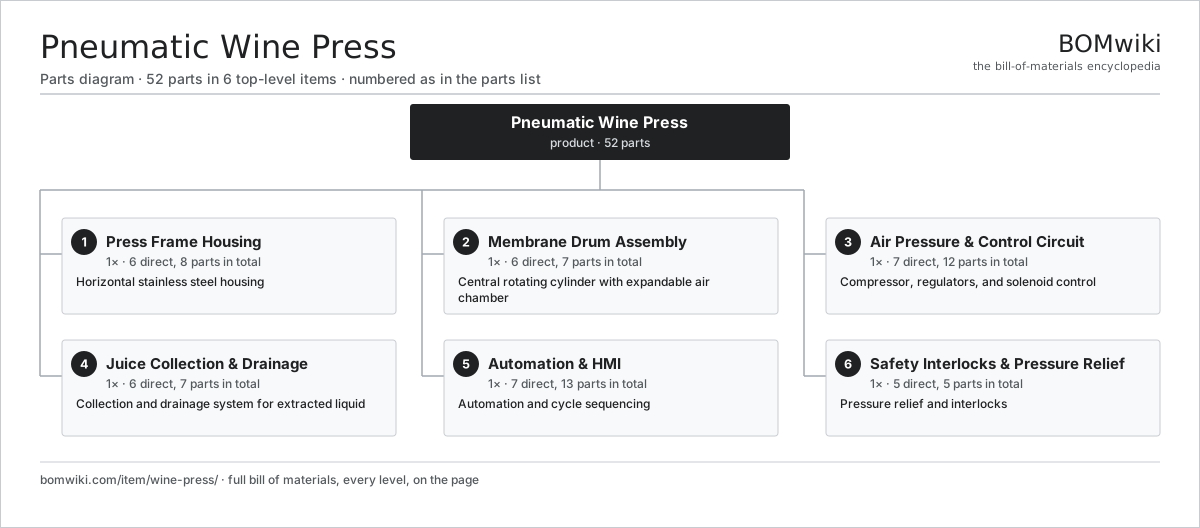
| # | Part | Qty | What it does |
|---|---|---|---|
| 1 | Press Frame Housing 6 parts | 1× | Horizontal stainless steel housing |
| 2 | Membrane Drum Assembly 6 parts | 1× | Central rotating cylinder with expandable air chamber |
| 3 | Air Pressure & Control Circuit 7 parts | 1× | Compressor, regulators, and solenoid control |
| 4 | Juice Collection & Drainage 6 parts | 1× | Collection and drainage system for extracted liquid |
| 5 | Automation & HMI 7 parts | 1× | Automation and cycle sequencing |
| 6 | Safety Interlocks & Pressure Relief 5 parts | 1× | Pressure relief and interlocks |
3D model
No 3D model yet. Have a CAD file of this? Add a 3D model. STL renders right on this page; STEP, FreeCAD, and OpenSCAD sources are welcome too (openly licensed, like all 3D models on BOMwiki).
Build & assembly graph
expand / collapse · shared sub-assemblies converge · links to related products · est. labourTap an assembly to expand/collapse · tap a part to open it · use “Open page” for any node · drag to pan, scroll to zoom.
Bill of materials for Pneumatic Wine Press
6 top-level lines · 43 rows shown · 52 parts total · indented to 3 levels| # | Item / sub-assembly | Part no. | Qty/assy | Ext. qty | Parts | Type |
|---|---|---|---|---|---|---|
| 1 | Press Frame Housing 6 parts | wine-press-frame-body | 1× | 1 | 8 | assembly |
| 1.1 | Outer Pressure Cylinder | wine-press-frame-cylinder | 1× | 1 | · | part |
| 1.2 | Charging Door Plate | wine-press-end-plate-inlet | 1× | 1 | · | part |
| 1.3 | Discharge End Plate | wine-press-end-plate-outlet | 1× | 1 | · | part |
| 1.4 | Drum Support Bearing | wine-press-frame-bearing | 2× | 2 | · | part |
| 1.5 | Rotating Shaft Seal | wine-press-membrane-seal | 1× | 1 | · | part |
| 1.6 | Fastener Set | fastener-set | 2× | 2 | · | part |
| 2 | Membrane Drum Assembly 6 parts | wine-press-membrane-drum | 1× | 1 | 7 | assembly |
| 2.1 | Membrane Drum Shaft | wine-press-drum-cylinder | 1× | 1 | · | part |
| 2.2 | Elastomer Membrane | wine-press-membrane-elastomer | 1× | 1 | · | part |
| 2.3 | Membrane End Ring | wine-press-drum-end-cap | 2× | 2 | · | part |
| 2.4 | Pneumatic Inlet Port | wine-press-air-inlet-port | 1× | 1 | · | part |
| 2.5 | Drum Drive Hub | wine-press-drum-bearing-hub | 1× | 1 | · | part |
| 2.6 | Juice Drainage Ports | wine-press-juice-perforations | 1× | 1 | · | part |
| 3 | Air Pressure & Control Circuit 7 parts | wine-press-pneumatic-system | 1× | 1 | 12 | assembly |
| 3.1 | Air Compressor | wine-press-air-compressor | 1× | 1 | · | part |
| 3.2 | Vacuum Pump | wine-press-vacuum-pump | 1× | 1 | · | part |
| 3.3 | Proportional Pressure Regulator | wine-press-regulator-block | 1× | 1 | · | part |
| 3.4 | Pressure Gauge | wine-press-pressure-gauge | 2× | 2 | · | part |
| 3.5 | System Safety Relief | wine-press-safety-relief-valve | 1× | 1 | · | part |
| 3.6 | One-Way Check Valve | wine-press-check-valve | 2× | 2 | · | part |
| 3.7 | Connector | connector | 4× | 4 | · | part |
| 4 | Juice Collection & Drainage 6 parts | wine-press-juice-tray | 1× | 1 | 7 | assembly |
| 4.1 | Collection Tray Pan | wine-press-tray-pan | 1× | 1 | · | part |
| 4.2 | Pomace Screen Grate | wine-press-perforated-grate | 1× | 1 | · | part |
| 4.3 | Tray Drain Valve | wine-press-drain-valve | 1× | 1 | · | part |
| 4.4 | Discharge Sump Pump | wine-press-sump-pump | 1× | 1 | · | part |
| 4.5 | Pressure Sensor | pressure-sensor | 1× | 1 | · | part |
| 4.6 | Connector | connector | 2× | 2 | · | part |
| 5 | Automation & HMI 7 parts | wine-press-plc-control | 1× | 1 | 13 | assembly |
| 5.1 | Press Automation PLC | wine-press-plc | 1× | 1 | · | part |
| 5.2 | HMI Touchscreen | wine-press-hmi-panel | 1× | 1 | · | part |
| 5.3 | I/O Output Module | wine-press-io-module | 1× | 1 | · | part |
| 5.4 | Pressure Sensor | pressure-sensor | 2× | 2 | · | part |
| 5.5 | Bare PCB | pcb-bare | 1× | 1 | · | part |
| 5.6 | Relay | relay | 3× | 3 | · | part |
| 5.7 | Connector | connector | 4× | 4 | · | part |
| 6 | Safety Interlocks & Pressure Relief 5 parts | wine-press-safety-system | 1× | 1 | 5 | assembly |
| 6.1 | Emergency Stop Button | wine-press-emergency-stop-button | 1× | 1 | · | part |
| 6.2 | Pressure Relief Valve | wine-press-pressure-relief-valve | 1× | 1 | · | part |
| 6.3 | Rupture Detection Switch | wine-press-membrane-rupture-sensor | 1× | 1 | · | part |
| 6.4 | Door Pneumatic Latch | wine-press-door-interlock | 1× | 1 | · | part |
| 6.5 | Manual Vent/Overflow | wine-press-overflow-drain | 1× | 1 | · | part |
Something wrong in this list? Report a problem with this BOM.
Related products
same domain, ranked by shared parts Automatic Espresso Tamper
45 parts · shares 3 with this page
Automatic Filleting Machine
73 parts · shares 3 with this page
Automatic Espresso Tamper
45 parts · shares 3 with this page
Automatic Filleting Machine
73 parts · shares 3 with this page
 Bakery Deck Oven
44 parts · shares 3 with this page
Beverage Carbonator
95 parts · shares 3 with this page
Bottle Rinser
36 parts · shares 3 with this page
Bakery Deck Oven
44 parts · shares 3 with this page
Beverage Carbonator
95 parts · shares 3 with this page
Bottle Rinser
36 parts · shares 3 with this page
 Bottle Washing Machine
2,388 parts · shares 3 with this page
Bottle Washing Machine
2,388 parts · shares 3 with this page
Sourcing: possible vendors
Browse the supplier directory → Prices, MOQ, and lead times are algorithmic estimates, not quotes, and not claims about these companies. Company mappings are curated by keyword; est. price band $1k–$500k. How estimates work| Vendor | HQ | Specialty | MOQ | Lead time |
|---|---|---|---|---|
| gea.com ↗ | Düsseldorf, DE | Process technology | 20 units | 12–20 wks |
| buhlergroup.com ↗ | Uzwil, CH | Food & materials processing | 20 units | 12–20 wks |
| tetrapak.com ↗ | Pully, CH | Food packaging & processing | 20 units | 12–20 wks |
| jbtc.com ↗ | Chicago, US | Food processing equipment | 20 units | 12–20 wks |
| alfalaval.com ↗ | Lund, SE | Heat transfer & separation | 20 units | 12–20 wks |
1,482-word article