Wire Chopping Line
ProductOverview
A wire chopping line is an integrated processing system engineered to process scrap electrical cables, power cords, and communication wire bundles in high-volume operations. The system combines a pre-chopper for bulk reduction, a fine-blade granulator for consistent sizing, and staged air and vibration separators to yield ultra-high-purity copper granules and plastic fines streams. A PLC-based control system coordinates all motors and safety interlocks.
Unlike single-stage grinders or granulators, the multi-stage design achieves superior separation efficiency and purity. Copper recovery runs 95–98% by weight, and the final copper granule product often qualifies for direct smelter feed without additional refining. Plastic fines (typically 30–40% by weight) are sold to pellet makers or recycled into lower-grade applications.
Processing scrap wire is economically attractive because of high copper value and the relatively low preprocessing cost compared to mining. A 500 kg/hr wire chopping line, running 16 hours daily, can process 4–5 tons of mixed scrap per day.
How it works
Bulk scrap wire and cable, in coiled or bundled form, is fed onto the pre-chopper feed table. An operator manually positions material or uses a pre-chopper unit to reduce large coils to manageable 20–50 mm segments. The heavy-duty cutting blades (typically hydraulic-powered guillotine or dual-rotor style) shear through multiple cable strands simultaneously.
Chopped segments flow via gravity or a short conveyor into the granulation rotor chamber. The rotor shaft, fitted with fine-pitched tungsten-carbide cutting blades, rotates at 1500–3000 rpm (controlled via VFD). Material is sheared between rotating and fixed counter-blades into consistent 2–5 mm granules.
A rotating perforated screen (2–5 mm aperture) immediately below the rotor classifies granules by size; oversized material re-circulates for a second pass. The classified product drops into the primary air classifier.
Inside the primary separator, an inclined mesh deck vibrates via a vibration motor at 50–60 Hz. Simultaneously, a fan system pumps 100–200 cfm of adjustable air upward through the deck. This combination creates a density-based settling gradient: heavy copper granules (density ~8.9 g/cc) settle and roll downslope faster; lightweight plastic insulation and fines (density ~1.2–1.4 g/cc) are entrained by the air stream and lift toward the outlet.
Two separate discharge chutes direct the streams: heavy copper granules to one collection bin, light plastic and dust to a secondary vibrating classifier (optional) or directly to the cyclone system.
The secondary separator provides an additional refining stage if ultra-high purity (99.5%+) is required. It further densifies the copper product and may recover some copper particles trapped in the plastic-rich stream.
All fine dust and light particles are drawn into a powerful induced-draft blower system. Air flows through a primary large-diameter cyclone where coarse dust (>100 microns) settles by gravity, then through a secondary fine cyclone capturing particles down to 10–50 microns. Below each cyclone, sealed hoppers with rotary air-lock valves collect dust for bin-off and disposal.
The entire line is coordinated by a PLC controller that sequences equipment startup (preventing the granulator from running before the chopper), monitors motor currents for jam detection, and controls individual motor speeds via VFDs. An operator interface touchscreen displays real-time throughput, energy consumption, and maintenance alerts.
Operational Modes and Throughput Tuning
Feed rate is controlled by adjusting the granulator motor speed (via VFD). Slower rotor speed (~1500 rpm) reduces power consumption and heat but yields larger, less uniform granules and slower production (200–300 kg/hr). Higher speed (~2500–3000 rpm) produces finer, more consistent granules but increases wear on blades and vibration in the separators.
Air classifier fan speed is independently controlled, allowing tuning for different wire insulation materials. PVC-insulated cable requires higher air flow (120–150 cfm) to effectively separate plastic fines; polyethylene-insulated wire may separate at lower air flow (80–100 cfm).
Consumables and Maintenance
The tungsten-carbide blades are the primary wear item, typically lasting 800–1500 hours at high-speed operation. Blade replacement (24 rotating + 6 stationary) takes 3–4 hours and costs $1,500–$3,000 per service. The screen drums are designed for quick-change in under 15 minutes.
Rotor bearings should be inspected every 200 operating hours and repacked with grease; bearing replacement costs $500–$800 per pair.
Environmental and Safety
The dust collection system captures >95% of fine airborne particles, reducing atmospheric dust to <5 mg/m³ outlet concentration. Recovered copper powder can be sold to smelters as fine copper fines (85%+ purity). Plastic dust is typically landfilled unless local markets exist for pelletized plastic scrap.
All rotating equipment is guarded with interlocked covers that cut power if opened. The pre-chopper blade poses severe crushing hazard and is protected by a hydraulic pressure-release system preventing unexpected descent. Emergency stop buttons are located at the operator station and control panel. Machine noise reaches 82–90 dB, requiring operator hearing protection in extended shifts.
Material ejected from a jammed granulator can achieve high velocity; the machine room should be cordoned off during operation. Regular inspection of blade sharpness and rotor balance reduces vibration and extends bearing life.
Wire Chopping Line parts and their functions
8 top-level parts · 99 parts in total · full bill of materials below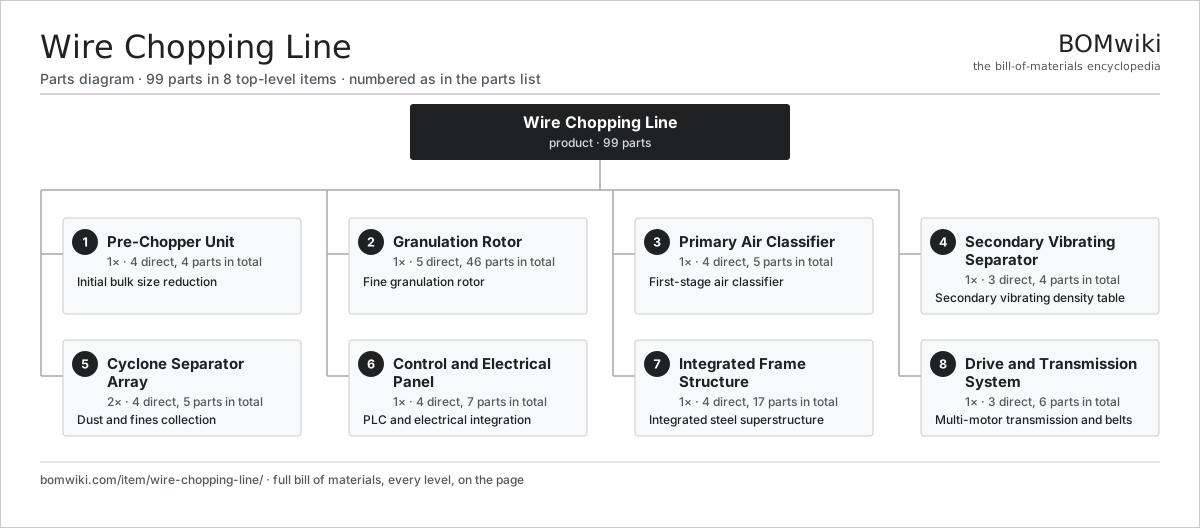
| # | Part | Qty | What it does |
|---|---|---|---|
| 1 | Pre-Chopper Unit 4 parts | 1× | Initial bulk size reduction |
| 2 | Granulation Rotor 5 parts | 1× | Fine granulation rotor |
| 3 | Primary Air Classifier 4 parts | 1× | First-stage air classifier |
| 4 | Secondary Vibrating Separator 3 parts | 1× | Secondary vibrating density table |
| 5 | Cyclone Separator Array 4 parts | 2× | Dust and fines collection |
| 6 | Control and Electrical Panel 4 parts | 1× | PLC and electrical integration |
| 7 | Integrated Frame Structure 4 parts | 1× | Integrated steel superstructure |
| 8 | Drive and Transmission System 3 parts | 1× | Multi-motor transmission and belts |
3D model
No 3D model yet. Have a CAD file of this? Add a 3D model. STL renders right on this page; STEP, FreeCAD, and OpenSCAD sources are welcome too (openly licensed, like all 3D models on BOMwiki).
Build & assembly graph
expand / collapse · shared sub-assemblies converge · links to related products · est. labourTap an assembly to expand/collapse · tap a part to open it · use “Open page” for any node · drag to pan, scroll to zoom.
Bill of materials for Wire Chopping Line
8 top-level lines · 39 rows shown · 99 parts total · indented to 3 levels| # | Item / sub-assembly | Part no. | Qty/assy | Ext. qty | Parts | Type |
|---|---|---|---|---|---|---|
| 1 | Pre-Chopper Unit 4 parts | wire-chopping-line-prechopper | 1× | 1 | 4 | assembly |
| 1.1 | Pre-Chopper Blades | wire-chopping-line-prechopper-blades | 1× | 1 | · | part |
| 1.2 | Pre-Chopper Frame | wire-chopping-line-prechopper-frame | 1× | 1 | · | part |
| 1.3 | Pre-Chopper Motor | wire-chopping-line-prechopper-motor | 1× | 1 | · | part |
| 1.4 | Pre-Chopper Feed Table | wire-chopping-line-prechopper-feed-table | 1× | 1 | · | part |
| 2 | Granulation Rotor 5 parts | wire-chopping-line-granulator | 1× | 1 | 46 | assembly |
| 2.1 | Granulator Shaft | wire-chopping-line-granulator-shaft | 1× | 1 | · | part |
| 2.2 | Granulator Blade | wire-chopping-line-granulator-blades | 36× | 36 | · | part |
| 2.3 | Stationary Counter-Blade | wire-chopping-line-granulator-stationary-blades | 6× | 6 | · | part |
| 2.4 | Granulator Bearing | wire-chopping-line-granulator-bearings | 2× | 2 | · | part |
| 2.5 | Granulator Screen | wire-chopping-line-granulator-screen | 1× | 1 | · | part |
| 3 | Primary Air Classifier 4 parts | wire-chopping-line-primary-separator | 1× | 1 | 5 | assembly |
| 3.1 | Primary Classifier Deck | wire-chopping-line-primary-table | 1× | 1 | · | part |
| 3.2 | Primary Air Blower | wire-chopping-line-primary-air-fan | 1× | 1 | · | part |
| 3.3 | Primary Vibrator Motor | wire-chopping-line-primary-vibrator | 1× | 1 | · | part |
| 3.4 | Primary Classifier Outlet | wire-chopping-line-primary-outlets | 2× | 2 | · | part |
| 4 | Secondary Vibrating Separator 3 parts | wire-chopping-line-secondary-separator | 1× | 1 | 4 | assembly |
| 4.1 | Secondary Separator Deck | wire-chopping-line-secondary-table | 1× | 1 | · | part |
| 4.2 | Secondary Vibrator | wire-chopping-line-secondary-vibrator | 1× | 1 | · | part |
| 4.3 | Secondary Outlet | wire-chopping-line-secondary-outlets | 2× | 2 | · | part |
| 5 | Cyclone Separator Array 4 parts | wire-chopping-line-cyclone-group | 2× | 2 | 5 | assembly |
| 5.1 | Primary Cyclone | wire-chopping-line-cyclone-primary | 1× | 2 | · | part |
| 5.2 | Secondary Polishing Cyclone | wire-chopping-line-cyclone-secondary | 1× | 2 | · | part |
| 5.3 | Cyclone Discharge Hopper | wire-chopping-line-cyclone-hopper | 2× | 4 | · | part |
| 5.4 | Cyclone Blower System | wire-chopping-line-cyclone-blower | 1× | 2 | · | part |
| 6 | Control and Electrical Panel 4 parts | wire-chopping-line-control-panel | 1× | 1 | 7 | assembly |
| 6.1 | PLC Unit | wire-chopping-line-plc | 1× | 1 | · | part |
| 6.2 | Variable-Frequency Drive | wire-chopping-line-vfd-array | 3× | 3 | · | part |
| 6.3 | HMI Touchscreen | wire-chopping-line-control-touchscreen | 1× | 1 | · | part |
| 6.4 | Safety Relay Module | wire-chopping-line-safety-relays | 2× | 2 | · | part |
| 7 | Integrated Frame Structure 4 parts | wire-chopping-line-frame-structure | 1× | 1 | 17 | assembly |
| 7.1 | Main Frame Rail | wire-chopping-line-main-rails | 2× | 2 | · | part |
| 7.2 | Cross Support Member | wire-chopping-line-cross-members | 6× | 6 | · | part |
| 7.3 | Leveling Foot | wire-chopping-line-leveling-feet | 8× | 8 | · | part |
| 7.4 | Fastener Set | fastener-set | 1× | 1 | · | part |
| 8 | Drive and Transmission System 3 parts | wire-chopping-line-drive-system | 1× | 1 | 6 | assembly |
| 8.1 | Main Drive Motor | wire-chopping-line-main-motor | 1× | 1 | · | part |
| 8.2 | Transmission Belt | wire-chopping-line-transmission-belt | 3× | 3 | · | part |
| 8.3 | Flexible Coupling | wire-chopping-line-shaft-alignment | 2× | 2 | · | part |
Something wrong in this list? Report a problem with this BOM.
Sourcing: possible vendors
Browse the supplier directory → Prices, MOQ, and lead times are algorithmic estimates, not quotes, and not claims about these companies. Company mappings are curated by keyword; est. price band $5k–$2M. How estimates work| Vendor | HQ | Specialty | MOQ | Lead time |
|---|---|---|---|---|
| atlascopco.com ↗ | Stockholm, SE | Compressors & industrial | 10 units | 12–20 wks |
|
🇦🇹Andritz
andritz.com ↗
|
Graz, AT | Process plants & machinery | 10 units | 12–20 wks |
| buhlergroup.com ↗ | Uzwil, CH | Food & materials processing | 10 units | 12–20 wks |
| gea.com ↗ | Düsseldorf, DE | Process technology | 10 units | 12–20 wks |
| mhi.com ↗ | Tokyo, JP | Heavy machinery | 10 units | 12–20 wks |
1,022-word article