Wire Enamelling Machine
ProductOverview
A wire enamelling machine applies a thin, high-dielectric-strength electrical insulation coating (enamel) onto fine copper or aluminum wire, then cures it through controlled heating. The result is enameled wire used extensively in electrical machines: transformer windings, motor stators, inductors, electromagnets, and precision devices. Enameled wire's insulation thickness (typically 10–100 micrometers) is far thinner than conventional thermoplastic jackets, enabling high conductor density in compact coils and transformers.
Wire enamelling is a chemical-mechanical process: liquid polyester, polyimide, or polyamide-imide enamel is metered onto the moving wire by precision dies, then cured by progressive heating in multi-zone ovens. The process demands exacting control: uneven enamel application, inadequate curing, or thermal shock (too-rapid cooling) can result in cracking, voids, or mechanical weakness in the insulation.
Wire enamelling machines are found in every electrical-equipment manufacturing plant: transformer manufacturers, motor builders, inductor suppliers, and high-frequency coil manufacturers. The process is also heavily used in aerospace and military systems where weight and compactness are paramount. Industrial production spans from laboratory machines (single-pass coating on fine wire, ~1 kg/hour) to mill-scale multi-pass lines (continuous coating on medium wire, 20–100 kg/hour).
How It Works
The process is a staged pipeline: (1) Bare copper or aluminum wire unwinds from the Payoff Unit at constant speed (50–300 m/min, depending on coating requirements). A Payoff Brake maintains tension. (2) The wire passes through one or more Applicator Dies Assembly, which meter liquid enamel onto the surface. The die pressure (2–5 bar) and Enamel Supply Pump flow rate determine coating thickness. Wipe Rings scrape excess enamel, ensuring uniform thickness. (3) The freshly coated wire (still liquid enamel, shiny and wet) enters the Curing Ovens Assembly, a series of 3–6 progressive heating zones. Early zones are ~60–100 °C (pre-cure, enamel begins to gel); middle zones are ~180–200 °C (active curing, solvents evaporate and polymer chains cross-link); final zones are ~220–250 °C (full cure, hardening to glossy finish). The wire spends 30–180 seconds total in the ovens, depending on enamel chemistry and wire diameter. (4) The cured (but still hot, ~250 °C) wire exits the final oven zone and enters the Cooling Tower Unit, where a Water Cooling Jacket with chilled water (15–25 °C) gradually cools the wire to ~60 °C. Rapid cooling can shatter the enamel or cause adhesion failure; slow cooling avoids thermal shock. (5) The cooled, enameled wire winds onto the Take-Up Reel.
Tension control via the Tension Control System system is critical: a Tension Transducer measures actual tension, and a feedback loop adjusts the Payoff Brake and take-up motor speed to maintain setpoint (typically 5–50 grams-force, depending on wire size). Inconsistent tension causes uneven enamel application (thinner on higher-tension spots, thicker on lower-tension spots), resulting in mechanical weak points.
Enamel Types and Properties
Modern wire enamels are categorized by thermal class and chemical composition:
- Polyester Imide (PE): Thermal class 155 °C, good mechanical properties, widely used in general-purpose motors and transformers. Lower cost.
- Polyimide (PI): Thermal class 220 °C, superior heat resistance, used in aircraft generators and high-temperature applications. Higher cost.
- Polyamide-Imide (PAI): Thermal class 220–240 °C, excellent mechanical toughness and adhesion, used in heavy-duty motors and demanding environments.
- Epoxy (EP): Lower thermal class (~130 °C), used primarily in aerospace and medical where low outgassing is critical (vacuum environments).
All enamels are solvent-based (containing aromatic hydrocarbons or esters to keep them liquid) and require heating to evaporate the solvent and harden the polymer. The oven temperature profile must avoid boiling the solvent (which creates bubbles and voids) while ensuring complete cross-linking (which requires reaching a minimum temperature for a minimum time).
Multi-Pass Coating
For thick insulation, the wire passes through the dies and ovens multiple times. A transformer winding requiring 0.3 mm insulation might use 3 passes of 0.1 mm enamel. After each pass, the enameled wire cools and winds back onto a reel, then unwinds again for the next pass. This is labor-intensive but allows precise control: each pass is cure-checked before proceeding to the next. Some modern machines have multiple applicator-die stations in series, allowing sequential coating without reel storage.
Applicator Die Precision
The Die Body is precision-machined carbide or hardened steel. A typical die for 0.5 mm wire has an internal passage shaped to deliver enamel concentrically around the wire at 3–5 bar pressure. The orifice diameter is critical: even 0.1 mm variation changes coating thickness by ~10–20%. Dies are custom-designed for specific wire gauges and coating thicknesses, and mills typically maintain a library of dies for standard wire sizes (AWG #8, #10, #12, #14, #18, #22, etc.).
Over millions of wire passes, the die internal surface gradually wears and scratches, degrading coating uniformity. Dies are typically reconditioned or replaced every 6–12 months in high-volume production. A worn die may be honed or polished by a specialized vendor and returned to service, or discarded.
Enamel Supply and Circulation
The Enamel Supply and Filtration System system is closed-loop: enamel flows from the Enamel Storage Tank, through the Enamel Filter (10–25 micron mesh), and back to the tank. The circulation Enamel Supply Pump operates continuously (even during machine idle time) to keep enamel homogeneous, preventing pigment settling and viscosity stratification. Temperature in the tank is held at 20–30 °C; if cooler, viscosity rises and flow becomes sluggish; if warmer, solvent evaporates and coating consistency degrades.
Enamel contamination (dust, moisture, fiber from clothing) is a leading cause of coating defects. Modern plants enforce strict cleanliness protocols: air-conditioned machine rooms, filtered air intake, sealed enamel tanks, and frequent filter cartridge replacement.
Cooling Profile and Adhesion
The water-cooling Water Cooling Jacket is the most critical control point after the cure ovens. Enamel that exits at 250 °C and is suddenly cooled to 60 °C in seconds will develop radial thermal stress: the outer layer cools and contracts faster than the inner layer, creating microscopic cracks and reducing dielectric strength. Modern machines cool in stages: the jacket inlet temperature is ~60 °C for rapid initial cooling, and controlled, typically cooling from 250 °C to 150 °C in 5–10 seconds, then from 150 °C to 60 °C more slowly over another 5–10 seconds. Some machines use variable-flow cooling water controlled by a PLC based on temperature feedback.
Adhesion between enamel and wire is critical: if the enamel separates, voids fill with moisture, leading to dielectric failure. Adhesion depends on:
- Wire cleanliness: Copper or aluminum oxide surface must be clean. Any grease, oxidation residue, or contamination degrades adhesion. Bare wire is often supplied pre-cleaned by the wire drawer.
- Enamel chemistry: Some enamels bond better to copper than others. Polyimide bonds very well; some polyesters require a subcoat adhesion promoter.
- Oven time-temperature profile: Insufficient cure leaves weak, under-hardened enamel with poor adhesion. Over-curing (too-long dwell at peak temperature) can degrade enamel chemistry.
Integration with Coil Winding
Enameled wire is typically wound into coils immediately after spooling. The Take-Up Reel produces spools of enameled wire (typically 1–10 kg per spool, depending on wire gauge) that are then mounted on a coil-winding machine (not the same as the Cable Coiling Machine, which works on finished cables). Precision coil winders lay the enameled wire in precise geometric patterns (solenoid, toroidal, conical) to form windings. The enamel insulation between adjacent turns provides electrical isolation; the mechanical compactness of enameled wire allows high turn-counts in small spaces.
Quality Testing
Finished enameled wire is tested for:
- Dielectric Strength: High-voltage stress test (e.g., 1 kV for 5 seconds) to verify insulation integrity.
- Adhesion: Mechanical scraping or solvent-soak tests to confirm enamel is bonded and not peeling.
- Coating Thickness: Measurement via capacitive or eddy-current sensors to verify thickness uniformity.
- Flexibility: Bending test around a mandrel to ensure enamel doesn't crack under mechanical stress.
- Thermal Endurance: Long-term aging in hot air (e.g., 220 °C for 1000 hours) to simulate motor or transformer service life.
Sample spools are tested from each production run; if defects are detected, the entire batch may be re-cured or rejected.
Troubleshooting and Maintenance
Common defects and causes:
- Uneven coating: Indicates worn die, misaligned wire, or inconsistent enamel pressure. Corrected by die inspection/replacement and pressure regulator calibration.
- Bubbles or voids: Causes include solvent boiling (oven too hot), air entrapment in die, or contaminated enamel. Corrected by lowering oven temperature, cleaning die, and replacing enamel.
- Cracking or adhesion failure: Indicates thermal shock from rapid cooling or enamel over-cure. Corrected by adjusting cooling water flow and oven time-temperature profile.
- Wire breakage in ovens: Caused by excessive tension, wire tangles, or enamel sticking to oven walls. Corrected by reducing tension and lubricating oven passages with dry release compound.
Routine maintenance includes monthly filter replacement in the enamel circulation system, quarterly die cleaning, and annual overhaul of the cooling-jacket water passages to remove mineral deposits.
Wire Enamelling Machine parts and their functions
7 top-level parts · 37 parts in total · full bill of materials below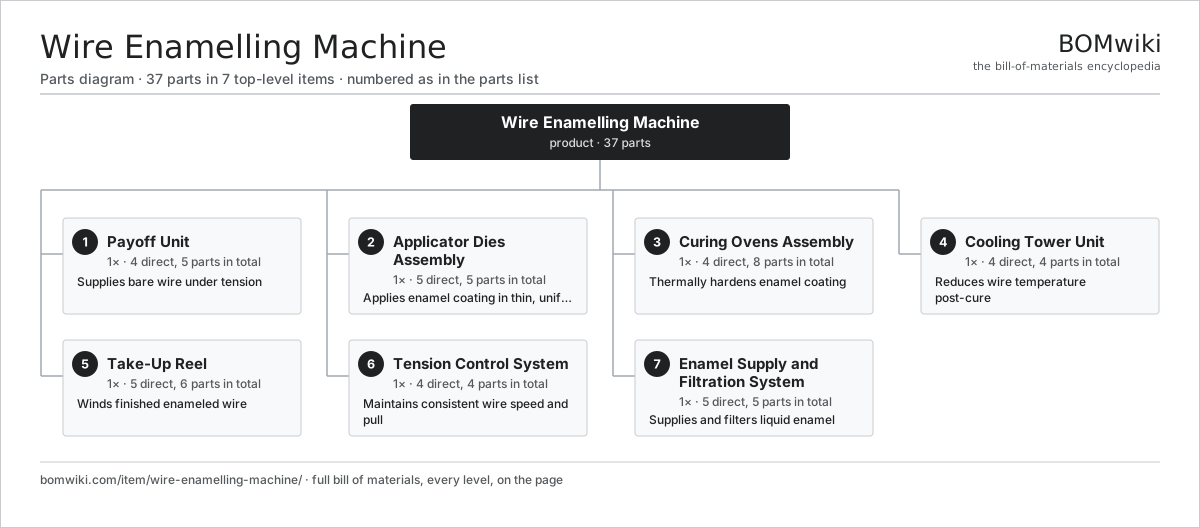
| # | Part | Qty | What it does |
|---|---|---|---|
| 1 | Payoff Unit 4 parts | 1× | Supplies bare wire under tension |
| 2 | Applicator Dies Assembly 5 parts | 1× | Applies enamel coating in thin, uniform layers |
| 3 | Curing Ovens Assembly 4 parts | 1× | Thermally hardens enamel coating |
| 4 | Cooling Tower Unit 4 parts | 1× | Reduces wire temperature post-cure |
| 5 | Take-Up Reel 5 parts | 1× | Winds finished enameled wire |
| 6 | Tension Control System 4 parts | 1× | Maintains consistent wire speed and pull |
| 7 | Enamel Supply and Filtration System 5 parts | 1× | Supplies and filters liquid enamel |
3D model
No 3D model yet. Have a CAD file of this? Add a 3D model. STL renders right on this page; STEP, FreeCAD, and OpenSCAD sources are welcome too (openly licensed, like all 3D models on BOMwiki).
Build & assembly graph
expand / collapse · shared sub-assemblies converge · links to related products · est. labourTap an assembly to expand/collapse · tap a part to open it · use “Open page” for any node · drag to pan, scroll to zoom.
Bill of materials for Wire Enamelling Machine
7 top-level lines · 38 rows shown · 37 parts total · indented to 3 levels| # | Item / sub-assembly | Part no. | Qty/assy | Ext. qty | Parts | Type |
|---|---|---|---|---|---|---|
| 1 | Payoff Unit 4 parts | wire-enamelling-machine-payoff-unit | 1× | 1 | 5 | assembly |
| 1.1 | Ball Bearing | ball-bearing | 2× | 2 | · | part |
| 1.2 | Payoff Brake | wire-enamelling-machine-payoff-brake | 1× | 1 | · | part |
| 1.3 | Pressure Sensor | pressure-sensor | 1× | 1 | · | part |
| 1.4 | Fastener Set | fastener-set | 1× | 1 | · | part |
| 2 | Applicator Dies Assembly 5 parts | wire-enamelling-machine-applicator-dies | 1× | 1 | 5 | assembly |
| 2.1 | Enamel Supply Pump | wire-enamelling-machine-enamel-pump | 1× | 1 | · | part |
| 2.2 | Die Body | wire-enamelling-machine-die-body | 1× | 1 | · | part |
| 2.3 | Wipe Rings | wire-enamelling-machine-wipe-rings | 1× | 1 | · | part |
| 2.4 | Pressure Sensor | pressure-sensor | 1× | 1 | · | part |
| 2.5 | Fastener Set | fastener-set | 1× | 1 | · | part |
| 3 | Curing Ovens Assembly 4 parts | wire-enamelling-machine-curing-ovens | 1× | 1 | 8 | assembly |
| 3.1 | Heating Element | heating-element | 4× | 4 | · | part |
| 3.2 | Oven Chamber | wire-enamelling-machine-oven-chamber | 1× | 1 | · | part |
| 3.3 | Pressure Sensor | pressure-sensor | 2× | 2 | · | part |
| 3.4 | Fastener Set | fastener-set | 1× | 1 | · | part |
| 4 | Cooling Tower Unit 4 parts | wire-enamelling-machine-cooling-tower | 1× | 1 | 4 | assembly |
| 4.1 | Coolant Pump | coolant-pump | 1× | 1 | · | part |
| 4.2 | Water Cooling Jacket | wire-enamelling-machine-water-jacket | 1× | 1 | · | part |
| 4.3 | Pressure Sensor | pressure-sensor | 1× | 1 | · | part |
| 4.4 | Fastener Set | fastener-set | 1× | 1 | · | part |
| 5 | Take-Up Reel 5 parts | wire-enamelling-machine-take-up-reel | 1× | 1 | 6 | assembly |
| 5.1 | Blower Motor | blower-motor | 1× | 1 | · | part |
| 5.2 | Reel Shaft | wire-enamelling-machine-reel-shaft | 1× | 1 | · | part |
| 5.3 | Encoder | encoder | 1× | 1 | · | part |
| 5.4 | Ball Bearing | ball-bearing | 2× | 2 | · | part |
| 5.5 | Fastener Set | fastener-set | 1× | 1 | · | part |
| 6 | Tension Control System 4 parts | wire-enamelling-machine-tension-control | 1× | 1 | 4 | assembly |
| 6.1 | Tension Transducer | wire-enamelling-machine-tension-sensor | 1× | 1 | · | part |
| 6.2 | Microcontroller | mcu | 1× | 1 | · | part |
| 6.3 | Relay | relay | 1× | 1 | · | part |
| 6.4 | SMD Passive (R/C/L) | smd-passives | 1× | 1 | · | part |
| 7 | Enamel Supply and Filtration System 5 parts | wire-enamelling-machine-enamel-circulation | 1× | 1 | 5 | assembly |
| 7.1 | Enamel Storage Tank | wire-enamelling-machine-enamel-tank | 1× | 1 | · | part |
| 7.2 | Enamel Filter | wire-enamelling-machine-circulation-filter | 1× | 1 | · | part |
| 7.3 | Enamel Supply Pump | wire-enamelling-machine-enamel-pump | 1× | 1 | · | part |
| 7.4 | Pressure Sensor | pressure-sensor | 1× | 1 | · | part |
| 7.5 | Fastener Set | fastener-set | 1× | 1 | · | part |
Something wrong in this list? Report a problem with this BOM.
Related products
same domain, ranked by shared parts Cable Extrusion Line
46 parts · shares 8 with this page
Electron Beam PBF
128 parts · shares 8 with this page
Cable Extrusion Line
46 parts · shares 8 with this page
Electron Beam PBF
128 parts · shares 8 with this page
 Industrial FDM Printer
98 parts · shares 8 with this page
Industrial FDM Printer
98 parts · shares 8 with this page
 Pencil Making Machine
43 parts · shares 6 with this page
Pencil Making Machine
43 parts · shares 6 with this page
 Industrial SLA Printer
94 parts · shares 7 with this page
Industrial SLA Printer
94 parts · shares 7 with this page
Sourcing: possible vendors
Browse the supplier directory → Prices, MOQ, and lead times are algorithmic estimates, not quotes, and not claims about these companies. Company mappings are curated by keyword; est. price band $5k–$2M. How estimates work| Vendor | HQ | Specialty | MOQ | Lead time |
|---|---|---|---|---|
| atlascopco.com ↗ | Stockholm, SE | Compressors & industrial | 10 units | 12–20 wks |
|
🇦🇹Andritz
andritz.com ↗
|
Graz, AT | Process plants & machinery | 10 units | 12–20 wks |
| buhlergroup.com ↗ | Uzwil, CH | Food & materials processing | 10 units | 12–20 wks |
| gea.com ↗ | Düsseldorf, DE | Process technology | 10 units | 12–20 wks |
| mhi.com ↗ | Tokyo, JP | Heavy machinery | 10 units | 12–20 wks |
1,567-word article