Point-to-Point Wireless Bridge
ProductOverview
A point-to-point wireless bridge joins two network segments through the air, making a pair of radios behave like a long Ethernet cable. The classic uses are building-to-building links on a campus, last-mile distribution for wireless ISPs, and connecting cameras or SCADA gear where trenching is impossible. Two identical units face each other across the path, one configured as master, one as slave, and bridge Ethernet frames transparently, so the networks on either end see a single layer-2 link with a few milliseconds of latency.
Each unit is a sealed all-outdoor device: the Radio Board and the Integrated Panel Antenna share one enclosure, eliminating the coax pigtails of older designs where every connector and meter of cable cost decibels and let water in. A single shielded cable from the PoE Power System indoors carries both power and data to the Ethernet Interface interface, the Weatherproof Enclosure keeps weather out for a decade on a mast, and the Mount & Alignment holds the aim that the narrow beam demands.
How it works
The radio is built on Wi-Fi silicon, the Radio SoC uses an 802.11ac-derived OFDM physical layer, but bridges of this class replace the Wi-Fi media-access protocol with TDMA. Standard Wi-Fi's listen-before-talk CSMA breaks down over kilometers: propagation delay defeats collision avoidance, and the protocol's ACK timeouts assume sub-microsecond distances. A TDMA scheduler instead divides time into fixed transmit windows for each end, which keeps latency bounded, makes throughput symmetric and predictable, and tolerates the hidden-node interference of a crowded band. The result is that a 2×2 MIMO radio in an 80 MHz channel sustains several hundred megabits of real traffic over paths where raw 802.11 would collapse.
The Patch Array gives the link its reach. Sixteen to sixty-four microstrip patches fed in phase by the Feed Network form a beam six to ten degrees wide with 16–25 dBi of gain, in both polarizations at once for the two MIMO streams. High gain matters twice: it multiplies both transmitted and received signal, and regulatory limits in the 5 GHz band cap EIRP rather than antenna size in the point-to-point case, so a narrow beam converts directly into range. It also rejects interference, the unit simply does not hear radios outside its beam, which in the unlicensed band is often worth more than the gain itself.
The link budget works out comfortably for typical paths: +27 dBm transmit, 23 dBi at each end, and about 125 dB of free-space loss over 5 km leaves a received signal near −52 dBm, enough margin for 256-QAM rates in clear air. Like all microwave links the path needs true line of sight with Fresnel-zone clearance, about 60% of an 8 m radius mid-path at 5 km, so trees that "barely clip" the visual line can still take half the signal. Adaptive modulation steps rates down gracefully when rain or interference erodes the margin.
Power and protection
Power arrives over the data cable. The PoE Magnetics tap DC off the pairs, the PoE Rectifier makes polarity irrelevant, and the DC-DC Converter generates the board rails from anything between 24 and 56 V; the whole unit draws 8–12 W. The cable is the unit's biggest vulnerability: a mast-top device on shielded cable is an efficient lightning energy collector, so installations bond the Ground Bond at the mast, place the Surge Protector where the cable enters the building, and use shielded cable with metal RJ45 ends throughout. Most field failures of these products trace to skipped grounding rather than the electronics.
Installation
Alignment is the craft step. The installer aims roughly by sight, then peaks the received signal level reported by the firmware while nudging the Pivot Joint, comparing the achieved signal against the link-planner prediction to confirm the aim is on the main lobe rather than a sidelobe several dB down. Once tightened, the mount must hold that aim through wind and seasonal mast movement; at 5 km, one degree of drift moves the beam 87 m at the far end. In the 5 GHz band the radio must also honor DFS, vacating channels within seconds when its radar-detection logic fires, so links near airports are usually planned on the non-DFS portions of the band. A well-installed pair of these units routinely runs for years of unattended service, with the Vent Membrane quietly preventing the condensation cycling that kills sealed outdoor electronics.
Point-to-Point Wireless Bridge parts and their functions
6 top-level parts · 227 parts in total · full bill of materials below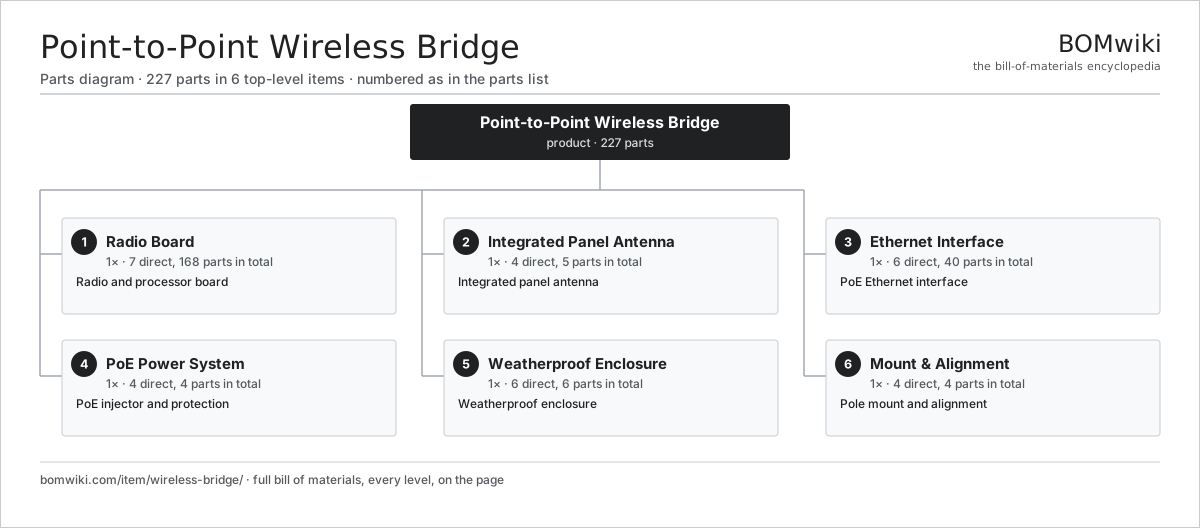
| # | Part | Qty | What it does |
|---|---|---|---|
| 1 | Radio Board 7 parts | 1× | Radio and processor board |
| 2 | Integrated Panel Antenna 4 parts | 1× | Integrated panel antenna |
| 3 | Ethernet Interface 6 parts | 1× | PoE Ethernet interface |
| 4 | PoE Power System 4 parts | 1× | PoE injector and protection |
| 5 | Weatherproof Enclosure 6 parts | 1× | Weatherproof enclosure |
| 6 | Mount & Alignment 4 parts | 1× | Pole mount and alignment |
3D model
No 3D model yet. Have a CAD file of this? Add a 3D model. STL renders right on this page; STEP, FreeCAD, and OpenSCAD sources are welcome too (openly licensed, like all 3D models on BOMwiki).
Build & assembly graph
expand / collapse · shared sub-assemblies converge · links to related products · est. labourTap an assembly to expand/collapse · tap a part to open it · use “Open page” for any node · drag to pan, scroll to zoom.
Bill of materials for Point-to-Point Wireless Bridge
6 top-level lines · 37 rows shown · 227 parts total · indented to 3 levels| # | Item / sub-assembly | Part no. | Qty/assy | Ext. qty | Parts | Type |
|---|---|---|---|---|---|---|
| 1 | Radio Board 7 parts | wireless-bridge-radio-board | 1× | 1 | 168 | assembly |
| 1.1 | Bare PCB | pcb-bare | 1× | 1 | · | part |
| 1.2 | Radio SoC | wireless-bridge-radio-soc | 1× | 1 | · | part |
| 1.3 | Front-End Module | wireless-bridge-fem | 2× | 2 | · | part |
| 1.4 | DDR Memory | wireless-bridge-ddr | 1× | 1 | · | part |
| 1.5 | Firmware Flash | wireless-bridge-flash | 1× | 1 | · | part |
| 1.6 | RF Shield Can | wireless-bridge-rf-shield | 2× | 2 | · | part |
| 1.7 | SMD Passive (R/C/L) | smd-passives | 160× | 160 | · | part |
| 2 | Integrated Panel Antenna 4 parts | wireless-bridge-antenna | 1× | 1 | 5 | assembly |
| 2.1 | Patch Array | wireless-bridge-patch-array | 1× | 1 | · | part |
| 2.2 | Feed Network | wireless-bridge-feed-network | 1× | 1 | · | part |
| 2.3 | Reflector Plate | wireless-bridge-reflector-plate | 1× | 1 | · | part |
| 2.4 | RF Contact Springs | wireless-bridge-rf-springs | 2× | 2 | · | part |
| 3 | Ethernet Interface 6 parts | wireless-bridge-ethernet | 1× | 1 | 40 | assembly |
| 3.1 | Ethernet PHY | wireless-bridge-eth-phy | 1× | 1 | · | part |
| 3.2 | RJ45 Jack | wireless-bridge-rj45 | 1× | 1 | · | part |
| 3.3 | PoE Magnetics | wireless-bridge-magnetics | 1× | 1 | · | part |
| 3.4 | PoE Rectifier | wireless-bridge-poe-rectifier | 1× | 1 | · | part |
| 3.5 | DC-DC Converter | wireless-bridge-dcdc | 1× | 1 | · | part |
| 3.6 | SMD Passive (R/C/L) | smd-passives | 35× | 35 | · | part |
| 4 | PoE Power System 4 parts | wireless-bridge-poe-system | 1× | 1 | 4 | assembly |
| 4.1 | Power Supply | power-supply | 1× | 1 | · | part |
| 4.2 | Surge Protector | wireless-bridge-surge-protector | 1× | 1 | · | part |
| 4.3 | Shielded Cable Run | wireless-bridge-shielded-cable | 1× | 1 | · | part |
| 4.4 | Ground Bond | wireless-bridge-ground-wire | 1× | 1 | · | part |
| 5 | Weatherproof Enclosure 6 parts | wireless-bridge-enclosure | 1× | 1 | 6 | assembly |
| 5.1 | Radome Shell | wireless-bridge-radome-shell | 1× | 1 | · | part |
| 5.2 | Rear Shell | wireless-bridge-rear-shell | 1× | 1 | · | part |
| 5.3 | Cable Bay Cover | wireless-bridge-cable-bay-cover | 1× | 1 | · | part |
| 5.4 | Vent Membrane | wireless-bridge-vent-membrane | 1× | 1 | · | part |
| 5.5 | O-Ring Set | oring-set | 1× | 1 | · | part |
| 5.6 | Fastener Set | fastener-set | 1× | 1 | · | part |
| 6 | Mount & Alignment 4 parts | wireless-bridge-mount | 1× | 1 | 4 | assembly |
| 6.1 | Pole Clamp | wireless-bridge-pole-clamp | 1× | 1 | · | part |
| 6.2 | Pivot Joint | wireless-bridge-pivot-joint | 1× | 1 | · | part |
| 6.3 | Quick Latch | wireless-bridge-quick-latch | 1× | 1 | · | part |
| 6.4 | Fastener Set | fastener-set | 1× | 1 | · | part |
Something wrong in this list? Report a problem with this BOM.
Related products
same domain, ranked by shared parts


Sourcing: possible vendors
Browse the supplier directory → Prices, MOQ, and lead times are algorithmic estimates, not quotes, and not claims about these companies. Company mappings are curated by keyword; est. price band $30–$50k. How estimates work| Vendor | HQ | Specialty | MOQ | Lead time |
|---|---|---|---|---|
|
🇺🇸Cisco
cisco.com ↗
|
San Jose, US | Networking | 500 units | 8–14 wks |
|
🇺🇸Juniper
juniper.net ↗
|
Sunnyvale, US | Networking | 500 units | 8–14 wks |
| arista.com ↗ | Santa Clara, US | Networking | 500 units | 8–14 wks |
|
🇫🇮Nokia
nokia.com ↗
|
Espoo, FI | Telecom equipment | 500 units | 8–14 wks |
|
🇨🇳Huawei
huawei.com ↗
|
Shenzhen, CN | Networking & telecom | 500 units | 8–14 wks |
785-word article