Worm Gear Reducer
ProductOverview
Worm gear reducers are right-angle speed reducers pairing a threaded input worm (screw) with a tangentially meshed output wheel. The worm threads engage the wheel teeth on its outer circumference in a helicoid pattern, similar to a threaded fastener engaging a nut. This geometry is unique: the worm and wheel axes are perpendicular and don't intersect, creating the characteristic compact, right-angle form factor.
Worm reducers are ubiquitous in lifting (hoists, winches), conveyor drives, and material handling because they offer large reduction ratios (5:1 to 100:1) in minimal space. A single-start worm reduces 5:1; double-start drops to 2.5:1. The wheel diameter determines final ratio: a 50-tooth wheel meshed with a 1-start worm yields 50:1. Efficiency ranges from 50% (high ratio) to 90% (low ratio) depending on lead angle and material selection.
How it works
The worm shaft rotates at input speed, threads advancing one pitch per revolution. As the worm thread rolls across the wheel teeth, it imparts tangential motion to the wheel, rotating the output shaft at a fraction of input speed. Load is distributed across multiple teeth in mesh simultaneously (typically 2–4 teeth in contact), reducing stress concentration compared to single-mesh helical gearboxes.
The worm is hardened to 48–54 HRC and precision ground post-heat-treat to maintain straightness within 0.05 mm over 200+ mm length. The wheel is typically cast from phosphor bronze or manganese bronze, chosen for self-lubricating properties and damping. The worm imparts significant axial thrust (1000–5000 N on mid-range units) onto angular-contact bearings at the input, which must be preloaded to minimize endplay.
Efficiency and thermal load
Worm reducers are inherently lower efficiency than helical or planetary units due to sliding friction between worm thread and wheel teeth (rather than pure rolling). Single-stage efficiency is:
Efficiency = (Tan(lead angle)) / (Tan(lead angle) + friction coefficient × π / (cos(pressure angle)))
A 5-degree lead angle with 0.04 coefficient of friction yields ~75% efficiency; 20-degree lead angle, ~90% efficiency. Most industrial reducers operate at 70–85% efficiency, dissipating 15–30% of input power as heat in the oil.
The lubrication system must continuously bathe the worm in circulating oil, removing heat. Mineral oil ISO 46 or ISO 68 is standard; synthetic PAO oils are used in food and high-cleanliness applications. Typical drain intervals are 2000–3000 operating hours; frequent oil analysis monitoring ferrous wear debris is strongly recommended given thermal stress.
Load distribution and material pairing
Worm tooth flank engagement is optimized by material pairing: hardened steel worm with ductile bronze wheel maximizes contact stress without damaging either. Cast ductile iron wheels (SG 500–600) are also used in low-cost variants, accepting lower fatigue margin and shorter life. Bronze wheels are self-lubricating, requiring only mineral oil; iron wheels demand synthetic or extreme-pressure additives to prevent scuffing.
Installation considerations
Worm and wheel must be precisely aligned; axial and radial runout of the worm must be <0.05 mm, and center-distance must be held to ±0.1 mm for optimum life. This precision is factory-set in the housing, but field installation of motor couplings and load shafts must maintain alignment. Misalignment accelerates tooth pitting and bearing wear.
Right-angle advantage
Unlike bevel or helical gearboxes, worm reducers achieve perpendicular shaft orientation naturally, without special bending of gears or use of expensive bevel designs. This compact form factor is essential in vertical hoist applications (elevator, stage lift, rack-and-pinion drive backup) where axial space is limited. The deep reduction (50:1, 100:1 in single stage) reduces motor speed requirements, enabling smaller (cheaper, more efficient) motors.
Reversibility and backlash
Standard worm reducers are not naturally self-locking; if the wheel drives the worm (back-driving), motion is possible at reduced torque. However, lead angles below ~5 degrees approach self-locking behavior (lock friction > available torque). High-reduction (50:1+) units with 2–4 degree lead angles are effectively irreversible under normal load, making them ideal for vertical lifting without mechanical brakes.
Backlash is a weakness: 5–20 arcmin is typical, limiting use in precision positioning. Specialized low-backlash variants use split wheels or preloaded designs, reducing backlash to 1–3 arcmin at the cost of increased price and heat generation.
Maintenance and failure modes
Typical failure is tooth pitting or spalling from thermal stress and corrosion; water ingress into the oil accelerates failure. The seal system is critical. Annual oil analysis (ASTM D4378) is standard in heavy duty; trending particle count predicts bearing or tooth failure 500–1000 hours in advance. Thermal monitoring via optional temperature sensor alarm at 80–85 °C is recommended in continuous-duty hoist applications.
Worm Gear Reducer parts and their functions
7 top-level parts · 25 parts in total · full bill of materials below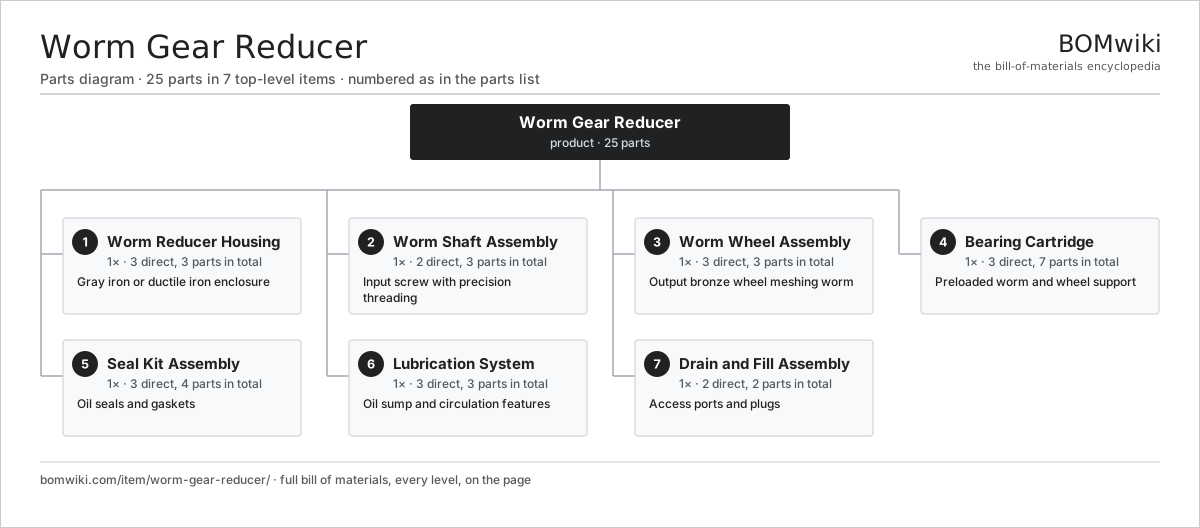
| # | Part | Qty | What it does |
|---|---|---|---|
| 1 | Worm Reducer Housing 3 parts | 1× | Gray iron or ductile iron enclosure |
| 2 | Worm Shaft Assembly 2 parts | 1× | Input screw with precision threading |
| 3 | Worm Wheel Assembly 3 parts | 1× | Output bronze wheel meshing worm |
| 4 | Bearing Cartridge 3 parts | 1× | Preloaded worm and wheel support |
| 5 | Seal Kit Assembly 3 parts | 1× | Oil seals and gaskets |
| 6 | Lubrication System 3 parts | 1× | Oil sump and circulation features |
| 7 | Drain and Fill Assembly 2 parts | 1× | Access ports and plugs |
3D model
No 3D model yet. Have a CAD file of this? Add a 3D model. STL renders right on this page; STEP, FreeCAD, and OpenSCAD sources are welcome too (openly licensed, like all 3D models on BOMwiki).
Build & assembly graph
expand / collapse · shared sub-assemblies converge · links to related products · est. labourTap an assembly to expand/collapse · tap a part to open it · use “Open page” for any node · drag to pan, scroll to zoom.
Bill of materials for Worm Gear Reducer
7 top-level lines · 26 rows shown · 25 parts total · indented to 3 levels| # | Item / sub-assembly | Part no. | Qty/assy | Ext. qty | Parts | Type |
|---|---|---|---|---|---|---|
| 1 | Worm Reducer Housing 3 parts | worm-gear-reducer-housing | 1× | 1 | 3 | assembly |
| 1.1 | Housing Base Casting | worm-gear-reducer-base | 1× | 1 | · | part |
| 1.2 | Top Cover Plate | worm-gear-reducer-top-cover | 1× | 1 | · | part |
| 1.3 | Fastener Set | fastener-set | 1× | 1 | · | part |
| 2 | Worm Shaft Assembly 2 parts | worm-gear-reducer-worm-shaft-assembly | 1× | 1 | 3 | assembly |
| 2.1 | Worm Screw | worm-gear-reducer-worm | 1× | 1 | · | part |
| 2.2 | Worm Bearing | worm-gear-reducer-worm-bearing | 2× | 2 | · | part |
| 3 | Worm Wheel Assembly 3 parts | worm-gear-reducer-wheel-assembly | 1× | 1 | 3 | assembly |
| 3.1 | Bronze Worm Wheel | worm-gear-reducer-wheel | 1× | 1 | · | part |
| 3.2 | Wheel Output Shaft | worm-gear-reducer-wheel-shaft | 1× | 1 | · | part |
| 3.3 | Wheel Hub | worm-gear-reducer-wheel-hub | 1× | 1 | · | part |
| 4 | Bearing Cartridge 3 parts | worm-gear-reducer-bearing-cartridge | 1× | 1 | 7 | assembly |
| 4.1 | Ball Bearing | ball-bearing | 4× | 4 | · | part |
| 4.2 | Bearing Spacer | worm-gear-reducer-bearing-spacer | 2× | 2 | · | part |
| 4.3 | Preload Element | worm-gear-reducer-preload-element | 1× | 1 | · | part |
| 5 | Seal Kit Assembly 3 parts | worm-gear-reducer-seal-kit | 1× | 1 | 4 | assembly |
| 5.1 | Oil Seal | oil-seal | 2× | 2 | · | part |
| 5.2 | Cover Gasket | worm-gear-reducer-gasket | 1× | 1 | · | part |
| 5.3 | O-Ring Set | oring-set | 1× | 1 | · | part |
| 6 | Lubrication System 3 parts | worm-gear-reducer-lube-system | 1× | 1 | 3 | assembly |
| 6.1 | Sump Cavity | worm-gear-reducer-sump-cavity | 1× | 1 | · | part |
| 6.2 | Oil Level Plug | worm-gear-reducer-oil-level-plug | 1× | 1 | · | part |
| 6.3 | Temp Sensor Port | worm-gear-reducer-temperature-sensor-boss | 1× | 1 | · | part |
| 7 | Drain and Fill Assembly 2 parts | worm-gear-reducer-drain-fill | 1× | 1 | 2 | assembly |
| 7.1 | Drain Plug | worm-gear-reducer-drain-plug | 1× | 1 | · | part |
| 7.2 | Fill Plug and Breather | worm-gear-reducer-fill-plug | 1× | 1 | · | part |
Something wrong in this list? Report a problem with this BOM.
Used in 1 assembly
Related products
same domain, ranked by shared parts Continuous Galvanizing Line
1,296 parts · shares 3 with this page
Continuous Galvanizing Line
1,296 parts · shares 3 with this page
 Decanter Centrifuge
172 parts · shares 3 with this page
Decanter Centrifuge
172 parts · shares 3 with this page
Sourcing: possible vendors
Browse the supplier directory → Prices, MOQ, and lead times are algorithmic estimates, not quotes, and not claims about these companies. Company mappings are curated by keyword; est. price band $5k–$2M. How estimates work| Vendor | HQ | Specialty | MOQ | Lead time |
|---|---|---|---|---|
| atlascopco.com ↗ | Stockholm, SE | Compressors & industrial | 10 units | 12–20 wks |
|
🇦🇹Andritz
andritz.com ↗
|
Graz, AT | Process plants & machinery | 10 units | 12–20 wks |
| buhlergroup.com ↗ | Uzwil, CH | Food & materials processing | 10 units | 12–20 wks |
| gea.com ↗ | Düsseldorf, DE | Process technology | 10 units | 12–20 wks |
| mhi.com ↗ | Tokyo, JP | Heavy machinery | 10 units | 12–20 wks |
815-word article