Industrial Zigzag Machine
ProductOverview
The industrial zigzag sewing machine is a flat-bed lockstitch system designed for high-speed production of variable-width zigzag seams in light to heavy-weight fabrics. The defining feature is a swing-motion needle bar cam that oscillates the needle left and right while simultaneously driving a rotating hook mechanism, enabling the needle to penetrate the fabric at different lateral positions per stitch cycle. This creates a zigzag seam pattern, left stitch, center stitch, right stitch, repeat, that is particularly valuable for elastic recovery, seam appearance, and thread entanglement in stretchy fabrics.
Unlike chainstitch machines, which use a shuttle looper and single thread, zigzag machines form true lockstitches (needle thread interlocked with bobbin thread on every penetration), making them more versatile for apparel, home textiles, technical fabrics, and decorative work. Stitch width is adjustable from 0 mm (straight stitch mode) to 9 mm (maximum zigzag amplitude), controlled via a dial or electronic input. Modern servo-driven models achieve sub-millisecond stitch synchronization, enabling precise registration even at 4000 spm.
Zigzag machines dominate the global apparel production landscape, used in everything from basic seaming to topstitching, elastic casing, decorative trim, and stretch-fabric garment assembly. The combination of reliability, adjustability, and aesthetic control makes them indispensable in both high-volume factories and job shops.
How It Works
The sewing cycle integrates three synchronized motions:
Swing Needle Bar Motion
The main crankshaft, driven by the servo motor, carries an eccentric throw that is not aligned with the shaft's center. This offset converts smooth rotation into a reciprocating motion that is transferred to the Swing Cam, a precision-ground profile that varies in width as the crankshaft rotates. As the cam rotates, its varying thickness pushes the Swing Needle Bar left and right within linear Needle Guide Rail elements. The needle bar simultaneously rises and falls due to a second cam profile, ensuring the needle penetrates fabric only when the needle bar reaches its leftmost, center, and rightmost positions. This coordination is critical: if the needle bar swings without vertical control, thread breakage occurs.
At 0 mm stitch width (straight stitch mode), the swing cam is mechanically deactivated or the needle bar is held at center, converting the machine to a straight-stitch mode useful for structural seaming.
Hook Rotation and Lockstitch Formation
As the needle bar swings and the needle penetrates fabric at left, center, and right positions, a separate lobed Hook Drive Cam on the crankshaft rotates the Rotating Hook (shuttle) precisely. The hook sweeps through the needle loop created on the upstroke, interceding the bobbin thread and forming a lockstitch. Because the hook is mechanical and precisely timed, the lockstitch quality and tension are consistent cycle after cycle. After the lockstitch is formed, the hook returns to rest position just before the next needle penetration.
Feed Dog Advancement
The Feed Dog, driven by its own Feed Drive Cam and Feed Connecting Lever, reciprocates forward under the needle and retracts when the needle is down. The fabric is advanced by a fixed stitch length (typically 2–5 mm, set via the Stitch Length Stop) each cycle, independent of needle width. This separation of stitch width (left-right needle swing) from stitch length (forward fabric feed) gives zigzag machines enormous flexibility.
Transmission and Drive
The crankshaft carries three primary lobed sections: one for needle bar vertical oscillation, one for horizontal swing motion, and one for hook rotation. All are ground and balanced to minute tolerances; even minor imbalances cause noticeable vibration and thread breakage at high stitch rates. The crankshaft runs in sealed ball bearings within a Gearbox Housing containing a circulating oil mist lubrication system. Heat exchangers cool the oil, preventing viscosity collapse under continuous duty.
The motor is a precision AC servo or variable-frequency-drive motor capable of 0–100% speed control. An Encoder on the motor shaft provides real-time speed feedback, allowing the Microcontroller (programmable logic controller) to compensate for load variations and maintain exact stitch rate. This is essential for preventing stitch length drift as fabric density and thread twist change.
Controls and Adjustment
The Stitch Width Dial allows operators to select stitch width from 0 to 9 mm. Electronically, this input modulates a solenoid or stepper motor that adjusts the effective throw of the swing cam, changing the lateral amplitude of needle bar motion. Mechanically, some older machines use a manual wedge adjustment; modern machines use programmable cam follower positioning.
Stitch length is set via the Stitch Length Stop, a mechanical block that limits how far the crankshaft can rotate before returning to start position. Operators dial in stitch length (mm) and tighten a lock knob; the machine then produces stitches of that exact length for all widths.
The foot pedal provides proportional speed control; pressing harder increases stitch rate from standstill to maximum. Modern machines include stitch-count memory: an operator can set a fixed stitch count (e.g., 50 stitches) and trigger automatic stopping after exactly 50 stitches are completed, useful for consistent seam termination and thread trimming intervals.
Emergency stop (e-stop) circuits interrupt motor power immediately if the operator detects thread breakage, needle deflection, or fabric misfeeding.
Thread Tension and Quality
Needle thread passes through Needle Tension Disc pairs, two smooth metal discs that clamp the thread. The Tension Control Knob adjusts spring tension on each disc pair independently. Bobbin thread tension is controlled separately via a spring-loaded Bobbin Tension Spring mechanism on the bobbin case.
Proper tension balance is essential:
- Needle tension too tight: Needle thread lies on top of fabric; seams pucker; bobbin thread pulls through.
- Needle tension too loose: Loops form on top surface; seam security is compromised.
- Bobbin tension too tight: Seam puckers; thread breakage risk increases.
- Bobbin tension too loose: Underside loops; weak seams.
Experienced operators achieve balance through test stitching and graduated adjustment of one knob at a time.
Applications
Apparel: Elastic casing seams (boxers, sweatpants), princess seams, decorative topstitching with contrast thread, hem edge binding. Zigzag seams accommodate fabric stretch and prevent seam pop.
Home textiles: Bedsheet hems, pillowcase edge finishing, decorative quilting borders.
Technical fabrics: Seaming of nonwoven, microfiber, and synthetic leather where stitch strength and aesthetic appearance matter equally.
Swimwear and activewear: Preferred for seaming stretch fabrics because the zigzag pattern and lockstitch provide superior seam recovery and durability.
Decorative work: Appliqué, free-motion embellishment, blind hemming (with specialty presser foot).
Maintenance
Daily: Remove lint from feed dog area; inspect needle for straightness and bending; check thread path for kinks.
Weekly: Lubricate external pivot points (if exposed); clean hook race; check bobbin case for thread nicks.
Monthly: Inspect and tension drive belt; check crankshaft runout with a dial indicator (should be <0.05 mm TIR).
Quarterly: Drain and replace gearbox oil; inspect ball bearings for radial play; check cam profiles for wear.
Annually: Send machine for professional overhaul; replace all seals and bearings; grind or replace hook if wear exceeds 0.1 mm.
The sealed gearbox and precise mechanical design yield service intervals of 8000–15,000 operating hours before major overhaul, with careful maintenance and thread handling.
Industrial Zigzag Machine parts and their functions
7 top-level parts · 88 parts in total · full bill of materials below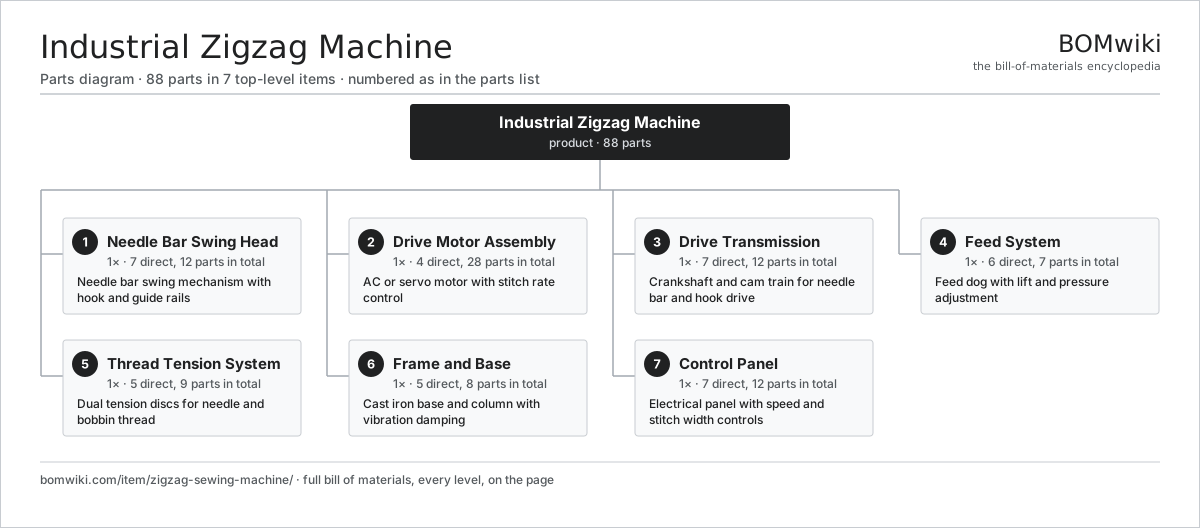
| # | Part | Qty | What it does |
|---|---|---|---|
| 1 | Needle Bar Swing Head 7 parts | 1× | Needle bar swing mechanism with hook and guide rails |
| 2 | Drive Motor Assembly 4 parts | 1× | AC or servo motor with stitch rate control |
| 3 | Drive Transmission 7 parts | 1× | Crankshaft and cam train for needle bar and hook drive |
| 4 | Feed System 6 parts | 1× | Feed dog with lift and pressure adjustment |
| 5 | Thread Tension System 5 parts | 1× | Dual tension discs for needle and bobbin thread |
| 6 | Frame and Base 5 parts | 1× | Cast iron base and column with vibration damping |
| 7 | Control Panel 7 parts | 1× | Electrical panel with speed and stitch width controls |
3D model
No 3D model yet. Have a CAD file of this? Add a 3D model. STL renders right on this page; STEP, FreeCAD, and OpenSCAD sources are welcome too (openly licensed, like all 3D models on BOMwiki).
Build & assembly graph
expand / collapse · shared sub-assemblies converge · links to related products · est. labourTap an assembly to expand/collapse · tap a part to open it · use “Open page” for any node · drag to pan, scroll to zoom.
Bill of materials for Industrial Zigzag Machine
7 top-level lines · 52 rows shown · 88 parts total · indented to 3 levels| # | Item / sub-assembly | Part no. | Qty/assy | Ext. qty | Parts | Type |
|---|---|---|---|---|---|---|
| 1 | Needle Bar Swing Head 7 parts | zigzag-sewing-machine-head | 1× | 1 | 12 | assembly |
| 1.1 | Swing Needle Bar | zigzag-sewing-machine-needle-bar | 1× | 1 | · | part |
| 1.2 | Rotating Hook | zigzag-sewing-machine-hook | 1× | 1 | · | part |
| 1.3 | Swing Cam | zigzag-sewing-machine-swing-cam | 1× | 1 | · | part |
| 1.4 | Hook Drive Cam | zigzag-sewing-machine-hook-cam | 1× | 1 | · | part |
| 1.5 | Ball Bearing | ball-bearing | 5× | 5 | · | part |
| 1.6 | Needle Guide Rail | zigzag-sewing-machine-guide-rail | 2× | 2 | · | part |
| 1.7 | Fastener Set | fastener-set | 1× | 1 | · | part |
| 2 | Drive Motor Assembly 4 parts | zigzag-sewing-machine-motor | 1× | 1 | 28 | assembly |
| 2.1 | Servo Motor 4 parts | servo-motor | 1× | 1 | 24 | assembly |
| 2.1.1 | Stator Assembly 3 parts + deeper › | stator-assembly | 1× | 1 | 3 | assembly |
| 2.1.2 | Rotor Assembly 4 parts + deeper › | rotor-assembly | 1× | 1 | 19 | assembly |
| 2.1.3 | Encoder | encoder | 1× | 1 | · | part |
| 2.1.4 | Motor Housing | motor-housing | 1× | 1 | · | part |
| 2.2 | Encoder | encoder | 1× | 1 | · | part |
| 2.3 | Ball Bearing | ball-bearing | 2× | 2 | · | part |
| 2.4 | Fastener Set | fastener-set | 1× | 1 | · | part |
| 3 | Drive Transmission 7 parts | zigzag-sewing-machine-transmission | 1× | 1 | 12 | assembly |
| 3.1 | Drive Crankshaft | zigzag-sewing-machine-crankshaft | 1× | 1 | · | part |
| 3.2 | Gearbox Housing | gearbox-housing | 1× | 1 | · | part |
| 3.3 | Ball Bearing | ball-bearing | 4× | 4 | · | part |
| 3.4 | Oil Seal | oil-seal | 3× | 3 | · | part |
| 3.5 | Drive Belt | drive-belt | 1× | 1 | · | part |
| 3.6 | Stitch Length Stop | zigzag-sewing-machine-stitch-length-stop | 1× | 1 | · | part |
| 3.7 | Fastener Set | fastener-set | 1× | 1 | · | part |
| 4 | Feed System 6 parts | zigzag-sewing-machine-feed | 1× | 1 | 7 | assembly |
| 4.1 | Feed Dog | zigzag-sewing-machine-feed-dog | 1× | 1 | · | part |
| 4.2 | Feed Drive Cam | zigzag-sewing-machine-feed-cam | 1× | 1 | · | part |
| 4.3 | Feed Connecting Lever | zigzag-sewing-machine-feed-lever | 1× | 1 | · | part |
| 4.4 | Coil Spring | coil-spring | 2× | 2 | · | part |
| 4.5 | Feed Dog Lifter | zigzag-sewing-machine-feed-lifter | 1× | 1 | · | part |
| 4.6 | Fastener Set | fastener-set | 1× | 1 | · | part |
| 5 | Thread Tension System 5 parts | zigzag-sewing-machine-tension | 1× | 1 | 9 | assembly |
| 5.1 | Needle Tension Disc | zigzag-sewing-machine-needle-tension-disc | 2× | 2 | · | part |
| 5.2 | Bobbin Tension Spring | zigzag-sewing-machine-bobbin-tension | 1× | 1 | · | part |
| 5.3 | Tension Control Knob | zigzag-sewing-machine-tension-adjust-knob | 2× | 2 | · | part |
| 5.4 | Thread Guide Eyelet | zigzag-sewing-machine-thread-guide | 3× | 3 | · | part |
| 5.5 | Fastener Set | fastener-set | 1× | 1 | · | part |
| 6 | Frame and Base 5 parts | zigzag-sewing-machine-frame | 1× | 1 | 8 | assembly |
| 6.1 | Machine Base Bed | zigzag-sewing-machine-base | 1× | 1 | · | part |
| 6.2 | Support Column | zigzag-sewing-machine-column | 1× | 1 | · | part |
| 6.3 | Throat Plate | zigzag-sewing-machine-work-plate | 1× | 1 | · | part |
| 6.4 | Vibration Isolator Foot | zigzag-sewing-machine-vibration-foot | 4× | 4 | · | part |
| 6.5 | Fastener Set | fastener-set | 1× | 1 | · | part |
| 7 | Control Panel 7 parts | zigzag-sewing-machine-controls | 1× | 1 | 12 | assembly |
| 7.1 | Control Panel Enclosure | zigzag-sewing-machine-control-box | 1× | 1 | · | part |
| 7.2 | Relay | relay | 3× | 3 | · | part |
| 7.3 | Microcontroller | mcu | 1× | 1 | · | part |
| 7.4 | Bare PCB | pcb-bare | 1× | 1 | · | part |
| 7.5 | Stitch Width Dial | zigzag-sewing-machine-stitch-width-dial | 1× | 1 | · | part |
| 7.6 | Connector | connector | 4× | 4 | · | part |
| 7.7 | Fastener Set | fastener-set | 1× | 1 | · | part |
Something wrong in this list? Report a problem with this BOM.
Related products
same domain, ranked by shared parts Automatic Fabric Cutting Machine
1,695 parts · shares 5 with this page
Automatic Winding Machine
288 parts · shares 5 with this page
Blindstitch Hemming Machine
67 parts · shares 5 with this page
Automatic Fabric Cutting Machine
1,695 parts · shares 5 with this page
Automatic Winding Machine
288 parts · shares 5 with this page
Blindstitch Hemming Machine
67 parts · shares 5 with this page
 Chainstitch Machine
82 parts · shares 5 with this page
Feed-Off-the-Arm Machine
87 parts · shares 5 with this page
Chainstitch Machine
82 parts · shares 5 with this page
Feed-Off-the-Arm Machine
87 parts · shares 5 with this page
 Industrial Quilting Machine
1,090 parts · shares 5 with this page
Industrial Quilting Machine
1,090 parts · shares 5 with this page
Sourcing: possible vendors
Browse the supplier directory → Prices, MOQ, and lead times are algorithmic estimates, not quotes, and not claims about these companies. Company mappings are curated by keyword; est. price band $10k–$1M. How estimates work| Vendor | HQ | Specialty | MOQ | Lead time |
|---|---|---|---|---|
|
🇨🇭Rieter
rieter.com ↗
|
Winterthur, CH | Spinning machinery | 10 units | 14–24 wks |
| truetzschler.com ↗ | Mönchengladbach, DE | Textile machinery | 10 units | 14–24 wks |
|
🇧🇪Picanol
picanol.be ↗
|
Ypres, BE | Weaving machines | 10 units | 14–24 wks |
| karlmayer.com ↗ | Obertshausen, DE | Warp knitting machines | 10 units | 14–24 wks |
|
🇨🇭Saurer
saurer.com ↗
|
Arbon, CH | Spinning & embroidery | 10 units | 14–24 wks |
1,215-word article