Non-Rigid Airship (Blimp)
ProductOverview
A non-rigid airship, or blimp, has no internal skeleton. Its 58 m hull is a fabric Envelope holding about 5,740 m³ of helium, and the hull keeps its streamlined shape purely because the gas inside is kept at a slight overpressure, typically 300 to 500 Pa, about the pressure a hand exerts resting on a table. Everything else hangs from or is glued to this pressurised bag: the Gondola below, two Engine Nacelle units on its sides, and four fins of the Empennage at the tail.
Helium provides roughly 1 kg of lift per cubic metre at sea level, so the full envelope lifts in the order of 5.5 tonnes, enough for structure, fuel, two crew and seven passengers. Unlike an aeroplane the ship is flown close to neutral buoyancy; the engines mostly provide airspeed for control authority and a modest dynamic lift margin, which is why two 157 kW piston engines suffice for a vehicle of this size and why endurance runs past twelve hours.
Envelope and pressure management
The hull is assembled from heat-welded Envelope Panel gores of polyester laminate with an outer Tedlar film for UV and weather resistance. Modern laminates leak helium slowly enough that topping-up is a maintenance event, not a daily task. The gondola's weight does not hang from the bottom fabric directly: steel Suspension Cable runs lead up inside the hull to Catenary Curtain panels bonded along the top, spreading the load over a large fabric area. At the bow, the Nose Cone with its radial Nose Batten Set stiffens the envelope against ram pressure in flight and carries the Mooring Probe.
Pressure management is the defining engineering problem of a blimp. Helium expands as the ship climbs and contracts as it descends or cools; if the envelope pressure fell to zero the hull would buckle and become uncontrollable, and if it rose too high the fabric would be overstressed. The solution is the Ballonet: two air bags inside the envelope, fore and aft, together around a quarter of hull volume. On climb, automatic Air Valve units vent ballonet air as the helium expands; on descent, Air Scoop intakes in the propeller wash and electric Blower Motor units refill them. The Pressure Controller sequences all of this against Pressure Sensor readings, and Helium Valve relief valves protect the hull if everything else fails. The altitude at which the ballonets are fully empty is the pressure ceiling, about 3,000 m for this ship. Having two ballonets adds a control trick: a Damper Valve can bias air fore or aft, shifting the centre of gravity for pitch trim.
Propulsion and control
Each nacelle carries a six-cylinder air-cooled Piston Engine driving a constant-speed Propeller that can be reversed, the main brake available to a vehicle with this much momentum and this little drag. Control surfaces are conventional but far away: Rudder and Elevator panels on the fabric-covered Fin structures are driven by Control Cable runs of 30 m or more from the gondola. The fins themselves are glued and laced to the envelope and braced by Fin Guy Wire cables into reinforced patches; on a hull with no frame, every concentrated load must be spread into fabric gradually.
At low speed the aerodynamic surfaces lose authority, which makes the last 10 m of a landing the hardest part of flying a blimp. Pilots manage buoyancy (slightly heavy for landing), power, and reversible propellers together, dropping Handling Line ropes to a ground crew that walks the ship to the mast. Once the Mooring Probe locks into the mast cup, the ship weathervanes freely around it, a moored blimp is parked facing the wind, not tied down.
Gondola and systems
The Gondola Frame of welded tube carries the engines, the single swivelling Landing Wheel, and a cabin enclosed by the Gondola Shell with a wrap-around Windscreen suited to the low-and-slow sightseeing and surveillance missions blimps actually fly. Fuel lives in two underfloor tanks of the Fuel System; burning fuel makes the ship lighter over a long flight, which the ballonets and a small helium valve budget absorb.
The Avionics fit is light-aircraft standard, VHF radios, a Mode-S Transponder, glass Flight Display panels, plus one instrument no aeroplane carries: the Envelope Monitor, showing hull pressure, ballonet fullness and helium purity. Purity matters because air slowly diffuses into the helium; below about 93% the lift loss becomes operationally significant and the gas is re-purified.
Operations
Blimps trade speed for endurance and steadiness. At a 50 km/h cruise they are slower than highway traffic, but they hold station for hours with negligible fuel burn, which keeps the type alive for advertising, broadcast camera work and persistent surveillance. The operational cost centre is not the air vehicle but the ground: mast mooring, a handling crew of four to fifteen, and a hull that must stay pressurised and monitored even when parked. An emergency Rip Panel allows rapid deflation if a moored ship breaks loose, destroying lift deliberately being safer than a free-flying unmanned hull.
Non-Rigid Airship (Blimp) parts and their functions
8 top-level parts · 336 parts in total · full bill of materials below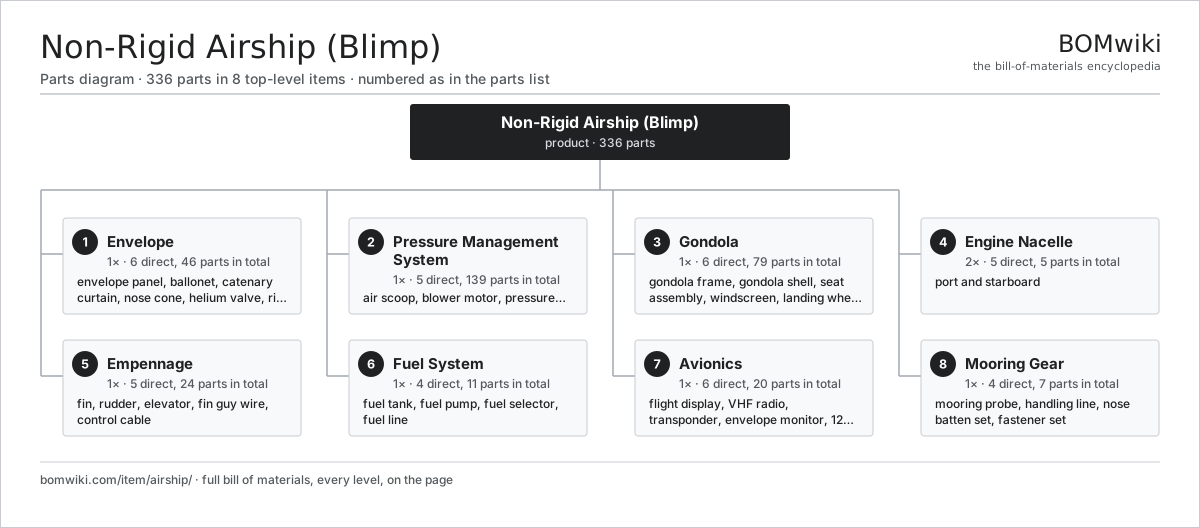
| # | Part | Qty | What it does |
|---|---|---|---|
| 1 | Envelope 6 parts | 1× | Pressurised fabric hull of about 5,700 m3 holding the helium lifting gas. |
| 2 | Pressure Management System 5 parts | 1× | Blowers, valves and sensors holding envelope overpressure near 300-500 Pa in all flight states. |
| 3 | Gondola 6 parts | 1× | Crew and passenger car suspended beneath the envelope. |
| 4 | Engine Nacelle 5 parts | 2× | port and starboard |
| 5 | Empennage 5 parts | 1× | Four fabric-covered fins in X or cruciform layout glued and laced to the envelope tail. |
| 6 | Fuel System 4 parts | 1× | Gondola fuel tanks and plumbing feeding both engines. |
| 7 | Avionics 6 parts | 1× | Communication, navigation and envelope monitoring instruments in the gondola. |
| 8 | Mooring Gear 4 parts | 1× | Nose hardware and lines for mast mooring and ground handling. |
3D model
No 3D model yet. Have a CAD file of this? Add a 3D model. STL renders right on this page; STEP, FreeCAD, and OpenSCAD sources are welcome too (openly licensed, like all 3D models on BOMwiki).
Build & assembly graph
expand / collapse · shared sub-assemblies converge · links to related products · est. labourTap an assembly to expand/collapse · tap a part to open it · use “Open page” for any node · drag to pan, scroll to zoom.
Bill of materials for Non-Rigid Airship (Blimp)
8 top-level lines · 67 rows shown · 336 parts total · indented to 3 levels| # | Item / sub-assembly | Part no. | Qty/assy | Ext. qty | Parts | Type |
|---|---|---|---|---|---|---|
| 1 | Envelope 6 parts | airship-envelope | 1× | 1 | 46 | assembly |
| 1.1 | Envelope Panel | airship-envelope-panel | 30× | 30 | · | part |
| 1.2 | Ballonet 4 parts | airship-ballonet | 2× | 2 | 5 | assembly |
| 1.2.1 | Ballonet Fabric | airship-ballonet-fabric | 1× | 2 | · | part |
| 1.2.2 | Air Valve | airship-air-valve | 2× | 4 | · | part |
| 1.2.3 | Blower Motor | blower-motor | 1× | 2 | · | part |
| 1.2.4 | O-Ring Set | oring-set | 1× | 2 | · | part |
| 1.3 | Catenary Curtain | airship-catenary-curtain | 2× | 2 | · | part |
| 1.4 | Nose Cone | airship-nose-cone | 1× | 1 | · | part |
| 1.5 | Helium Valve | airship-helium-valve | 2× | 2 | · | part |
| 1.6 | Rip Panel | airship-rip-panel | 1× | 1 | · | part |
| 2 | Pressure Management System 5 parts | airship-pressure-system | 1× | 1 | 139 | assembly |
| 2.1 | Air Scoop | airship-air-scoop | 2× | 2 | · | part |
| 2.2 | Blower Motor | blower-motor | 2× | 2 | · | part |
| 2.3 | Pressure Sensor | pressure-sensor | 3× | 3 | · | part |
| 2.4 | Pressure Controller 5 parts | airship-pressure-controller | 1× | 1 | 130 | assembly |
| 2.4.1 | Bare PCB | pcb-bare | 1× | 1 | · | part |
| 2.4.2 | Microcontroller | mcu | 1× | 1 | · | part |
| 2.4.3 | Relay | relay | 4× | 4 | · | part |
| 2.4.4 | SMD Passive (R/C/L) | smd-passives | 120× | 120 | · | part |
| 2.4.5 | Connector | connector | 4× | 4 | · | part |
| 2.5 | Damper Valve | airship-damper-valve | 2× | 2 | · | part |
| 3 | Gondola 6 parts | airship-gondola | 1× | 1 | 79 | assembly |
| 3.1 | Gondola Frame | airship-gondola-frame | 1× | 1 | · | part |
| 3.2 | Gondola Shell | airship-gondola-shell | 1× | 1 | · | part |
| 3.3 | Seat Assembly 5 parts | seat-assembly | 9× | 9 | 7 | assembly |
| 3.3.1 | Seat Frame | seat-frame | 1× | 9 | · | part |
| 3.3.2 | Seat Foam | seat-foam | 2× | 18 | · | part |
| 3.3.3 | Seat Cover | seat-cover | 1× | 9 | · | part |
| 3.3.4 | Seat Motor | seat-motor | 2× | 18 | · | part |
| 3.3.5 | Seat Heater Mat | seat-heater | 1× | 9 | · | part |
| 3.4 | Windscreen | airship-windscreen | 1× | 1 | · | part |
| 3.5 | Landing Wheel | airship-landing-wheel | 1× | 1 | · | part |
| 3.6 | Suspension Cable | airship-suspension-cable | 12× | 12 | · | part |
| 4 | Engine Nacelle 5 parts | airship-engine-nacelle | 2× | 2 | 5 | assembly |
| 4.1 | Piston Engine | airship-piston-engine | 1× | 2 | · | part |
| 4.2 | Propeller | airship-propeller | 1× | 2 | · | part |
| 4.3 | Engine Mount | airship-engine-mount | 1× | 2 | · | part |
| 4.4 | Engine Cowling | airship-engine-cowling | 1× | 2 | · | part |
| 4.5 | Radiator | radiator | 1× | 2 | · | part |
| 5 | Empennage 5 parts | airship-empennage | 1× | 1 | 24 | assembly |
| 5.1 | Fin | airship-fin | 4× | 4 | · | part |
| 5.2 | Rudder | airship-rudder-surface | 2× | 2 | · | part |
| 5.3 | Elevator | airship-elevator-surface | 2× | 2 | · | part |
| 5.4 | Fin Guy Wire | airship-fin-guy-wire | 8× | 8 | · | part |
| 5.5 | Control Cable | airship-control-cable | 8× | 8 | · | part |
| 6 | Fuel System 4 parts | airship-fuel-system | 1× | 1 | 11 | assembly |
| 6.1 | Fuel Tank | airship-fuel-tank | 2× | 2 | · | part |
| 6.2 | Fuel Pump | airship-fuel-pump | 2× | 2 | · | part |
| 6.3 | Fuel Selector | airship-fuel-selector | 1× | 1 | · | part |
| 6.4 | Fuel Line | airship-fuel-line | 6× | 6 | · | part |
| 7 | Avionics 6 parts | airship-avionics | 1× | 1 | 20 | assembly |
| 7.1 | Flight Display 4 parts | airship-flight-display | 2× | 2 | 6 | assembly |
| 7.1.1 | LCD Panel | lcd-panel | 1× | 2 | · | part |
| 7.1.2 | Bare PCB | pcb-bare | 1× | 2 | · | part |
| 7.1.3 | Microcontroller | mcu | 1× | 2 | · | part |
| 7.1.4 | Connector | connector | 3× | 6 | · | part |
| 7.2 | VHF Radio | airship-vhf-radio | 2× | 2 | · | part |
| 7.3 | Transponder | airship-transponder | 1× | 1 | · | part |
| 7.4 | Envelope Monitor | airship-envelope-monitor | 1× | 1 | · | part |
| 7.5 | 12 V Battery | lv-battery | 2× | 2 | · | part |
| 7.6 | Wire Bundle | wire-bundle | 2× | 2 | · | part |
| 8 | Mooring Gear 4 parts | airship-mooring-gear | 1× | 1 | 7 | assembly |
| 8.1 | Mooring Probe | airship-mooring-probe | 1× | 1 | · | part |
| 8.2 | Handling Line | airship-handling-line | 4× | 4 | · | part |
| 8.3 | Nose Batten Set | airship-nose-batten-set | 1× | 1 | · | part |
| 8.4 | Fastener Set | fastener-set | 1× | 1 | · | part |
Something wrong in this list? Report a problem with this BOM.
Related products
same domain, ranked by shared parts Ultralight Aircraft
455 parts · shares 10 with this page
Ultralight Aircraft
455 parts · shares 10 with this page
 Gyroplane
168 parts · shares 9 with this page
Gyroplane
168 parts · shares 9 with this page
 Amphibious Seaplane
163 parts · shares 9 with this page
Amphibious Seaplane
163 parts · shares 9 with this page
 Helicopter
16,033 parts · shares 10 with this page
Helicopter
16,033 parts · shares 10 with this page
 Sailplane Glider
139 parts · shares 9 with this page
Sailplane Glider
139 parts · shares 9 with this page
 Commercial Airliner
604,977 parts · shares 9 with this page
Commercial Airliner
604,977 parts · shares 9 with this page
Sourcing: possible vendors
Browse the supplier directory → Prices, MOQ, and lead times are algorithmic estimates, not quotes, and not claims about these companies. Company mappings are curated by keyword; est. price band $50k–$300M. How estimates work| Vendor | HQ | Specialty | MOQ | Lead time |
|---|---|---|---|---|
|
🇺🇸Boeing
boeing.com ↗
|
Arlington, US | Aerospace OEM | made to order | 40–80 wks |
|
🇫🇷Airbus
airbus.com ↗
|
Toulouse, FR | Aerospace OEM | made to order | 40–80 wks |
| lockheedmartin.com ↗ | Bethesda, US | Aerospace & defense | made to order | 40–80 wks |
|
🇧🇷Embraer
embraer.com ↗
|
São José dos Campos, BR | Aircraft OEM | made to order | 40–80 wks |
| txtav.com ↗ | Wichita, US | Aircraft OEM | made to order | 40–80 wks |
889-word article