BOMwiki the bill-of-materials encyclopedia

Analytical Balance Product

Overview

The analytical balance is a precision laboratory instrument that determines mass to a readability of 0.1 mg within a draft-shielded weighing chamber. It is the standard tool for preparing standards, weighing reagents for quantitative analysis, and gravimetric calibration. Sub-milligram resolution at 220 g full scale demands isolation from air currents, vibration, thermal gradients, and electrostatic charge, which shapes nearly every element of its construction.

Unlike a spring or strain-gauge scale, the balance never deflects under load. The Weigh Cell holds the pan at a fixed null position and reports the electrical effort required to keep it there, giving high resolution and excellent long-term stability.

How it works

A sample placed on the Pan Assembly couples through the draft-shield floor to a monolithic flexure lever inside the weigh cell. As the load tries to deflect the lever, the Position Sensor detects the displacement and the control loop increases current through the Force Coil, which sits in the field of a permanent magnet. The current needed to restore the lever exactly to its null is proportional to the applied mass.

That current is digitized by the Main Board through a high-resolution converter, temperature-compensated against the on-board sensor, and shown on the Display Module. Because the magnet's strength and the local gravity both affect the result, the balance performs automatic span calibration: the Calibration Mechanism lowers an internal reference weight onto the lever and the system corrects its scale factor.

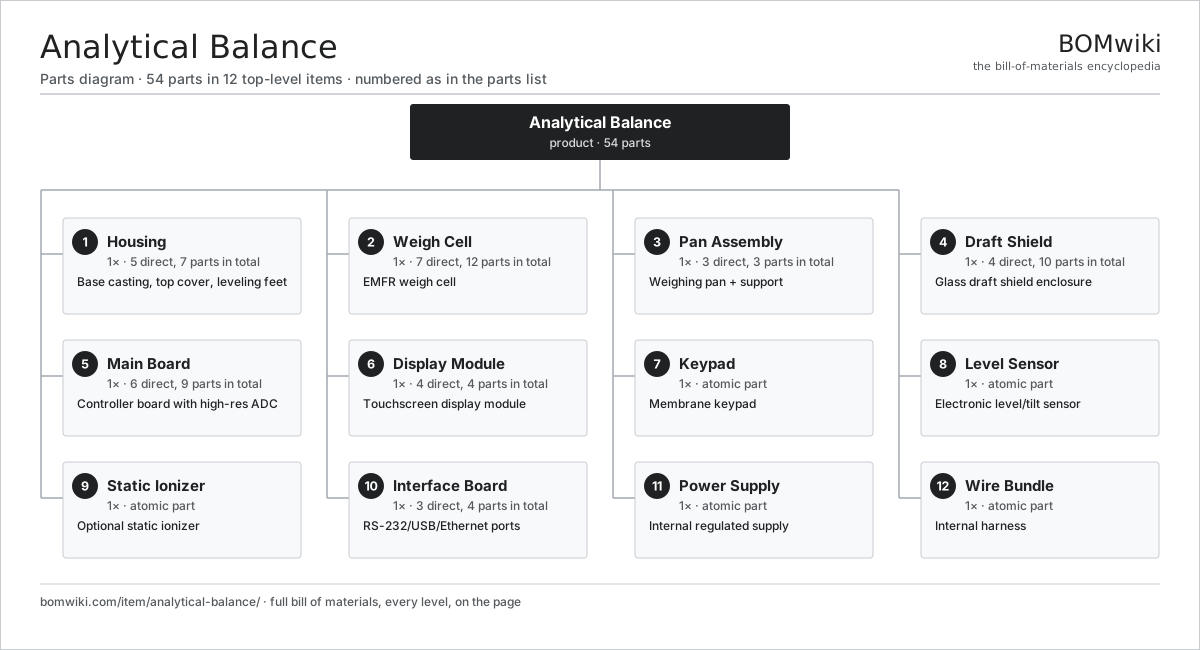
The Draft Shield encloses the pan with sliding glass doors so that air movement does not register as drifting mass. The Housing anchors the cell on a die-cast base and carries the leveling feet and bubble level; the electronic level sensor warns the operator if the instrument tips out of plane, which would otherwise bias the reading. An optional static ionizer neutralizes charge on plastic vessels and powders, while the Interface Board exports results to a LIMS over RS-232, USB, or Ethernet.', },

'autoclave': { specs: [ ['Type', 'Benchtop pre/post-vacuum steam sterilizer'], ['Chamber volume', '23 L'], ['Chamber material', '316L stainless steel'], ['Sterilization temperature', '121 °C and 134 °C'], ['Working pressure', '~2.1 bar (134 °C)'], ['Cycle types', 'Wrapped, unwrapped, porous, liquids, prion'], ['Hold time', '3–30 min, programmable'], ['Vacuum stages', 'Pre-vacuum air removal + post-vacuum drying'], ['Air filtration', '0.2 µm sterile air intake'], ['Temperature sensing', 'Dual PT100 RTD + drain thermocouple'], ['Documentation', 'Integrated thermal cycle printer'], ['Door', 'Radial-locking swing door with pressure interlock'], ['Power', '230 VAC, ~2.6 kW heaters'], ], body: '## Overview

The autoclave is a pressure-vessel sterilizer that exposes loads to saturated steam at 121–134 °C to destroy bacteria, viruses, fungi, and spores. It is used to sterilize surgical instruments, glassware, culture media, and biohazardous waste. Reaching temperatures above water's atmospheric boiling point requires the chamber to be sealed and pressurized, so the design centers on containing steam safely and removing the air that would otherwise shield contaminated surfaces.

Construction

The Pressure Vessel & Door is a welded 316L stainless chamber closed by a forged swing door. The Radial Locking Mechanism mechanism rotates a breech ring that drives hardened lugs behind the chamber flange, clamping the door against an O-ring seal, while the pressure safety interlock physically prevents the door from unlocking until the chamber has vented. The Chamber Jacket & Insulation wraps the chamber in mineral wool to cut heat loss and reduce burn risk.

The Heating System system uses immersion elements that boil feed water from the reservoir into steam, guarded by a one-shot thermal fuse against dry-firing. The Steam & Plumbing Circuit circuit fills, charges, and drains the chamber through a diaphragm pump, solenoid valves, a steam trap that bleeds condensate while holding live steam, and a 0.2 µm filter that sterilizes admitted air.

How it works

A cycle begins when the Pressure System draws a pre-vacuum, pulling cool air out of the load so steam can reach every surface; trapped air is the main cause of sterilization failure. Steam then floods the chamber and the Control System system holds the set temperature for the programmed time, switching heaters and pumps through solid-state relays while dual RTDs and a drain-line thermocouple confirm that even the coldest point reaches temperature. The relief valve bounds chamber pressure throughout. After the hold, a post-vacuum phase evaporates residual moisture to dry the load. The Cycle Log Printer logs the full time, temperature, and pressure trace for each run, and the Trays & Rack rack carries perforated trays that let steam circulate freely around the instruments.', },

'centrifuge': { specs: [ ['Type', 'Refrigerated benchtop centrifuge'], ['Maximum speed', '15,000 rpm'], ['Maximum RCF', '21,500 × g'], ['Drive', 'Brushless DC (BLDC) spindle motor'], ['Rotor', 'Interchangeable fixed-angle, 24 × 1.5/2.0 mL'], ['Temperature range', '−10 °C to +40 °C'], ['Temperature setpoint', '4 °C typical for cold runs'], ['Imbalance protection', 'Accelerometer auto-abort'], ['Lid safety', 'Solenoid lock + interlock cutout'], ['Containment', 'Steel burst-containment armor ring'], ['Timer', '1 s to 99 h, plus continuous'], ['Acceleration profiles', 'Programmable ramp up/down'], ['Power', '230 VAC'], ], body: '## Overview

The laboratory centrifuge separates the components of a liquid sample by spinning it at high speed, so denser particles such as cells, organelles, or precipitates migrate outward under centrifugal force. This refrigerated benchtop model reaches 15,000 rpm and up to roughly 21,500 × g while holding samples near 4 °C, which is essential for protein, nucleic acid, and live-cell work where heat would degrade the sample. Relative centrifugal force (RCF, in units of g) rather than raw rpm defines the separation, since it accounts for the rotor radius.

Construction

The Drive Motor is a brushless DC spindle motor on precision bearings, isolated by a damped mount that absorbs the transient forces of an imperfectly balanced load. It turns an interchangeable Fixed-Angle Rotor, a bored aluminum body that seats sample tubes at a fixed angle, sealed by an aerosol-tight cap and fitted with adapters that size each bore to the tube.

Containment dominates the Housing & Lid: a heavy steel armor ring surrounds the spin bowl to arrest a rotor burst, the lid latches over a solenoid lock that holds it shut throughout a run, and an interlock switch cuts drive power the instant the lid opens.

How it works

The Drive Electronics commutate the BLDC motor and continuously watch an accelerometer-based imbalance sensor; if vibration exceeds a threshold, indicating an unevenly loaded rotor, the controller aborts the run before the rotor can damage the bearings or fail. Speed feedback comes from a Hall sensor on the spindle. To keep heat-sensitive samples cold, the Refrigeration System system runs a vapor-compression loop whose evaporator coil is bonded around the spin bowl, with a hermetic compressor, condenser, and expansion valve maintaining the chamber setpoint against the heat that windage generates at speed. The operator sets speed (or RCF), time, and temperature on the Control Panel, a front touchscreen backed by membrane start/stop keys.', },

'fume-hood': { specs: [ ['Type', 'Ducted bypass chemical fume hood'], ['Nominal width', '1.8 m (6 ft)'], ['Target face velocity', '0.5 m/s (100 fpm)'], ['Sash type', 'Vertical-rising tempered safety glass'], ['Sash counterbalance', 'Cable-and-counterweight'], ['Liner material', 'Epoxy / phenolic resin'], ['Worktop', 'Dished epoxy resin with raised lip'], ['Blower', 'Direct-drive centrifugal, coated scroll'], ['Airflow monitor', 'Thermal anemometer with audible/visual alarm'], ['Baffles', 'Adjustable top/center/bottom slots'], ['Services', 'Gas, water, vacuum, GFCI outlets'], ['Lighting', 'Sealed vapor-proof LED fixture'], ['Exhaust', 'Round collar to building duct, with damper'], ], body: '## Overview

The fume hood is a ventilated enclosure that protects laboratory workers from inhaling toxic vapors, fumes, and aerosols by drawing contaminated air away from the operator and exhausting it outside the building. It is the primary engineering control for chemical handling. The hood works by maintaining an inward airflow at the open sash, the face velocity, that is fast enough to capture contaminants but not so fast that it creates turbulence pulling them back out.

Construction

The Superstructure is a welded steel frame clad in chemical-resistant epoxy or phenolic liner walls, with a dished epoxy worktop, a cup sink, and an adjustable Baffle Panel Assembly panel set whose slots shape airflow evenly across the work zone. A sealed LED Interior Light Fixture illuminates the chamber from behind safety glass so the lamp never contacts fumes.

The Sash Assembly is a vertical-rising tempered-glass pane on guided tracks, balanced by a cable-and-counterweight system so it stays at any height, with a stop that limits the open area to the rated face velocity. The Base Cabinet supports the superstructure and houses service plumbing.

How it works

Air entering at the sash sweeps across the work surface, through the baffle slots, into the Exhaust Connection plenum, and out a round collar to the building stack. The Exhaust Blower, a direct-drive centrifugal wheel in a coated scroll housing, provides the suction; an in-line Exhaust Damper balances and throttles the flow.

Containment is verified continuously by the Airflow Monitor & Controller, a thermal-anemometer sensor at the sash plane feeding a controller that displays face velocity and triggers an audible and visual alarm if flow drops below the safe threshold. Plumbed Service Fixtures bring gas, water, and vacuum to gooseneck fixtures inside the hood, with GFCI receptacles mounted on the face so electrical connections stay outside the contaminated zone.', },

'mass-spectrometer': { specs: [ ['Type', 'LC-MS triple-stage quadrupole (ESI)'], ['Ionization', 'Heated electrospray (ESI)'], ['Mass analyzer', 'Quadrupole mass filter'], ['m/z range', '5–2000 Th'], ['Resolution', 'Unit (0.7 Th FWHM)'], ['Scan speed', 'Up to 12,000 Th/s'], ['Detector', 'Conversion dynode + electron multiplier'], ['Vacuum', 'Rotary-vane backing + 2× turbomolecular'], ['Analyzer pressure', '~10⁻⁵ mbar'], ['Process gas', 'Nitrogen (nebulizer/desolvation), argon (collision)'], ['Desolvation temperature', 'Up to 600 °C'], ['Spray voltage', '0.5–5.5 kV'], ['Cooling', 'Recirculating liquid chiller'], ['Control', 'Ethernet/USB link to acquisition PC'], ], body: '## Overview

The mass spectrometer identifies and quantifies chemical compounds by measuring the mass-to-charge ratio (m/z) of ions derived from a sample. This LC-MS instrument couples to a liquid chromatograph: the LC separates a mixture in time, and the mass spectrometer ionizes and weighs each eluting component, giving both the structure and the concentration of analytes down to trace levels. It is indispensable in pharmaceutical analysis, proteomics, toxicology, and environmental testing.

How it works

Liquid eluent enters the Electrospray Ion Source, where a heated electrospray needle held at several kilovolts disperses it into a charged aerosol. A curtain of heated desolvation nitrogen evaporates the solvent, and the bare ions pass through a sampling cone and skimmer into the first vacuum stage. The Ion Optics then use an RF-only multipole guide and electrostatic lenses to confine the diverging ion cloud and focus it into a tight beam.

The beam enters the Quadrupole Mass Analyzer, four hyperbolic rods driven by combined RF and DC voltages from the RF generator. Only ions within a narrow m/z window have stable trajectories and reach the far end; the rest collide with the rods. By ramping the voltages, the instrument scans across the mass range. Surviving ions strike the Electron Multiplier Detector, where a conversion dynode and electron multiplier turn each ion into a measurable current pulse that the preamplifier conditions for counting.

Construction

The entire ion path must be under high vacuum so ions travel without colliding with air. The Vacuum System system stages this: a rotary-vane backing pump roughs the chamber and two turbomolecular pumps pull the analyzer region down to roughly 10⁻⁵ mbar, with gauges and isolation valves dividing the pressure drop. The Gas Supply regulates nitrogen for the source and meters argon collision gas, while the Control Electronics provide programmable high-voltage and RF power and a fast data-acquisition board that synchronizes the quadrupole scan to detector counts. A recirculating chiller in the Cooling System system removes heat from the turbo pumps and RF stage, and the Control Interface interface links the instrument to the acquisition PC.', },

'microscope': { specs: [ ['Type', 'Compound upright trinocular microscope'], ['Illumination', 'Köhler transmitted-light LED'], ['Objectives', '4×, 10×, 40×, 60×, 100× (oil)'], ['Eyepieces', '10× wide-field'], ['Total magnification', '40×–1000×'], ['Head', 'Trinocular (binocular + camera port)'], ['Condenser', 'Abbe, adjustable aperture and height'], ['Nosepiece', 'Five-position ball-detented turret'], ['Stage', 'Mechanical XY with coaxial drive'], ['Focus', 'Coarse/fine coaxial, dovetail-guided'], ['Camera port', 'C-mount with digital camera module'], ['Diopter', 'Adjustable on one ocular'], ['Power', 'Mains, switch-mode supply'], ], body: '## Overview

The compound microscope magnifies small specimens up to about 1000× by passing light through the sample and a series of lenses. This trinocular laboratory model adds a third optical path to the binocular eyepieces, feeding a digital camera so the live image can be captured or displayed. It is a workhorse for histology, microbiology, and materials inspection. Köhler illumination, the defining feature of a research-grade stand, produces an evenly lit field free of any image of the lamp filament.

Construction

Everything mounts on the Stand & Frame, a heavy die-cast base and rigid C-shaped arm that gives the instrument a low center of gravity and holds the optical groups in fixed alignment. The specimen sits on the Mechanical Stage, a mechanical XY platform whose coaxial knobs translate the slide precisely under the objective through a rack and pinion. The Focus Mechanism mechanism raises and lowers the stage on a dovetail slide with stacked coarse and fine knobs, the fine knob geared down for micron-level adjustment.

How it works

The Illumination System system sets up the Köhler path: an LED lamp feeds a collector lens and field diaphragm, and the Condenser Assembly cones that light onto the slide with an adjustable aperture that controls contrast, resolution, and depth of field. Light passing through the specimen enters whichever objective is clicked into place on the Revolving Nosepiece, a detented turret carrying parfocal objectives from 4× to 100×, each correcting aberrations for a sharp magnified image.

The magnified beam travels up to the Trinocular Head, where a prism set splits it between the two eyepieces and the third camera tube. Through the Camera Port port, a C-mount adapter projects that third path onto a digital image sensor, and the optional Digital Display shows the live view on an LCD. A switch-mode power supply drives the lamp, camera, and display from mains.', },

'pcr-thermocycler': { specs: [ ['Type', 'Real-time qPCR thermal cycler'], ['Format', '96-well'], ['Block material', 'Silver-plated aluminum'], ['Temperature range', '4 °C to 99 °C'], ['Ramp rate', 'Up to ~6 °C/s'], ['Thermal element', 'Stacked Peltier modules'], ['Temperature uniformity', '±0.3 °C across block'], ['Sensing', 'Embedded platinum RTDs'], ['Heated lid', 'Up to 110 °C, motorized clamp'], ['Optical channels', 'Up to 6 fluorophore channels'], ['Detection', 'LED excitation + CMOS/photodiode readout'], ['Detection mode', 'Per-cycle fluorescence (real-time)'], ['Interfaces', 'USB, Ethernet (LIMS)'], ], body: '## Overview

The PCR thermocycler amplifies specific DNA sequences by repeatedly cycling a reaction through denaturation, annealing, and extension temperatures, doubling the target with each cycle. This real-time (qPCR) model adds an optical system that reads fluorescence after every cycle, so the amount of product is quantified as it accumulates rather than only at the end. It is fundamental to molecular diagnostics, gene-expression studies, and pathogen detection. Fast, uniform temperature changes across all 96 wells are the central engineering challenge.

Construction

The cycling engine is the Thermal Block: a silver-plated aluminum block machined with 96 conical wells, ramped by a stack of Peltier modules and instrumented with embedded platinum RTDs, all wrapped in insulation for uniform wells. Because Peltier modules dump waste heat from their hot side, the Heat Dissipation assembly bonds a finned heatsink to that face and a blower drives air through it.

The Housing & Heated Lid carries a motorized heated lid that presses the plate down and is held above block temperature to stop condensation on the tube caps, which would otherwise change reaction concentrations.

How it works

The Drive & Control Board runs the protocol, closing the temperature loop and driving the Peltier stack through bidirectional H-bridge stages that source or sink current to heat or cool the block on demand. Reversing Peltier current is what gives the cycler its fast ramps in both directions.

For real-time quantification, the Optical System system excites fluorescent reporter dyes and reads their emission once per cycle. An LED array and excitation filters deliver light to the wells, emission filters and a CMOS or photodiode detector capture the returning fluorescence, and a stepper-driven filter wheel indexes filter sets to distinguish multiple dye channels in one run. Results appear as live amplification curves on the Touchscreen Display, and the I/O Panel exports data over USB and Ethernet to a LIMS.', },

'spectrophotometer': { specs: [ ['Type', 'Double-beam UV-Vis spectrophotometer'], ['Wavelength range', '190–1100 nm'], ['Sources', 'Deuterium (UV) + tungsten-halogen (Vis/NIR)'], ['Monochromator', 'Czerny-Turner'], ['Grating', '~1200 lines/mm'], ['Spectral bandwidth', '1 nm (variable slit)'], ['Wavelength accuracy', '±0.3 nm'], ['Photometric range', '−0.3 to 3.0 A'], ['Detector', 'Silicon photodiode array'], ['ADC', '24-bit delta-sigma'], ['Beam mode', 'Double-beam with chopper'], ['Cuvette', '10 mm standard path length'], ['Interfaces', 'USB / serial'], ['Power', 'Universal AC-DC supply'], ], body: '## Overview

The spectrophotometer measures how much light a sample absorbs at each wavelength across the ultraviolet, visible, and near-infrared range. From absorbance it determines concentration, via the Beer-Lambert law, and characterizes the spectral fingerprint of a compound. It is used everywhere from nucleic-acid quantitation to reaction kinetics and quality control. This double-beam design splits the light into sample and reference paths and compares them in real time, so lamp drift and electronic noise cancel out and the measurement stays stable over a long scan.

Construction

All optics mount on a cast-aluminum Optical Bench Baseplate inside a light-tight Housing & Chassis, which keeps stray light out and holds the alignment fixed. The Light Source Assembly combines two lamps: a deuterium lamp covers the UV down to 190 nm and a tungsten-halogen lamp covers the visible and near-infrared, brought onto a single axis by a switchable source mirror so the instrument can cover the full range in one scan.

How it works

Light enters the Monochromator, a Czerny-Turner arrangement that selects a single wavelength. The entrance slit defines the input, a collimating mirror parallels the beam onto a diffraction grating that disperses it by wavelength, and a focusing mirror images the chosen color onto the exit slit. The Grating Drive rotates the grating to scan wavelength, with an optical encoder reporting its angle, while an order-sorting filter wheel blocks higher diffraction orders that would otherwise contaminate the beam.

In the Sample Compartment, a beam splitter and a rotating chopper alternate the monochromatic beam between the sample cuvette and a reference cuvette, and a shutter provides a dark reading. The two beams fall on the Detector Assembly, whose silicon photodiode array and low-noise readout convert light into current. The Main Control Board digitizes that signal with a 24-bit ADC, computes the sample/reference ratio as absorbance, and shows results on the Front-Panel Display. A calibration filter set verifies wavelength and photometric accuracy.

Build & assembly graph

expand / collapse · shared sub-assemblies converge · links to related products · est. labour
product / assembly shared across products atomic part related product

Tap an assembly to expand/collapse · tap a part to open it · use “Open page” for any node · drag to pan, scroll to zoom.

Bill of materials

12 top-level lines · 48 rows shown · 54 parts total · indented to 3 levels
# Item / sub-assembly Part no. Qty/assy Ext. qty Parts Type
1 Housing 5 parts analytical-balance-housing 1 7 assembly
1.1 Base Casting analytical-balance-base-casting 1 part
1.2 Top Cover analytical-balance-top-cover 1 part
1.3 Leveling Foot analytical-balance-leveling-feet 3 part
1.4 Bubble Level analytical-balance-bubble-level 1 part
1.5 Fastener Set fastener-set 1 part
2 Weigh Cell 7 parts analytical-balance-weigh-cell 1 12 assembly
2.1 Lever Mechanism analytical-balance-lever-mechanism 1 part
2.2 Force Coil analytical-balance-force-coil 1 part
2.3 Neodymium Magnet neodymium-magnet 1 part
2.4 Position Sensor analytical-balance-position-sensor 1 part
2.5 Calibration Mechanism 4 parts analytical-balance-cal-mechanism 1 6 assembly
2.5.1 Calibration Weight analytical-balance-cal-weight 1 part
2.5.2 Stator Assembly 3 parts + deeper › stator-assembly 1 3 assembly
2.5.3 Calibration Rotor analytical-balance-cal-rotor 1 part
2.5.4 Calibration Cam analytical-balance-cal-cam 1 part
2.6 Coil Spring coil-spring 1 part
2.7 Fastener Set fastener-set 1 part
3 Pan Assembly 3 parts analytical-balance-pan-assembly 1 3 assembly
3.1 Weighing Pan analytical-balance-weighing-pan 1 part
3.2 Pan Support analytical-balance-pan-support 1 part
3.3 Shield Coupling analytical-balance-shield-coupling 1 part
4 Draft Shield 4 parts analytical-balance-draft-shield 1 10 assembly
4.1 Draft Shield Frame analytical-balance-shield-frame 1 part
4.2 Glass Door analytical-balance-glass-door 3 part
4.3 Door Slide analytical-balance-shield-slide 3 part
4.4 Door Handle analytical-balance-door-handle 3 part
5 Main Board 6 parts analytical-balance-main-board 1 9 assembly
5.1 Bare PCB pcb-bare 1 part
5.2 Microcontroller mcu 1 part
5.3 High-Resolution ADC analytical-balance-hires-adc 1 part
5.4 Temperature Sensor analytical-balance-temp-sensor 1 part
5.5 SMD Passive (R/C/L) smd-passives 1 part
5.6 Connector connector 4 part
6 Display Module 4 parts analytical-balance-display 1 4 assembly
6.1 LCD Panel lcd-panel 1 part
6.2 Touch Digitizer touch-digitizer 1 part
6.3 Display Bezel analytical-balance-display-bezel 1 part
6.4 Connector connector 1 part
7 Keypad analytical-balance-keypad 1 part
8 Level Sensor analytical-balance-level-sensor 1 part
9 Static Ionizer analytical-balance-ionizer 1 part
10 Interface Board 3 parts analytical-balance-interface-board 1 4 assembly
10.1 Bare PCB pcb-bare 1 part
10.2 I/O Port Cluster analytical-balance-io-ports 1 part
10.3 Connector connector 2 part
11 Power Supply power-supply 1 part
12 Wire Bundle wire-bundle 1 part

Sourcing — likely vendors

Companies that make this · indicative price $1k–$500k · MOQ & lead are typical
VendorHQSpecialtyMOQLead time
thermofisher.com ↗ Waltham, US Lab instruments 100 units 10–18 wks
🇺🇸Agilent
agilent.com ↗
Santa Clara, US Analytical instruments 100 units 10–18 wks
🇺🇸Bruker
bruker.com ↗
Billerica, US Scientific instruments 100 units 10–18 wks
🇯🇵Shimadzu
shimadzu.com ↗
Kyoto, JP Analytical instruments 100 units 10–18 wks
🇺🇸Waters
waters.com ↗
Milford, US Chromatography & MS 100 units 10–18 wks

3,241-word article