BOMwiki the bill-of-materials encyclopedia

Anesthesia Machine Product

Overview

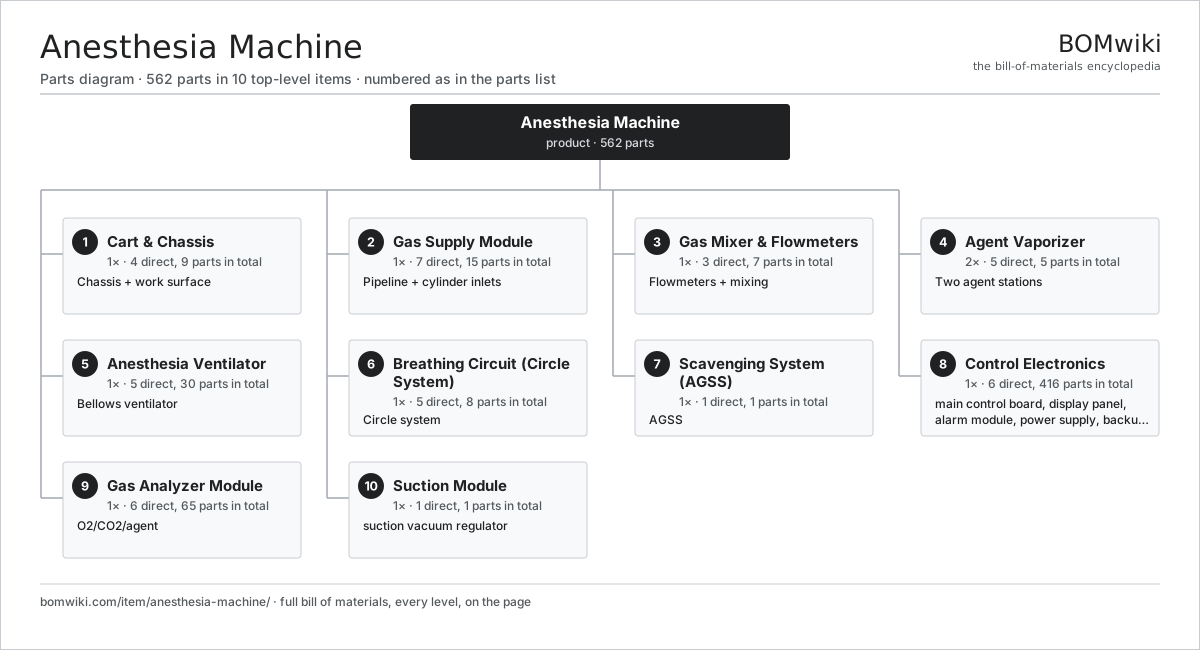
An anesthesia machine, or anesthesia workstation, delivers a precisely metered mixture of medical gases and volatile anesthetic agent to a patient under general anesthesia and ventilates the lungs through a closed rebreathing circuit. It draws oxygen, nitrous oxide, and medical air from the hospital pipeline (with backup cylinders), blends them to a chosen flow and oxygen fraction, adds anesthetic vapor, and recirculates exhaled gas after stripping carbon dioxide.

Fresh gas enters through the Gas Supply Module, where pipeline and cylinder inlets are pressure-regulated and protected by a hypoxic guard that mechanically links nitrous oxide to oxygen so the delivered mixture can never fall below roughly 25% oxygen. The Gas Mixer & Flowmeters meters each gas through flow-control valves and rotameter tubes into a common manifold, and the Agent Vaporizer saturates a controlled fraction of the carrier flow with liquid agent. The blended gas passes to the Breathing Circuit (Circle System), a circle system, where the Anesthesia Ventilator drives the patient's breaths.

How it works

Exhaled gas returns through the circle system and crosses a CO2 absorber filled with soda lime before being rebreathed, allowing low fresh-gas flows that conserve agent and warm and humidify the circuit. Unidirectional dome valves enforce one-way flow, and an adjustable pressure-limiting valve vents excess. Waste anesthetic gas is captured by the Scavenging System (AGSS) interface and routed to hospital vacuum rather than into room air.

The Control Electronics regulate ventilator timing, drive the displays, and run the alarm logic that monitors airway pressure, volumes, and apnea. A sidestream Gas Analyzer Module continuously measures inspired and expired oxygen, carbon dioxide, nitrous oxide, and agent concentration, reporting end-tidal values and minimum alveolar concentration. The whole assembly rides on the Cart & Chassis, a braked-caster frame with a work surface, supply drawers, and monitor mounts, and an integrated battery sustains delivery through a mains interruption.', },

'ct-scanner': { specs: [ ['Type', 'Multi-detector helical CT scanner'], ['Slices per rotation', '128 (up to 320 on wide-detector systems)'], ['Detector rows', '64–320'], ['Minimum rotation time', '0.27–0.35 s per 360°'], ['Tube voltage', '70–140 kVp'], ['Tube current', '10–800 mA'], ['Anode heat capacity', '≥ 5 MHU (mega heat units)'], ['Bore diameter', '70–80 cm'], ['Scan field of view', 'Up to 50 cm'], ['Spatial resolution', '≤ 0.35 mm isotropic'], ['Gantry tilt', '±30°'], ['Power transfer', 'Slip ring (contact power + contactless data)'], ['Cooling', 'Closed-loop water chiller + forced air'], ], body: '## Overview

A computed tomography scanner reconstructs cross-sectional images of the body from a large set of X-ray projections acquired at many angles. An X-ray tube and an opposed detector arc spin continuously around the patient while the table advances through the bore, tracing a helical path that yields a volumetric dataset reconstructed into thin contiguous slices.

The rotating components live in the Gantry, whose disk turns on a large bearing at sub-second rotation times. Power and detector data cross the spinning interface through a slip ring, since cables cannot wrap around a continuously rotating rotor. Mounted on the rotor are the X-Ray Tube Assembly, a rotating-anode tube in an oil-cooled lead housing, and the opposed Detector Array array.

How it works

The High-Voltage Generator supplies up to ~140 kV across the tube through a high-frequency inverter and an oil-filled transformer-rectifier tank. The emitted fan beam passes through the Beam Shaping Assembly stage, where bowtie filters equalize dose across the fan, a motorized collimator sets the irradiated width and slice thickness, and a focused anti-scatter grid rejects scattered photons before they reach the detector. Each detector module converts X-rays to light in a pixelated scintillator, then to current in a photodiode array, and the data-acquisition system digitizes thousands of channels per view.

The Patient Couch indexes the patient through the bore on a low-attenuation carbon-fiber tabletop driven by a ball-screw. Digitized projections stream off the rotor to the Reconstruction Computer system, where filtered back-projection or iterative algorithms build the image volume, and the operator drives acquisition and review from the Operator Console. Tube and electronics heat is rejected by the Cooling System system, which circulates chilled coolant to the tube and HV tank.', },

'defibrillator': { specs: [ ['Type', 'Biphasic external defibrillator / monitor'], ['Waveform', 'Biphasic truncated exponential'], ['Energy range', '1–360 J (manual); escalating AED protocol'], ['Charge time to max energy', '≤ 7 s (new battery)'], ['Energy-storage capacitor', 'Film capacitor, ~200 J at full charge'], ['Modes', 'AED, manual defib, synchronized cardioversion, pacing'], ['Pacing output', '0–200 mA, 30–180 ppm (demand/fixed)'], ['ECG leads', '3-lead and 5-lead patient cable'], ['Patient isolation', 'IEC 60601 defib-proof isolation barrier'], ['Display', 'Color LCD, ECG + parameter waveforms'], ['Battery', 'Li-ion, ≥ 4 h monitoring / ≥ 200 shocks'], ['Self-test', 'Automatic daily readiness check'], ['Recorder', 'Thermal strip printer'], ], body: '## Overview

A defibrillator delivers a controlled electrical shock across the chest to terminate a life-threatening arrhythmia, most importantly ventricular fibrillation and pulseless ventricular tachycardia, allowing the heart's natural pacemaker to resume an organized rhythm. Modern external units combine the shock function with ECG monitoring, synchronized cardioversion, and non-invasive pacing, and many operate as automated external defibrillators that analyze the rhythm and advise the rescuer.

Therapy energy is generated on the High-Voltage Therapy Board. A high-voltage charging circuit steps battery voltage up through a transformer and rectifier to charge a film energy-storage capacitor, then a biphasic H-bridge of high-voltage switches discharges that capacitor through the patient in a current pulse that reverses polarity partway through, the truncated-exponential biphasic waveform that defibrillates at lower energy than older monophasic designs.

How it works

The Control Board sequences charge and discharge, runs the rhythm-analysis algorithm, and enforces the safety interlocks that arm and disarm the shock. Patient ECG is captured by the ECG Front-End Board, whose analog front-end amplifies and filters the signal behind a defib-proof isolation barrier; the same electrodes carry the shock. The Electrode Pad Assembly of pre-gelled adhesive pads and a shielded high-voltage cable couples energy to the chest, while a separate ECG Patient Cable provides multi-lead monitoring.

The operator interacts through the Display Assembly and the User Interface, whose guarded shock button, energy-select dial, and status LEDs guide the rescue. A Battery Pack powers the unit, and the Self-Test Board runs a daily readiness check, discharging into an internal test load to confirm the high-voltage path is sound. Events and ECG are logged for later review.', },

'dialysis-machine': { specs: [ ['Type', 'Single-pass hemodialysis machine'], ['Blood flow rate', '50–600 mL/min'], ['Dialysate flow rate', '300–800 mL/min'], ['Dialysate temperature', '35–39 °C'], ['Conductivity range', '12.5–15.5 mS/cm'], ['Ultrafiltration rate', '0–4,000 mL/h'], ['UF volume accuracy', '± 1% / volumetric balancing'], ['Heparin pump rate', '0.1–10 mL/h'], ['Arterial pressure', '−300 to +300 mmHg'], ['Venous pressure', '−100 to +500 mmHg'], ['Air detector', 'Ultrasonic, ≥ ~20 µL bubble sensitivity'], ['Blood leak detection', 'Optical, on spent dialysate'], ['Concentrate', 'Acid + bicarbonate proportioning'], ['Disinfection', 'Heat + chemical rinse cycle'], ], body: '## Overview

A hemodialysis machine removes metabolic waste, excess fluid, and electrolytes from the blood of a patient with failing kidneys. It pumps blood from a vascular access through a hollow-fiber dialyzer where, across a semipermeable membrane, solutes diffuse into a counter-flowing dialysate while a controlled pressure gradient pulls off excess water. Two separate hydraulic circuits, one for blood and one for dialysate, run in parallel through the machine.

Blood handling is the job of the Extracorporeal Blood Circuit. A peristaltic blood pump occludes a disposable tubing segment to push blood through the dialyzer at a set flow, a heparin syringe pump meters anticoagulant, and arterial and venous pressure sensors watch both ends of the loop. An ultrasonic air detector and a solenoid venous clamp form the air-embolism safeguard: if bubbles are sensed, the clamp closes and the pump stops.

How it works

The Dialysate Circuit prepares the dialysate online. Treated water is heated and degassed, then proportioning pumps blend it with acid and bicarbonate concentrates while a conductivity cell verifies the ion concentration against limits. Volumetric balancing chambers match the volume of fresh and spent dialysate exactly, so any deliberate imbalance imposed by the ultrafiltration pump equals the fluid removed from the patient. An optical blood-leak detector on the spent line catches a ruptured dialyzer membrane.

The Control System coordinates the pumps, valves, and protective sensors and enforces the treatment prescription, while the operator sets blood flow, dialysate composition, and fluid-removal targets at the Operator Interface. Everything mounts in the Chassis & Cabinet, a mobile chassis on locking casters. Between treatments the Disinfection System cycle flushes the fluid path with heat and chemical agents to control bacterial and endotoxin load.', },

'ecg-machine': { specs: [ ['Type', 'Resting 12-lead electrocardiograph'], ['Leads', '12-lead (10-electrode)'], ['Channels acquired', '12 simultaneous'], ['ADC resolution', '24-bit sigma-delta'], ['Sampling rate', 'Up to 32 kHz/channel (acquisition)'], ['Bandwidth', '0.05–150 Hz'], ['CMRR', '≥ 100 dB'], ['Input impedance', '≥ 100 MΩ'], ['Patient isolation', 'IEC 60601 isolated front-end'], ['Defibrillator protection', 'Series resistor + clamp network'], ['Recorder', 'Thermal array printer'], ['Connectivity', 'WiFi, Ethernet (HL7/DICOM)'], ['Power', 'Mains + internal rechargeable battery'], ], body: '## Overview

An electrocardiograph records the heart's electrical activity from electrodes placed on the skin and prints or transmits the resulting waveforms. The standard resting study uses ten electrodes to derive twelve leads, each a different vector through the heart, from which clinicians read rate, rhythm, conduction, and signs of ischemia or chamber enlargement.

Signal capture happens on the Acquisition Front-End Board, the isolated patient front-end. An analog front-end ASIC and instrumentation amplifiers boost the microvolt-to-millivolt biopotentials, a 24-bit sigma-delta converter digitizes every lead simultaneously, and a galvanic isolation barrier keeps the patient electrically separate from mains-referenced electronics. A defibrillator-protection network of series resistors and clamps lets the front-end survive a defibrillation pulse delivered while the patient is connected.

How it works

Biopotentials reach the board through the Patient Cable Assembly, a shielded trunk that fans out to lead wires and clip or suction electrodes. The digitized leads pass to the Main Board, which filters baseline wander and mains interference, runs measurement and interpretation algorithms, and renders the traces. The clinician views and annotates the study on the Display Assembly and drives the unit from the Operator Keypad.

Reports print on the Thermal Recorder, a thermal array recorder whose printhead burns the waveform onto heat-sensitive paper advanced by a stepper-driven platen. Studies cross the network through the Connectivity Board over WiFi or Ethernet to the hospital record using HL7 or DICOM. The whole instrument is built into the Housing & Cart, a molded case on a wheeled trolley, and runs from mains power or an internal battery for bedside and transport use.', },

'endoscope-system': { specs: [ ['Type', 'Flexible video endoscopy tower'], ['Imager', 'Distal CMOS sensor (chip-on-tip)'], ['Resolution', 'Up to HD/4K depending on scope'], ['Illumination', 'High-power LED, white + narrow-band imaging'], ['Insertion-tube diameter', '5–13 mm (procedure dependent)'], ['Working-channel diameter', '2.0–4.2 mm'], ['Tip articulation', 'Four-way: up/down + left/right'], ['Up/down angulation', 'Up to ~210° / 90°'], ['Field of view', '140–170°'], ['Channels', 'Working/suction, air, water/lens-wash'], ['Air/water supply', 'Pressurized sterile-water bottle + pump'], ['Video outputs', 'SDI / HDMI / DVI'], ['Reprocessing', 'Fully immersible, sealed for high-level disinfection'], ], body: '## Overview

A flexible video endoscope system lets a clinician inspect and treat the interior of a hollow organ through a natural orifice. A slender steerable scope carries a camera chip and illumination to the distal tip; a tower of supporting equipment processes the image, supplies light and irrigation, and displays live video. The same instrument channel passes biopsy forceps, snares, and other tools to the field.

The instrument itself is the Flexible Video Endoscope, a flexible insertion shaft with a four-way articulating bending section, an ergonomic control body with steering knobs and valves, and an umbilical cord back to the tower. At its tip sits a CMOS imager behind an objective lens, distal LED or fiber illumination, and a lens-wash nozzle. Internal lumens run a working/suction channel alongside air and water lines for insufflation and cleaning.

How it works

The imager's signal travels up the scope to the Video Processor, which drives the sensor, processes the raw image, applies enhancement modes such as narrow-band imaging, and renders live video. Illumination comes from the Light Source, a high-output LED illuminator that couples regulated light into the scope's light guide under automatic brightness feedback so exposure stays even as the camera moves. Processed video is shown on the Surgical Monitor, a medical-grade display on an articulating arm.

Insufflation and lens washing are fed from the Water Bottle Unit, a pressurized sterile-water unit whose pump drives air and water through the scope's channels. The clinician captures images and triggers accessory functions hands-free with the Foot Pedal. All of it stacks on the Tower Cart, a mobile tower on locking casters with a medical isolation transformer powering the components. After each case the scope is leak-tested and reprocessed by high-level disinfection.', },

'hospital-bed': { specs: [ ['Type', 'Electric acute-care hospital bed'], ['Sections', 'Four-section articulating deck'], ['Height range', '330–760 mm (low-height fall reduction)'], ['Backrest angle', '0–70°'], ['Knee (thigh) angle', '0–35°'], ['Trendelenburg / reverse', '±12° to ±16°'], ['Actuators', '4 × 24 V DC linear drives'], ['Safe working load', '250 kg'], ['Max patient weight', '185 kg'], ['Integrated scale', 'Load-cell weighing, ± 0.5 kg'], ['CPR release', 'Manual rapid backrest drop'], ['Battery backup', 'Sealed lead-acid / Li for power loss'], ['Casters', '4 × Ø150 mm, central + steer lock'], ['Side rails', '4 split rails with integrated controls'], ], body: '## Overview

An electric hospital bed positions a patient for care, comfort, and safety while supporting nursing tasks and patient transfer. Powered actuators raise and lower the whole bed and independently articulate the backrest and knee sections, letting staff achieve sitting, supine, Trendelenburg, and chair-like positions, and lower the deck to reduce fall injury. Integrated weighing, fall-prevention rails, and a battery backup distinguish a modern acute-care bed from a simple frame.

Load is carried by the Base Frame, a welded steel base on braked, swiveling casters with corner bumpers. Above it the Lift Mechanism raises and lowers the sleep surface, and the Mattress Platform forms the four-section articulating mattress platform whose head, thigh, and foot segments hinge independently.

How it works

Every motion is produced by a Linear Actuator, a 24 V DC linear drive built on a common motor-and-leadscrew core that pushes against a section pivot until an end-of-travel limit switch stops it. The drives are commanded by the Control System, which houses the control box, hand pendant, and the battery backup that keeps the bed movable during a power failure. A mechanical CPR release lets staff drop the backrest flat instantly for resuscitation, bypassing the motor.

Fall prevention and patient control come from the Side Rail assemblies, split rails with caregiver and patient control pads built into them. The Bed Scale weighs the patient in place using load cells under the deck, important for fluid and drug dosing without moving an unstable patient. A pressure-relief Mattress completes the bed, and removable head and foot boards give access for transfer and codes.', },

'infusion-pump': { specs: [ ['Type', 'Volumetric peristaltic infusion pump'], ['Mechanism', 'Linear peristaltic (finger) pump'], ['Flow rate range', '0.1–1,200 mL/h'], ['Rate resolution', '0.1 mL/h'], ['Volume accuracy', '± 5% (typical, with dedicated set)'], ['Bolus rate', 'Up to 1,200 mL/h'], ['Occlusion pressure', 'Adjustable ~50–900 mmHg'], ['Air-in-line detection', 'Ultrasonic, single + cumulative limits'], ['Drug library', 'Programmable limits (dose error reduction)'], ['KVO rate', '0.1–5 mL/h'], ['Battery runtime', '≥ 5 h at 25 mL/h'], ['Safety architecture', 'Independent safety/watchdog monitor'], ['Interfaces', 'Nurse-call, barcode scanner'], ], body: '## Overview

A volumetric infusion pump delivers fluids, medications, blood products, or nutrition to a patient at a precisely controlled rate and total volume. It drives a disposable administration set rather than touching the fluid directly, and it watches that delivery with independent sensors so that over-infusion, occlusions, and air bubbles are detected and stopped. A drug library enforces dose limits to reduce programming errors.

Fluid is moved by the Peristaltic Mechanism, a linear peristaltic pump whose stepper-driven fingers press sequentially on a segment of the IV tubing, milking a fixed volume downstream with each cycle. The disposable IV Administration Set is the only fluid-contacting part, loaded into the door so the mechanism acts on it from outside, which keeps the fluid path sterile and single-use.

How it works

Delivery is supervised by the Sensor Suite: upstream and downstream pressure sensors detect occlusions and a closed clamp, an ultrasonic air-in-line detector catches bubbles before they reach the patient, and a door sensor confirms the set is properly loaded. The Main Control Board runs the rate calculation, drives the motor, and applies the drug-library limits, while an Safety Monitor Board independently watches motor motion and the sensor signals and can halt the pump if the primary controller misbehaves, a deliberate two-channel safety architecture.

The clinician programs rate, volume, and drug on the User Interface, a touchscreen and keypad with an audible-visual alarm. Power comes from the Power Supply supply, a medical-grade unit with a backup battery that keeps the infusion running during transport or a mains interruption. The pump mounts to a pole through the Enclosure clamp, and a barcode scanner and nurse-call output integrate it into bedside workflow.', },

'mri-scanner': { specs: [ ['Type', 'Superconducting whole-body MRI scanner'], ['Field strength', '1.5 T or 3.0 T (clinical)'], ['Magnet', 'NbTi superconducting coils, liquid-helium cooled'], ['Bore diameter', '60–70 cm'], ['Field homogeneity', '< 1 ppm over 40 cm DSV'], ['Gradient strength', 'Up to 80 mT/m per axis'], ['Gradient slew rate', 'Up to ~200 T/m/s'], ['RF transmit', 'Body coil, broadband solid-state PA (kW)'], ['RF receive', 'Multi-channel phased-array coils (16–64 ch)'], ['Proton frequency', '~63.9 MHz (1.5 T) / ~127.7 MHz (3 T)'], ['Cryogen', 'Liquid helium with cold-head reliquefaction'], ['Quench protection', 'Vented quench pipe to exterior'], ['Siting', 'RF-shielded cabin (Faraday room)'], ], body: '## Overview

A magnetic resonance imaging scanner produces detailed cross-sectional images of soft tissue without ionizing radiation. It places the body in an intense, highly uniform magnetic field that aligns hydrogen nuclei, tips them with radio-frequency pulses, and reads the faint signal they emit as they relax. Spatially varying gradient fields encode position, and the signal is reconstructed into images whose contrast depends on tissue relaxation properties.

The static field comes from the Superconducting Magnet, a set of niobium-titanium superconducting coils immersed in a liquid-helium cryostat. Once energized, the coils carry persistent current with no resistive loss, and a cold head reliquefies boil-off helium to maintain the cryogenic temperature. Superconducting and passive shims trim the field to part-per-million homogeneity across the imaging volume; a quench pipe safely vents helium gas if the magnet ever loses superconductivity.

How it works

Spatial encoding is done by the Gradient Coil Assembly, an X/Y/Z coil set that briefly superimposes linear field gradients, switched at high current by the Gradient Amplifier cabinet, which produces the loud knocking of a scan. The RF System transmits the excitation pulses through a body coil driven by a kilowatt solid-state amplifier and receives the tissue signal on multi-channel phased-array coils placed close to the anatomy.

Received signals are digitized and turned into images by the Reconstruction System system, a spectrometer plus a GPU-accelerated reconstruction engine, and the operator drives the exam from the Operator Console. The patient enters on a non-magnetic Patient Table, everything is cooled by a closed-loop Cooling System system, and the scanner sits inside an RF-shielded room joined to the equipment through the RF Shield Room Interface penetration panel and line filters.', },

'patient-monitor': { specs: [ ['Type', 'Multiparameter bedside patient monitor'], ['ECG', '3/5/12-lead, arrhythmia + ST analysis'], ['Heart rate range', '15–300 bpm'], ['SpO2 range', '0–100% (1–100% displayed)'], ['Pulse rate', '25–300 bpm'], ['NIBP method', 'Oscillometric, sys/dia/MAP'], ['NIBP range', '~10–270 mmHg'], ['Temperature', '2 channels, 0–50 °C, ± 0.1 °C'], ['Respiration', 'Thoracic impedance, 0–150 rpm'], ['IBP', 'Up to 2–4 invasive pressure channels'], ['EtCO2', 'Capnography, 0–150 mmHg'], ['Display', 'Color touchscreen, multi-trace'], ['Connectivity', 'WiFi / Ethernet to central station'], ['Power', 'Mains + backup battery'], ], body: '## Overview

A multiparameter patient monitor continuously measures and displays a patient's vital signs at the bedside and alarms when any value leaves a set range. A single unit fuses several physiological measurements, electrocardiogram, oxygen saturation, blood pressure, temperature, respiration, and others, onto one screen and reports them to a central nursing station so one clinician can watch many beds.

Measurement is split across dedicated parameter modules behind the Parameter Acquisition Board, an isolated front-end that keeps every patient connection electrically separate from mains. The ECG Module amplifies the heart's biopotentials for rhythm and ST analysis, the SpO2 Module derives oxygen saturation from red and infrared light passed through a finger, and the NIBP Module inflates a cuff and reads systolic, diastolic, and mean pressure by the oscillometric method.

How it works

Further channels extend the picture: the IBP Module reads continuous invasive pressures from arterial or central lines through disposable transducers, the EtCO2 Capnography Module measures exhaled carbon dioxide by infrared capnography to confirm ventilation, while temperature and impedance-respiration modules round out the standard set. All module data is collected by the Main Board, which runs the alarm logic, trends, and the user interface.

Values and waveforms appear on the Display Assembly, a color touchscreen, and breaches drive the Alarm Unit with prioritized audible and visual signals. The Connectivity Board streams data over WiFi or Ethernet to a central station and the patient record, and the Power System runs the monitor from mains with a backup battery for transport. Patient leads land on the dedicated Ports Panel.', },

'surgical-robot': { specs: [ ['Type', 'Teleoperated robotic surgical system'], ['Architecture', 'Surgeon console + patient cart + vision cart'], ['Patient-cart arms', '3–4 robotic arms'], ['Arm degrees of freedom', '7 per arm (incl. wristed instrument)'], ['Instrument articulation', 'Cable-driven wrist, ~540° roll'], ['Instrument diameter', '5–8 mm'], ['Visualization', 'Stereo (3D) endoscope, HD/4K'], ['Motion scaling', 'Adjustable, e.g. 1:1 to 5:1'], ['Tremor filtering', 'Active, on master inputs'], ['Control loop', 'Real-time master–slave servo'], ['Energy', 'Integrated electrosurgical generator'], ['Safety', 'Redundant safety board, force/position limits'], ], body: '## Overview

A surgical robot lets a surgeon perform minimally invasive operations through small ports with greater dexterity and precision than handheld laparoscopic tools allow. The surgeon sits at a console and manipulates master controls; the system scales and filters those motions and reproduces them with wristed instruments held by robotic arms over the patient, viewing the field in magnified stereo 3D. The surgeon is always in command, the robot never acts autonomously.

The instruments and camera are carried by the Patient Cart, whose multiple robotic arms position through the body-wall ports. Each arm pivots about a remote center of motion at the port so the instrument shaft does not lever against tissue, and a cable-driven wrist near the instrument tip gives the articulation, the seven degrees of freedom, that restores the dexterity lost with rigid laparoscopic tools.

How it works

The surgeon works at the Surgeon Console, looking into a stereo viewer fed by the endoscope and gripping master tele-manipulators whose motion is scaled down and tremor-filtered before being sent to the arms. A real-time master-slave servo loop ties hand motion to instrument motion with low latency, and a redundant safety board enforces force and position limits and halts motion on fault.

Imaging and energy are managed by the Vision Cart, which houses the image-processing computer for the stereo endoscope, the LED light source, and the electrosurgical generator for cutting and coagulation. Together the three units form the system: the patient cart acts in the body, the console captures the surgeon's intent, and the vision cart provides sight and energy.', },

'ultrasound-machine': { specs: [ ['Type', 'Cart-based diagnostic ultrasound system'], ['Imaging modes', 'B-mode, M-mode, color/PW/CW Doppler'], ['Frequency range', '1–18 MHz (probe dependent)'], ['Beamforming', 'Digital, multi-channel (≥ 128 ch)'], ['Probe ports', '3–4 active connectors'], ['Convex probe', '2–5 MHz, abdominal/obstetric'], ['Linear probe', '5–15 MHz, vascular/superficial'], ['Phased-array probe', '1–5 MHz, cardiac'], ['Display', 'High-resolution LED monitor on articulating arm'], ['Penetration depth', 'Up to ~30 cm'], ['Battery', 'Backup for transport / standby'], ['Storage', 'SSD + DICOM image/clip export'], ], body: '## Overview

A diagnostic ultrasound machine images soft tissue and blood flow in real time using high-frequency sound. A handheld probe transmits short acoustic pulses into the body and listens for echoes returned from tissue boundaries; the time of flight gives depth and the echo strength gives brightness, building a live cross-sectional image. Doppler processing of the returning frequency shift measures blood-flow velocity and direction.

Sound is generated and received by interchangeable probes, each a piezoelectric element array tuned to a frequency band: the Convex Probe for deep abdominal and obstetric imaging, the Linear Probe for shallow vascular and superficial work, and the Phased-Array Probe for cardiac scanning through the rib spaces. Probes plug into the Probe Port Panel connector panel, and the active probe is selected from the console.

How it works

Echo signals flow to the Beamformer & Processing chain, the heart of the system. An analog front-end amplifies and digitizes each channel with time-gain compensation, the digital beamformer applies per-element delays to focus the transmit and receive beams electronically, and the back-end builds B-mode, M-mode, and Doppler images that are scan-converted for display. The processed image appears on the Main Display Monitor, a high-resolution monitor on an articulating arm.

The clinician drives the exam from the Operator Console, a control panel with a touchscreen for mode, gain, depth, and measurements. Everything is built on the Cart Chassis, a mobile chassis with a height-adjustable column, and powered by the Power System with a backup battery for transport. Acquired images and clips are archived to the Storage & I/O SSD and exported in DICOM.', },

'ventilator': { specs: [ ['Type', 'Critical-care mechanical ventilator'], ['Gas source', 'Internal turbine + O2/air blending'], ['Modes', 'VCV, PCV, SIMV, PSV, CPAP, APRV, NIV'], ['Tidal volume', '20–2,000 mL'], ['Respiratory rate', '1–80 breaths/min'], ['Inspiratory flow', 'Up to ~180 L/min'], ['PEEP range', '0–35 cmH2O'], ['Pressure support', '0–60 cmH2O'], ['Peak pressure limit', 'Up to ~100 cmH2O (alarmed)'], ['FiO2 range', '21–100%'], ['I:E ratio', 'Adjustable, incl. inverse ratio'], ['Monitoring', 'Flow, pressure, volume, EtCO2'], ['Safety', 'Independent monitoring board + backup battery'], ], body: '## Overview

A critical-care ventilator supports or replaces a patient's breathing by delivering a controlled mixture of oxygen and air to the lungs at set volumes, pressures, and rates. It can take over breathing entirely for a paralyzed or sedated patient or assist a patient's own efforts, synchronizing with them through a range of modes. Precise control of delivered volume and pressure, and continuous monitoring of the result, protect the lungs from injury.

Breath delivery is the job of the Gas Delivery Unit unit. An internal turbine blower pressurizes the breathing gas, an inspiratory flow-control valve shapes each delivered breath, and an expiratory valve with PEEP control holds residual pressure at end-exhalation to keep alveoli open. Oxygen and air are blended to the set FiO2 by the Gas Mixing Module module, fed through the Pneumatic Manifold of regulators and filters.

How it works

Every breath is closed-loop controlled from the Sensor Suite, whose flow and pressure sensors at the airway measure delivered volume and pressure breath by breath, letting the controller hit a volume or pressure target and detect the patient's inspiratory effort to trigger assisted breaths. Gas reaches the patient through the Breathing Circuit, heated and humidified inspiratory and expiratory limbs with a patient-side wye.

Control is split for safety: the Main Control Board runs the breath delivery and modes, while an Independent Monitoring Board independently watches airway pressure and volume and raises alarms or opens to ambient if the primary controller fails. The clinician sets mode, volume, rate, PEEP, and FiO2 on the User Interface Panel, and the Power System runs the ventilator from mains with an internal battery that sustains ventilation through power loss and transport.', },

'x-ray-machine': { specs: [ ['Type', 'Digital radiography (DR) X-ray system'], ['Tube', 'Rotating-anode, dual focal spot'], ['Focal spots', '0.6 mm (fine) / ~1.2 mm (broad)'], ['Tube voltage', '40–150 kVp'], ['Tube current', '10–800 mA'], ['Exposure time', '1 ms–6 s'], ['mAs range', '0.5–600 mAs'], ['Anode heat capacity', '≥ 300 kHU'], ['Generator', 'High-frequency inverter'], ['Detector', 'Flat-panel, CsI scintillator over TFT array'], ['Detector pixel pitch', '100–150 µm'], ['Collimation', 'Motorized, light-field aligned'], ['Added filtration', 'Al/Cu, selectable'], ['Cooling', 'Forced-air oil cooling of tube housing'], ], body: '## Overview

A radiographic X-ray machine produces projection images of the body by passing a controlled X-ray beam through the patient onto a detector. Dense structures such as bone attenuate more of the beam than soft tissue, so the transmitted pattern forms a shadow image. A digital radiography system replaces film with an electronic flat-panel detector, giving an immediate image and a measured dose.

X-rays are generated in the X-Ray Tube Assembly, a rotating-anode tube insert in an oil-filled, lead-lined housing. An induction stator spins the anode while a heated filament boils off electrons that are accelerated across the tube and strike the tungsten target, producing X-rays; the rotating anode and circulating oil spread and carry away the intense heat. The tube is energized by the High-Voltage Generator, a high-frequency inverter that steps mains up to the selected kilovoltage and regulates the tube current and exposure time.

How it works

Between the tube and patient, the Collimator limits the beam to the region of interest with motorized lead blades, projects a matching light field for alignment, and adds aluminum or copper filtration to harden the beam and cut skin dose. The tube is aimed and positioned by the Tube Stand / Gantry tube stand and the patient lies on the Patient Table, whose floating top and Bucky tray hold the anti-scatter grid and detector.

The transmitted beam lands on the Flat-Panel Detector, an indirect-conversion flat panel where a cesium-iodide scintillator turns X-rays to light over a TFT photodiode array that reads out a digital image in seconds. The operator selects technique and reviews images at the Control Console, and tube housing heat is rejected by the Tube Cooling Unit unit, which circulates the housing oil through a fan-cooled radiator.

Build & assembly graph

expand / collapse · shared sub-assemblies converge · links to related products · est. labour
product / assembly shared across products atomic part related product

Tap an assembly to expand/collapse · tap a part to open it · use “Open page” for any node · drag to pan, scroll to zoom.

Bill of materials

10 top-level lines · 76 rows shown · 562 parts total · indented to 3 levels
# Item / sub-assembly Part no. Qty/assy Ext. qty Parts Type
1 Cart & Chassis 4 parts anesthesia-machine-cart 1 9 assembly
1.1 Welded Cart Frame anesthesia-machine-frame 1 part
1.2 Swivel Caster w/ Brake anesthesia-machine-caster 4 part
1.3 Storage Drawer anesthesia-machine-drawer 3 part
1.4 Fastener Set fastener-set 1 part
2 Gas Supply Module 7 parts anesthesia-machine-gas-supply 1 15 assembly
2.1 Pipeline Gas Inlet (DISS) anesthesia-machine-pipeline-inlet 3 part
2.2 Cylinder Yoke (PISS) anesthesia-machine-cylinder-yoke 3 part
2.3 First-Stage Pressure Regulator anesthesia-machine-pressure-regulator 3 part
2.4 O2/N2O/Air Supply Manifold anesthesia-machine-supply-manifold 1 part
2.5 Piezoresistive Pressure Sensor anesthesia-machine-pressure-sensor 3 part
2.6 Hypoxic Guard (O2/N2O Link) anesthesia-machine-hypoxic-guard 1 part
2.7 O-Ring Set oring-set 1 part
3 Gas Mixer & Flowmeters 3 parts anesthesia-machine-gas-mixer 1 7 assembly
3.1 Proportional Flow Control Valve anesthesia-machine-flow-control-valve 3 part
3.2 Rotameter Flow Tube anesthesia-machine-rotameter-tube 3 part
3.3 O2 Flush Valve anesthesia-machine-o2-flush-valve 1 part
4 Agent Vaporizer 5 parts anesthesia-machine-vaporizer 2 5 assembly
4.1 Vaporizing Chamber anesthesia-machine-vaporizing-chamber 2 part
4.2 Concentration Control Dial anesthesia-machine-concentration-dial 2 part
4.3 Bimetallic Temperature Compensator anesthesia-machine-temp-compensation 2 part
4.4 Heating Element heating-element 2 part
4.5 O-Ring Set oring-set 2 part
5 Anesthesia Ventilator 5 parts anesthesia-machine-ventilator 1 30 assembly
5.1 Ascending Bellows Assembly anesthesia-machine-bellows-assembly 1 part
5.2 Drive Piston Motor 4 parts anesthesia-machine-drive-motor 1 25 assembly
5.2.1 Stator Assembly 3 parts + deeper › stator-assembly 1 3 assembly
5.2.2 Rotor Assembly 4 parts + deeper › rotor-assembly 1 19 assembly
5.2.3 Ball Bearing ball-bearing 2 part
5.2.4 Motor Housing motor-housing 1 part
5.3 Ventilator Check Valve anesthesia-machine-vent-valve 2 part
5.4 Piezoresistive Pressure Sensor anesthesia-machine-pressure-sensor 1 part
5.5 Ventilator Flow Sensor anesthesia-machine-vent-flow-sensor 1 part
6 Breathing Circuit (Circle System) 5 parts anesthesia-machine-breathing-circuit 1 8 assembly
6.1 CO2 Absorber Canister 2 parts anesthesia-machine-co2-absorber 1 2 assembly
6.1.1 Soda Lime Absorbent anesthesia-machine-soda-lime 1 part
6.1.2 O-Ring Set oring-set 1 part
6.2 Unidirectional Dome Valve anesthesia-machine-unidirectional-valve 2 part
6.3 APL Valve anesthesia-machine-apl-valve 1 part
6.4 Reservoir Bag anesthesia-machine-reservoir-bag 1 part
6.5 Corrugated Breathing Hose anesthesia-machine-breathing-hose 2 part
7 Scavenging System (AGSS) 1 parts anesthesia-machine-scavenging 1 1 assembly
7.1 Scavenging Interface anesthesia-machine-scavenging-interface 1 part
8 Control Electronics 6 parts anesthesia-machine-control-electronics 1 416 assembly
8.1 Main Control Board 5 parts anesthesia-machine-main-board 1 318 assembly
8.1.1 Bare PCB pcb-bare 1 part
8.1.2 Compute SoC Module soc-module 1 part
8.1.3 Microcontroller mcu 2 part
8.1.4 Connector connector 14× 14 part
8.1.5 SMD Passive (R/C/L) smd-passives 300× 300 part
8.2 Display Panel 5 parts anesthesia-machine-display 1 54 assembly
8.2.1 LCD Panel lcd-panel 1 part
8.2.2 Touch Digitizer touch-digitizer 1 part
8.2.3 Rotary Encoder Knob anesthesia-machine-encoder-knob 1 part
8.2.4 Bare PCB pcb-bare 1 part
8.2.5 SMD Passive (R/C/L) smd-passives 50× 50 part
8.3 Alarm Module 4 parts anesthesia-machine-alarm-module 1 33 assembly
8.3.1 Bare PCB pcb-bare 1 part
8.3.2 Microcontroller mcu 1 part
8.3.3 Alarm Annunciator anesthesia-machine-alarm-annunciator 1 part
8.3.4 SMD Passive (R/C/L) smd-passives 30× 30 part
8.4 Power Supply power-supply 1 part
8.5 Backup Battery Pack 3 parts anesthesia-machine-backup-battery 1 9 assembly
8.5.1 LiPo Cell lipo-cell 6 part
8.5.2 BMS Board bms-board 1 part
8.5.3 Connector connector 2 part
8.6 Wire Bundle wire-bundle 1 part
9 Gas Analyzer Module 6 parts anesthesia-machine-gas-analyzer 1 65 assembly
9.1 Galvanic Oxygen Sensor anesthesia-machine-oxygen-sensor 1 part
9.2 NDIR Optical Bench (CO2 + Agent) anesthesia-machine-ndir-bench 1 part
9.3 Sidestream Sample Pump anesthesia-machine-sample-pump 1 part
9.4 Bare PCB pcb-bare 1 part
9.5 Microcontroller mcu 1 part
9.6 SMD Passive (R/C/L) smd-passives 60× 60 part
10 Suction Module 1 parts anesthesia-machine-suction 1 1 assembly
10.1 Suction Vacuum Regulator anesthesia-machine-suction-regulator 1 part

Sourcing — likely vendors

Companies that make this · indicative price $500–$3M · MOQ & lead are typical
VendorHQSpecialtyMOQLead time
gehealthcare.com ↗ Chicago, US Medical imaging & devices 100 units 12–20 wks
siemens-healthineers.com ↗ Erlangen, DE Medical systems 100 units 12–20 wks
🇳🇱Philips
philips.com ↗
Amsterdam, NL Health technology 100 units 12–20 wks
🇺🇸Medtronic
medtronic.com ↗
Minneapolis, US Medical devices 100 units 12–20 wks
🇨🇳Mindray
mindray.com ↗
Shenzhen, CN Medical devices 100 units 12–20 wks

5,307-word article