Twin-Wire Arc Spray
ProductOverview
Twin-wire arc spray is a high-deposition-rate thermal coating technology where two consumable metal wires are fed simultaneously into a convergence point, struck against each other to create an electric arc, and the resulting molten metal is atomized and propelled onto a surface by a high-pressure air cap. Unlike MIG (metal inert gas) welding, which relies on a shielding gas to prevent oxidation, arc spray uses the arc itself to generate the heat and deliberately allows the spray to pass through open air before solidification. The molten droplets oxidize slightly during flight, which creates a stronger mechanical bond to grit-blasted substrates than would occur with unoxidized transfer. Arc spray excels at high-speed coating where deposition efficiency and material utilization matter more than pristine metallurgy.
The Wire Feed Drives provide synchronized motion of two consumable wires. Each drive consists of a brushed DC motor (48 V, 2 kW) coupled through a 150:1 reduction gearbox to pull wire at 10–20 m/min. The two motors are electrically synchronized via PWM control signals from the Control Module so that both wires reach the Arc Gun Assembly at identical speeds. Wire Idler Roller rollers maintain contact pressure on the wires, preventing slipping during feed; a manual Clutch Release Lever lever allows the operator to disengage the motors for emergency wire unloading.
The Arc Gun Assembly is the heart of the spray process. Two wires enter the gun body from opposite directions and are clamped by Left Contact Tip and Right Contact Tip (copper electrodes delivering current to each wire). The tips are electrically isolated by an Insulator Block ceramic that keeps one tip at +150 V and the other at −150 V relative to the midpoint. As the wire tips advance toward each other, they strike an arc in the Arc Chamber Liner; the arc voltage is constant (regulated by the power supply to 20–40 V), and the current self-adjusts based on contact resistance. The arcing tips melt, and as the wires continue to feed, the molten pool at the arc junction becomes increasingly pressurized by the advancing wire feed, eventually expelling molten droplets into the surrounding air.
The Power Supply maintains the constant-voltage arc condition. A 600 V three-phase mains supply steps down through a Power Transformer to 42 V secondary. A Rectifier Bridge full-wave diode bridge converts the secondary AC to DC. A Filter Choke (50 mH inductor) and Energy Storage Capacitor (2000 µF) smooth the rectified output to <5% ripple. The resulting DC bus is regulated by the MCU via gate-drive commands to the power supply; if arc current drifts high (too much melting), the MCU reduces duty cycle to increase impedance. The operator controls absolute arc current via a Remote Arc Control (foot pedal or hand control, 0–10 kΩ), allowing dynamic adjustment from 150–350 A.
Once the molten droplets form at the arc, they are immediately blasted by the Air Atomizer Cap. Compressed air at 60 bar enters tangential ports in the Air Cap Body, creating a spiral shroud around the arc zone. The air imparts lateral velocity to the droplets, converting them from roughly spherical molten pools into fine, elongated particles. The Orifice Ring, a tungsten carbide insert, resists erosion as molten metal passes through at 200 kg/h rates. A Diffuser Cone downstream ensures the spray fan cone remains uniform (35–45°) and stable across the entire working distance of 150–300 mm.
Thermal management is essential because the arc gun dissipates significant power. The Cooling System circulates demineralized water at 20 L/min through jackets surrounding the Arc Gun Assembly body and the Power Supply transformer. A Water Cooler Unit chiller maintains inlet water at 25°C, and a Thermostat Valve blends the return flow to hold temperature stable. A Flow Sensor continuously monitors circulation; if flow drops below 15 L/min, the Control Module immediately de-energizes the arc to prevent thermal runaway.
The Control Module is a microcontroller-based module that orchestrates the entire spray operation. It executes startup logic: verify cooling water flow, energize both wire motors to bring the wires into contact, detect the arc strike by monitoring voltage rise, then regulate arc current to a user-set value via feedback from a Arc Voltage Sensor. The MCU drives two independent PWM Motor Driver modules (one per motor) at matching duty cycles, ensuring synchronous wire advance. An Position Encoder incremental encoder on the left motor shaft tracks total wire consumed, allowing the operator and system to know coating thickness applied. Safety interlocks prevent arc ignition unless cooling is confirmed, and the system shuts down immediately if arc voltage diverges from the controlled band (indicating wire breakage or electrode shorting).
All interconnections use Cable & Connector Assembly. Heavy-duty Power Cable (two 70 mm² welding cables) carry DC positive and negative from the supply to the gun. A Control Cable (shielded twisted pair) routes feedback and PWM signals. Quick-disconnect connectors, Positive Connector and Negative Connector (rated 600 A), allow field replacement of power cables without hand-crimping. A sealed 37-pin Gun Quick-Disconnect packages all gun-side signals: arc voltage, water in/out, compressed air, motor PWM commands, and encoder feedback.
In production, arc spray is preferred for high-volume coating of large surface areas: ship hulls, industrial pipe, engine blocks, and mining equipment. Deposition rates of 100–250 kg/h (depending on wire chemistry and diameter) far exceed most other thermal spray methods. Coating efficiency runs 85–95% because the arc process produces droplets of uniform size and velocity, with minimal spatter. The open-air spray path accepts any metal wire, steel, stainless, aluminum, bronze, nickel alloys, expanding the material palette compared to shielded-gas processes. The slight oxidation of droplets in flight actually strengthens the mechanical bond to the substrate, making arc spray ideal for bearing surfaces, guide ways, and wear-critical repairs.
How it works
- Compressed air from the shop supply feeds the Air Atomizer Cap at 60 bar through regulated inlet.
- Mains power (600 V 3-phase) energizes the Power Supply: the Power Transformer steps down to 42 V, the Rectifier Bridge converts to DC, and the Filter Choke and Energy Storage Capacitor smooth ripple.
- The operator verifies cooling water is flowing (thermostat and flow sensor confirm), then engages the Wire Feed Drives via the Control Module MCU.
- Both Left Wire Motor and Right Wire Motor spin synchronized, pulling wire at 10–20 m/min via their Reduction Gearbox reducers. The Wire Idler Roller rollers press the wires and guide them into the Arc Gun Assembly.
- Wire tips advance and strike each other, creating an arc in the Arc Chamber Liner. The Left Contact Tip and Right Contact Tip are held at ±150 V bias, establishing the voltage potential for the arc.
- The Arc Voltage Sensor monitors arc voltage; the MCU maintains constant voltage (20–40 V) by adjusting current via the power supply. The operator's Remote Arc Control sets the current baseline (150–350 A).
- Molten metal pools at the arc junction as wire melts and continues to advance. The feeding wires mechanically expel droplets into open air.
- Compressed air in the Air Cap Body enters tangential ports, creating a spiral shroud that atomizes droplets into fine particles traveling at 150–200 m/s outward.
- The Orifice Ring (tungsten carbide) meters the air flow for uniform spray; the Diffuser Cone stabilizes the spray fan angle at 35–45°.
- The operator angles the gun at 15–30° to the workpiece surface, maintaining 150–300 mm standoff distance. Droplets impact the grit-blasted surface and solidify, forming a mechanical bond.
- Throughout operation, the Cooling System pumps 20 L/min water through the Arc Gun Assembly and supply transformers; the Thermostat Valve holds inlet temperature at 25°C.
- The Control Module monitors Position Encoder position to track total wire consumed and thus coating thickness applied.
- If cooling water flow drops, arc voltage drifts out of band, or wire feeds asymmetrically, the MCU instantly shuts down the arc via relay de-energization, preventing damage.
Twin-Wire Arc Spray parts and their functions
7 top-level parts · 39 parts in total · full bill of materials below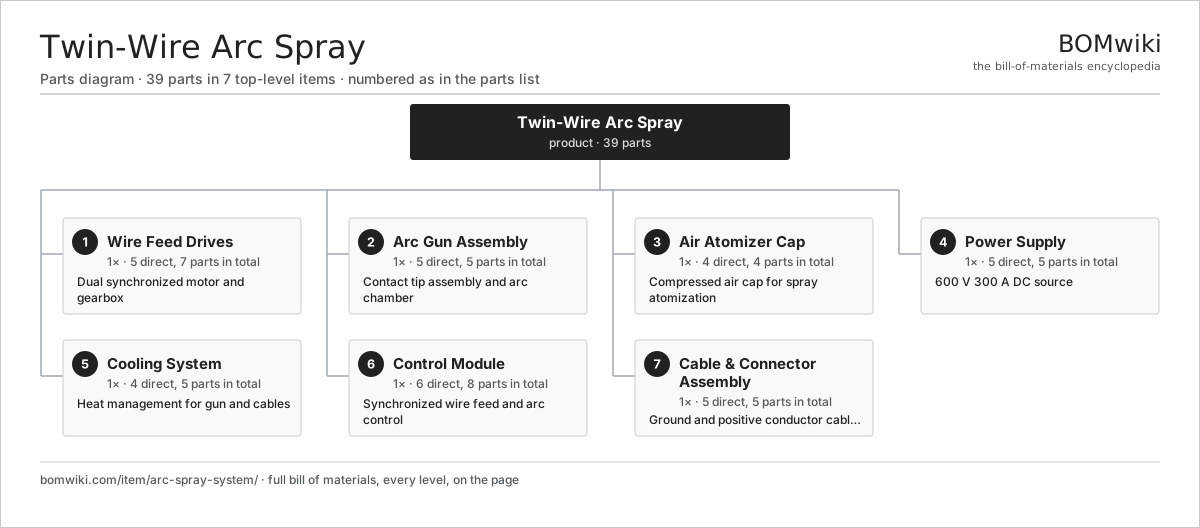
| # | Part | Qty | What it does |
|---|---|---|---|
| 1 | Wire Feed Drives 5 parts | 1× | Dual synchronized motor and gearbox |
| 2 | Arc Gun Assembly 5 parts | 1× | Contact tip assembly and arc chamber |
| 3 | Air Atomizer Cap 4 parts | 1× | Compressed air cap for spray atomization |
| 4 | Power Supply 5 parts | 1× | 600 V 300 A DC source |
| 5 | Cooling System 4 parts | 1× | Heat management for gun and cables |
| 6 | Control Module 6 parts | 1× | Synchronized wire feed and arc control |
| 7 | Cable & Connector Assembly 5 parts | 1× | Ground and positive conductor cables |
3D model
No 3D model yet. Have a CAD file of this? Add a 3D model. STL renders right on this page; STEP, FreeCAD, and OpenSCAD sources are welcome too (openly licensed, like all 3D models on BOMwiki).
Build & assembly graph
expand / collapse · shared sub-assemblies converge · links to related products · est. labourTap an assembly to expand/collapse · tap a part to open it · use “Open page” for any node · drag to pan, scroll to zoom.
Bill of materials for Twin-Wire Arc Spray
7 top-level lines · 41 rows shown · 39 parts total · indented to 3 levels| # | Item / sub-assembly | Part no. | Qty/assy | Ext. qty | Parts | Type |
|---|---|---|---|---|---|---|
| 1 | Wire Feed Drives 5 parts | arc-spray-system-wire-feed-drives | 1× | 1 | 7 | assembly |
| 1.1 | Left Wire Motor | arc-spray-system-motor-left | 1× | 1 | · | part |
| 1.2 | Right Wire Motor | arc-spray-system-motor-right | 1× | 1 | · | part |
| 1.3 | Reduction Gearbox | arc-spray-system-gearbox-150 | 2× | 2 | · | part |
| 1.4 | Wire Idler Roller | arc-spray-system-wire-idler | 2× | 2 | · | part |
| 1.5 | Clutch Release Lever | arc-spray-system-clutch-release | 1× | 1 | · | part |
| 2 | Arc Gun Assembly 5 parts | arc-spray-system-arc-gun | 1× | 1 | 5 | assembly |
| 2.1 | Gun Body | arc-spray-system-gun-body | 1× | 1 | · | part |
| 2.2 | Left Contact Tip | arc-spray-system-contact-tip-left | 1× | 1 | · | part |
| 2.3 | Right Contact Tip | arc-spray-system-contact-tip-right | 1× | 1 | · | part |
| 2.4 | Arc Chamber Liner | arc-spray-system-arc-chamber-liner | 1× | 1 | · | part |
| 2.5 | Insulator Block | arc-spray-system-insulator-block | 1× | 1 | · | part |
| 3 | Air Atomizer Cap 4 parts | arc-spray-system-air-atomizer | 1× | 1 | 4 | assembly |
| 3.1 | Air Cap Body | arc-spray-system-air-cap-body | 1× | 1 | · | part |
| 3.2 | Orifice Ring | arc-spray-system-air-orifice-ring | 1× | 1 | · | part |
| 3.3 | Diffuser Cone | arc-spray-system-diffuser-cone | 1× | 1 | · | part |
| 3.4 | Fastener Set | fastener-set | 1× | 1 | · | part |
| 4 | Power Supply 5 parts | arc-spray-system-power-supply | 1× | 1 | 5 | assembly |
| 4.1 | Power Transformer | arc-spray-system-transformer | 1× | 1 | · | part |
| 4.2 | Rectifier Bridge | arc-spray-system-rectifier-bridge | 1× | 1 | · | part |
| 4.3 | Filter Choke | arc-spray-system-filter-choke | 1× | 1 | · | part |
| 4.4 | Energy Storage Capacitor | arc-spray-system-capacitor-bank | 1× | 1 | · | part |
| 4.5 | Remote Arc Control | arc-spray-system-remote-potentiometer | 1× | 1 | · | part |
| 5 | Cooling System 4 parts | arc-spray-system-cooling-system | 1× | 1 | 5 | assembly |
| 5.1 | Water Cooler Unit | arc-spray-system-cooler-unit | 1× | 1 | · | part |
| 5.2 | Water Hose | arc-spray-system-water-hose-set | 2× | 2 | · | part |
| 5.3 | Thermostat Valve | arc-spray-system-thermostat-valve | 1× | 1 | · | part |
| 5.4 | Flow Sensor | arc-spray-system-flow-sensor | 1× | 1 | · | part |
| 6 | Control Module 6 parts | arc-spray-system-controller | 1× | 1 | 8 | assembly |
| 6.1 | Bare PCB | pcb-bare | 1× | 1 | · | part |
| 6.2 | Microcontroller | mcu | 1× | 1 | · | part |
| 6.3 | PWM Motor Driver | arc-spray-system-pwm-driver | 2× | 2 | · | part |
| 6.4 | Relay | relay | 2× | 2 | · | part |
| 6.5 | Arc Voltage Sensor | arc-spray-system-voltage-sensor | 1× | 1 | · | part |
| 6.6 | Position Encoder | arc-spray-system-encoder-feedback | 1× | 1 | · | part |
| 7 | Cable & Connector Assembly 5 parts | arc-spray-system-cable-assembly | 1× | 1 | 5 | assembly |
| 7.1 | Power Cable | arc-spray-system-power-cable | 1× | 1 | · | part |
| 7.2 | Control Cable | arc-spray-system-control-cable | 1× | 1 | · | part |
| 7.3 | Positive Connector | arc-spray-system-connector-positive | 1× | 1 | · | part |
| 7.4 | Negative Connector | arc-spray-system-connector-negative | 1× | 1 | · | part |
| 7.5 | Gun Quick-Disconnect | arc-spray-system-gun-connector | 1× | 1 | · | part |
Something wrong in this list? Report a problem with this BOM.
Related products
same domain, ranked by shared parts All-Electric Injection Molding Machine
851 parts · shares 1 with this page
Automated Paint Spray Line
2,003 parts · shares 1 with this page
Ballpoint Pen Assembly Machine
51 parts · shares 1 with this page
Banbury Internal Mixer
64 parts · shares 1 with this page
Binder Jetting Printer
112 parts · shares 1 with this page
All-Electric Injection Molding Machine
851 parts · shares 1 with this page
Automated Paint Spray Line
2,003 parts · shares 1 with this page
Ballpoint Pen Assembly Machine
51 parts · shares 1 with this page
Banbury Internal Mixer
64 parts · shares 1 with this page
Binder Jetting Printer
112 parts · shares 1 with this page
Sourcing: possible vendors
Browse the supplier directory → Prices, MOQ, and lead times are algorithmic estimates, not quotes, and not claims about these companies. Company mappings are curated by keyword; est. price band $5k–$2M. How estimates work| Vendor | HQ | Specialty | MOQ | Lead time |
|---|---|---|---|---|
| atlascopco.com ↗ | Stockholm, SE | Compressors & industrial | 10 units | 12–20 wks |
|
🇦🇹Andritz
andritz.com ↗
|
Graz, AT | Process plants & machinery | 10 units | 12–20 wks |
| buhlergroup.com ↗ | Uzwil, CH | Food & materials processing | 10 units | 12–20 wks |
| gea.com ↗ | Düsseldorf, DE | Process technology | 10 units | 12–20 wks |
| mhi.com ↗ | Tokyo, JP | Heavy machinery | 10 units | 12–20 wks |
1,524-word article