USB Audio Interface
ProductOverview
A USB audio interface is the converter box between the analog world of microphones, guitars, and studio monitors and the digital world of a recording computer. Built-in laptop audio is engineered for headphones and conference calls; an interface replaces it with microphone preamps, professional-grade converters, balanced outputs, and a stable low-latency stream into the recording software. The common desktop format records two channels and plays back two, all powered by the USB cable itself.
Each input channel is a complete Mic Preamp Channel that raises a microphone's millivolt output to converter level. The AD/DA Converter Section digitises and reconstructs audio at up to 24-bit/192 kHz, the USB Controller and Clocking streams it to the host and holds the master clock, and the Monitor Output Section drives speakers and headphones. The Front Panel and Metering surfaces gain and metering, the Power Section turns 5 V of bus power into clean analog rails and 48 V phantom power, and the aluminium Chassis shields everything inside.
Signal path
A dynamic microphone delivers around 2 mV at conversational speech levels, roughly 60 dB below the converter's full scale. The Preamp IC closes that gap in one low-noise differential stage; its equivalent input noise of about -128 dBu means the preamp adds barely more noise than the microphone's own source resistance generates thermally. The Gain-Set Network gives the user roughly 56 dB of continuous adjustment via the Gain Knob, with an LED LED Halo Meter ring showing level at a glance. Condenser microphones need polarisation voltage, which the Phantom Power Supply delivers as +48 V through matched 6.8 kilohm resistors on both signal legs per IEC 61938, because the voltage is identical on both legs of the balanced line, the differential preamp does not see it. Plugging a guitar into the XLR/TRS Combo Jack and engaging the Instrument Buffer switches the input to about 1 megohm impedance, preventing the passive pickup from being loaded down and losing treble.
The amplified signal passes an Anti-Alias Filter and reaches the Analog-to-Digital Converter, a delta-sigma converter that oversamples the input millions of times per second and decimates the result to 24-bit samples with around 110 dB of dynamic range. Playback runs the mirror path through the Digital-to-Analog Converter, with full scale defined by the precision Voltage Reference. On the way out, Balanced Line Driver stages produce balanced signal for the monitors under the big Monitor Level Control, while the Headphone Amplifier runs an independent feed with enough current for low-impedance headphones.
USB streaming and clocking
The USB Audio Controller implements USB Audio Class 2.0, so the unit works without proprietary drivers on macOS and Linux and with a vendor ASIO driver on Windows. The critical design choice is asynchronous clocking: conversion is timed by the interface's own Master Clock Oscillator, a crystal oscillator with picosecond-level jitter, and the controller tells the host how fast to deliver samples through a feedback endpoint. Running the converters from a local clean clock rather than recovering timing from the USB bus is what keeps jitter-induced distortion below audibility. A USB 2.0 high-speed link carries far more than two channels of 192 kHz audio, so the same architecture scales to larger interfaces; bus power through the USB-C Port is the tighter constraint, and the Bus-Power DC-DC plus Low-Noise LDO Rails must produce quiet bipolar analog rails from a 2.5 W budget shared with phantom power.
Latency and monitoring
A recorded signal takes 3 to 6 ms to travel through the ADC, USB buffers, the host's audio engine, and back out the DAC. That round trip is fine for playback but disorienting for a performer listening to themselves, so interfaces provide a Direct Monitor Path path that mixes the live input straight into the output stage ahead of the computer. The performer hears themselves with effectively zero latency while the host still records the full-quality stream. Buffer size is the user's trade: small buffers cut latency but demand the host service the stream more often, and an underrun is heard as a click.
Construction
The Body Extrusion is a single anodised aluminium sleeve closed by machined End Plates, forming both the structure and the electrostatic shield around the high-gain analog circuitry. Input protection on each channel guards the preamps against the transient that occurs when a cable is hot-plugged with phantom power active, and MIDI Interface DIN ports carry controller data alongside audio, letting one box connect an entire small studio to a single USB-C cable.
USB Audio Interface parts and their functions
7 top-level parts · 381 parts in total · full bill of materials below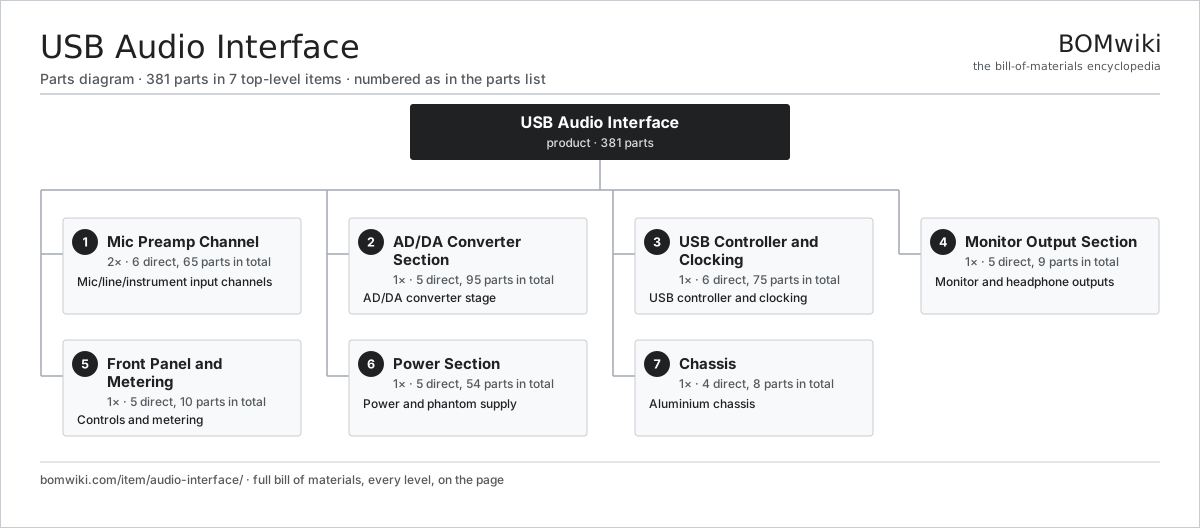
| # | Part | Qty | What it does |
|---|---|---|---|
| 1 | Mic Preamp Channel 6 parts | 2× | Mic/line/instrument input channels |
| 2 | AD/DA Converter Section 5 parts | 1× | AD/DA converter stage |
| 3 | USB Controller and Clocking 6 parts | 1× | USB controller and clocking |
| 4 | Monitor Output Section 5 parts | 1× | Monitor and headphone outputs |
| 5 | Front Panel and Metering 5 parts | 1× | Controls and metering |
| 6 | Power Section 5 parts | 1× | Power and phantom supply |
| 7 | Chassis 4 parts | 1× | Aluminium chassis |
3D model
No 3D model yet. Have a CAD file of this? Add a 3D model. STL renders right on this page; STEP, FreeCAD, and OpenSCAD sources are welcome too (openly licensed, like all 3D models on BOMwiki).
Build & assembly graph
expand / collapse · shared sub-assemblies converge · links to related products · est. labourTap an assembly to expand/collapse · tap a part to open it · use “Open page” for any node · drag to pan, scroll to zoom.
Bill of materials for USB Audio Interface
7 top-level lines · 43 rows shown · 381 parts total · indented to 3 levels| # | Item / sub-assembly | Part no. | Qty/assy | Ext. qty | Parts | Type |
|---|---|---|---|---|---|---|
| 1 | Mic Preamp Channel 6 parts | audio-interface-preamp-section | 2× | 2 | 65 | assembly |
| 1.1 | XLR/TRS Combo Jack | audio-interface-combo-jack | 1× | 2 | · | part |
| 1.2 | Preamp IC | audio-interface-preamp-ic | 1× | 2 | · | part |
| 1.3 | Gain-Set Network | audio-interface-gain-stage | 1× | 2 | · | part |
| 1.4 | Instrument Buffer | audio-interface-inst-buffer | 1× | 2 | · | part |
| 1.5 | Input Protection | audio-interface-input-protection | 1× | 2 | · | part |
| 1.6 | SMD Passive (R/C/L) | smd-passives | 60× | 120 | · | part |
| 2 | AD/DA Converter Section 5 parts | audio-interface-converter-section | 1× | 1 | 95 | assembly |
| 2.1 | Analog-to-Digital Converter | audio-interface-adc | 1× | 1 | · | part |
| 2.2 | Digital-to-Analog Converter | audio-interface-dac | 1× | 1 | · | part |
| 2.3 | Anti-Alias Filter | audio-interface-aa-filter | 2× | 2 | · | part |
| 2.4 | Voltage Reference | audio-interface-vref | 1× | 1 | · | part |
| 2.5 | SMD Passive (R/C/L) | smd-passives | 90× | 90 | · | part |
| 3 | USB Controller and Clocking 6 parts | audio-interface-usb-section | 1× | 1 | 75 | assembly |
| 3.1 | USB Audio Controller | audio-interface-usb-controller | 1× | 1 | · | part |
| 3.2 | USB-C Port | audio-interface-usb-port | 1× | 1 | · | part |
| 3.3 | Master Clock Oscillator | audio-interface-master-clock | 1× | 1 | · | part |
| 3.4 | MIDI Interface | audio-interface-midi-io | 1× | 1 | · | part |
| 3.5 | Bare PCB | pcb-bare | 1× | 1 | · | part |
| 3.6 | SMD Passive (R/C/L) | smd-passives | 70× | 70 | · | part |
| 4 | Monitor Output Section 5 parts | audio-interface-monitor-section | 1× | 1 | 9 | assembly |
| 4.1 | Balanced Line Driver | audio-interface-line-driver | 2× | 2 | · | part |
| 4.2 | Headphone Amplifier | audio-interface-headphone-amp | 1× | 1 | · | part |
| 4.3 | Monitor Level Control | audio-interface-monitor-pot | 1× | 1 | · | part |
| 4.4 | Direct Monitor Path | audio-interface-direct-monitor | 1× | 1 | · | part |
| 4.5 | Connector | connector | 4× | 4 | · | part |
| 5 | Front Panel and Metering 5 parts | audio-interface-front-panel | 1× | 1 | 10 | assembly |
| 5.1 | Gain Knob | audio-interface-gain-knob | 2× | 2 | · | part |
| 5.2 | LED Halo Meter | audio-interface-halo-meter | 2× | 2 | · | part |
| 5.3 | Function Switches | audio-interface-switches | 4× | 4 | · | part |
| 5.4 | Microcontroller | mcu | 1× | 1 | · | part |
| 5.5 | Bare PCB | pcb-bare | 1× | 1 | · | part |
| 6 | Power Section 5 parts | audio-interface-power-section | 1× | 1 | 54 | assembly |
| 6.1 | Phantom Power Supply | audio-interface-phantom-supply | 1× | 1 | · | part |
| 6.2 | Low-Noise LDO Rails | audio-interface-ldo-rails | 1× | 1 | · | part |
| 6.3 | Bus-Power DC-DC | audio-interface-dcdc | 1× | 1 | · | part |
| 6.4 | SMD Passive (R/C/L) | smd-passives | 50× | 50 | · | part |
| 6.5 | Thermal Fuse | thermal-fuse | 1× | 1 | · | part |
| 7 | Chassis 4 parts | audio-interface-chassis | 1× | 1 | 8 | assembly |
| 7.1 | Body Extrusion | audio-interface-extrusion | 1× | 1 | · | part |
| 7.2 | End Plates | audio-interface-end-plates | 2× | 2 | · | part |
| 7.3 | Rubber Feet | audio-interface-feet-pads | 4× | 4 | · | part |
| 7.4 | Fastener Set | fastener-set | 1× | 1 | · | part |
Something wrong in this list? Report a problem with this BOM.
Related products
same domain, ranked by shared parts AV Matrix Switcher
112 parts · shares 1 with this page
AV Matrix Switcher
112 parts · shares 1 with this page
 CD Player
47 parts · shares 1 with this page
CD Player
47 parts · shares 1 with this page
 Channel Strip
55 parts · shares 1 with this page
Digital Stage Box
567 parts · shares 1 with this page
Channel Strip
55 parts · shares 1 with this page
Digital Stage Box
567 parts · shares 1 with this page
 DJ Mixer
86 parts · shares 1 with this page
DJ Mixer
86 parts · shares 1 with this page
Sourcing: possible vendors
Browse the supplier directory → Prices, MOQ, and lead times are algorithmic estimates, not quotes, and not claims about these companies. Company mappings are curated by keyword; est. price band $50–$3k. How estimates work| Vendor | HQ | Specialty | MOQ | Lead time |
|---|---|---|---|---|
|
🇯🇵Sony
sony.com ↗
|
Tokyo, JP | Consumer electronics | 1,000 units | 8–12 wks |
| samsung.com ↗ | Suwon, KR | Electronics & displays | 1,000 units | 8–12 wks |
|
🇺🇸Harman
harman.com ↗
|
Stamford, US | Audio (JBL, AKG) | 1,000 units | 8–12 wks |
|
🇺🇸Bose
bose.com ↗
|
Framingham, US | Audio | 1,000 units | 8–12 wks |
| yamaha.com ↗ | Hamamatsu, JP | Audio & instruments | 1,000 units | 8–12 wks |
808-word article