Automatic Rising Bollard
ProductOverview
An automatic rising bollard controls vehicle access without fencing the space. Lowered, its Head Plate sits flush with the road and traffic drives straight over it; raised, a steel Bollard Barrel of 220–275 mm diameter stands 500–800 mm proud of the surface and physically stops anything from a car to, in crash-rated versions, a 7,200 kg truck at 80 km/h. The product splits into a buried Pit Casing casing cast into concrete, the moving Bollard Cylinder, a hydraulic Hydraulic Drive Unit, and a roadside Control Cabinet cabinet with its Safety Detection System detection.
Two grades dominate the market. Traffic-control bollards (6–10 mm wall) manage city-centre access, residential compounds, and bus lanes, where the goal is deterrence and the occasional low-speed bump. Security bollards tested to IWA 14-1 or PAS 68 use 12–20 mm walls, deeper foundations, and heavier Anchor Reinforcement Cage reinforcement to arrest deliberate vehicle attack; these protect stadium perimeters, government buildings, and pedestrian zones.
How it works
Most automatic bollards are hydraulic. On a raise command the Pump Motor spins a small Gear Pump, pushing oil from the Oil Reservoir through the Valve Block into the single-acting Lift Ram inside the barrel. Fifty to 150 bar lifts the cylinder in 3–7 seconds; an adjustable restrictor in the valve block cushions the last centimetres so the barrel does not bang against its end stop. Lowering is simpler: a solenoid valve opens a return path and the barrel descends under its own weight, the same restrictor governing speed. Because the down direction needs no power, a manual key-operated valve drops the bollard during a power cut, or, on security sites, a gas-charged Hydraulic Accumulator stores one emergency raise instead.
Electromechanical variants replace the hydraulics with a motor-driven screw or rack inside the barrel. They avoid oil and suit cold climates, but hydraulics still dominate intensive-use installations because the pump tolerates 2,000 cycles a day and the Hydraulic Hose Set lets the power pack live in a remote cabinet where it can be serviced without excavating the road.
The cylinder never touches the pit steel directly. Polymer Guide Shoe pads slide inside the machined Guide Liner Tube, keeping the barrel concentric, while a Scraper Ring at the mouth wipes grit and water film off the barrel on every retraction. The Top Frame Collar collar carries wheel loads of 10–40 t when vehicles cross the lowered unit.
Safety and control
EN 12453 treats a rising bollard like any powered barrier: it must not rise under a vehicle or trap a pedestrian. The primary protection is a pair of inductive Inductive Safety Loop coils cut into the asphalt on each side of the bollard line. The Loop Detector Module watches each loop's resonant frequency; metal mass above the loop shifts it, and while either loop reports a vehicle the Logic Board refuses to raise. Infrared Safety Photocell beams cover what loops cannot, pedestrians, bicycles, and trailers with little metal near the ground. During any movement the LED Crown flashes and the Warning Buzzer sounds, and an upstream Traffic Light Head shows green only when a position switch confirms the barrel is fully down.
Commands arrive at the Command Receiver from rolling-code remotes, card readers, keypads, intercom relays, or a building-management contact. The controller runs a timed auto-close by default: vehicle passes, loops clear, a settable delay elapses, bollard rises. One cabinet typically sequences up to four bollards so a wide entrance reads as a single barrier.
Installation and maintenance
The civil work outweighs the machine. A pit roughly 1.5 m deep is excavated, the galvanized Pit Caisson set plumb, and about a cubic metre of reinforced concrete poured around the anchor cage, with conduits run to the cabinet and a Drainage Kit connected to a sump or soakaway. Drainage is the single most important detail: a pit that holds water freezes the mechanism in winter and corrodes it year-round. Cold-climate sites add the Pit Heater Thermostat heater, rated to keep the pit workable to −40 °C.
Maintenance is scheduled by cycle count: every 6–12 months the scraper ring and guide shoes are inspected, the pit cleaned of silt, the hydraulic oil level checked, and the Reflective Band and lighting verified. Hydraulic oil changes fall every 3–5 years. A well-drained, well-maintained hydraulic bollard routinely exceeds one million cycles before the ram seals or Oil Seal elements need replacement.
Automatic Rising Bollard parts and their functions
8 top-level parts · 64 parts in total · full bill of materials below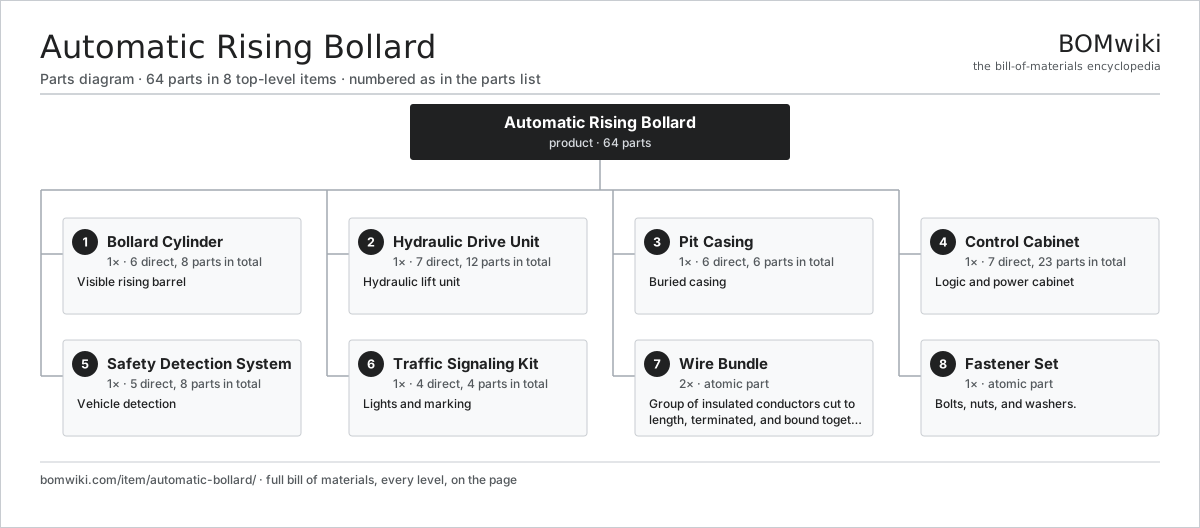
| # | Part | Qty | What it does |
|---|---|---|---|
| 1 | Bollard Cylinder 6 parts | 1× | Visible rising barrel |
| 2 | Hydraulic Drive Unit 7 parts | 1× | Hydraulic lift unit |
| 3 | Pit Casing 6 parts | 1× | Buried casing |
| 4 | Control Cabinet 7 parts | 1× | Logic and power cabinet |
| 5 | Safety Detection System 5 parts | 1× | Vehicle detection |
| 6 | Traffic Signaling Kit 4 parts | 1× | Lights and marking |
| 7 | Wire Bundle | 2× | Group of insulated conductors cut to length, terminated, and bound together to carry power and signals between the assemblies of a machine. |
| 8 | Fastener Set | 1× | Bolts, nuts, and washers. |
3D model
No 3D model yet. Have a CAD file of this? Add a 3D model. STL renders right on this page; STEP, FreeCAD, and OpenSCAD sources are welcome too (openly licensed, like all 3D models on BOMwiki).
Build & assembly graph
expand / collapse · shared sub-assemblies converge · links to related products · est. labourTap an assembly to expand/collapse · tap a part to open it · use “Open page” for any node · drag to pan, scroll to zoom.
Bill of materials for Automatic Rising Bollard
8 top-level lines · 53 rows shown · 64 parts total · indented to 3 levels| # | Item / sub-assembly | Part no. | Qty/assy | Ext. qty | Parts | Type |
|---|---|---|---|---|---|---|
| 1 | Bollard Cylinder 6 parts | automatic-bollard-cylinder | 1× | 1 | 8 | assembly |
| 1.1 | Bollard Barrel | automatic-bollard-barrel | 1× | 1 | · | part |
| 1.2 | Head Plate | automatic-bollard-head-plate | 1× | 1 | · | part |
| 1.3 | Guide Shoe | automatic-bollard-guide-shoe | 3× | 3 | · | part |
| 1.4 | LED Crown | automatic-bollard-led-crown | 1× | 1 | · | part |
| 1.5 | Reflective Band | automatic-bollard-reflective-band | 1× | 1 | · | part |
| 1.6 | Scraper Ring | automatic-bollard-scraper-ring | 1× | 1 | · | part |
| 2 | Hydraulic Drive Unit 7 parts | automatic-bollard-drive | 1× | 1 | 12 | assembly |
| 2.1 | Hydraulic Power Pack 5 parts | automatic-bollard-power-pack | 1× | 1 | 5 | assembly |
| 2.1.1 | Pump Motor | automatic-bollard-pump-motor | 1× | 1 | · | part |
| 2.1.2 | Gear Pump | automatic-bollard-gear-pump | 1× | 1 | · | part |
| 2.1.3 | Oil Reservoir | automatic-bollard-reservoir | 1× | 1 | · | part |
| 2.1.4 | Suction Filter | automatic-bollard-filter | 1× | 1 | · | part |
| 2.1.5 | Pressure Sensor | pressure-sensor | 1× | 1 | · | part |
| 2.2 | Lift Ram | automatic-bollard-ram | 1× | 1 | · | part |
| 2.3 | Valve Block | automatic-bollard-valve-block | 1× | 1 | · | part |
| 2.4 | Hydraulic Accumulator | automatic-bollard-accumulator | 1× | 1 | · | part |
| 2.5 | Hydraulic Hose Set | automatic-bollard-hose-set | 1× | 1 | · | part |
| 2.6 | Oil Seal | oil-seal | 2× | 2 | · | part |
| 2.7 | O-Ring Set | oring-set | 1× | 1 | · | part |
| 3 | Pit Casing 6 parts | automatic-bollard-pit | 1× | 1 | 6 | assembly |
| 3.1 | Pit Caisson | automatic-bollard-caisson | 1× | 1 | · | part |
| 3.2 | Guide Liner Tube | automatic-bollard-liner-tube | 1× | 1 | · | part |
| 3.3 | Top Frame Collar | automatic-bollard-top-frame | 1× | 1 | · | part |
| 3.4 | Drainage Kit | automatic-bollard-drain-kit | 1× | 1 | · | part |
| 3.5 | Anchor Reinforcement Cage | automatic-bollard-anchor-cage | 1× | 1 | · | part |
| 3.6 | Fastener Set | fastener-set | 1× | 1 | · | part |
| 4 | Control Cabinet 7 parts | automatic-bollard-control | 1× | 1 | 23 | assembly |
| 4.1 | Logic Board 5 parts | automatic-bollard-logic-board | 1× | 1 | 9 | assembly |
| 4.1.1 | Bare PCB | pcb-bare | 1× | 1 | · | part |
| 4.1.2 | Microcontroller | mcu | 1× | 1 | · | part |
| 4.1.3 | SMD Passive (R/C/L) | smd-passives | 1× | 1 | · | part |
| 4.1.4 | Relay | relay | 2× | 2 | · | part |
| 4.1.5 | Connector | connector | 4× | 4 | · | part |
| 4.2 | Command Receiver | automatic-bollard-receiver | 1× | 1 | · | part |
| 4.3 | Pit Heater Thermostat | automatic-bollard-heater-stat | 1× | 1 | · | part |
| 4.4 | Power Supply | power-supply | 1× | 1 | · | part |
| 4.5 | Relay | relay | 4× | 4 | · | part |
| 4.6 | Connector | connector | 6× | 6 | · | part |
| 4.7 | Wire Bundle | wire-bundle | 1× | 1 | · | part |
| 5 | Safety Detection System 5 parts | automatic-bollard-safety | 1× | 1 | 8 | assembly |
| 5.1 | Inductive Safety Loop | automatic-bollard-loop | 2× | 2 | · | part |
| 5.2 | Loop Detector Module | automatic-bollard-loop-detector | 1× | 1 | · | part |
| 5.3 | Safety Photocell | automatic-bollard-photocell | 2× | 2 | · | part |
| 5.4 | Warning Buzzer | automatic-bollard-buzzer | 1× | 1 | · | part |
| 5.5 | Connector | connector | 2× | 2 | · | part |
| 6 | Traffic Signaling Kit 4 parts | automatic-bollard-signal | 1× | 1 | 4 | assembly |
| 6.1 | Traffic Light Head | automatic-bollard-traffic-light | 1× | 1 | · | part |
| 6.2 | Signal Post | automatic-bollard-signal-post | 1× | 1 | · | part |
| 6.3 | Warning Sign | automatic-bollard-warning-sign | 1× | 1 | · | part |
| 6.4 | Wire Bundle | wire-bundle | 1× | 1 | · | part |
| 7 | Wire Bundle | wire-bundle | 2× | 2 | · | part |
| 8 | Fastener Set | fastener-set | 1× | 1 | · | part |
Something wrong in this list? Report a problem with this BOM.
Related products
same domain, ranked by shared parts AAC Block Plant
155 parts · shares 6 with this page
AAC Block Plant
155 parts · shares 6 with this page
 Clay Brick Extruder
154 parts · shares 6 with this page
Clay Brick Extruder
154 parts · shares 6 with this page
 Fiber Cement Sheet Machine
819 parts · shares 6 with this page
Fiber Cement Sheet Machine
819 parts · shares 6 with this page
 Gypsum Board Production Line
207 parts · shares 6 with this page
Insulated Sandwich Panel Line
1,856 parts · shares 6 with this page
Metal Roofing Roll Former
704 parts · shares 6 with this page
Gypsum Board Production Line
207 parts · shares 6 with this page
Insulated Sandwich Panel Line
1,856 parts · shares 6 with this page
Metal Roofing Roll Former
704 parts · shares 6 with this page
Sourcing: possible vendors
Browse the supplier directory → Prices, MOQ, and lead times are algorithmic estimates, not quotes, and not claims about these companies. Company mappings are curated by keyword; est. price band $50–$10k. How estimates work| Vendor | HQ | Specialty | MOQ | Lead time |
|---|---|---|---|---|
| assaabloy.com ↗ | Stockholm, SE | Locks & access | 1,000 units | 8–12 wks |
|
🇺🇸Allegion
allegion.com ↗
|
Dublin, US | Security products (Schlage) | 1,000 units | 8–12 wks |
| dormakaba.com ↗ | Rümlang, CH | Access & door systems | 1,000 units | 8–12 wks |
| honeywell.com ↗ | Charlotte, US | Building & safety tech | 1,000 units | 8–12 wks |
| hikvision.com ↗ | Hangzhou, CN | Surveillance & security | 1,000 units | 8–12 wks |
793-word article