Autorefractor
ProductOverview
An autorefractor measures refractive error, the sphere, cylinder, and axis numbers of a spectacle prescription, objectively, without asking the patient anything. It shines infrared light into the eye, observes how the light returning from the retina has been bent by the eye's optics, and computes the correction that would neutralize the error. A measurement takes well under a second per eye. The result is not usually dispensed directly; it is the starting point that the optometrist refines by subjective refraction with a phoropter, and the screening tool for children and patients who cannot respond reliably.
The optical core is the IR Measurement Optics channel, supported by the Fixation & Fogging System that controls the patient's accommodation, the Alignment System and Motorized Positioning Stage that keep the instrument on the pupil center, and the Processor Unit that turns ring images into diopters. The patient sits at the Chin Rest Assembly; results show on the Console & Printer and print on the Thermal Slip Printer.
Measurement principle
Measurement uses 880 nm light from the 880 nm IR Source, invisible, so the pupil stays large and the patient is not dazzled, and kept under the ISO 15004-2 exposure limits. The beam passes through the Ring Aperture Mask, which shapes it into an annulus, and the Relay Lens Element train images this ring through the pupil onto the retina. The retina scatters the light back out through the eye's optics, and the Hot Mirror Beamsplitter folds the returning reflex onto the CMOS Image Sensor.
An emmetropic (correctly focused) eye returns the ring at its nominal size and shape. Myopia shrinks the imaged ring, hyperopia enlarges it, and astigmatism turns it into an ellipse: each meridian of the eye refracts independently, so ring diameter measured around the ellipse gives the refractive power meridian by meridian. The Compute SoC Module in the Processor Unit fits an ellipse to the ring image; the fit's mean size, eccentricity, and orientation map directly to sphere, cylinder, and axis. Before the shot, the Badal Focus Stage drives a lens along a Badal track to roughly null the reflex, on the Badal principle the carriage position read by its Encoder is linear in diopters, which extends the measurable range to about -25/+22 D and keeps the ring well-formed for the fine fit.
Controlling accommodation
The largest error source in objective refraction is instrument myopia: a patient looking into a nearby machine accommodates, and the instrument then measures the eye in its near-focused state, overestimating myopia by a diopter or more. The Fixation & Fogging System counters this with fogging. The patient views the Fixation Target Slide, the traditional hot-air-balloon scene, lit by the Target Backlight LED, through the visible side of the hot mirror. After a preliminary measurement, a Servo Motor slides the Fogging Lens so the target appears 1.5–2 D beyond the patient's far point. Accommodating would only blur it further, so the ciliary muscle relaxes, and the definitive shots are taken in that relaxed state. Three or more shots are averaged and confidence-flagged.
Alignment and tracking
Valid readings require the measurement axis to pass through the pupil center at the calibrated working distance. The Alignment System images the anterior eye through a Lens Assembly onto its own CMOS Image Sensor; the corneal reflections of the Alignment Mire LED pair give lateral position and distance, while the Pupil Illumination Ring outlines the pupil so the firmware can verify the 2.3 mm minimum diameter and skip blinks. The tracking loop drives the three Servo Motor axes of the Motorized Positioning Stage through Ball Screw leadscrews, holding the Optical Head Carriage on the moving pupil and firing automatically; the Control Joystick covers manual operation. Patient setup follows the usual ophthalmic-table routine: raise the Chin Cup on its Chin Rest Column until the eyes sit mid-travel, forehead against the Forehead Rest.
Output and accuracy
Results list sphere in 0.12 or 0.25 D steps, cylinder to ±10 D, and axis to 1°, corrected to the selected vertex distance (12 or 13.75 mm for spectacles, 0 for contact lenses). Against subjective refraction, modern autorefractors agree within ±0.25 D sphere for the large majority of healthy adult eyes; agreement degrades with small pupils, media opacities such as cataract, and in young children, where residual accommodation defeats fogging and cycloplegic drops are used instead. Verification against ISO 10342 uses calibrated model eyes across the dioptric range. Many units combine the same optical head with keratometry mires to also measure corneal curvature, sharing the Processor Unit, stage, and console.
Autorefractor parts and their functions
8 top-level parts · 513 parts in total · full bill of materials below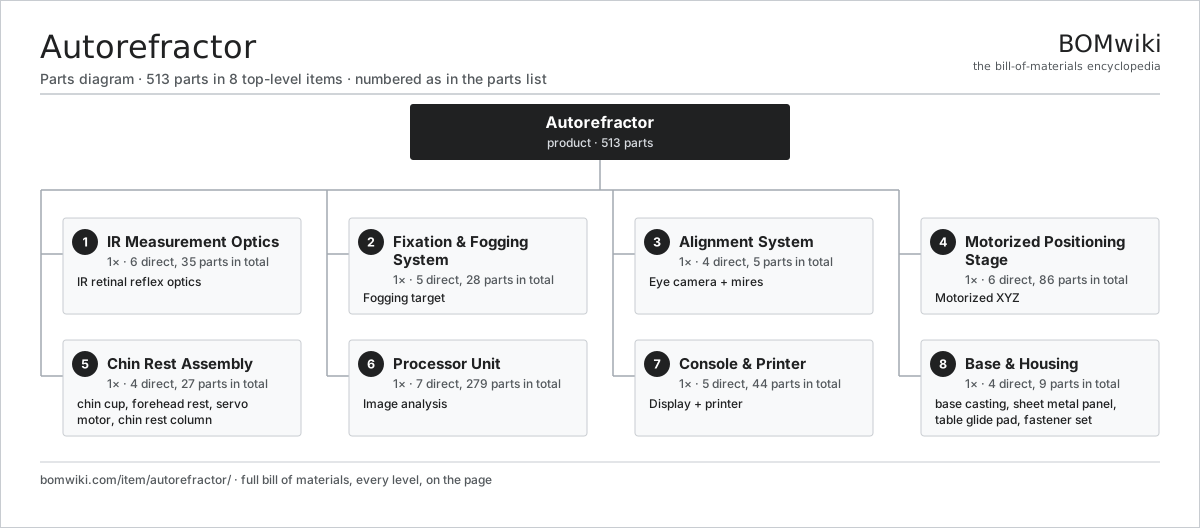
| # | Part | Qty | What it does |
|---|---|---|---|
| 1 | IR Measurement Optics 6 parts | 1× | IR retinal reflex optics |
| 2 | Fixation & Fogging System 5 parts | 1× | Fogging target |
| 3 | Alignment System 4 parts | 1× | Eye camera + mires |
| 4 | Motorized Positioning Stage 6 parts | 1× | Motorized XYZ |
| 5 | Chin Rest Assembly 4 parts | 1× | Motorized chin cup and forehead rest centering the patient eyes in the stage travel. |
| 6 | Processor Unit 7 parts | 1× | Image analysis |
| 7 | Console & Printer 5 parts | 1× | Display + printer |
| 8 | Base & Housing 4 parts | 1× | Cast base on table glide pads with molded covers enclosing the optical head. |
3D model
No 3D model yet. Have a CAD file of this? Add a 3D model. STL renders right on this page; STEP, FreeCAD, and OpenSCAD sources are welcome too (openly licensed, like all 3D models on BOMwiki).
Build & assembly graph
expand / collapse · shared sub-assemblies converge · links to related products · est. labourTap an assembly to expand/collapse · tap a part to open it · use “Open page” for any node · drag to pan, scroll to zoom.
Bill of materials for Autorefractor
8 top-level lines · 65 rows shown · 513 parts total · indented to 3 levels| # | Item / sub-assembly | Part no. | Qty/assy | Ext. qty | Parts | Type |
|---|---|---|---|---|---|---|
| 1 | IR Measurement Optics 6 parts | autorefractor-ir-measurement | 1× | 1 | 35 | assembly |
| 1.1 | 880 nm IR Source | autorefractor-ir-sld | 1× | 1 | · | part |
| 1.2 | Ring Aperture Mask | autorefractor-ring-aperture | 1× | 1 | · | part |
| 1.3 | Relay Lens Element | autorefractor-relay-lens | 3× | 3 | · | part |
| 1.4 | Hot Mirror Beamsplitter | autorefractor-hot-mirror | 1× | 1 | · | part |
| 1.5 | CMOS Image Sensor | image-sensor | 1× | 1 | · | part |
| 1.6 | Badal Focus Stage 4 parts | autorefractor-focus-stage | 1× | 1 | 28 | assembly |
| 1.6.1 | Servo Motor 4 parts + deeper › | servo-motor | 1× | 1 | 24 | assembly |
| 1.6.2 | Ball Screw | ball-screw | 1× | 1 | · | part |
| 1.6.3 | Encoder | encoder | 1× | 1 | · | part |
| 1.6.4 | Ball Bearing | ball-bearing | 2× | 2 | · | part |
| 2 | Fixation & Fogging System 5 parts | autorefractor-fixation-system | 1× | 1 | 28 | assembly |
| 2.1 | Fixation Target Slide | autorefractor-fixation-slide | 1× | 1 | · | part |
| 2.2 | Target Backlight LED | autorefractor-target-led | 1× | 1 | · | part |
| 2.3 | Fogging Lens | autorefractor-fogging-lens | 1× | 1 | · | part |
| 2.4 | Servo Motor 4 parts | servo-motor | 1× | 1 | 24 | assembly |
| 2.4.1 | Stator Assembly 3 parts + deeper › | stator-assembly | 1× | 1 | 3 | assembly |
| 2.4.2 | Rotor Assembly 4 parts + deeper › | rotor-assembly | 1× | 1 | 19 | assembly |
| 2.4.3 | Encoder | encoder | 1× | 1 | · | part |
| 2.4.4 | Motor Housing | motor-housing | 1× | 1 | · | part |
| 2.5 | Ball Screw | ball-screw | 1× | 1 | · | part |
| 3 | Alignment System 4 parts | autorefractor-alignment-system | 1× | 1 | 5 | assembly |
| 3.1 | CMOS Image Sensor | image-sensor | 1× | 1 | · | part |
| 3.2 | Lens Assembly | camera-lens | 1× | 1 | · | part |
| 3.3 | Alignment Mire LED | autorefractor-mire-led | 2× | 2 | · | part |
| 3.4 | Pupil Illumination Ring | autorefractor-pupil-ring-led | 1× | 1 | · | part |
| 4 | Motorized Positioning Stage 6 parts | autorefractor-positioning-stage | 1× | 1 | 86 | assembly |
| 4.1 | Servo Motor 4 parts | servo-motor | 3× | 3 | 24 | assembly |
| 4.1.1 | Stator Assembly 3 parts + deeper › | stator-assembly | 1× | 3 | 3 | assembly |
| 4.1.2 | Rotor Assembly 4 parts + deeper › | rotor-assembly | 1× | 3 | 19 | assembly |
| 4.1.3 | Encoder | encoder | 1× | 3 | · | part |
| 4.1.4 | Motor Housing | motor-housing | 1× | 3 | · | part |
| 4.2 | Ball Screw | ball-screw | 3× | 3 | · | part |
| 4.3 | Hall Sensor | hall-sensor | 3× | 3 | · | part |
| 4.4 | Optical Head Carriage | autorefractor-stage-carriage | 1× | 1 | · | part |
| 4.5 | Control Joystick | autorefractor-joystick | 1× | 1 | · | part |
| 4.6 | Ball Bearing | ball-bearing | 6× | 6 | · | part |
| 5 | Chin Rest Assembly 4 parts | autorefractor-chin-rest | 1× | 1 | 27 | assembly |
| 5.1 | Chin Cup | autorefractor-chin-cup | 1× | 1 | · | part |
| 5.2 | Forehead Rest | autorefractor-forehead-rest | 1× | 1 | · | part |
| 5.3 | Servo Motor 4 parts | servo-motor | 1× | 1 | 24 | assembly |
| 5.3.1 | Stator Assembly 3 parts + deeper › | stator-assembly | 1× | 1 | 3 | assembly |
| 5.3.2 | Rotor Assembly 4 parts + deeper › | rotor-assembly | 1× | 1 | 19 | assembly |
| 5.3.3 | Encoder | encoder | 1× | 1 | · | part |
| 5.3.4 | Motor Housing | motor-housing | 1× | 1 | · | part |
| 5.4 | Chin Rest Column | autorefractor-chinrest-column | 1× | 1 | · | part |
| 6 | Processor Unit 7 parts | autorefractor-processor-unit | 1× | 1 | 279 | assembly |
| 6.1 | Bare PCB | pcb-bare | 1× | 1 | · | part |
| 6.2 | Compute SoC Module | soc-module | 1× | 1 | · | part |
| 6.3 | Microcontroller | mcu | 1× | 1 | · | part |
| 6.4 | Power Supply | power-supply | 1× | 1 | · | part |
| 6.5 | Connector | connector | 14× | 14 | · | part |
| 6.6 | SMD Passive (R/C/L) | smd-passives | 260× | 260 | · | part |
| 6.7 | Wire Bundle | wire-bundle | 1× | 1 | · | part |
| 7 | Console & Printer 5 parts | autorefractor-console | 1× | 1 | 44 | assembly |
| 7.1 | LCD Panel | lcd-panel | 1× | 1 | · | part |
| 7.2 | Touch Digitizer | touch-digitizer | 1× | 1 | · | part |
| 7.3 | Thermal Slip Printer | autorefractor-thermal-printer | 1× | 1 | · | part |
| 7.4 | Bare PCB | pcb-bare | 1× | 1 | · | part |
| 7.5 | SMD Passive (R/C/L) | smd-passives | 40× | 40 | · | part |
| 8 | Base & Housing 4 parts | autorefractor-housing | 1× | 1 | 9 | assembly |
| 8.1 | Base Casting | autorefractor-base-casting | 1× | 1 | · | part |
| 8.2 | Sheet Metal Panel | sheet-panel | 4× | 4 | · | part |
| 8.3 | Table Glide Pad | autorefractor-glide-pad | 3× | 3 | · | part |
| 8.4 | Fastener Set | fastener-set | 1× | 1 | · | part |
Something wrong in this list? Report a problem with this BOM.
Related products
same domain, ranked by shared parts Ophthalmic Tonometer
505 parts · shares 22 with this page
Ophthalmic Tonometer
505 parts · shares 22 with this page
 ECMO Machine
142 parts · shares 19 with this page
Heart-Lung Machine
298 parts · shares 19 with this page
ECMO Machine
142 parts · shares 19 with this page
Heart-Lung Machine
298 parts · shares 19 with this page
 Surgical Robot
2,740 parts · shares 19 with this page
Surgical Robot
2,740 parts · shares 19 with this page
 Gamma Camera
421 parts · shares 18 with this page
Gamma Camera
421 parts · shares 18 with this page
 PET-CT Scanner
514 parts · shares 18 with this page
PET-CT Scanner
514 parts · shares 18 with this page
Sourcing: possible vendors
Browse the supplier directory → Prices, MOQ, and lead times are algorithmic estimates, not quotes, and not claims about these companies. Company mappings are curated by keyword; est. price band $500–$3M. How estimates work| Vendor | HQ | Specialty | MOQ | Lead time |
|---|---|---|---|---|
| gehealthcare.com ↗ | Chicago, US | Medical imaging & devices | 100 units | 12–20 wks |
| siemens-healthineers.com ↗ | Erlangen, DE | Medical systems | 100 units | 12–20 wks |
|
🇳🇱Philips
philips.com ↗
|
Amsterdam, NL | Health technology | 100 units | 12–20 wks |
| medtronic.com ↗ | Minneapolis, US | Medical devices | 100 units | 12–20 wks |
|
🇨🇳Mindray
mindray.com ↗
|
Shenzhen, CN | Medical devices | 100 units | 12–20 wks |
775-word article