Ballpoint Pen Assembly Machine
ProductOverview
Ballpoint pen assembly machines integrate the insertion of ballpoint tips into plastic barrels, ink filling via centrifuge, refill mechanism assembly, leak testing, cap placement, and final writing verification into a single automated line. These machines handle cartridge-based ballpoint pen assembly at rates of 200–400 units per minute using carousel indexing and precisely timed pneumatic, hydraulic, and centrifugal operations. The critical challenge is preventing ink leakage and ensuring air-free fill; vacuum-assisted centrifuge filling and pressure-decay leak detection are standard quality controls.
How It Works
Ballpoint Tip Feeding
The Ballpoint Tip Feeder station receives pre-manufactured ballpoint tips (hardened steel ball in a precision socket). A Tip Vibratory Bowl vibratory feeder orients tips uniformly in a spiral track. A Tip Pick-and-Place Head (solenoid vacuum or magnetic gripper) pick-and-place arm retrieves one tip per cycle and transfers it to the first carousel position, where it is held in a Press Head Assembly guide bushing.
Barrel Tube Supply and Positioning
Plastic barrel tubes (2–5 mm diameter, 40–50 mm length) are gravity-fed from a Barrel Hopper onto the main Control and Synchronization carousel. A Barrel Clamping Chuck (pneumatic or mechanical) clamps each barrel at the first assembly station with light force (1–3 bar) to avoid deformation.
Ballpoint Insertion
At the Ballpoint Insertion Press station, a Insertion Press Cylinder (double-acting pneumatic, 5–20 bar) drives a press head downward, forcing the ballpoint tip into the pre-drilled barrel opening. The Press Head Assembly guide bushing maintains ±0.05 mm concentricity. A Pressure Sensor detects press force; if force is too high (tip diameter over-spec), the controller flags the pen as a reject. Typical press depth is 3–5 mm, determined by mechanical stop.
Ink Filling and Deaeration
The carousel advances to the Ink Fill and Centrifuge station, where filled barrels are loaded into a Centrifuge Rotor Bowl rotor. A Ink Metering Pump (peristaltic or gear pump) dispenses 0.5–2 mL of ballpoint ink into each barrel. Simultaneously, a Vacuum Deaeration Pump applies vacuum (10–15 inches water) to the barrel interior, evacuating air trapped in the ink reservoir.
The centrifuge rotor then spins at 500–1500 rpm for 10–30 seconds. Centrifugal acceleration drives liquid deeper into the barrel cavity and against the sidewalls, displacing remaining air bubbles toward the vacuum outlet. This dual action (vacuum + centrifuge) ensures that the assembled pen contains minimal dissolved air, which prevents ink sputtering and extends pen life. A Temperature Sensor monitors ink temperature; warm ink (<35 °C) flows freely, while cold ink becomes viscous and resists complete fill.
Refill and Spring Assembly
At the next station, the Refill and Spring Assembly mechanism inserts the ballpoint refill cartridge (which contains the spring, push rod, and retract mechanism). A Refill Magazine Cartridge holds pre-assembled refill units indexed sequentially. A Refill Press Mechanism (pneumatic, 30–100 bar) presses the refill tube into the barrel bore with controlled force. A Pressure Sensor detects insertion depth and seating force; insufficient force leaves the refill loose, while excessive force may deform the barrel opening.
Leak Detection and Quality Assurance
At the Leak Test Chamber station, the assembled barrel+ballpoint+refill assembly is placed into a Leak Test Vessel, a sealed pressure vessel. Air at 2–5 bar is introduced around the assembled pen for 10–30 seconds. If ink is leaking from any joint (ballpoint-to-barrel, refill-to-barrel, or cap-to-barrel seams), a visible bubble forms. A Pressure Sensor detects pressure drop >0.1 bar, flagging the pen as a leak-failure. A Reject Arm pneumatic arm diverts failed pens to a scrap chute; good pens proceed to cap assembly.
Cap Placement and Assembly
The Cap Assembly Station station receives a Cap Feeder Magazine pre-assembled plastic cap. A Cap Placer (vacuum or mechanical gripper) places the cap onto the barrel. A Cap Press or Screw Driver then either presses the cap (press-fit) or screws it (using a servo-driven electric screw driver) with torque feedback to ensure consistent tightness. Typical press-fit force is 100–200 bar.
Automated Writing Test
Before final discharge, the Writing Test and Quality Check station conducts a final writing and ink-flow check. A Writing Test Servo Stage servo-driven linear stage presses the completed pen onto a Paper Test Pad paper roll with controlled force (200–500 grams-force) and strokes test lines at 50–100 mm/s. A Vision Inspection Camera camera with LED ring-light captures images of the written line and inspects:
- Line width uniformity (expected 0.7–1.2 mm)
- Ink density and color match
- Line continuity (no skips or gaps indicating air bubbles)
- Pen retraction mechanism function (mechanical check via position feedback)
Vision software detects defects and signals rejection; failed pens are diverted to scrap; good pens discharge to output tray.
Carousel Synchronization
All operations are sequenced by the Control and Synchronization PLC. A Microcontroller receives step/direction commands and triggers all solenoids, pumps, and motor drives via Relay contactors. An Encoder senses carousel position at each station; operations begin only after position verification. If any station takes too long (e.g., leak test pressure doesn't rise, ballpoint insertion blocked), the carousel is halted and an alarm is triggered.
Engineering Considerations
Ink Chemistry: Ballpoint ink is a complex suspension of dyes, waxes, and oils in organic solvent. Over-viscous ink (cold, high dye loading) fails to fill completely; under-viscous ink (warm, low dye) may leak. Ink suppliers typically provide data on optimal fill temperature (usually 25–35 °C).
Deaeration Control: Residual air in the barrel causes skipping during writing and dramatically shortens pen life. Centrifuge speed must be sufficient to accelerate ink to >1 G; below 500 rpm, deaeration is incomplete. Vacuum strength (must exceed ink vapor pressure) is also critical.
Tip Seating Depth: Ballpoint tip must seat flush with or slightly recessed into the barrel opening; if too shallow, the tip protrudes and can be damaged during cap press-fit. Press depth is typically set via mechanical stop block, verified by Pressure Sensor feedback.
Refill Force Control: Refill tube diameter and barrel bore tolerance must match precisely. Over-force deforms the barrel and creates press-fit variance; under-force leaves refill loose and causes ink leakage during centrifuge spin.
Leak Test Sensitivity: Pressure-decay detection must distinguish legitimate slow leaks from normal temperature/pressure drifts. Typical pressure drop threshold is 0.1 bar over 30 seconds; calibration is needed for seasonal ambient temperature changes.
Writing Test Reliability: Vision inspection of ink line quality is sensitive to ambient lighting and camera focus. Test pads must be changed regularly (every 1000–5000 tests) to avoid ink buildup and false defects.
Production Metrics
A machine with 10 carousel stations, 5-second dwell per station yields 120 pens per minute baseline. With optimized indexing, modern machines reach 200–400/minute. Power consumption is 5–10 kW, with vacuum deaeration and centrifuge accounting for 30% of load. Changeover between pen models (different barrel color, cap style, or ink type) typically requires 20–30 minutes of fixture adjustment and test-pad recalibration.
Ballpoint Pen Assembly Machine parts and their functions
9 top-level parts · 51 parts in total · full bill of materials below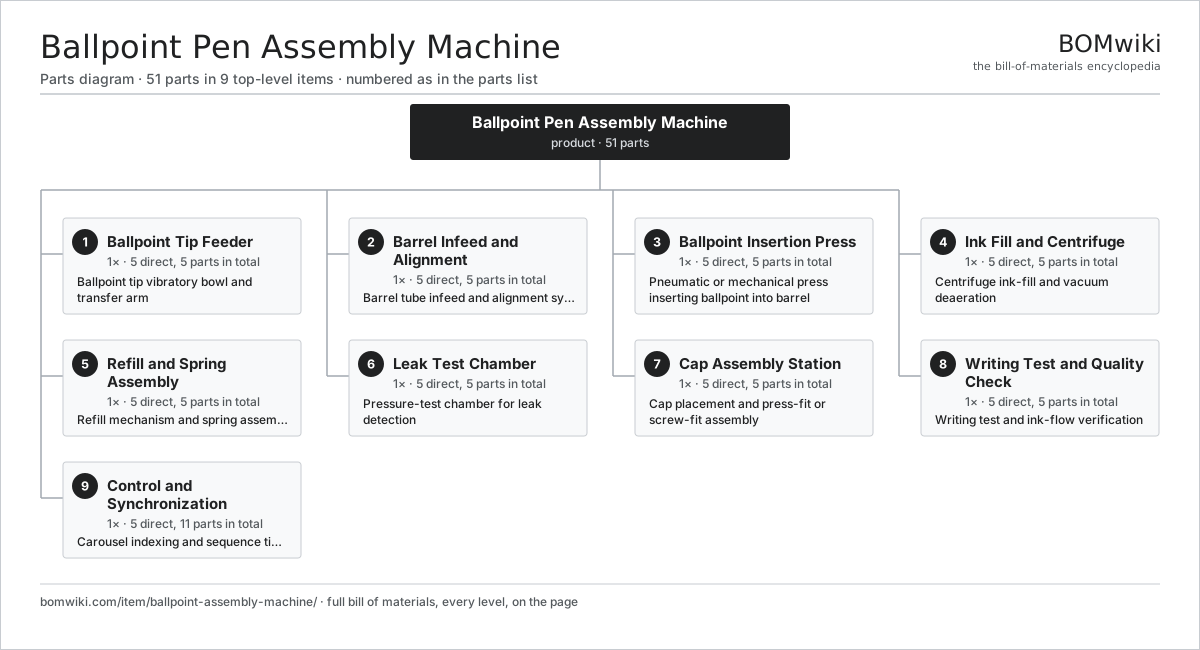
| # | Part | Qty | What it does |
|---|---|---|---|
| 1 | Ballpoint Tip Feeder 5 parts | 1× | Ballpoint tip vibratory bowl and transfer arm |
| 2 | Barrel Infeed and Alignment 5 parts | 1× | Barrel tube infeed and alignment system |
| 3 | Ballpoint Insertion Press 5 parts | 1× | Pneumatic or mechanical press inserting ballpoint into barrel |
| 4 | Ink Fill and Centrifuge 5 parts | 1× | Centrifuge ink-fill and vacuum deaeration |
| 5 | Refill and Spring Assembly 5 parts | 1× | Refill mechanism and spring assembly press-fit station |
| 6 | Leak Test Chamber 5 parts | 1× | Pressure-test chamber for leak detection |
| 7 | Cap Assembly Station 5 parts | 1× | Cap placement and press-fit or screw-fit assembly |
| 8 | Writing Test and Quality Check 5 parts | 1× | Writing test and ink-flow verification |
| 9 | Control and Synchronization 5 parts | 1× | Carousel indexing and sequence timing |
3D model
No 3D model yet. Have a CAD file of this? Add a 3D model. STL renders right on this page; STEP, FreeCAD, and OpenSCAD sources are welcome too (openly licensed, like all 3D models on BOMwiki).
Build & assembly graph
expand / collapse · shared sub-assemblies converge · links to related products · est. labourTap an assembly to expand/collapse · tap a part to open it · use “Open page” for any node · drag to pan, scroll to zoom.
Bill of materials for Ballpoint Pen Assembly Machine
9 top-level lines · 54 rows shown · 51 parts total · indented to 3 levels| # | Item / sub-assembly | Part no. | Qty/assy | Ext. qty | Parts | Type |
|---|---|---|---|---|---|---|
| 1 | Ballpoint Tip Feeder 5 parts | ballpoint-assembly-machine-tip-feed | 1× | 1 | 5 | assembly |
| 1.1 | Tip Vibratory Bowl | ballpoint-assembly-machine-tip-bowl | 1× | 1 | · | part |
| 1.2 | Tip Pick-and-Place Head | ballpoint-assembly-machine-tip-picker | 1× | 1 | · | part |
| 1.3 | Tip Magazine | ballpoint-assembly-machine-tip-magazine | 1× | 1 | · | part |
| 1.4 | Connector | connector | 1× | 1 | · | part |
| 1.5 | O-Ring Set | oring-set | 1× | 1 | · | part |
| 2 | Barrel Infeed and Alignment 5 parts | ballpoint-assembly-machine-barrel | 1× | 1 | 5 | assembly |
| 2.1 | Barrel Hopper | ballpoint-assembly-machine-barrel-hopper | 1× | 1 | · | part |
| 2.2 | Barrel Guide | ballpoint-assembly-machine-barrel-guide | 1× | 1 | · | part |
| 2.3 | Barrel Clamping Chuck | ballpoint-assembly-machine-barrel-chuck | 1× | 1 | · | part |
| 2.4 | Pressure Sensor | pressure-sensor | 1× | 1 | · | part |
| 2.5 | Encoder | encoder | 1× | 1 | · | part |
| 3 | Ballpoint Insertion Press 5 parts | ballpoint-assembly-machine-insert | 1× | 1 | 5 | assembly |
| 3.1 | Insertion Press Cylinder | ballpoint-assembly-machine-insert-cylinder | 1× | 1 | · | part |
| 3.2 | Press Head Assembly | ballpoint-assembly-machine-insert-head | 1× | 1 | · | part |
| 3.3 | Pressure Sensor | pressure-sensor | 1× | 1 | · | part |
| 3.4 | Encoder | encoder | 1× | 1 | · | part |
| 3.5 | O-Ring Set | oring-set | 1× | 1 | · | part |
| 4 | Ink Fill and Centrifuge 5 parts | ballpoint-assembly-machine-ink | 1× | 1 | 5 | assembly |
| 4.1 | Centrifuge Rotor Bowl | ballpoint-assembly-machine-centrifuge-bowl | 1× | 1 | · | part |
| 4.2 | Ink Metering Pump | ballpoint-assembly-machine-ink-pump | 1× | 1 | · | part |
| 4.3 | Vacuum Deaeration Pump | ballpoint-assembly-machine-vacuum-pump | 1× | 1 | · | part |
| 4.4 | Temperature Sensor | temperature-sensor | 1× | 1 | · | part |
| 4.5 | Pressure Sensor | pressure-sensor | 1× | 1 | · | part |
| 5 | Refill and Spring Assembly 5 parts | ballpoint-assembly-machine-refill | 1× | 1 | 5 | assembly |
| 5.1 | Refill Magazine Cartridge | ballpoint-assembly-machine-refill-magazine | 1× | 1 | · | part |
| 5.2 | Refill Press Mechanism | ballpoint-assembly-machine-refill-press | 1× | 1 | · | part |
| 5.3 | Refill Guide | ballpoint-assembly-machine-refill-guide | 1× | 1 | · | part |
| 5.4 | Pressure Sensor | pressure-sensor | 1× | 1 | · | part |
| 5.5 | Encoder | encoder | 1× | 1 | · | part |
| 6 | Leak Test Chamber 5 parts | ballpoint-assembly-machine-leak | 1× | 1 | 5 | assembly |
| 6.1 | Leak Test Vessel | ballpoint-assembly-machine-test-chamber | 1× | 1 | · | part |
| 6.2 | Air Supply | ballpoint-assembly-machine-air-supply | 1× | 1 | · | part |
| 6.3 | Pressure Sensor | pressure-sensor | 1× | 1 | · | part |
| 6.4 | Reject Arm | ballpoint-assembly-machine-reject-arm | 1× | 1 | · | part |
| 6.5 | Connector | connector | 1× | 1 | · | part |
| 7 | Cap Assembly Station 5 parts | ballpoint-assembly-machine-cap | 1× | 1 | 5 | assembly |
| 7.1 | Cap Feeder Magazine | ballpoint-assembly-machine-cap-magazine | 1× | 1 | · | part |
| 7.2 | Cap Placer | ballpoint-assembly-machine-cap-placer | 1× | 1 | · | part |
| 7.3 | Cap Press or Screw Driver | ballpoint-assembly-machine-cap-press | 1× | 1 | · | part |
| 7.4 | Pressure Sensor | pressure-sensor | 1× | 1 | · | part |
| 7.5 | Encoder | encoder | 1× | 1 | · | part |
| 8 | Writing Test and Quality Check 5 parts | ballpoint-assembly-machine-test | 1× | 1 | 5 | assembly |
| 8.1 | Paper Test Pad | ballpoint-assembly-machine-test-pad | 1× | 1 | · | part |
| 8.2 | Writing Test Servo Stage | ballpoint-assembly-machine-write-head | 1× | 1 | · | part |
| 8.3 | Vision Inspection Camera | ballpoint-assembly-machine-vision | 1× | 1 | · | part |
| 8.4 | Encoder | encoder | 1× | 1 | · | part |
| 8.5 | Reject Arm | ballpoint-assembly-machine-reject-arm | 1× | 1 | · | part |
| 9 | Control and Synchronization 5 parts | ballpoint-assembly-machine-control | 1× | 1 | 11 | assembly |
| 9.1 | Microcontroller | mcu | 1× | 1 | · | part |
| 9.2 | Bare PCB | pcb-bare | 1× | 1 | · | part |
| 9.3 | Relay | relay | 6× | 6 | · | part |
| 9.4 | Power Supply | power-supply | 1× | 1 | · | part |
| 9.5 | Encoder | encoder | 2× | 2 | · | part |
Something wrong in this list? Report a problem with this BOM.
Related products
same domain, ranked by shared parts Chalk Extrusion Machine
47 parts · shares 7 with this page
Crayon Molding Machine
56 parts · shares 7 with this page
Marker Filling Machine
45 parts · shares 6 with this page
Match Making Machine
47 parts · shares 6 with this page
Chalk Extrusion Machine
47 parts · shares 7 with this page
Crayon Molding Machine
56 parts · shares 7 with this page
Marker Filling Machine
45 parts · shares 6 with this page
Match Making Machine
47 parts · shares 6 with this page
 Vacuum Casting Machine
39 parts · shares 5 with this page
Nail Polish Filling Machine
82 parts · shares 5 with this page
Vacuum Casting Machine
39 parts · shares 5 with this page
Nail Polish Filling Machine
82 parts · shares 5 with this page
Sourcing: possible vendors
Browse the supplier directory → Prices, MOQ, and lead times are algorithmic estimates, not quotes, and not claims about these companies. Company mappings are curated by keyword; est. price band $5k–$2M. How estimates work| Vendor | HQ | Specialty | MOQ | Lead time |
|---|---|---|---|---|
| atlascopco.com ↗ | Stockholm, SE | Compressors & industrial | 10 units | 12–20 wks |
|
🇦🇹Andritz
andritz.com ↗
|
Graz, AT | Process plants & machinery | 10 units | 12–20 wks |
| buhlergroup.com ↗ | Uzwil, CH | Food & materials processing | 10 units | 12–20 wks |
| gea.com ↗ | Düsseldorf, DE | Process technology | 10 units | 12–20 wks |
| mhi.com ↗ | Tokyo, JP | Heavy machinery | 10 units | 12–20 wks |
1,231-word article