Barcode Verifier
ProductOverview
A barcode verifier is an optical measurement instrument certifying that printed barcodes meet industry grading standards. Barcodes are ubiquitous, every product in a store, every shipping label, every asset tag, yet a barcode that is out of spec (too light, too thin, wrong aspect ratio) will fail to scan. Retailers impose costly chargebacks if a supplier ships products with unreadable barcodes; manufacturers conduct verification at the print station to catch defects before they ship.
Barcode verifiers measure the optical properties (contrast, edge definition, quiet zone) and report a grade (A = highest quality, F = fail) per ANSI/ISO 15426. This allows a production line to dynamically adjust print pressure, ink darkness, or label stock if a run is drifting out of spec, preventing waste and chargebacks.
Optical System
The Optical System assembly is precision engineering. A Machine Vision Lens (12–25 mm fixed focal length, telecentric or near-telecentric design) focuses an image of the barcode onto a Line-Scan or Area Sensor line-scan camera. Telecentric optics are critical: they minimise perspective distortion, ensuring that the top and bottom edges of a barcode are imaged at the same magnification regardless of sample depth. A non-telecentric lens would report different edge positions if a label were tilted, yielding false fails.
The Lens Mount Assembly supports fine focus adjustment via a helical thread or stepper motor, setting the working distance to 100–400 mm depending on the barcode size. The Adjustable Iris Diaphragm adjustable iris (f/2.8 to f/22) controls the depth of field and light throughput, allowing compensation for variations in printed contrast (light barcodes on dark labels vs dark barcodes on light stock).
The Precision Optical Bench is a precision-ground steel or aluminium platform holding the lens, camera, and illumination in fixed spatial relationship. Any vibration or thermal drift would change the optical alignment and thus the measurement. The bench sits on Vibration Isolation Feet elastomer isolation mounts, decoupling it from factory floor vibrations (stamping presses, conveyor lines) that would otherwise blur images and induce measurement noise.
Illumination
The Calibrated Illumination Dome dome is calibrated white light. A LED Ring Array of cool-white (5000–6500 K) high-CRI LEDs surrounds the sample, providing diffuse illumination. High colour-rendering index (CRI ≥90) is essential because barcode grading measures contrast, which is highly dependent on the light spectrum, low-CRI LEDs would overstate or understate the contrast of certain inks.
The Optical Diffuser Dome dome encloses the LEDs, scattering their light evenly across the sample. The goal is <10% intensity variation across the barcode area, achieving this requires careful geometry. The LED Power Supply power supply provides PWM dimming (0–100%) with automatic intensity stabilisation, compensating for LED ageing (LEDs output decreases ~5% per 10,000 hours) and temperature variations. The Light Sensor photodiode continuously measures the actual illuminant and feeds back to the CPU for automatic white-balance adjustment.
Camera and Signal Chain
The Camera Sensor is typically a line-scan imager, not an area camera. Line-scan achieves higher pixel density (2048–4096 pixels) in a single line and scans at high speed (10–40 kHz line rate). As the Sample Positioning Stage moves the sample under the camera, successive lines build up the full 2D image. The 14-bit or 16-bit ADC quantization gives exquisite contrast resolution: a barcode's light and dark bars differ in reflectance by ~20%, which translates to 1/5 of the full ADC range, still 2560–4096 levels of precision, far better than the 256 levels an 8-bit camera would provide.
The Frame Grabber / ADC frame grabber digitises the sensor output and transfers images into the CPU's memory via high-speed DMA (direct memory access), keeping the processing pipeline flowing without stalling.
Stage and Positioning
The Sample Positioning Stage holds the sample, a label, a carton, or a direct-printed surface, under the camera. Most verifiers offer motorised XYZ stage motion via stepper or servo motors, allowing automated multi-point scanning. For example, a verifier can scan all four corners of a carton label to detect print misregistration or positioning errors. The Position Sensors limit switches and home sensors ensure repeatable positioning.
Sample holders are configurable: a clamp for shipping labels, a flat platform for labels on cartons, or a cylindrical adapter for scanning barcodes on curved surfaces (rolls of labels, bottles). Repeatability is ±0.5 mm, critical because a 0.5 mm error can shift the measured edge position and alter the grade.
Image Processing and Grading
The Image Processing Engine is the brains. Its CPU PCB CPU runs OpenCV and custom barcode-grading algorithms implementing the ANSI/ISO 15426 standard. The measurement pipeline:
Edge detection: Identify the rising and falling edges of each dark bar and light space using Sobel or Canny operators, fitted to sub-pixel accuracy via parabolic interpolation.
Quiet zone: Measure the white space around the barcode (quiet zone) to ensure sufficient margin, preventing reader misalignment due to adjacent symbols.
Contrast: Calculate reflectance of the light spaces and dark bars, computing the contrast ratio. A typical requirement is contrast ≥0.5 (dark bars must be at least 50% darker than light spaces).
Modulation: Measure the uniformity of bar widths and heights. Ink spread (squeegee misalignment) or worn print heads cause variations in bar width, degrading readability.
Defects: Scan for voids (missing pixels in bars), spots (unwanted marks), and edge raggedness. These reduce grade significantly.
The algorithm outputs a single ISO grade (A, B, C, D, F) and a detailed metrics report: numeric values for contrast, modulation, quiet zone, etc. The LCD Touchscreen shows the pass/fail result and a heat map highlighting any defects.
Production Integration
Factory verifiers are typically installed inline at a print station or label applicator. After each carton is printed or labelled, it passes under the camera, is scanned, and graded. The Data Output Interface USB or Ethernet output sends results to the factory MES (manufacturing execution system). If a grade drops below D, the MES alerts an operator or triggers an automatic line stop, allowing the print technician to adjust pressure or ink.
Some verifiers support closed-loop feedback: measuring the grade, comparing to a setpoint (e.g. "grade B or better"), and adjusting a pneumatic print-head height or ink supply automatically. This requires calibration and is less common than manual intervention.
Variants and Applications
Standard verifiers are benchtop units with motorised stages. Handheld verifiers exist for field use, a portable 1D/2D camera with a built-in grading engine, though accuracy is lower due to lighting and mounting variability. Inline verifiers are built into high-speed label presses (100+ labels/minute), scanning continuously and buffering images for forensic analysis if a fail is detected.
Multifunction verifiers also read 2D codes (QR, Data Matrix, PDF417), embedding content verification into the grading workflow. A barcode may be optically perfect (grade A) but contain corrupted data, caught only if the verifier decodes and checksums the payload.
Large consumer goods manufacturers (Procter & Gamble, Unilever, Nestlé) run dozens of verifiers across their supply chain, maintaining centralised dashboards of barcode compliance. Retailers (Walmart, Target) use spot-check verifiers at receiving to audit supplier compliance, imposing fines for out-of-spec shipments. This enforcement has driven near-universal adoption of verifiers in label printing and packaging operations.
Barcode Verifier parts and their functions
9 top-level parts · 80 parts in total · full bill of materials below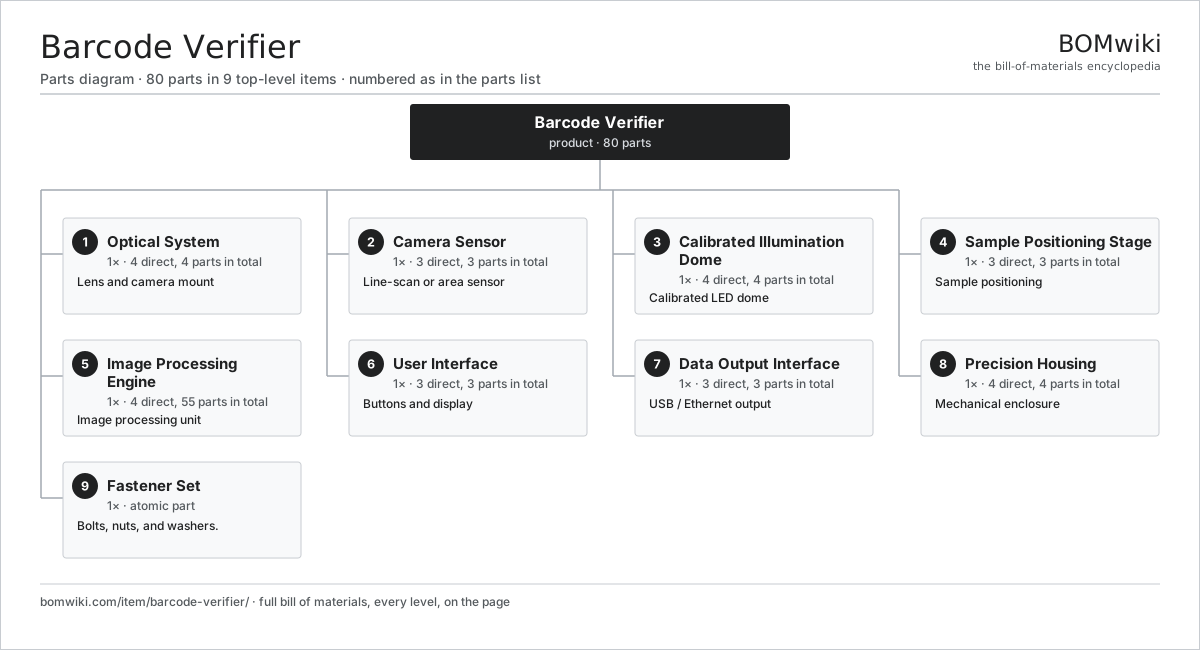
| # | Part | Qty | What it does |
|---|---|---|---|
| 1 | Optical System 4 parts | 1× | Lens and camera mount |
| 2 | Camera Sensor 3 parts | 1× | Line-scan or area sensor |
| 3 | Calibrated Illumination Dome 4 parts | 1× | Calibrated LED dome |
| 4 | Sample Positioning Stage 3 parts | 1× | Sample positioning |
| 5 | Image Processing Engine 4 parts | 1× | Image processing unit |
| 6 | User Interface 3 parts | 1× | Buttons and display |
| 7 | Data Output Interface 3 parts | 1× | USB / Ethernet output |
| 8 | Precision Housing 4 parts | 1× | Mechanical enclosure |
| 9 | Fastener Set | 1× | Bolts, nuts, and washers. |
3D model
No 3D model yet. Have a CAD file of this? Add a 3D model. STL renders right on this page; STEP, FreeCAD, and OpenSCAD sources are welcome too (openly licensed, like all 3D models on BOMwiki).
Build & assembly graph
expand / collapse · shared sub-assemblies converge · links to related products · est. labourTap an assembly to expand/collapse · tap a part to open it · use “Open page” for any node · drag to pan, scroll to zoom.
Bill of materials for Barcode Verifier
9 top-level lines · 40 rows shown · 80 parts total · indented to 3 levels| # | Item / sub-assembly | Part no. | Qty/assy | Ext. qty | Parts | Type |
|---|---|---|---|---|---|---|
| 1 | Optical System 4 parts | barcode-verifier-optics | 1× | 1 | 4 | assembly |
| 1.1 | Machine Vision Lens | barcode-verifier-lens | 1× | 1 | · | part |
| 1.2 | Lens Mount Assembly | barcode-verifier-lens-mount | 1× | 1 | · | part |
| 1.3 | Adjustable Iris Diaphragm | barcode-verifier-aperture | 1× | 1 | · | part |
| 1.4 | Precision Optical Bench | barcode-verifier-optical-bench | 1× | 1 | · | part |
| 2 | Camera Sensor 3 parts | barcode-verifier-camera | 1× | 1 | 3 | assembly |
| 2.1 | Line-Scan or Area Sensor | barcode-verifier-sensor | 1× | 1 | · | part |
| 2.2 | Frame Grabber / ADC | barcode-verifier-camera-processor | 1× | 1 | · | part |
| 2.3 | CMOS Image Sensor | image-sensor | 1× | 1 | · | part |
| 3 | Calibrated Illumination Dome 4 parts | barcode-verifier-illumination | 1× | 1 | 4 | assembly |
| 3.1 | LED Ring Array | barcode-verifier-led-array | 1× | 1 | · | part |
| 3.2 | Optical Diffuser Dome | barcode-verifier-diffuser | 1× | 1 | · | part |
| 3.3 | LED Power Supply | barcode-verifier-intensity-control | 1× | 1 | · | part |
| 3.4 | Light Sensor | barcode-verifier-color-temp-monitor | 1× | 1 | · | part |
| 4 | Sample Positioning Stage 3 parts | barcode-verifier-stage | 1× | 1 | 3 | assembly |
| 4.1 | Motorised XYZ Stage | barcode-verifier-stage-motion | 1× | 1 | · | part |
| 4.2 | Sample Holder Platform | barcode-verifier-stage-platform | 1× | 1 | · | part |
| 4.3 | Position Sensors | barcode-verifier-stage-sensors | 1× | 1 | · | part |
| 5 | Image Processing Engine 4 parts | barcode-verifier-processor | 1× | 1 | 55 | assembly |
| 5.1 | CPU PCB 3 parts | barcode-verifier-processor-board | 1× | 1 | 3 | assembly |
| 5.1.1 | Bare PCB | pcb-bare | 1× | 1 | · | part |
| 5.1.2 | Compute SoC Module | soc-module | 1× | 1 | · | part |
| 5.1.3 | System Clock | barcode-verifier-oscillator | 1× | 1 | · | part |
| 5.2 | System RAM | barcode-verifier-memory | 1× | 1 | · | part |
| 5.3 | SSD Storage | barcode-verifier-storage | 1× | 1 | · | part |
| 5.4 | SMD Passive (R/C/L) | smd-passives | 50× | 50 | · | part |
| 6 | User Interface 3 parts | barcode-verifier-controls | 1× | 1 | 3 | assembly |
| 6.1 | LCD Touchscreen | barcode-verifier-display | 1× | 1 | · | part |
| 6.2 | Capture Trigger Button | barcode-verifier-trigger-button | 1× | 1 | · | part |
| 6.3 | Status Indicator Lights | barcode-verifier-status-lights | 1× | 1 | · | part |
| 7 | Data Output Interface 3 parts | barcode-verifier-communications | 1× | 1 | 3 | assembly |
| 7.1 | USB Type B Port | barcode-verifier-usb-port | 1× | 1 | · | part |
| 7.2 | Ethernet Interface | barcode-verifier-ethernet | 1× | 1 | · | part |
| 7.3 | RS-232 Serial Port | barcode-verifier-serial-port | 1× | 1 | · | part |
| 8 | Precision Housing 4 parts | barcode-verifier-housing | 1× | 1 | 4 | assembly |
| 8.1 | Precision Frame | barcode-verifier-housing-frame | 1× | 1 | · | part |
| 8.2 | Light-Blocking Hood | barcode-verifier-housing-cover | 1× | 1 | · | part |
| 8.3 | Vibration Isolation Feet | barcode-verifier-vibration-feet | 1× | 1 | · | part |
| 8.4 | Thermal Management | barcode-verifier-enclosure-cooling | 1× | 1 | · | part |
| 9 | Fastener Set | fastener-set | 1× | 1 | · | part |
Something wrong in this list? Report a problem with this BOM.
Related products
same domain, ranked by shared parts


Sourcing: possible vendors
Browse the supplier directory → Prices, MOQ, and lead times are algorithmic estimates, not quotes, and not claims about these companies. Company mappings are curated by keyword; est. price band $20–$3k. How estimates work| Vendor | HQ | Specialty | MOQ | Lead time |
|---|---|---|---|---|
| dell.com ↗ | Round Rock, US | Computers & infrastructure | 1,000 units | 8–14 wks |
|
🇺🇸HP
hp.com ↗
|
Palo Alto, US | Computers & printers | 1,000 units | 8–14 wks |
|
🇨🇳Lenovo
lenovo.com ↗
|
Beijing, CN | Computers | 1,000 units | 8–14 wks |
|
🇹🇼ASUS
asus.com ↗
|
Taipei, TW | Computers & components | 1,000 units | 8–14 wks |
|
🇨🇳Foxconn
foxconn.com ↗
|
Shenzhen, CN | Electronics contract mfg | 1,000 units | 8–14 wks |
1,236-word article