Battery Formation System
ProductOverview
A battery formation system is an electrochemical cycler that initializes newly assembled lithium-ion cells through controlled charge/discharge cycles. During assembly, the Cell Grading Machine jelly-roll is filled with electrolyte (Electrolyte Filling Machine), sealed, and rested for hours or days to allow the electrolyte to fully wet the electrodes. Formation cycling activates the cell: lithium-ions are driven from cathode to anode (discharge), then back (charge), over multiple cycles.
Formation accomplishes three goals:
- Electrolyte decomposition and solid-electrolyte interface (SEI) layer growth: On the first charge, electrolyte components decompose on the anode surface, creating a passivating SEI layer. This layer is essential for long-term cycle life, but its initial formation is lossy, permanent capacity loss of 5–15%.
- Lithium distribution and activation: Lithium ions distribute throughout the anode and cathode structure, establishing the local electrochemical potential gradient that enables smooth subsequent cycling.
- Capacity and safety screening: Cells with low capacity, high self-discharge, or internal shorts are identified and rejected before shipping.
Formation systems are high-precision instruments capable of independently cycling 8–64 cells in parallel, logging voltage, current, and temperature every 1–10 seconds. A typical formation cycle lasts 6–48 hours depending on C-rate (discharge rate relative to nominal capacity).
How It Works
Sealed cells exit the Electrolyte Filling Machine and are placed into the Cell Contact Array, a spring-loaded contact array that makes electrical connection to the cell's positive tab and center post (or negative terminal, depending on pouch design). Multiple cells (8–64) are inserted into the fixture, and a motorized carousel or indexer positions them under the contacts.
The Multi-Channel Cycling Unit array contains 8–64 independent charge/discharge modules, each rated for ±10 A bidirectional current at 2.5–4.5V. These modules are stacked on a CAN Backplane CAN fieldbus, allowing synchronized control via a CAN Master Controller master controller.
A central Power Supply & Load Array supplies 48V DC at 200–400 A. The bus voltage is stepped down to the cell voltage range (2.5–4.5V) by each module's isolated buck-boost or full-bridge converter. During charge, the converter draws from the 48V bus and feeds current into the cell. During discharge, the cell voltage drives current through the converter (now operating as a boost), and this energy is dissipated in the Discharge Load Array.
The Thermal Control Chamber encloses the contact fixture and cells. A Heating Element and optional Refrigeration Chiller maintain temperature setpoint (e.g., 25°C) within ±2°C via a feedback loop. Temperature Probe thermocouples measure cell-level and air temperature.
A Data Acquisition & Logging ADC continuously samples each channel's voltage (10–12 bits, ±0.1% accuracy), current (typically via Hall-effect or shunt resistor, ±0.2% accuracy), and temperature every 1–10 seconds. This data is buffered to onboard Data Storage (1–2 TB SSD or SD card) for post-analysis.
The Power & Safety Cabinet houses the main Main Contactor, E-Stop Relay, and {{power-supply}} modules. A programmable PLC (embedded in the master controller) sequences the formation profile: charge at constant current (e.g., 0.2C for 6 hours), then constant voltage at 4.2V until current drops to 0.01C. Rest for 1 hour. Discharge at 0.2C to 2.5V. Repeat 2–5 cycles.
A Network & Protocol Gateway CAN or Ethernet module uploads pass/fail grades in real-time to the manufacturing execution system (MES). Cells exceeding capacity or impedance thresholds are flagged for re-work or scrap.
Formation Profile and Electro chemistry
A typical formation protocol for a pouch cell might be:
Cycle 1 (Full Formation):
- Charge: CC at 0.2C to 4.2V, then CV at 4.2V until I < 0.01C (6–12 hours).
- Rest: 1–2 hours.
- Discharge: CC at 0.2C to 2.5V (5–10 hours).
- Rest: 1 hour.
Cycles 2–5 (Stabilization):
- Shorter charge/discharge at 0.5C or 1C.
The first charge is slow (0.2C) to allow SEI formation to proceed gradually without overheating. The constant-voltage tail (CV phase) drives current toward zero as the anode becomes progressively saturated with lithium and the voltage reaches the cathode redox window.
Electrolyte decomposition during the first charge consumes 5–15% of the cell's initial lithium inventory, which is "lost" as electrolyte oxidation products (Li₂CO₃, LiF, etc.) on the anode surface. This is irreversible capacity loss, the cell's rated capacity is measured after formation, not before.
Capacity Grading and Screening
After formation, the first discharge at 0.2C yields the rated capacity. For example, a cell intended as a 3.0 Ah nominal cell might have:
- Initial discharge: 3.05 Ah (excess to account for SEI loss).
- After formation: 2.85–2.95 Ah (5–10% loss from SEI).
- Specification: 2.8 Ah minimum (95% of nominal).
Cells falling below 2.8 Ah are rejected (low-capacity bin, possibly re-worked or recycled). Cells above 3.0 Ah are also suspect (possible short or assembly defect) and require further testing.
Impedance and Safety Screening
The formation system also measures electrochemical impedance by applying small AC voltage (10–100 mV) at discrete frequencies (0.01–1 kHz) and computing impedance vs. frequency. This detects:
- Separator shorts: Extremely low impedance, cell voltage collapses quickly under load.
- Tab weld failures: High resistance at the current collector, causing voltage sag.
- Soft shorts: Partial internal leakage, detected by elevated impedance or slow voltage rise during rest.
Cells with impedance >100 mΩ or exhibiting unusual frequency response are quarantined.
Data Logging and Post-Analysis
The Data Acquisition & Logging logs every charge/discharge cycle in detail: voltage (mV), current (mA), and temperature (°C) every 1–10 seconds. Typical storage is 1–10 GB per cell, depending on cycle count and duration.
Post-analysis involves fitting coulombic efficiency (ratio of discharge to charge capacity), calculating internal resistance (slope of U vs. I), and trending impedance over cycles. Early-life degradation patterns predict long-term reliability.
Parallelization and Throughput
A single-channel formation system cycles one cell at a time; 100 cells per day requires ~50–100 hours, infeasible for production. Multi-channel systems (8–64 channels) cycle many cells in parallel. A 64-channel system at 36-hour formation per cell processes 64 cells every 36 hours, or ~42 cells/day. Industrial lines may chain multiple formation systems (4–8 units in series) or use higher C-rates (faster formation, <12 hours) to achieve 500+ cells/day throughput.
Thermal Management
Charge/discharge generates Joule heat (I²R losses in internal resistance) and electrochemical overpotential loss. A 3 Ah cell at 1C discharge (3 A) with 10 mΩ internal resistance dissipates 0.09 W at the cell, plus ~0.2–0.5 W electrochemical loss = ~0.3–0.6 W total. With 64 cells running simultaneously, the chamber generates 20–40 W. The Thermal Control Chamber insulation (50–100 mm foam) keeps temperature rise to 1–3°C above ambient, allowing the Heating Element and optional cooler to regulate ±2°C. At higher C-rates (1C or 2C), active cooling (chiller) becomes necessary.
Safety Interlocks
The E-Stop Relay immediately de-energizes the main Main Contactor, stopping all charge/discharge within <100 ms if E-stop is pressed or an over-voltage/over-current fault occurs. Ground-fault detection monitors leakage current from the 48V bus to chassis ground; a single-phase short triggers shutdown.
Cell overvoltage (>4.5V) or overcurrent (>15 A per channel) automatically terminates the cycle and flags the cell as defective.
Battery Formation System parts and their functions
8 top-level parts · 57 parts in total · full bill of materials below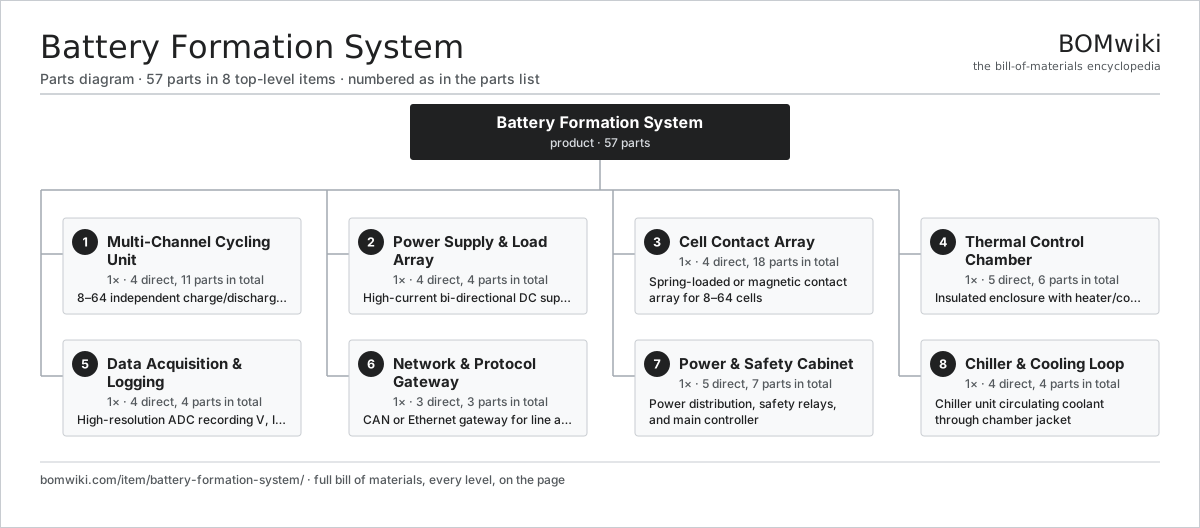
| # | Part | Qty | What it does |
|---|---|---|---|
| 1 | Multi-Channel Cycling Unit 4 parts | 1× | 8–64 independent charge/discharge channels |
| 2 | Power Supply & Load Array 4 parts | 1× | High-current bi-directional DC supply and load array |
| 3 | Cell Contact Array 4 parts | 1× | Spring-loaded or magnetic contact array for 8–64 cells |
| 4 | Thermal Control Chamber 5 parts | 1× | Insulated enclosure with heater/cooler maintaining 20–60°C |
| 5 | Data Acquisition & Logging 4 parts | 1× | High-resolution ADC recording V, I, T every 1–10 seconds |
| 6 | Network & Protocol Gateway 3 parts | 1× | CAN or Ethernet gateway for line automation |
| 7 | Power & Safety Cabinet 5 parts | 1× | Power distribution, safety relays, and main controller |
| 8 | Chiller & Cooling Loop 4 parts | 1× | Chiller unit circulating coolant through chamber jacket |
3D model
No 3D model yet. Have a CAD file of this? Add a 3D model. STL renders right on this page; STEP, FreeCAD, and OpenSCAD sources are welcome too (openly licensed, like all 3D models on BOMwiki).
Build & assembly graph
expand / collapse · shared sub-assemblies converge · links to related products · est. labourTap an assembly to expand/collapse · tap a part to open it · use “Open page” for any node · drag to pan, scroll to zoom.
Bill of materials for Battery Formation System
8 top-level lines · 41 rows shown · 57 parts total · indented to 3 levels| # | Item / sub-assembly | Part no. | Qty/assy | Ext. qty | Parts | Type |
|---|---|---|---|---|---|---|
| 1 | Multi-Channel Cycling Unit 4 parts | battery-formation-system-cycling-channels | 1× | 1 | 11 | assembly |
| 1.1 | Single-Channel Module | battery-formation-system-channel-card | 8× | 8 | · | part |
| 1.2 | CAN Master Controller | battery-formation-system-can-interface | 1× | 1 | · | part |
| 1.3 | CAN Backplane | battery-formation-system-backplane | 1× | 1 | · | part |
| 1.4 | Connector | connector | 1× | 1 | · | part |
| 2 | Power Supply & Load Array 4 parts | battery-formation-system-power-module | 1× | 1 | 4 | assembly |
| 2.1 | AC/DC Rectifier | battery-formation-system-rectifier-unit | 1× | 1 | · | part |
| 2.2 | Discharge Load Array | battery-formation-system-load-resistor-array | 1× | 1 | · | part |
| 2.3 | Main Power Contactor | battery-formation-system-isolation-relay | 1× | 1 | · | part |
| 2.4 | Power Supply | power-supply | 1× | 1 | · | part |
| 3 | Cell Contact Array 4 parts | battery-formation-system-contact-fixtures | 1× | 1 | 18 | assembly |
| 3.1 | Pogo-Pin Contact | battery-formation-system-contact-socket | 8× | 8 | · | part |
| 3.2 | Contact Fixture Frame | battery-formation-system-fixture-frame | 1× | 1 | · | part |
| 3.3 | Automated Cell Loader | battery-formation-system-carousel-loader | 1× | 1 | · | part |
| 3.4 | Contact Spring | battery-formation-system-contact-pressure-spring | 8× | 8 | · | part |
| 4 | Thermal Control Chamber 5 parts | battery-formation-system-thermal-chamber | 1× | 1 | 6 | assembly |
| 4.1 | Chamber Housing | battery-formation-system-chamber-frame | 1× | 1 | · | part |
| 4.2 | Thermal Insulation | battery-formation-system-insulation-liner | 1× | 1 | · | part |
| 4.3 | Heating Element | heating-element | 1× | 1 | · | part |
| 4.4 | Circulation Fan | battery-formation-system-fan-circulation | 1× | 1 | · | part |
| 4.5 | Temperature Probe | battery-formation-system-temperature-sensor | 2× | 2 | · | part |
| 5 | Data Acquisition & Logging 4 parts | battery-formation-system-data-logger | 1× | 1 | 4 | assembly |
| 5.1 | Multi-Channel ADC | battery-formation-system-adc-module | 1× | 1 | · | part |
| 5.2 | Data Storage | battery-formation-system-storage-module | 1× | 1 | · | part |
| 5.3 | Bare PCB | pcb-bare | 1× | 1 | · | part |
| 5.4 | SMD Passive (R/C/L) | smd-passives | 1× | 1 | · | part |
| 6 | Network & Protocol Gateway 3 parts | battery-formation-system-communication-interface | 1× | 1 | 3 | assembly |
| 6.1 | CAN/Ethernet Bridge | battery-formation-system-can-gateway | 1× | 1 | · | part |
| 6.2 | Network Interface | battery-formation-system-network-adapter | 1× | 1 | · | part |
| 6.3 | Bare PCB | pcb-bare | 1× | 1 | · | part |
| 7 | Power & Safety Cabinet 5 parts | battery-formation-system-control-cabinet | 1× | 1 | 7 | assembly |
| 7.1 | Main Contactor | battery-formation-system-main-contactor | 1× | 1 | · | part |
| 7.2 | Soft-Start Module | battery-formation-system-soft-start-unit | 1× | 1 | · | part |
| 7.3 | E-Stop Relay | battery-formation-system-emergency-stop-relay | 1× | 1 | · | part |
| 7.4 | Power Supply | power-supply | 2× | 2 | · | part |
| 7.5 | Relay | relay | 2× | 2 | · | part |
| 8 | Chiller & Cooling Loop 4 parts | battery-formation-system-cooling-circulation | 1× | 1 | 4 | assembly |
| 8.1 | Refrigeration Chiller | battery-formation-system-chiller-unit | 1× | 1 | · | part |
| 8.2 | Coolant Circulation Pump | battery-formation-system-circulation-pump | 1× | 1 | · | part |
| 8.3 | Coolant Hose | battery-formation-system-coolant-hose | 1× | 1 | · | part |
| 8.4 | Connector | connector | 1× | 1 | · | part |
Something wrong in this list? Report a problem with this BOM.
Related products
same domain, ranked by shared parts All-Electric Injection Molding Machine
851 parts · shares 4 with this page
Automated Paint Spray Line
2,003 parts · shares 4 with this page
Battery Pack Tester
45 parts · shares 4 with this page
Binder Jetting Printer
112 parts · shares 4 with this page
All-Electric Injection Molding Machine
851 parts · shares 4 with this page
Automated Paint Spray Line
2,003 parts · shares 4 with this page
Battery Pack Tester
45 parts · shares 4 with this page
Binder Jetting Printer
112 parts · shares 4 with this page
 DMLS/SLM Printer
68 parts · shares 4 with this page
Electrocoating Line
2,977 parts · shares 4 with this page
DMLS/SLM Printer
68 parts · shares 4 with this page
Electrocoating Line
2,977 parts · shares 4 with this page
Sourcing: possible vendors
Browse the supplier directory → Prices, MOQ, and lead times are algorithmic estimates, not quotes, and not claims about these companies. Company mappings are curated by keyword; est. price band $5k–$2M. How estimates work| Vendor | HQ | Specialty | MOQ | Lead time |
|---|---|---|---|---|
| atlascopco.com ↗ | Stockholm, SE | Compressors & industrial | 10 units | 12–20 wks |
|
🇦🇹Andritz
andritz.com ↗
|
Graz, AT | Process plants & machinery | 10 units | 12–20 wks |
| buhlergroup.com ↗ | Uzwil, CH | Food & materials processing | 10 units | 12–20 wks |
| gea.com ↗ | Düsseldorf, DE | Process technology | 10 units | 12–20 wks |
| mhi.com ↗ | Tokyo, JP | Heavy machinery | 10 units | 12–20 wks |
1,302-word article