Battery Pack Tester
ProductOverview
A battery pack tester is an advanced electrochemical test station that validates complete assembled battery packs (module-level or full EV packs) before customer delivery. Unlike cell-level Battery Formation System testers, pack testers operate at high voltage (100–600V) and high current (0–200A+), cycling packs through realistic charging and discharging profiles while monitoring cell balancing, thermal behavior, and battery management system (BMS) communications.
The tester's role is quality assurance: detecting manufacturing defects (internal shorts, cell imbalance, BMS firmware errors) that slipped past cell-level testing. It also performs accelerated life tests (Calendar aging, cycle aging) under controlled temperature to predict long-term performance.
How It Works
An assembled battery pack (8–32 cells in series, or parallel-series arrays) is connected to a test channel via Anderson connectors or custom terminals. The High-Current Contact Interface makes electrical contact and establishes BMS communication via CAN.
The Multi-Channel Cycling Unit array contains 4–16 independent bidirectional channels, each capable of:
- Charge: Drawing power from the 700V DC bus and delivering current into the pack at programmable C-rates (0.2C, 0.5C, 1C, 2C).
- Discharge: The pack voltage drives current through a load resistor bank or buck converter, dissipating energy and measuring pack voltage sag and temperature rise.
A Safety & Control Cabinet PLC sequences the test protocol. A typical test might be:
Pre-Test Checks (5 min): Measure open-circuit voltage (OCV), internal resistance via pulse, and BMS state-of-charge (SOC) estimate. Log any pre-existing faults.
Insulation Resistance Test (1 min): Isolate the pack via Insulation Test Relay Matrix, apply 500–1000V DC isolation test voltage, measure leakage current. Target: <10 µA (indicates <10 GΩ leakage resistance). Higher leakage suggests moisture ingress or manufacturing defect.
Charge Cycle (2–4 hr): Charge at constant-current 0.2–1C until voltage reaches pack max (e.g., 48V for a 12s4p pack), then constant-voltage hold until current drops to 0.01C. High-Speed Data Logger logs voltage (all series strings and parallel branches via BMS CAN), current, and temperature every 1–10 seconds. Detect early voltage divergence (cell imbalance).
Rest & Stabilization (30 min): Hold pack in idle state. Temperature and voltage stabilize. OCV is measured again to estimate cell state-of-health.
Discharge Cycle (2–4 hr): Discharge at constant-current 0.2–1C to pack minimum voltage (e.g., 30V), then trickle-discharge at constant-voltage 0.01C until current drops to 0.001C. Measure total discharge capacity, the key performance metric.
Cool-Down (if next cycle at different temperature).
Repeat: Cycle 2–5 times to measure capacity fade and power fade.
All data streams, pack voltage (0–100V, 1 mV resolution), current (0–200A, 10 mA resolution), cell voltages and temperatures (via BMS CAN messages), and thermal chamber setpoint, are recorded to the High-Capacity SSD Storage. Results are uploaded to the MES and cloud.
BMS Communication and CAN Handshake
Modern packs include a BMS Board microcontroller managing cell-level balancing, voltage/current cutoffs, and thermal protection. The CAN Protocol Gateway connects to the BMS CAN interface, exchanging messages during test:
- BMS → Tester: Cell voltages, cell temperatures, SOC%, SOH%, fault codes.
- Tester → BMS: Test mode command, allowable charge/discharge current (CAN current limit), battery heater on/off.
Real-time monitoring catches BMS firmware bugs (e.g., incorrect temperature scaling causing false overheat shutdown) or cell balancing failures (if cell voltages diverge >50 mV during charge).
Fault injection is also possible: the tester can simulate a cell over-temperature via CAN message to verify the BMS triggers a protective shutdown correctly.
Insulation Resistance and Leakage Testing
Before cycling, the tester measures leakage current at 500–1000V DC (typically 750V, matching automotive ISO standards). Current is expected to be <10 µA for a healthy pack.
Higher leakage (<10 mΩ but >1 GΩ) indicates:
- Moisture in the pouch or case (electrolyte is hygroscopic, absorbs trace H₂O from air).
- Electrolyte creep along external traces or terminals (if conductive salts are present).
- Manufacturing defect: burst cell separator, allowing electrolyte to seep to case.
Insulation failures are catastrophic for vehicle safety (shock hazard, arc flash risk during charging). This test is mandatory in EV battery validation standards (UN38.3, Tesla, OEM specs).
Thermal Control and Environmental Testing
The Environmental Test Chamber maintains -10 to +60°C (room-temperature testing is typical; extreme-temperature testing is optional). Heating via Heating Element, cooling via optional Cooling Loop Coil or immersion in a larger environmental chamber.
Temperature affects:
- OCV and voltage sag: Voltage rises ~2 mV/°C for Li-ion. At -10°C, pack voltage is ~0.3V lower than at 25°C.
- Internal resistance: Impedance doubles at -10°C, limiting power output. Pack-level thermal tests confirm safe operation in cold climate (e.g., -20°C startup for EV).
- Charging efficiency: Faster charge is possible at higher temperature but risks thermal runaway. Room temperature (20–30°C) is standard to avoid this.
Capacity and Energy Output
The main test metric is discharge capacity (mAh), calculated by integrating current over time during discharge:
Capacity = ∫(I dt) = Σ(I_avg × Δt)
For example, a 50 Ah pack discharged at 0.5C (25 A) for 2 hours delivers ~50 Ah. At different C-rates, capacity may vary: discharge at 0.2C (fast, lower internal resistance losses) yields higher capacity than 1C or 2C (where resistive losses are higher).
Energy = ∫(V × I dt) = Σ(V_avg × I_avg × Δt) [Wh]
Energy accounts for voltage sag during discharge. A pack with poor cell balance (one weak cell dragging voltage down) has lower energy than expected.
Pass/Fail Criteria typically:
- Capacity ≥95% of rated (e.g., ≥47.5 Ah for 50 Ah rated).
- Energy ≥90% of rated (accounting for resistive losses).
- Voltage at end-of-discharge ≥30V (pack minimum).
- No BMS faults logged during test.
- Leakage <10 µA (insulation OK).
Multi-Channel Scaling and Throughput
A 16-channel system testing packs at 2-hour cycles achieves: 16 channels × 12 cycles/day = 192 pack tests/day (practical: ~100–150 accounting for setup, data transfer, cool-down between runs).
High-volume production (1000+ packs/day) requires:
- 8–16 parallel tester units.
- Automated load/unload (conveyor, robotic arm).
- Load-balancing software distributing packs across idle channels.
Data Logging and Root-Cause Analysis
Complete V, I, T data (1 second resolution, ~200 KB per test) enables post-analysis:
- Capacity fade trends: Track pack capacity over 100+ cycles to predict end-of-life.
- Power fade: Measure resistance change (slope of V vs. I during discharge).
- Cell imbalance: Detect if one cell lags others during charge (indicates aging or internal short).
- Thermal runaway signature: Monitor temperature spikes during charge (exothermic reaction).
Root-cause analysis uses this data to categorize failures:
- Cell defect: Low individual cell voltage.
- Connector defect: Intermittent connection (voltage glitches).
- BMS firmware bug: Erratic SOC estimates or cutoff errors.
- Separator short: Sudden voltage collapse under load.
Safety and HVDC Mitigation
Pack testers operate at up to 600V DC, lethal voltage. Safety features:
- Dual-channel E-stop relay immediately de-energizes the Main HVDC Contactor.
- Insulation monitoring: Continuous leakage current measurement detects case fault.
- Arc flash studies: Resistive components sized to limit fault current, reducing arc energy.
- Interlocks: Chamber door switch prevents access when main contactor is energized.
Maintenance procedures require:
- De-energize and discharge all high-voltage nodes (using discharge resistors).
- Lockout/tagout (LOTO) the main breaker.
- Measure voltage with multimeter before touching circuits.
Variations: Calendar Aging vs. Cycling Aging
- Calendar Aging Test: Pack is stored at fixed SOC (50%), temperature (25°C, 45°C, 55°C), for weeks to months. Measures self-discharge and internal resistance growth without active cycling. Less power-intensive; long runtime.
- Cycle Aging Test: Pack is cycled 100–1000 times, measuring capacity and resistance fade per cycle. Accelerates aging (higher stress) but requires more test time and power.
Most production uses cycle aging (faster feedback) combined with periodic calendar aging tests for qualification.
Battery Pack Tester parts and their functions
8 top-level parts · 45 parts in total · full bill of materials below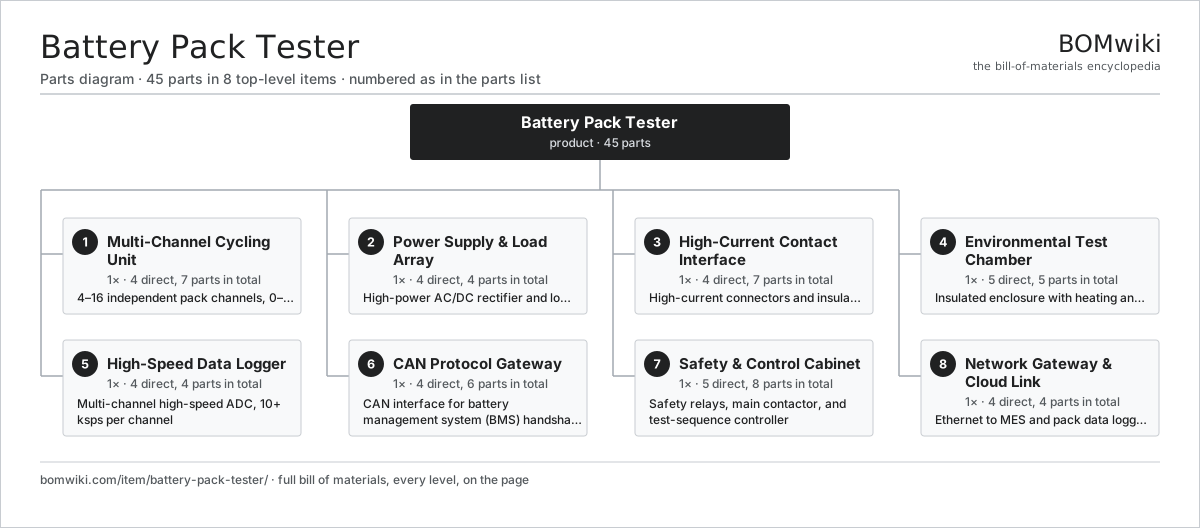
| # | Part | Qty | What it does |
|---|---|---|---|
| 1 | Multi-Channel Cycling Unit 4 parts | 1× | 4–16 independent pack channels, 0–100V, 0–200A range |
| 2 | Power Supply & Load Array 4 parts | 1× | High-power AC/DC rectifier and load resistor array, 20–50 kW |
| 3 | High-Current Contact Interface 4 parts | 1× | High-current connectors and insulation test relay matrix |
| 4 | Environmental Test Chamber 5 parts | 1× | Insulated enclosure with heating and cooling for -10 to +60°C |
| 5 | High-Speed Data Logger 4 parts | 1× | Multi-channel high-speed ADC, 10+ ksps per channel |
| 6 | CAN Protocol Gateway 4 parts | 1× | CAN interface for battery management system (BMS) handshake |
| 7 | Safety & Control Cabinet 5 parts | 1× | Safety relays, main contactor, and test-sequence controller |
| 8 | Network Gateway & Cloud Link 4 parts | 1× | Ethernet to MES and pack data logging cloud |
3D model
No 3D model yet. Have a CAD file of this? Add a 3D model. STL renders right on this page; STEP, FreeCAD, and OpenSCAD sources are welcome too (openly licensed, like all 3D models on BOMwiki).
Build & assembly graph
expand / collapse · shared sub-assemblies converge · links to related products · est. labourTap an assembly to expand/collapse · tap a part to open it · use “Open page” for any node · drag to pan, scroll to zoom.
Bill of materials for Battery Pack Tester
8 top-level lines · 42 rows shown · 45 parts total · indented to 3 levels| # | Item / sub-assembly | Part no. | Qty/assy | Ext. qty | Parts | Type |
|---|---|---|---|---|---|---|
| 1 | Multi-Channel Cycling Unit 4 parts | battery-pack-tester-cycling-channels | 1× | 1 | 7 | assembly |
| 1.1 | Single-Channel Converter Card | battery-pack-tester-channel-module | 4× | 4 | · | part |
| 1.2 | CAN Bus Master Controller | battery-pack-tester-can-master | 1× | 1 | · | part |
| 1.3 | CAN Power Backplane | battery-pack-tester-backplane-bus | 1× | 1 | · | part |
| 1.4 | Connector | connector | 1× | 1 | · | part |
| 2 | Power Supply & Load Array 4 parts | battery-pack-tester-power-module | 1× | 1 | 4 | assembly |
| 2.1 | AC/DC Rectifier | battery-pack-tester-rectifier-unit | 1× | 1 | · | part |
| 2.2 | High-Power Load Resistors | battery-pack-tester-load-resistor-bank | 1× | 1 | · | part |
| 2.3 | Main HVDC Contactor | battery-pack-tester-isolation-contactor | 1× | 1 | · | part |
| 2.4 | Power Supply | power-supply | 1× | 1 | · | part |
| 3 | High-Current Contact Interface 4 parts | battery-pack-tester-contact-interface | 1× | 1 | 7 | assembly |
| 3.1 | Anderson PowerPole Connector | battery-pack-tester-anderson-connector | 4× | 4 | · | part |
| 3.2 | Insulation Test Relay Matrix | battery-pack-tester-insulation-relay | 1× | 1 | · | part |
| 3.3 | HVDC Isolation Switch | battery-pack-tester-hvdc-switch | 1× | 1 | · | part |
| 3.4 | Pressure Sensor | pressure-sensor | 1× | 1 | · | part |
| 4 | Environmental Test Chamber 5 parts | battery-pack-tester-thermal-chamber | 1× | 1 | 5 | assembly |
| 4.1 | Test Chamber Enclosure | battery-pack-tester-chamber-vessel | 1× | 1 | · | part |
| 4.2 | Thermal Insulation Liner | battery-pack-tester-insulation-material | 1× | 1 | · | part |
| 4.3 | Heating Element | heating-element | 1× | 1 | · | part |
| 4.4 | Cooling Loop Coil | battery-pack-tester-cooler-coil | 1× | 1 | · | part |
| 4.5 | Chamber Circulation Fan | battery-pack-tester-circulation-fan | 1× | 1 | · | part |
| 5 | High-Speed Data Logger 4 parts | battery-pack-tester-data-acquisition | 1× | 1 | 4 | assembly |
| 5.1 | Multi-Channel ADC Module | battery-pack-tester-adc-module | 1× | 1 | · | part |
| 5.2 | High-Capacity SSD Storage | battery-pack-tester-storage-ssd | 1× | 1 | · | part |
| 5.3 | Bare PCB | pcb-bare | 1× | 1 | · | part |
| 5.4 | SMD Passive (R/C/L) | smd-passives | 1× | 1 | · | part |
| 6 | CAN Protocol Gateway 4 parts | battery-pack-tester-can-gateway | 1× | 1 | 6 | assembly |
| 6.1 | CAN Physical Layer Transceiver | battery-pack-tester-can-transceiver | 2× | 2 | · | part |
| 6.2 | CAN Gateway MCU | battery-pack-tester-can-bridge-controller | 1× | 1 | · | part |
| 6.3 | Bare PCB | pcb-bare | 1× | 1 | · | part |
| 6.4 | Connector | connector | 2× | 2 | · | part |
| 7 | Safety & Control Cabinet 5 parts | battery-pack-tester-control-cabinet | 1× | 1 | 8 | assembly |
| 7.1 | Main AC/DC Contactor | battery-pack-tester-main-contactor | 1× | 1 | · | part |
| 7.2 | Soft-Start Unit | battery-pack-tester-soft-start | 1× | 1 | · | part |
| 7.3 | E-Stop Relay Module | battery-pack-tester-estop-relay | 1× | 1 | · | part |
| 7.4 | Power Supply | power-supply | 2× | 2 | · | part |
| 7.5 | Relay | relay | 3× | 3 | · | part |
| 8 | Network Gateway & Cloud Link 4 parts | battery-pack-tester-communication-network | 1× | 1 | 4 | assembly |
| 8.1 | Ethernet Interface Module | battery-pack-tester-ethernet-gateway | 1× | 1 | · | part |
| 8.2 | 4G/5G Industrial Modem | battery-pack-tester-router-modem | 1× | 1 | · | part |
| 8.3 | Bare PCB | pcb-bare | 1× | 1 | · | part |
| 8.4 | Connector | connector | 1× | 1 | · | part |
Something wrong in this list? Report a problem with this BOM.
Related products
same domain, ranked by shared parts DMLS/SLM Printer
68 parts · shares 5 with this page
Electrocoating Line
2,977 parts · shares 5 with this page
Electron Beam PBF
128 parts · shares 5 with this page
Horizontal Injection Molding Machine
301 parts · shares 5 with this page
DMLS/SLM Printer
68 parts · shares 5 with this page
Electrocoating Line
2,977 parts · shares 5 with this page
Electron Beam PBF
128 parts · shares 5 with this page
Horizontal Injection Molding Machine
301 parts · shares 5 with this page
Sourcing: possible vendors
Browse the supplier directory → Prices, MOQ, and lead times are algorithmic estimates, not quotes, and not claims about these companies. Company mappings are curated by keyword; est. price band $5k–$2M. How estimates work| Vendor | HQ | Specialty | MOQ | Lead time |
|---|---|---|---|---|
| atlascopco.com ↗ | Stockholm, SE | Compressors & industrial | 10 units | 12–20 wks |
|
🇦🇹Andritz
andritz.com ↗
|
Graz, AT | Process plants & machinery | 10 units | 12–20 wks |
| buhlergroup.com ↗ | Uzwil, CH | Food & materials processing | 10 units | 12–20 wks |
| gea.com ↗ | Düsseldorf, DE | Process technology | 10 units | 12–20 wks |
| mhi.com ↗ | Tokyo, JP | Heavy machinery | 10 units | 12–20 wks |
1,334-word article