Belt Sander
ProductOverview
A belt sander is the most aggressive of the common handheld sanders. It runs an endless abrasive loop, the Sanding Belt, around two parallel drums and presses the lower run flat against the work with a steel Platen Assembly. Because the abrasive moves linearly at 200–400 m per minute rather than orbiting, it cuts fast and leaves straight scratch lines, which makes it the tool of choice for levelling rough boards, stripping paint, flattening glue-ups and scribing doors to fit. The same speed makes it unforgiving: a few seconds of dwell in one spot will dish a surface.
The standard handheld format takes a 75 × 533 mm (3 × 21 in) belt; 100 × 610 mm machines exist for heavier work. Belts are graded like other coated abrasives, from P40 for hogging off material to P240 for pre-finish work.
How it works
The Drive System is built around a brushed universal motor turning at 12,000–15,000 rpm. A toothed Drive Belt between the Drive Pulley and the larger Driven Pulley steps this down roughly 4:1 to the rear Drive Drum, whose rubber coating grips the inside of the sanding belt. At the front, the free-spinning Idler Drum rides on a Tension Arm preloaded by a Coil Spring; pulling the release lever retracts the arm so a worn belt can be slipped off and a new one fitted in seconds.
Between the drums the belt passes over the Platen Assembly. The hardened Platen Plate defines the flat working face, a Cork Backing Pad behind it evens out pressure, and a replaceable Graphite Liner keeps friction and heat down where the moving belt rubs the plate. Worn liners show up as scorched belts and reduced cutting speed, and are a routine service item.
Belt tracking
A belt running on two cylindrical drums has no inherent reason to stay centred, any misalignment walks it sideways until it either runs off the drums or grinds against the housing. Two features keep it in place. First, the Idler Drum is crowned: slightly larger in diameter at its centre, which makes the belt self-centre toward the high point. Second, the Tracking Adjustment mechanism lets the operator trim the idler axis. Turning the Tracking Knob drives a fine-pitch Tracking Screw that tilts the Pivot Block carrying the idler axle by a degree or two; the belt then steers toward the slack side. Tracking is set with the machine running, watching the belt edge against the housing reference.
Dust collection
Sanding wood at these removal rates produces dust at a rate no other handheld sander matches, so extraction is built in. The Dust Collection System system uses a dedicated Dust Fan on the motor shaft to pull air through the Dust Channel, which opens right at the nip where the belt leaves the work. The flow either discharges into the clip-on Dust Bag, whose fabric acts as the filter, or through the Vacuum Adapter to a shop extractor, the preferred arrangement for fine dust, since bag filtration passes much of the sub-10 µm fraction that is the actual respiratory hazard.
Controls and electronics
The trigger in the Main Handle includes a lock-on button, since most belt-sanding strokes last longer than is comfortable to hold a trigger. Variable-speed models add a Speed Dial feeding a phase-control board: a small triac or Power MOSFET stage chops the AC waveform to slow the universal motor, useful when sanding heat-sensitive finishes or veneer where full belt speed would burn through. The Carbon Brushes of the motor are user-replaceable and typically last 50–120 hours of run time.
Usage and wear
Correct technique keeps the platen flat on the work and moves the sander continuously, with strokes along the grain and successive grits no more than one step apart (P60 → P80 → P120). The machine's own weight supplies adequate down-pressure; leaning on it slows the belt, overheats the motor and clogs the abrasive. Common wear items are the belt itself, the Graphite Liner, the drive timing belt, the rubber face of the drive drum (which glazes and slips with age) and the motor brushes. Belt splices are directional on older lap-jointed belts, run against the arrow and the joint peels, though modern butt-spliced belts run either way.
Belt Sander parts and their functions
8 top-level parts · 68 parts in total · full bill of materials below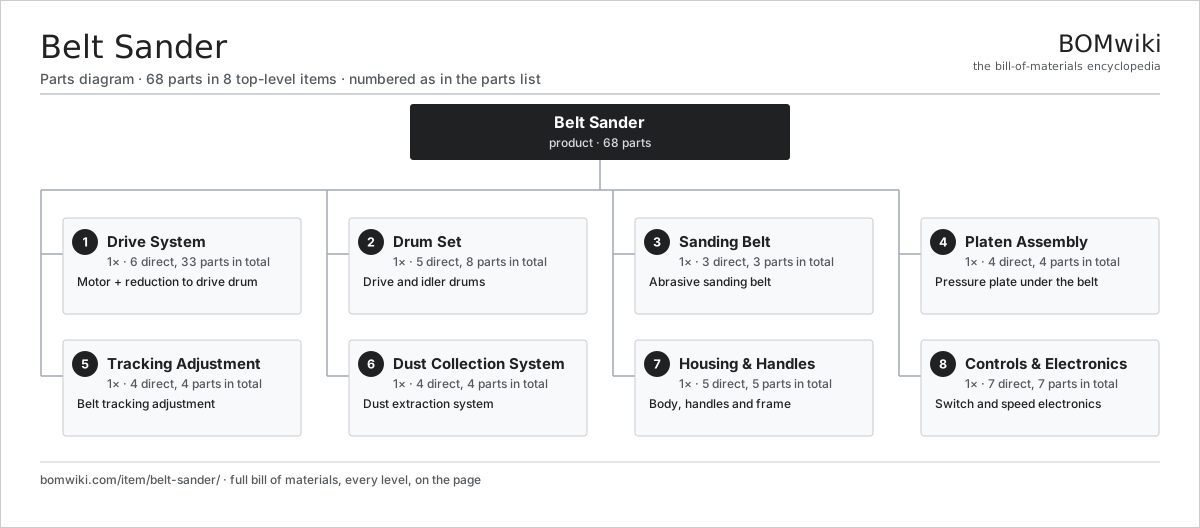
| # | Part | Qty | What it does |
|---|---|---|---|
| 1 | Drive System 6 parts | 1× | Motor + reduction to drive drum |
| 2 | Drum Set 5 parts | 1× | Drive and idler drums |
| 3 | Sanding Belt 3 parts | 1× | Abrasive sanding belt |
| 4 | Platen Assembly 4 parts | 1× | Pressure plate under the belt |
| 5 | Tracking Adjustment 4 parts | 1× | Belt tracking adjustment |
| 6 | Dust Collection System 4 parts | 1× | Dust extraction system |
| 7 | Housing & Handles 5 parts | 1× | Body, handles and frame |
| 8 | Controls & Electronics 7 parts | 1× | Switch and speed electronics |
3D model
No 3D model yet. Have a CAD file of this? Add a 3D model. STL renders right on this page; STEP, FreeCAD, and OpenSCAD sources are welcome too (openly licensed, like all 3D models on BOMwiki).
Build & assembly graph
expand / collapse · shared sub-assemblies converge · links to related products · est. labourTap an assembly to expand/collapse · tap a part to open it · use “Open page” for any node · drag to pan, scroll to zoom.
Bill of materials for Belt Sander
8 top-level lines · 51 rows shown · 68 parts total · indented to 3 levels| # | Item / sub-assembly | Part no. | Qty/assy | Ext. qty | Parts | Type |
|---|---|---|---|---|---|---|
| 1 | Drive System 6 parts | belt-sander-drive-system | 1× | 1 | 33 | assembly |
| 1.1 | Universal Motor 5 parts | belt-sander-motor | 1× | 1 | 27 | assembly |
| 1.1.1 | Stator Assembly 3 parts + deeper › | stator-assembly | 1× | 1 | 3 | assembly |
| 1.1.2 | Rotor Assembly 4 parts + deeper › | rotor-assembly | 1× | 1 | 19 | assembly |
| 1.1.3 | Copper Winding | copper-winding | 2× | 2 | · | part |
| 1.1.4 | Carbon Brushes | belt-sander-carbon-brushes | 2× | 2 | · | part |
| 1.1.5 | Motor Housing | motor-housing | 1× | 1 | · | part |
| 1.2 | Drive Belt | drive-belt | 1× | 1 | · | part |
| 1.3 | Drive Pulley | belt-sander-drive-pulley | 1× | 1 | · | part |
| 1.4 | Driven Pulley | belt-sander-driven-pulley | 1× | 1 | · | part |
| 1.5 | Ball Bearing | ball-bearing | 2× | 2 | · | part |
| 1.6 | Cooling Fan | belt-sander-cooling-fan | 1× | 1 | · | part |
| 2 | Drum Set 5 parts | belt-sander-drum-set | 1× | 1 | 8 | assembly |
| 2.1 | Drive Drum | belt-sander-drive-drum | 1× | 1 | · | part |
| 2.2 | Idler Drum | belt-sander-idler-drum | 1× | 1 | · | part |
| 2.3 | Ball Bearing | ball-bearing | 4× | 4 | · | part |
| 2.4 | Tension Arm | belt-sander-tension-arm | 1× | 1 | · | part |
| 2.5 | Coil Spring | coil-spring | 1× | 1 | · | part |
| 3 | Sanding Belt 3 parts | belt-sander-belt | 1× | 1 | 3 | assembly |
| 3.1 | Belt Backing | belt-sander-belt-backing | 1× | 1 | · | part |
| 3.2 | Abrasive Grain Layer | belt-sander-abrasive-grain | 1× | 1 | · | part |
| 3.3 | Belt Splice | belt-sander-belt-splice | 1× | 1 | · | part |
| 4 | Platen Assembly 4 parts | belt-sander-platen | 1× | 1 | 4 | assembly |
| 4.1 | Platen Plate | belt-sander-platen-plate | 1× | 1 | · | part |
| 4.2 | Cork Backing Pad | belt-sander-cork-pad | 1× | 1 | · | part |
| 4.3 | Graphite Liner | belt-sander-graphite-liner | 1× | 1 | · | part |
| 4.4 | Fastener Set | fastener-set | 1× | 1 | · | part |
| 5 | Tracking Adjustment 4 parts | belt-sander-tracking | 1× | 1 | 4 | assembly |
| 5.1 | Tracking Knob | belt-sander-tracking-knob | 1× | 1 | · | part |
| 5.2 | Tracking Screw | belt-sander-tracking-screw | 1× | 1 | · | part |
| 5.3 | Pivot Block | belt-sander-pivot-block | 1× | 1 | · | part |
| 5.4 | Coil Spring | coil-spring | 1× | 1 | · | part |
| 6 | Dust Collection System 4 parts | belt-sander-dust-collection | 1× | 1 | 4 | assembly |
| 6.1 | Dust Fan | belt-sander-dust-fan | 1× | 1 | · | part |
| 6.2 | Dust Channel | belt-sander-dust-channel | 1× | 1 | · | part |
| 6.3 | Dust Bag | belt-sander-dust-bag | 1× | 1 | · | part |
| 6.4 | Vacuum Adapter | belt-sander-vac-adapter | 1× | 1 | · | part |
| 7 | Housing & Handles 5 parts | belt-sander-housing | 1× | 1 | 5 | assembly |
| 7.1 | Body Shell | belt-sander-body-shell | 1× | 1 | · | part |
| 7.2 | Main Handle | belt-sander-main-handle | 1× | 1 | · | part |
| 7.3 | Front Knob | belt-sander-front-knob | 1× | 1 | · | part |
| 7.4 | Side Cover | belt-sander-side-cover | 1× | 1 | · | part |
| 7.5 | Fastener Set | fastener-set | 1× | 1 | · | part |
| 8 | Controls & Electronics 7 parts | belt-sander-controls | 1× | 1 | 7 | assembly |
| 8.1 | Trigger Switch | belt-sander-trigger | 1× | 1 | · | part |
| 8.2 | Speed Dial | belt-sander-speed-dial | 1× | 1 | · | part |
| 8.3 | Bare PCB | pcb-bare | 1× | 1 | · | part |
| 8.4 | Power MOSFET | mosfet | 1× | 1 | · | part |
| 8.5 | SMD Passive (R/C/L) | smd-passives | 1× | 1 | · | part |
| 8.6 | Wire Bundle | wire-bundle | 1× | 1 | · | part |
| 8.7 | Power Cord | belt-sander-power-cord | 1× | 1 | · | part |
Something wrong in this list? Report a problem with this BOM.
Related products
same domain, ranked by shared parts


Sourcing: possible vendors
Browse the supplier directory → Prices, MOQ, and lead times are algorithmic estimates, not quotes, and not claims about these companies. Company mappings are curated by keyword; est. price band $30–$800. How estimates work| Vendor | HQ | Specialty | MOQ | Lead time |
|---|---|---|---|---|
| stanleyblackanddecker.com ↗ | New Britain, US | Tools (DeWalt, Craftsman) | 500 units | 6–12 wks |
| bosch-professional.com ↗ | Leinfelden, DE | Power tools | 500 units | 6–12 wks |
| ttigroup.com ↗ | Hong Kong, CN | Tools (Milwaukee, Ryobi) | 500 units | 6–12 wks |
|
🇯🇵Makita
makita.com ↗
|
Anjo, JP | Power tools | 500 units | 6–12 wks |
|
🇨🇭Hilti
hilti.com ↗
|
Schaan, CH | Construction tools | 500 units | 6–12 wks |
768-word article