Board Edger
ProductOverview
A board edger is a secondary sawmill station that trims the rough sides of boards to precise width. It is typically fed boards that have already been broken down from a log by a headrig and may be followed by a resaw or planing line. The edger removes bark and irregular edges in a single pass or multiple passes, producing flat-sided lumber ready for market or further processing.
The core of an edger is the Saw Cluster, a stack of three to six vertically mounted circular Saw Blades spaced to remove trim from both edges simultaneously or sequentially. Each blade is driven by its own electric Saw Motor, allowing independent speed control and on-demand engagement. The Saw Carriage carries all the saws and is positioned laterally by a Positioning System, which adjusts the blade cluster to match incoming board width and desired final dimensions.
The board is fed through the saw array by the Infeed System, a pair of Feed Rollers driven by a Infeed Motor through a Feed Gearbox. A Control Panel with a PLC monitors Position Sensors and automatically positions the saws, or allows the operator to set positions manually via pendant control. Edge trim and sawdust are evacuated by the Waste Conveyor.
How it works
Before an edger run, the operator or PLC sets the target width by commanding the Positioning System. The Solenoid Valves receive solenoid signals from the Control Panel. A Hydraulic Pump, driven by the Main Electric Motor, supplies pressurized fluid. This fluid actuates the Positioning Cylinder, which drives the Saw Carriage to the desired position. The Position Sensors feed back the actual position to the PLC, which closes the control loop.
Once the saws are positioned, the operator presses the run button. The Infeed Motor engages, spinning the Feed Rollers. A board is placed onto the rollers or fed from an upstream station. The rollers grip and advance it at a preset feed rate (100–300 ft/min) through the Saw Cluster. Each Saw Blade revolves at 3,000–5,000 rpm, cutting material from the board edges as it passes underneath. The Saw Motors are typically left running continuously, or they may be individually controlled to engage only when a board is present.
Once the board exits the saw zone, the Waste Conveyor automatically removes the edge trim and sawdust created by the cuts. The edged board is either caught in a tray, falls onto a downstream conveyor, or is manually removed.
Modern edgers use the Position Display to show blade spacing in inches or millimeters, making it easy to dial in precise widths without manual measurement. A typical sequence: load or feed a board, wait for passage through saws (typically 2–5 seconds), eject trim, repeat. A single edger can process 3,000–6,000 board feet per hour depending on board length, number of passes, and saw sharpness.
Saw arrangement
Paired-blade edgers carry two blades (left and right edge), each movable. This is typical for boards 4–12 inches wide; both edges are cut in a single pass.
Four- or six-blade edgers carry multiple blades allowing progressive widening: the outer blades cut the edges, and inner blades can be used to cut center strips or to make multiple passes without repositioning.
Gate or slider edgers position the entire saw carriage perpendicular to the infeed direction, allowing saws to be moved from side to side. This is less common in modern mills but allows flexible positioning.
The Saw Blades are typically hardwood-specific (rip or crosscut), with 40–60 teeth for smooth edge finish on rough-sawn lumber. Blade sharpness directly affects cut quality and feed rate; dull blades require slower infeed and cause edge roughness or burning.
Positioning and control
The Control Panel manages all positioning through the Position Sensors. Modern edgers use capacitive or inductive proximity sensors to detect blade position, allowing repeatability to ±0.025 inches over many cuts. The Hydraulic Pump operates at up to 3,000 psi, providing fast blade movement (positioning cycle under 1 second). Some mills integrate edger control into a mill-wide network: incoming log dimensions (measured by a log scanner) automatically set edger widths.
The Infeed System feed speed is adjustable from 100 to 300 feet per minute via a hydraulic flow control or electric VSD on the Infeed Motor. Slower feeds allow larger chip sizes and easier evacuation; faster feeds reduce product dwell time but risk stalling the motor if blade friction becomes excessive.
Waste handling
Edge trim and sawdust are pulled away from the saw zone by the Waste Conveyor, powered by a Conveyor Motor. Typical conveyors are rubber-belted with inclination toward a collection hopper. In high-volume mills, trim is fed to a chipper and converted to chips for pulp or fuel. Sawdust is pneumatically conveyed to a dust collection system or a hog fuel pile.
Integration and throughput
In a complete mill, the edger sits between the headrig and either a resaw (for further narrowing) or a planer mill (for thickness planing). A typical flow: log → headrig (produces cant) → edger (trims width) → resaw (splits to narrower strips) → kiln (dries) → planer (trims thickness). An edger that is too slow becomes the mill bottleneck; an edger that is too fast floods the downstream resaw with material. Sequencing and feed coordination across multiple stations is critical to mill efficiency.
Board Edger parts and their functions
8 top-level parts · 75 parts in total · full bill of materials below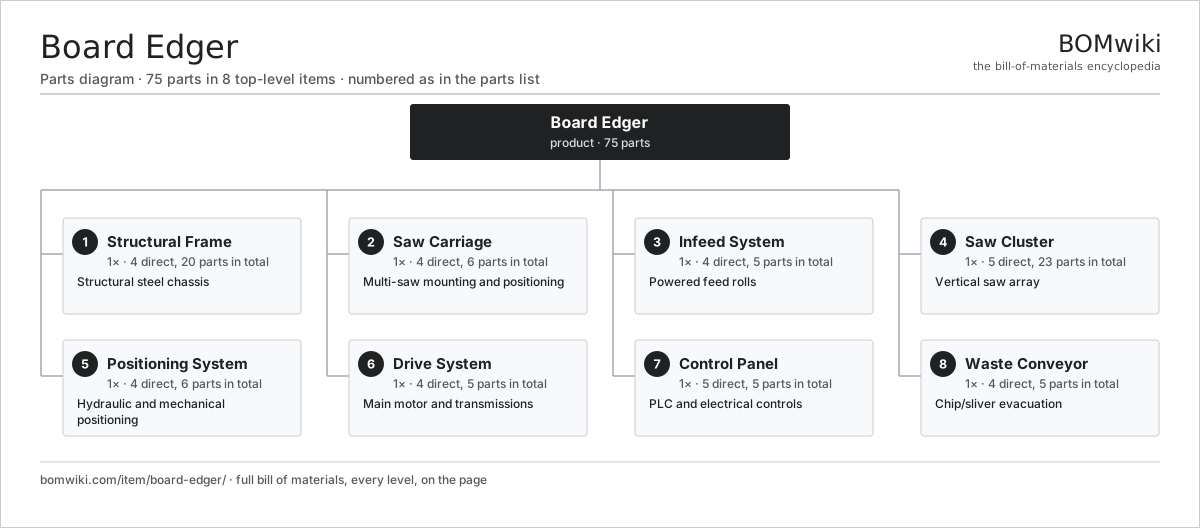
| # | Part | Qty | What it does |
|---|---|---|---|
| 1 | Structural Frame 4 parts | 1× | Structural steel chassis |
| 2 | Saw Carriage 4 parts | 1× | Multi-saw mounting and positioning |
| 3 | Infeed System 4 parts | 1× | Powered feed rolls |
| 4 | Saw Cluster 5 parts | 1× | Vertical saw array |
| 5 | Positioning System 4 parts | 1× | Hydraulic and mechanical positioning |
| 6 | Drive System 4 parts | 1× | Main motor and transmissions |
| 7 | Control Panel 5 parts | 1× | PLC and electrical controls |
| 8 | Waste Conveyor 4 parts | 1× | Chip/sliver evacuation |
3D model
No 3D model yet. Have a CAD file of this? Add a 3D model. STL renders right on this page; STEP, FreeCAD, and OpenSCAD sources are welcome too (openly licensed, like all 3D models on BOMwiki).
Build & assembly graph
expand / collapse · shared sub-assemblies converge · links to related products · est. labourTap an assembly to expand/collapse · tap a part to open it · use “Open page” for any node · drag to pan, scroll to zoom.
Bill of materials for Board Edger
8 top-level lines · 42 rows shown · 75 parts total · indented to 3 levels| # | Item / sub-assembly | Part no. | Qty/assy | Ext. qty | Parts | Type |
|---|---|---|---|---|---|---|
| 1 | Structural Frame 4 parts | board-edger-frame | 1× | 1 | 20 | assembly |
| 1.1 | Frame Beam | board-edger-frame-beam | 4× | 4 | · | part |
| 1.2 | Cross Brace | board-edger-frame-cross-member | 6× | 6 | · | part |
| 1.3 | Gusset Plate | board-edger-frame-gusset | 8× | 8 | · | part |
| 1.4 | Fastener Set | fastener-set | 2× | 2 | · | part |
| 2 | Saw Carriage 4 parts | board-edger-saw-carriage | 1× | 1 | 6 | assembly |
| 2.1 | Carriage Frame | board-edger-carriage-frame | 1× | 1 | · | part |
| 2.2 | Carriage Wheel | board-edger-carriage-wheel | 2× | 2 | · | part |
| 2.3 | Positioning Cylinder | board-edger-positioning-cylinder | 1× | 1 | · | part |
| 2.4 | Ball Bearing | ball-bearing | 2× | 2 | · | part |
| 3 | Infeed System 4 parts | board-edger-infeed-system | 1× | 1 | 5 | assembly |
| 3.1 | Feed Roller | board-edger-infeed-roller | 2× | 2 | · | part |
| 3.2 | Infeed Motor | board-edger-infeed-motor | 1× | 1 | · | part |
| 3.3 | Feed Gearbox | board-edger-speed-reducer | 1× | 1 | · | part |
| 3.4 | Drive Belt | drive-belt | 1× | 1 | · | part |
| 4 | Saw Cluster 5 parts | board-edger-saw-cluster | 1× | 1 | 23 | assembly |
| 4.1 | Saw Blade | board-edger-saw-blade | 4× | 4 | · | part |
| 4.2 | Saw Arbor | board-edger-saw-arbor | 4× | 4 | · | part |
| 4.3 | Saw Motor | board-edger-saw-motor | 4× | 4 | · | part |
| 4.4 | Blade Spacer | board-edger-saw-spacer | 3× | 3 | · | part |
| 4.5 | Ball Bearing | ball-bearing | 8× | 8 | · | part |
| 5 | Positioning System 4 parts | board-edger-positioning-system | 1× | 1 | 6 | assembly |
| 5.1 | Position Sensor | board-edger-position-sensor | 2× | 2 | · | part |
| 5.2 | Solenoid Valve | board-edger-hydraulic-valve | 2× | 2 | · | part |
| 5.3 | Pressure Sensor | pressure-sensor | 1× | 1 | · | part |
| 5.4 | Manifold Block | board-edger-position-manifold | 1× | 1 | · | part |
| 6 | Drive System 4 parts | board-edger-drive-system | 1× | 1 | 5 | assembly |
| 6.1 | Hydraulic Pump | board-edger-hydraulic-pump | 1× | 1 | · | part |
| 6.2 | Hydraulic Motor | board-edger-hydraulic-motor | 1× | 1 | · | part |
| 6.3 | Main Electric Motor | board-edger-main-motor | 1× | 1 | · | part |
| 6.4 | Coupling | board-edger-coupling | 2× | 2 | · | part |
| 7 | Control Panel 5 parts | board-edger-control-panel | 1× | 1 | 5 | assembly |
| 7.1 | Microcontroller | mcu | 1× | 1 | · | part |
| 7.2 | Bare PCB | pcb-bare | 1× | 1 | · | part |
| 7.3 | Position Display | board-edger-position-display | 1× | 1 | · | part |
| 7.4 | Input Module | board-edger-input-module | 1× | 1 | · | part |
| 7.5 | Output Module | board-edger-output-module | 1× | 1 | · | part |
| 8 | Waste Conveyor 4 parts | board-edger-waste-conveyor | 1× | 1 | 5 | assembly |
| 8.1 | Conveyor Belt | board-edger-conveyor-belt | 1× | 1 | · | part |
| 8.2 | Conveyor Pulley | board-edger-conveyor-pulley | 2× | 2 | · | part |
| 8.3 | Conveyor Motor | board-edger-conveyor-motor | 1× | 1 | · | part |
| 8.4 | Conveyor Frame | board-edger-conveyor-frame | 1× | 1 | · | part |
Something wrong in this list? Report a problem with this BOM.
Related products
same domain, ranked by shared parts Cable Coiling Machine
36 parts · shares 4 with this page
Cable Coiling Machine
36 parts · shares 4 with this page
 Cable Extrusion Line
46 parts · shares 4 with this page
Cable Extrusion Line
46 parts · shares 4 with this page
 Continuous Galvanizing Line
1,296 parts · shares 4 with this page
Continuous Galvanizing Line
1,296 parts · shares 4 with this page
Sourcing: possible vendors
Browse the supplier directory → Prices, MOQ, and lead times are algorithmic estimates, not quotes, and not claims about these companies. Company mappings are curated by keyword; est. price band $5k–$2M. How estimates work| Vendor | HQ | Specialty | MOQ | Lead time |
|---|---|---|---|---|
| atlascopco.com ↗ | Stockholm, SE | Compressors & industrial | 10 units | 12–20 wks |
|
🇦🇹Andritz
andritz.com ↗
|
Graz, AT | Process plants & machinery | 10 units | 12–20 wks |
| buhlergroup.com ↗ | Uzwil, CH | Food & materials processing | 10 units | 12–20 wks |
| gea.com ↗ | Düsseldorf, DE | Process technology | 10 units | 12–20 wks |
| mhi.com ↗ | Tokyo, JP | Heavy machinery | 10 units | 12–20 wks |
985-word article