Portable Boombox
ProductOverview
The boombox is a one-box portable stereo: speakers, amplification, a radio, and now Bluetooth streaming in a single cabinet with a carry handle. The category was created in the late 1970s around cassette decks and D-cell batteries; the modern descendant keeps the form factor and replaces every subsystem, class-D amplification instead of class-AB, a lithium pack instead of ten D cells, a silicon tuner instead of a coil-and-gang front end, and a Bluetooth SoC where the tape transport used to be. What survives unchanged is the acoustic architecture: two driver arrays at the ends of a cabinet that is itself the speaker enclosure.
Acoustics in a suitcase
The Speaker System puts a 100–130 mm Speaker woofer and a small tweeter (Tweeters) at each end of the cabinet, split by a simple LC Crossover Network around 4 kHz. The hard problem is bass from a few litres of air. Each woofer works against a sealed back volume formed by the Internal Baffles, extended by either tuned Reflex Ports, which add several dB around a 60–90 Hz tuning frequency, or a Passive Radiator, an undriven cone whose moving mass does the same job without port turbulence at high excursion. Below tuning, output falls fast, which is why the DSP/EQ Stage applies a loudness curve at low volume and, critically, a dynamic limiter at high volume: the DSP knows the drivers' excursion limits and trades bass extension for loudness in real time, the trick that lets a 3 kg box play at 95 dB without destroying itself.
The cabinet is a structural-acoustic component, not packaging. The Front Shell is the speaker baffle; its panel resonances are the buzz cheap units make at volume, and better designs rib the molding heavily. The Rear Shell closes the volumes, the Carry Handle carries the full weight, and End Bumpers absorb the drops a product designed to travel will receive.
Class-D changed the category
The Power Amplifier is where the modern boombox most differs from its ancestors. A Class-D Amp IC switches the supply rail at around 400 kHz, pulse-width-modulated by the audio, and the Output LC Filters reconstruct the waveform at the terminals. Efficiency above 90 % means a 2 × 25 W amplifier dissipates a few watts instead of tens, handled by a simple Heat Spreader with no vents, which in turn allows a sealed, splash-resistant cabinet. The same efficiency is what makes battery loudness possible at all: a class-AB design of equal output would halve the playing time. Power flows from the Power System, a 2s2p Li-ion Cell, 18650 pack under a BMS Board, charged by the internal Power Supply, through DC-DC Converters converters that hold the amplifier rail steady as the cells discharge. Retro-styled models still offer a D-Cell Bay, more homage than power source.
Sources
Radio remains a defining function. The Radio Tuner is now a single DSP Tuner IC silicon tuner that digitizes the band right behind the antenna and performs filtering and demodulation in DSP, with RDS text and, in European models, DAB+. The Telescopic Antenna is still a quarter-wave whip at FM frequencies and is still the first thing to break; AM-capable models keep an internal Ferrite Rod Antenna rod.
The Bluetooth & Media Module replaced the cassette mechanism as the primary source. A Compute SoC Module handles Bluetooth 5.x with SBC/AAC codecs through a PCB Bluetooth Antenna, the USB Port plays files from mass storage and doubles as a phone charger off the internal battery, the Aux Input remains the universal analog fallback, and a Microphone turns a paired phone call into a speakerphone. Source selection, volume via the Volume Encoder, and status on the LCD Panel all run through the Control Panel's Microcontroller.
The form factor's logic
The boombox occupies a deliberate niche between the pocket Bluetooth speaker and the home system: big enough for real stereo separation (the end-mounted drivers sit 40 cm apart) and genuine low-frequency output, small enough to carry one-handed. Battery life of 8–24 hours at moderate volume comes from the arithmetic of class-D efficiency against 35–50 Wh of lithium. The original 1980s machines weighed three times as much, drew their power from ten D cells, and put most of their cost into the tape transport; the modern bill of materials puts it into drivers, battery, and DSP. The handle, the end-firing speakers, and the social premise, music carried into a public space, are the parts of the design that have not moved in forty-five years.
Portable Boombox parts and their functions
8 top-level parts · 47 parts in total · full bill of materials below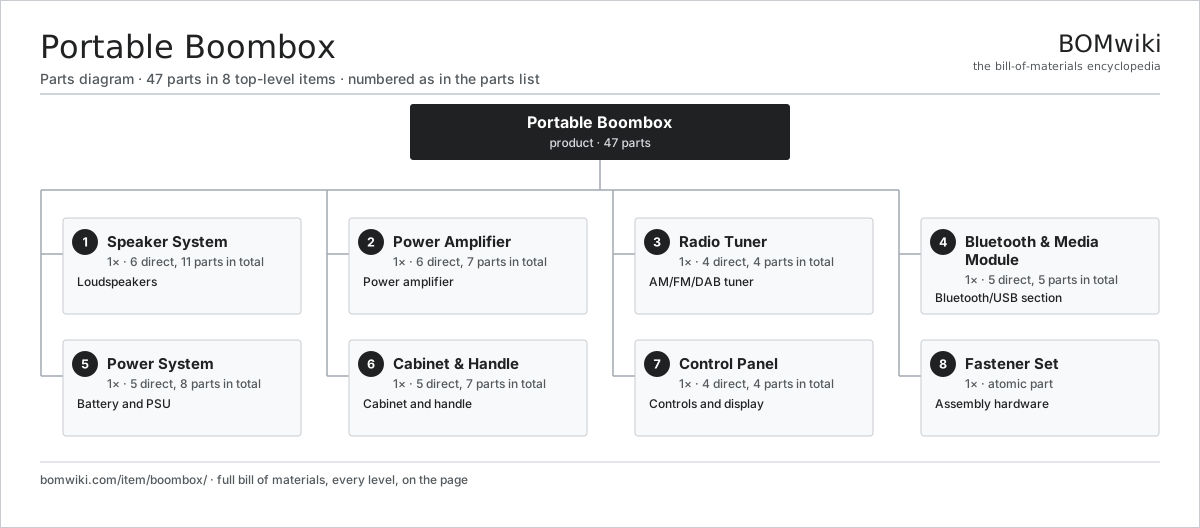
| # | Part | Qty | What it does |
|---|---|---|---|
| 1 | Speaker System 6 parts | 1× | Loudspeakers |
| 2 | Power Amplifier 6 parts | 1× | Power amplifier |
| 3 | Radio Tuner 4 parts | 1× | AM/FM/DAB tuner |
| 4 | Bluetooth & Media Module 5 parts | 1× | Bluetooth/USB section |
| 5 | Power System 5 parts | 1× | Battery and PSU |
| 6 | Cabinet & Handle 5 parts | 1× | Cabinet and handle |
| 7 | Control Panel 4 parts | 1× | Controls and display |
| 8 | Fastener Set | 1× | Assembly hardware |
3D model
No 3D model yet. Have a CAD file of this? Add a 3D model. STL renders right on this page; STEP, FreeCAD, and OpenSCAD sources are welcome too (openly licensed, like all 3D models on BOMwiki).
Build & assembly graph
expand / collapse · shared sub-assemblies converge · links to related products · est. labourTap an assembly to expand/collapse · tap a part to open it · use “Open page” for any node · drag to pan, scroll to zoom.
Bill of materials for Portable Boombox
8 top-level lines · 43 rows shown · 47 parts total · indented to 3 levels| # | Item / sub-assembly | Part no. | Qty/assy | Ext. qty | Parts | Type |
|---|---|---|---|---|---|---|
| 1 | Speaker System 6 parts | bbx-speaker-system | 1× | 1 | 11 | assembly |
| 1.1 | Speaker | speaker | 2× | 2 | · | part |
| 1.2 | Tweeters | bbx-tweeters | 2× | 2 | · | part |
| 1.3 | Crossover Network | bbx-crossover | 2× | 2 | · | part |
| 1.4 | Passive Radiator | bbx-passive-radiator | 1× | 1 | · | part |
| 1.5 | Speaker Grilles | bbx-speaker-grilles | 2× | 2 | · | part |
| 1.6 | Reflex Ports | bbx-port-tubes | 2× | 2 | · | part |
| 2 | Power Amplifier 6 parts | bbx-amplifier | 1× | 1 | 7 | assembly |
| 2.1 | Class-D Amp IC | bbx-classd-ic | 1× | 1 | · | part |
| 2.2 | Bare PCB | pcb-bare | 1× | 1 | · | part |
| 2.3 | Output LC Filters | bbx-output-filters | 2× | 2 | · | part |
| 2.4 | DSP/EQ Stage | bbx-dsp-eq | 1× | 1 | · | part |
| 2.5 | SMD Passive (R/C/L) | smd-passives | 1× | 1 | · | part |
| 2.6 | Heat Spreader | bbx-heatsink-plate | 1× | 1 | · | part |
| 3 | Radio Tuner 4 parts | bbx-tuner | 1× | 1 | 4 | assembly |
| 3.1 | DSP Tuner IC | bbx-tuner-ic | 1× | 1 | · | part |
| 3.2 | Telescopic Antenna | bbx-telescopic-antenna | 1× | 1 | · | part |
| 3.3 | Ferrite Rod Antenna | bbx-ferrite-antenna | 1× | 1 | · | part |
| 3.4 | SMD Passive (R/C/L) | smd-passives | 1× | 1 | · | part |
| 4 | Bluetooth & Media Module 5 parts | bbx-bt-module | 1× | 1 | 5 | assembly |
| 4.1 | Compute SoC Module | soc-module | 1× | 1 | · | part |
| 4.2 | Bluetooth Antenna | bbx-bt-antenna | 1× | 1 | · | part |
| 4.3 | USB Port | bbx-usb-port | 1× | 1 | · | part |
| 4.4 | Aux Input | bbx-aux-jack | 1× | 1 | · | part |
| 4.5 | Microphone | bbx-mic | 1× | 1 | · | part |
| 5 | Power System 5 parts | bbx-power-system | 1× | 1 | 8 | assembly |
| 5.1 | Li-ion Cell, 18650 | li-cell-18650 | 4× | 4 | · | part |
| 5.2 | BMS Board | bms-board | 1× | 1 | · | part |
| 5.3 | Power Supply | power-supply | 1× | 1 | · | part |
| 5.4 | DC-DC Converters | bbx-dc-rails | 1× | 1 | · | part |
| 5.5 | D-Cell Bay | bbx-d-cell-bay | 1× | 1 | · | part |
| 6 | Cabinet & Handle 5 parts | bbx-cabinet | 1× | 1 | 7 | assembly |
| 6.1 | Front Shell | bbx-front-shell | 1× | 1 | · | part |
| 6.2 | Rear Shell | bbx-rear-shell | 1× | 1 | · | part |
| 6.3 | Internal Baffles | bbx-internal-baffles | 2× | 2 | · | part |
| 6.4 | Carry Handle | bbx-carry-handle | 1× | 1 | · | part |
| 6.5 | End Bumpers | bbx-end-bumpers | 2× | 2 | · | part |
| 7 | Control Panel 4 parts | bbx-control-panel | 1× | 1 | 4 | assembly |
| 7.1 | Button Board | bbx-button-board | 1× | 1 | · | part |
| 7.2 | Volume Encoder | bbx-volume-encoder | 1× | 1 | · | part |
| 7.3 | LCD Panel | lcd-panel | 1× | 1 | · | part |
| 7.4 | Microcontroller | mcu | 1× | 1 | · | part |
| 8 | Fastener Set | fastener-set | 1× | 1 | · | part |
Something wrong in this list? Report a problem with this BOM.
Related products
same domain, ranked by shared parts Karaoke Machine
59 parts · shares 6 with this page
Karaoke Machine
59 parts · shares 6 with this page
 Portable PA System
86 parts · shares 5 with this page
Portable PA System
86 parts · shares 5 with this page
 Dolby Atmos Soundbar
387 parts · shares 4 with this page
Dolby Atmos Soundbar
387 parts · shares 4 with this page
 Wireless In-Ear Monitor System
75 parts · shares 4 with this page
UHF Wireless Microphone System
291 parts · shares 3 with this page
Wireless In-Ear Monitor System
75 parts · shares 4 with this page
UHF Wireless Microphone System
291 parts · shares 3 with this page
 Projector
482 parts · shares 3 with this page
Projector
482 parts · shares 3 with this page
Sourcing: possible vendors
Browse the supplier directory → Prices, MOQ, and lead times are algorithmic estimates, not quotes, and not claims about these companies. Company mappings are curated by keyword; est. price band $50–$3k. How estimates work| Vendor | HQ | Specialty | MOQ | Lead time |
|---|---|---|---|---|
|
🇯🇵Sony
sony.com ↗
|
Tokyo, JP | Consumer electronics | 1,000 units | 8–12 wks |
| samsung.com ↗ | Suwon, KR | Electronics & displays | 1,000 units | 8–12 wks |
|
🇺🇸Harman
harman.com ↗
|
Stamford, US | Audio (JBL, AKG) | 1,000 units | 8–12 wks |
|
🇺🇸Bose
bose.com ↗
|
Framingham, US | Audio | 1,000 units | 8–12 wks |
| yamaha.com ↗ | Hamamatsu, JP | Audio & instruments | 1,000 units | 8–12 wks |
791-word article