Broadcast Audio Console
ProductOverview
A broadcast audio console is the control center for sound in a television, radio, or live-streaming production. The operator sits at the Control Surface, where 16 to 32 motorized faders control the level of each audio input, from studio microphones, remote feeds, pre-recorded audio, and graphics packages. The DSP Mixing Engine is the real-time DSP (digital signal processor) that performs the actual mixing: it sums together the audio from all active channels, applies compression and EQ to shape tone, routes the mixed output to broadcast transmission, and simultaneously feeds the operator a private monitor mix so they can hear themselves and coordinate with the studio.
In a fast-moving live show, a news broadcast, sports event, or awards show, the audio operator is constantly riding the faders, bringing microphones up and down to catch speeches, music, and ambient sound while preventing feedback and keeping the overall level consistent. The motorized faders allow the console to "remember" settings: once a show is configured with fader positions for each camera operator's microphone, audio effects, music, and so on, those positions can be saved and automated, allowing a repeat performance or network affiliate to reproduce the exact audio mix with one button press.
How it works
Every input, a studio microphone, a remote reporter in the field, a CD player in the production truck, connects to the Input Rack (8–16 channels). A Microphone Input Card has several microphone preamplifiers, each one boosting a low-level mic signal to line level, and providing 48V phantom power for condenser microphones that need it. An analog-to-digital converter on the card digitizes the microphone signal at high resolution (24-bit, 48 kHz), and sends the digital stream into the DSP Mixing Engine.
The DSP Processor Board is the heart: it runs a real-time audio mixing firmware that simultaneously:
- Reads the digital audio from all 24–48 inputs
- Applies per-channel EQ and compression (stored in DSP RAM/ROM Module)
- Mixes them together according to the fader settings
- Applies bus-level effects (limiter, reverb, delay)
- Sends the program mix to digital-to-analog converters on the Program Output Card
- Also routes audio to monitor outputs
The operator controls fader position via a motorized slide potentiometer that the DSP reads thousands of times per second. When the operator grabs the fader and slides it up, the DSP instantly fades in that channel. If two inputs are close in frequency (e.g., two reporters with similar voices), the operator might use the per-channel EQ knob on the Motorized Fader Strip to brighten one and darken the other, making each speaker more distinguishable.
The master DSP Mixing Engine also performs routing: the operator can send any input to any of 4–8 auxiliary buses for separate mixes. For example, a sports broadcast might have one aux send that feeds a post-game show with commentator microphone and crowd noise, another aux that feeds an over-the-air radio simulcast, and a third that feeds a deaf services secondary audio program (SAP) with only dialog. All these mixes happen simultaneously on the same hardware, all controlled from the single console.
Monitoring and cuing
The Monitor Section is where the operator hears what is happening. The Headphone Amplifier provides four independent stereo headphone mixes, so:
- The operator wears one headphones output feeding the program mix (so they hear what the audience hears)
- A studio floor monitor speaker plays the studio monitor mix, a mix of talent microphones and counting for timing
- A second headphone mix feeds the director with a mix of talent mics plus director cues from the control room
- A third might feed an in-ear monitor (IFB) wireless transmitter that sends announcer cues to on-set talent
The Monitor Routing Switch allows the operator to change which signal is feeding each headphone output or speaker, so during a commercial break they can mute the program feed from the headphones and listen to the director talk to them without broadcast audio interrupting.
The Meter Bridge displays the instantaneous level of the program output on large VU (volume unit) or PPM (peak program meter) meters, giving the operator a visual reference for whether the level is too hot (compressing, distorting), too soft (barely audible), or right on target. In broadcast, the legal program level is standardized: in North America, −20 dBFS (20 dB below full scale digital) peaks at dialogue, −18 dBFS at peaks of music, and the short-term loudness (LUFS) must average between −23 and −27 dB per broadcast regulations (FCC/CALM act). The limiter on the Program Output Card prevents accidental over-level, but the operator is responsible for keeping the show dynamic and interesting while staying within compliance.
Real-time show operation
In a live broadcast, the audio operator and the production director communicate via headset (intercom). The director calls out transitions: "stand by for a tape play-in 5 seconds... rolling tape in 3, 2, 1, mark." The operator has pre-configured the console so that a macro button press (or full automation sequence) brings up the music or narrator voice at the right level while muting the studio mics. When the director says "take live camera," the operator fades down the tape and brings up the studio microphones in real time.
The motorized faders and recall system allow the console to "play back" previously recorded fader movements. If a show runs multiple times a week (e.g., a daily news broadcast), the operator can save the entire fader state at the start of each segment, and on the next day, press a recall button to restore all faders to their positions, eliminating manual setup time. Many consoles now integrate with newsroom automation systems (iNews, Vizrt), so the automation script can directly trigger fader recalls and equipment cues in sync with the rundown.
Broadcast Audio Console parts and their functions
11 top-level parts · 1,111 parts in total · full bill of materials below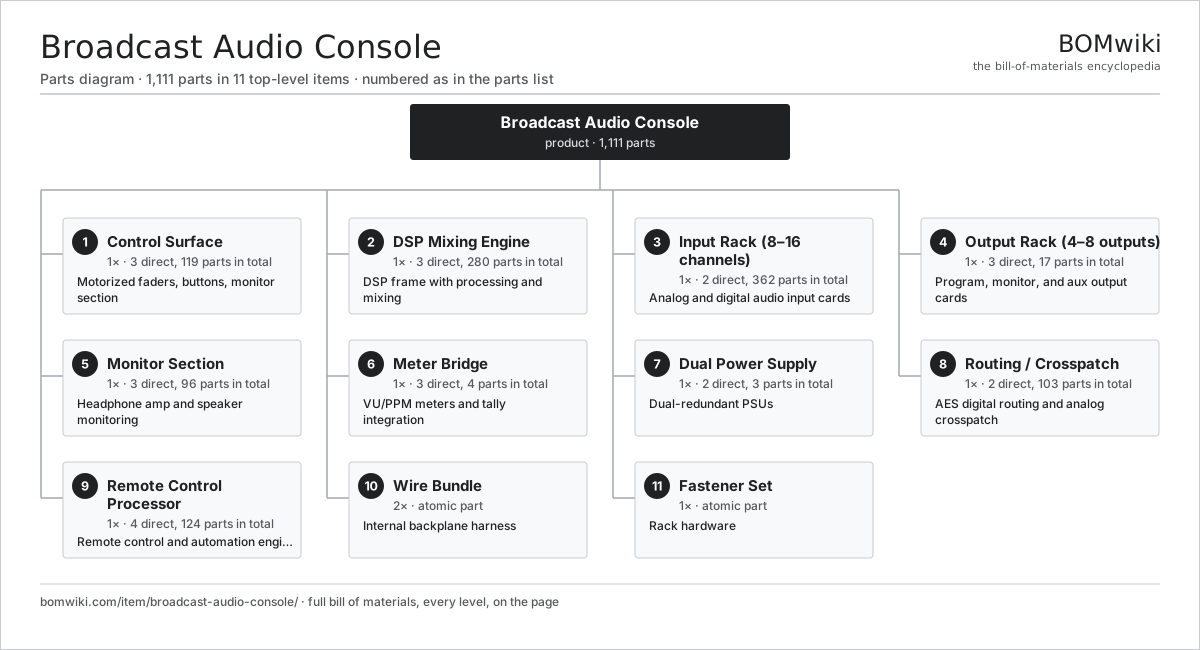
| # | Part | Qty | What it does |
|---|---|---|---|
| 1 | Control Surface 3 parts | 1× | Motorized faders, buttons, monitor section |
| 2 | DSP Mixing Engine 3 parts | 1× | DSP frame with processing and mixing |
| 3 | Input Rack (8–16 channels) 2 parts | 1× | Analog and digital audio input cards |
| 4 | Output Rack (4–8 outputs) 3 parts | 1× | Program, monitor, and aux output cards |
| 5 | Monitor Section 3 parts | 1× | Headphone amp and speaker monitoring |
| 6 | Meter Bridge 3 parts | 1× | VU/PPM meters and tally integration |
| 7 | Dual Power Supply 2 parts | 1× | Dual-redundant PSUs |
| 8 | Routing / Crosspatch 2 parts | 1× | AES digital routing and analog crosspatch |
| 9 | Remote Control Processor 4 parts | 1× | Remote control and automation engine |
| 10 | Wire Bundle | 2× | Internal backplane harness |
| 11 | Fastener Set | 1× | Rack hardware |
Diagrams & photos

3D model
No 3D model yet. Have a CAD file of this? Add a 3D model. STL renders right on this page; STEP, FreeCAD, and OpenSCAD sources are welcome too (openly licensed, like all 3D models on BOMwiki).
Build & assembly graph
expand / collapse · shared sub-assemblies converge · links to related products · est. labourTap an assembly to expand/collapse · tap a part to open it · use “Open page” for any node · drag to pan, scroll to zoom.
Bill of materials for Broadcast Audio Console
11 top-level lines · 78 rows shown · 1,111 parts total · indented to 3 levels| # | Item / sub-assembly | Part no. | Qty/assy | Ext. qty | Parts | Type |
|---|---|---|---|---|---|---|
| 1 | Control Surface 3 parts | broadcast-audio-control-surface | 1× | 1 | 119 | assembly |
| 1.1 | Motorized Fader Strip 3 parts | broadcast-audio-fader-strip | 16× | 16 | 7 | assembly |
| 1.1.1 | Motorized Fader Motor | broadcast-audio-fader-motor | 1× | 16 | · | part |
| 1.1.2 | Gain Potentiometer | broadcast-audio-fader-potentiometer | 2× | 32 | · | part |
| 1.1.3 | Strip Indicator LED | broadcast-audio-strip-leds | 4× | 64 | · | part |
| 1.2 | Monitor Mixing Panel 3 parts | broadcast-audio-monitor-controls | 1× | 1 | 6 | assembly |
| 1.2.1 | Headphone Level Pot | broadcast-audio-headphone-pot | 1× | 1 | · | part |
| 1.2.2 | Speaker Level Pot | broadcast-audio-speaker-pot | 1× | 1 | · | part |
| 1.2.3 | Monitor Control Button | broadcast-audio-monitor-button | 4× | 4 | · | part |
| 1.3 | Meter Display (LCD or LED) | broadcast-audio-meter-display | 1× | 1 | · | part |
| 2 | DSP Mixing Engine 3 parts | broadcast-audio-mixing-engine | 1× | 1 | 280 | assembly |
| 2.1 | DSP Processor Board 4 parts | broadcast-audio-dsp-board | 1× | 1 | 153 | assembly |
| 2.1.1 | Bare PCB | pcb-bare | 1× | 1 | · | part |
| 2.1.2 | SHARC/DSP Chip | broadcast-audio-dsp-chip | 1× | 1 | · | part |
| 2.1.3 | DSP RAM/ROM Module | broadcast-audio-dsp-memory | 1× | 1 | · | part |
| 2.1.4 | SMD Passive (R/C/L) | smd-passives | 150× | 150 | · | part |
| 2.2 | FPGA Routing Matrix 3 parts | broadcast-audio-fpga-router | 1× | 1 | 122 | assembly |
| 2.2.1 | Bare PCB | pcb-bare | 1× | 1 | · | part |
| 2.2.2 | FPGA Chip | broadcast-audio-fpga-chip | 1× | 1 | · | part |
| 2.2.3 | SMD Passive (R/C/L) | smd-passives | 120× | 120 | · | part |
| 2.3 | AES/EBU Digital Interface 2 parts | broadcast-audio-aes-interface | 1× | 1 | 5 | assembly |
| 2.3.1 | AES Driver IC | broadcast-audio-aes-driver | 1× | 1 | · | part |
| 2.3.2 | Connector | connector | 4× | 4 | · | part |
| 3 | Input Rack (8–16 channels) 2 parts | broadcast-audio-input-rack | 1× | 1 | 362 | assembly |
| 3.1 | Microphone Input Card 5 parts | broadcast-audio-mic-input-card | 2× | 2 | 114 | assembly |
| 3.1.1 | Bare PCB | pcb-bare | 1× | 2 | · | part |
| 3.1.2 | Microphone Preamplifier IC | broadcast-audio-mic-preamp | 4× | 8 | · | part |
| 3.1.3 | Phantom Power Supply Module | broadcast-audio-phantom-supply | 1× | 2 | · | part |
| 3.1.4 | SMD Passive (R/C/L) | smd-passives | 100× | 200 | · | part |
| 3.1.5 | Connector | connector | 8× | 16 | · | part |
| 3.2 | Line Input Card 4 parts | broadcast-audio-line-input-card | 2× | 2 | 67 | assembly |
| 3.2.1 | Bare PCB | pcb-bare | 1× | 2 | · | part |
| 3.2.2 | Line Preamp IC | broadcast-audio-input-preamp | 2× | 4 | · | part |
| 3.2.3 | Connector | connector | 4× | 8 | · | part |
| 3.2.4 | SMD Passive (R/C/L) | smd-passives | 60× | 120 | · | part |
| 4 | Output Rack (4–8 outputs) 3 parts | broadcast-audio-output-rack | 1× | 1 | 17 | assembly |
| 4.1 | Program Output Card 3 parts | broadcast-audio-program-output | 1× | 1 | 5 | assembly |
| 4.1.1 | Output Amplifier IC | broadcast-audio-output-amp | 2× | 2 | · | part |
| 4.1.2 | Limiter DSP Module | broadcast-audio-limiter-dsp | 1× | 1 | · | part |
| 4.1.3 | Connector | connector | 2× | 2 | · | part |
| 4.2 | Monitor Output Card (×2) 2 parts | broadcast-audio-monitor-output | 2× | 2 | 4 | assembly |
| 4.2.1 | Output Amplifier IC | broadcast-audio-output-amp | 2× | 4 | · | part |
| 4.2.2 | Connector | connector | 2× | 4 | · | part |
| 4.3 | Aux Subgroup Output 2 parts | broadcast-audio-aux-output | 1× | 1 | 4 | assembly |
| 4.3.1 | Output Amplifier IC | broadcast-audio-output-amp | 2× | 2 | · | part |
| 4.3.2 | Connector | connector | 2× | 2 | · | part |
| 5 | Monitor Section 3 parts | broadcast-audio-monitor-section | 1× | 1 | 96 | assembly |
| 5.1 | Headphone Amplifier 4 parts | broadcast-audio-headphone-amp | 1× | 1 | 89 | assembly |
| 5.1.1 | Bare PCB | pcb-bare | 1× | 1 | · | part |
| 5.1.2 | Headphone Amp IC | broadcast-audio-hp-amp-ic | 4× | 4 | · | part |
| 5.1.3 | SMD Passive (R/C/L) | smd-passives | 80× | 80 | · | part |
| 5.1.4 | Connector | connector | 4× | 4 | · | part |
| 5.2 | Studio Speaker Amplifier 2 parts | broadcast-audio-speaker-amp | 1× | 1 | 2 | assembly |
| 5.2.1 | Audio Power Amp IC (50–100 W) | broadcast-audio-power-amp-ic | 1× | 1 | · | part |
| 5.2.2 | Speaker Protection Circuit | broadcast-audio-speaker-protection | 1× | 1 | · | part |
| 5.3 | Monitor Routing Switch 2 parts | broadcast-audio-monitor-switch | 1× | 1 | 5 | assembly |
| 5.3.1 | Audio Routing Relay | broadcast-audio-routing-relay | 4× | 4 | · | part |
| 5.3.2 | Switch Control Logic | broadcast-audio-switch-control | 1× | 1 | · | part |
| 6 | Meter Bridge 3 parts | broadcast-audio-meter-bridge | 1× | 1 | 4 | assembly |
| 6.1 | VU Meter | broadcast-audio-vu-meter | 2× | 2 | · | part |
| 6.2 | Meter Amplifier | broadcast-audio-meter-amplifier | 1× | 1 | · | part |
| 6.3 | Tally Light Driver | broadcast-audio-tally-driver | 1× | 1 | · | part |
| 7 | Dual Power Supply 2 parts | broadcast-audio-power-supply | 1× | 1 | 3 | assembly |
| 7.1 | Power Supply | power-supply | 2× | 2 | · | part |
| 7.2 | Power Supply Switchover Module | broadcast-audio-psu-switch | 1× | 1 | · | part |
| 8 | Routing / Crosspatch 2 parts | broadcast-audio-routing-matrix | 1× | 1 | 103 | assembly |
| 8.1 | Routing Processor 3 parts | broadcast-audio-routing-processor | 1× | 1 | 102 | assembly |
| 8.1.1 | Bare PCB | pcb-bare | 1× | 1 | · | part |
| 8.1.2 | Microcontroller | mcu | 1× | 1 | · | part |
| 8.1.3 | SMD Passive (R/C/L) | smd-passives | 100× | 100 | · | part |
| 8.2 | Routing Configuration Memory | broadcast-audio-routing-memory | 1× | 1 | · | part |
| 9 | Remote Control Processor 4 parts | broadcast-audio-control-processor | 1× | 1 | 124 | assembly |
| 9.1 | Bare PCB | pcb-bare | 1× | 1 | · | part |
| 9.2 | Microcontroller | mcu | 1× | 1 | · | part |
| 9.3 | Connector | connector | 2× | 2 | · | part |
| 9.4 | SMD Passive (R/C/L) | smd-passives | 120× | 120 | · | part |
| 10 | Wire Bundle | wire-bundle | 2× | 2 | · | part |
| 11 | Fastener Set | fastener-set | 1× | 1 | · | part |
Something wrong in this list? Report a problem with this BOM.
Related products
same domain, ranked by shared parts AV Receiver
1,097 parts · shares 2 with this page
AV Receiver
1,097 parts · shares 2 with this page
 Broadcast Studio Camera
287 parts · shares 2 with this page
Broadcast Studio Camera
287 parts · shares 2 with this page
 CD Player
47 parts · shares 2 with this page
CD Player
47 parts · shares 2 with this page
 Channel Strip
55 parts · shares 2 with this page
Cinema Sound Processor
839 parts · shares 2 with this page
Channel Strip
55 parts · shares 2 with this page
Cinema Sound Processor
839 parts · shares 2 with this page
 Digital Jukebox
563 parts · shares 2 with this page
Digital Jukebox
563 parts · shares 2 with this page
Sourcing: possible vendors
Browse the supplier directory → Prices, MOQ, and lead times are algorithmic estimates, not quotes, and not claims about these companies. Company mappings are curated by keyword; est. price band $50–$3k. How estimates work| Vendor | HQ | Specialty | MOQ | Lead time |
|---|---|---|---|---|
|
🇯🇵Sony
sony.com ↗
|
Tokyo, JP | Consumer electronics | 1,000 units | 8–12 wks |
| samsung.com ↗ | Suwon, KR | Electronics & displays | 1,000 units | 8–12 wks |
|
🇺🇸Harman
harman.com ↗
|
Stamford, US | Audio (JBL, AKG) | 1,000 units | 8–12 wks |
|
🇺🇸Bose
bose.com ↗
|
Framingham, US | Audio | 1,000 units | 8–12 wks |
| yamaha.com ↗ | Hamamatsu, JP | Audio & instruments | 1,000 units | 8–12 wks |
1,025-word article