Brush Making Machine
ProductOverview
Brush making machines automate the assembly and finishing of bristle brushes by drilling holes into pre-molded plastic or wooden brush heads, inserting bundles of natural or synthetic bristles, anchoring them with staples, trimming bristles to uniform length, and shaping the bristle tuft profile. These machines handle paint brushes, cleaning brushes, industrial sweepers, and similar products at rates of 200–400 units per minute using carousel indexing and synchronized multi-station processing. The integration of precision drilling, pneumatic insertion, mechanical stapling, high-speed trimming, and finishing operations requires tight coordination and feedback control to maintain consistent quality across millions of brushes annually.
How It Works
Brush Head Loading and Drilling
Blank brush head stock (molded plastic or wood) is loaded into the Brush Head Carousel carousel at the first station. The carousel rotates to position a brush head under the Drilling Station station. The Drill Spindle Assembly (2000–4000 rpm) lowers and drills 2–4 holes (15–25 mm depth) into the brush head blank using a twist drill bit supplied by the Coolant Pump. The Drill Work Fixture locates and clamps the brush head with repeatable precision; a Pressure Sensor monitors feed force to detect drill breakage or material variations.
Bristle Bundle Insertion
At the next carousel position, the Bristle Filling Assembly assembly inserts pre-bundled bristle tufts (4–8 per brush depending on brush size and stiffness). A Bristle Bundle Hopper vibration feeder meters bristle bundles onto the work table. Precision Fill Guide Bushings (hardened steel bushings) align each bundle over its target hole. A Fill Press Head (pneumatic double-acting cylinder) descends under 500–1000 N force, pressing bristles into the hole and seating them firmly. The Pressure Sensor detects insertion force; if pressure is low, the controller flags a possible misalignment.
Staple Anchoring
Immediately following insertion, the bristles are locked into place at the next carousel station by the Staple Feed and Drive assembly. A Staple Feeder Bowl vibration feeder orients pre-formed staples (typically U-shaped or wire-staples) and meters one per cycle onto the work surface. A solenoid or pneumatic Staple Punch Actuator delivers 300–800 J of impact energy, driving the staple through the bristle bundle anchor points and into the Staple Anvil Block. The Pressure Sensor confirms staple seating; under-driven staples result in loose bristles during use.
Bristle Trimming
The Bristle Trimming Station station removes excess bristle length protruding above the brush head rim. A high-speed Trimmer Spindle (3000–6000 rpm) rotates a Trim Cutting Blade, hardened stainless steel with micro-serrated edge, that cuts all bristles to uniform height in a single pass. The Trim Depth Stop fixture and depth stop ensure trim height accuracy to ±0.5 mm. Trimmed fibers are immediately evacuated by the Blower Motor and directed to the Dust Extraction and Suction system.
Bristle Shaping and Profiling
At the final processing station, the Shaping and Profiling Station assembly finishes the bristle tuft. A rotating Shaping Abrasive Drum (60–120 grit abrasive, 1000–2000 rpm) gently rounds bristle tips and shapes the tuft into a tapered or domed profile. The Shaping Work Table holds the brush head with bristles protruding through escape ports, allowing uniform contact with the spinning drum. Air jets from the Blower Motor assist in bristle alignment and fluffing. Abrasive dust is continuously evacuated to the central vacuum system.
Carousel Sequencing
The Carousel Turret turret holds 8–16 brush heads in indexed fixtures, advancing one position (typically 45° rotation) at the start of each machine cycle. A Carousel Motor and Gearbox (stepper motor with gearbox) receives step pulses from the controller. Pneumatic or mechanical Clamp Block Assembly at each carousel position hold brush heads firmly during operations. An Encoder senses carousel position and verifies correct indexing before operations at each station begin.
Dust Management
High-speed trimming and shaping generate significant bristle and abrasive dust. The Dust Extraction and Suction system maintains constant suction at all work stations via ductwork and quick-disconnect hoses. A Vacuum Pump Unit (rotary vane or centrifugal, 20–100 cfm at 15 inches water) draws dust into a HEPA Filter Cartridge (HEPA, 99.97% at 0.3 micron). Filtered air is exhausted, preventing dust clouds and cross-contamination between brush lots.
Control and Synchronization
The Control System and Synchronization system coordinates all operations via a programmable Microcontroller. The controller manages:
- Drill spindle speed and feed rate via Relay contactor
- Bristle fill press cylinder solenoid activation
- Staple punch solenoid triggering and force feedback
- Trim spindle on/off and blade speed regulation
- Carousel stepper-motor indexing pulses
- Vacuum pump and shape-drum motor enable
- Safety interlocks to prevent simultaneous station operations
Encoder feedback from carousel position and spindle speed ensures synchronization. If carousel indexing fails or a solenoid misfire is detected, the controller halts and triggers an alarm.
Engineering Considerations
Hole Drilling Precision: Hole location must be repeatable to ±0.3 mm; misaligned holes cause bristles to protrude unevenly or drift during filling. Drill spindle runout should be <0.05 mm TIR.
Staple Quality: Poorly formed or over-hardened staples jam the feeder or fail to seat properly. Supplier quality control on staple temper and geometry is critical.
Bristle Fiber Uniformity: Bristles must have consistent diameter (±0.02 mm for nylon) and stiffness (denier for synthetic, diameter for animal hair). Off-spec fiber causes visible appearance defects.
Trim Blade Wear: Continuous cutting dulls the blade within 50,000–150,000 cuts depending on bristle material. Regular inspection and blade replacement prevent fraying and bristle damage.
Carousel Timing: If carousel rotation is too slow, bristles insufficiently set before the next operation; if too fast, drilled holes are improperly cleaned before filling. Typical cycle is 1–2 seconds per station.
Dust Containment: Bristle and abrasive dust clogs bearings and drives if not evacuated continuously. HEPA filtration and regular cartridge replacement are essential.
Production Metrics
An 8-position carousel with 5-second dwell per station yields 144 brushes per hour per station, or approximately 400–500 total/hour at full capacity. Bristle material changeover requires hopper cleaning (5–10 minutes) and possible trimmer blade inspection. Brush head blank changeover involves adjusting carousel fixtures and drill depth (10–20 minutes).
Brush Making Machine parts and their functions
8 top-level parts · 50 parts in total · full bill of materials below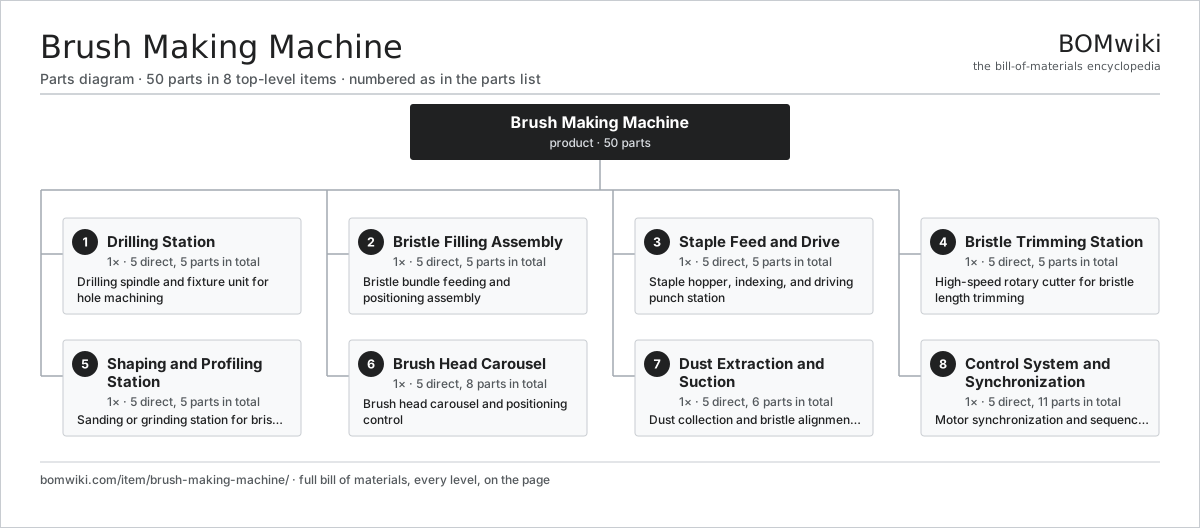
| # | Part | Qty | What it does |
|---|---|---|---|
| 1 | Drilling Station 5 parts | 1× | Drilling spindle and fixture unit for hole machining |
| 2 | Bristle Filling Assembly 5 parts | 1× | Bristle bundle feeding and positioning assembly |
| 3 | Staple Feed and Drive 5 parts | 1× | Staple hopper, indexing, and driving punch station |
| 4 | Bristle Trimming Station 5 parts | 1× | High-speed rotary cutter for bristle length trimming |
| 5 | Shaping and Profiling Station 5 parts | 1× | Sanding or grinding station for bristle profile shaping |
| 6 | Brush Head Carousel 5 parts | 1× | Brush head carousel and positioning control |
| 7 | Dust Extraction and Suction 5 parts | 1× | Dust collection and bristle alignment suction |
| 8 | Control System and Synchronization 5 parts | 1× | Motor synchronization and sequence controller |
3D model
No 3D model yet. Have a CAD file of this? Add a 3D model. STL renders right on this page; STEP, FreeCAD, and OpenSCAD sources are welcome too (openly licensed, like all 3D models on BOMwiki).
Build & assembly graph
expand / collapse · shared sub-assemblies converge · links to related products · est. labourTap an assembly to expand/collapse · tap a part to open it · use “Open page” for any node · drag to pan, scroll to zoom.
Bill of materials for Brush Making Machine
8 top-level lines · 48 rows shown · 50 parts total · indented to 3 levels| # | Item / sub-assembly | Part no. | Qty/assy | Ext. qty | Parts | Type |
|---|---|---|---|---|---|---|
| 1 | Drilling Station 5 parts | brush-making-machine-drill | 1× | 1 | 5 | assembly |
| 1.1 | Drill Spindle Assembly | brush-making-machine-drill-spindle | 1× | 1 | · | part |
| 1.2 | Drilling Head Unit | brush-making-machine-drill-head | 1× | 1 | · | part |
| 1.3 | Drill Work Fixture | brush-making-machine-work-fixture | 1× | 1 | · | part |
| 1.4 | Coolant Pump | coolant-pump | 1× | 1 | · | part |
| 1.5 | Pressure Sensor | pressure-sensor | 1× | 1 | · | part |
| 2 | Bristle Filling Assembly 5 parts | brush-making-machine-fill | 1× | 1 | 5 | assembly |
| 2.1 | Bristle Bundle Hopper | brush-making-machine-fill-hopper | 1× | 1 | · | part |
| 2.2 | Fill Press Head | brush-making-machine-fill-head | 1× | 1 | · | part |
| 2.3 | Fill Guide Bushings | brush-making-machine-fill-guides | 1× | 1 | · | part |
| 2.4 | Pressure Sensor | pressure-sensor | 1× | 1 | · | part |
| 2.5 | O-Ring Set | oring-set | 1× | 1 | · | part |
| 3 | Staple Feed and Drive 5 parts | brush-making-machine-staple | 1× | 1 | 5 | assembly |
| 3.1 | Staple Feeder Bowl | brush-making-machine-staple-bowl | 1× | 1 | · | part |
| 3.2 | Staple Punch Actuator | brush-making-machine-staple-punch | 1× | 1 | · | part |
| 3.3 | Staple Anvil Block | brush-making-machine-staple-anvil | 1× | 1 | · | part |
| 3.4 | Connector | connector | 1× | 1 | · | part |
| 3.5 | Pressure Sensor | pressure-sensor | 1× | 1 | · | part |
| 4 | Bristle Trimming Station 5 parts | brush-making-machine-trim | 1× | 1 | 5 | assembly |
| 4.1 | Trimmer Spindle | brush-making-machine-trim-spindle | 1× | 1 | · | part |
| 4.2 | Trim Cutting Blade | brush-making-machine-trim-blade | 1× | 1 | · | part |
| 4.3 | Trim Depth Stop | brush-making-machine-trim-guide | 1× | 1 | · | part |
| 4.4 | Blower Motor | blower-motor | 1× | 1 | · | part |
| 4.5 | Encoder | encoder | 1× | 1 | · | part |
| 5 | Shaping and Profiling Station 5 parts | brush-making-machine-shape | 1× | 1 | 5 | assembly |
| 5.1 | Shaping Abrasive Drum | brush-making-machine-shape-drum | 1× | 1 | · | part |
| 5.2 | Shaping Spindle | brush-making-machine-shape-spindle | 1× | 1 | · | part |
| 5.3 | Shaping Work Table | brush-making-machine-shape-table | 1× | 1 | · | part |
| 5.4 | Blower Motor | blower-motor | 1× | 1 | · | part |
| 5.5 | Fastener Set | fastener-set | 1× | 1 | · | part |
| 6 | Brush Head Carousel 5 parts | brush-making-machine-indexer | 1× | 1 | 8 | assembly |
| 6.1 | Carousel Turret | brush-making-machine-carousel | 1× | 1 | · | part |
| 6.2 | Carousel Motor and Gearbox | brush-making-machine-carousel-drive | 1× | 1 | · | part |
| 6.3 | Clamp Block Assembly | brush-making-machine-clamp-fixtures | 4× | 4 | · | part |
| 6.4 | Encoder | encoder | 1× | 1 | · | part |
| 6.5 | Fastener Set | fastener-set | 1× | 1 | · | part |
| 7 | Dust Extraction and Suction 5 parts | brush-making-machine-vacuum | 1× | 1 | 6 | assembly |
| 7.1 | Vacuum Pump Unit | brush-making-machine-vacuum-pump | 1× | 1 | · | part |
| 7.2 | HEPA Filter Cartridge | brush-making-machine-filter-cartridge | 1× | 1 | · | part |
| 7.3 | Dust Collection Ductwork | brush-making-machine-dust-trunk | 1× | 1 | · | part |
| 7.4 | Connector | connector | 2× | 2 | · | part |
| 7.5 | Blower Motor | blower-motor | 1× | 1 | · | part |
| 8 | Control System and Synchronization 5 parts | brush-making-machine-control | 1× | 1 | 11 | assembly |
| 8.1 | Microcontroller | mcu | 1× | 1 | · | part |
| 8.2 | Bare PCB | pcb-bare | 1× | 1 | · | part |
| 8.3 | Relay | relay | 6× | 6 | · | part |
| 8.4 | Power Supply | power-supply | 1× | 1 | · | part |
| 8.5 | Encoder | encoder | 2× | 2 | · | part |
Something wrong in this list? Report a problem with this BOM.
Related products
same domain, ranked by shared parts Pencil Making Machine
43 parts · shares 8 with this page
Binder Jetting Printer
112 parts · shares 7 with this page
Electron Beam PBF
128 parts · shares 7 with this page
Pencil Making Machine
43 parts · shares 8 with this page
Binder Jetting Printer
112 parts · shares 7 with this page
Electron Beam PBF
128 parts · shares 7 with this page
 Industrial FDM Printer
98 parts · shares 7 with this page
Industrial FDM Printer
98 parts · shares 7 with this page
 Vacuum Casting Machine
39 parts · shares 6 with this page
Wash & Cure Station
65 parts · shares 6 with this page
Vacuum Casting Machine
39 parts · shares 6 with this page
Wash & Cure Station
65 parts · shares 6 with this page
Sourcing: possible vendors
Browse the supplier directory → Prices, MOQ, and lead times are algorithmic estimates, not quotes, and not claims about these companies. Company mappings are curated by keyword; est. price band $5k–$2M. How estimates work| Vendor | HQ | Specialty | MOQ | Lead time |
|---|---|---|---|---|
| atlascopco.com ↗ | Stockholm, SE | Compressors & industrial | 10 units | 12–20 wks |
|
🇦🇹Andritz
andritz.com ↗
|
Graz, AT | Process plants & machinery | 10 units | 12–20 wks |
| buhlergroup.com ↗ | Uzwil, CH | Food & materials processing | 10 units | 12–20 wks |
| gea.com ↗ | Düsseldorf, DE | Process technology | 10 units | 12–20 wks |
| mhi.com ↗ | Tokyo, JP | Heavy machinery | 10 units | 12–20 wks |
1,069-word article