Cable Armoring Machine
ProductOverview
A cable armoring machine applies a helical wrapping of steel or aluminum wire around multi-conductor power or control cables to provide mechanical protection against rodent damage, abrasion, crushing, and UV degradation. The armored cable is standard in underground installations, exposed industrial environments, and offshore applications where durability and protection of internal conductors is critical.
Armor wire is typically cold-drawn to high tensile strength (400–900 MPa for steel, 200–400 MPa for aluminum), forming a lattice cage around the cable. The wrapping is applied in either a single layer (bi-directional pairs of wires, known as "round wire armor") or double layer (two independent sets of wires, known as "flat strap armor"), depending on the required mechanical strength. The finished product is often sealed with polyvinyl chloride (PVC) or polyethylene (PE) tape to prevent moisture ingress and corrosion of the armor itself.
Cable armoring is essential in underground and subsea installations. Power-distribution cables rated 10 kV and above almost always include steel armor to prevent accidental damage during soil excavation. Control cables in chemical plants, oil refineries, and marine vessels require armor protection due to harsh handling and exposure. The armor layer adds 30–50% to cable weight and cost but is non-negotiable for these applications.
How It Works
The machine orchestrates synchronized rotation and tape application: (1) A multi-conductor insulated cable core (typically 2–10 mm diameter, produced by previous stages such as stranding and extrusion) feeds through a Cable Guide Assembly, which centers it with rubber or felt pads. (2) The Armor Wire Cage Assembly, driven by the main motor, rotates at a constant speed (50–800 rpm, depending on desired armor pitch). The cage carries 2–4 armor-wire bobbins (typically arranged symmetrically), each feeding wire toward the cable center. (3) As the cage orbits, the wire from each bobbin is drawn and wrapped helically around the core cable in a lattice pattern. The lay (pitch) of the armor spiral is controlled by the ratio of cage rotation speed to axial cable pull-through speed, similar to a Wire Stranding Machine. (4) A Capstan Drive Unit synchronized to the cage rotation electronically pulls the cable at a constant speed (10–80 m/min) through the machine. (5) The Taping Head Assembly apply protective tape (plastic, paper, or cloth) over the armor in a spiral pattern, sealing the armor and improving appearance. (6) The finished armored cable winds onto the Take-Up Unit.
Counter-rotating armor wires (two pairs arranged at opposite angles) provide balanced radial stiffness and prevent twisting or torque imbalance. The Armor Wire Cage Assembly design allows independent rotation direction of each pair via differential gearing or separate motor drives, ensuring the armor forms a stable, symmetric lattice.
Tension uniformity is critical in armor application. The Tension Control System uses Friction Discs on each armor bobbin to apply drag equal to approximately 10–30% of the armor-wire breaking load, depending on wire diameter and pitch. Too-low tension allows armor to sag, creating voids and weak spots; too-high tension crushes the core cable and can cause conductor damage or insulation cracking. Pneumatic pressure regulators allow fine-tuning without stopping the line.
The armor wrap angle (the angle between the armor spiral and the cable axis) is typically 20–40 degrees from horizontal, controlled by the pitch calculation: Armor Pitch (mm) = (Cable Pull Speed m/min / Cage RPM) × Cage Circumference × Conversion Factor. A tighter pitch (smaller lay) creates a denser, stronger armor lattice but is slower to apply and uses more wire; a longer pitch produces lighter armor and faster throughput. The choice depends on the cable's rated crush-load and abrasion environment.
Armor Wire Materials and Specifications
Armor wire is cold-drawn to high hardness for strength while retaining sufficient ductility to wrap without breaking:
- Galvanized Steel Wire: Yield strength 400–600 MPa, ultimate tensile strength 600–900 MPa. Zinc coating (70–100 µm) provides corrosion resistance in damp soil and marine environments. Standard for power cables in underground and submarine applications.
- Stainless Steel (300-series or 316L): Yield strength 200–300 MPa, superior corrosion resistance in acidic or saltwater environments. Used in offshore and chemical-plant cables where galvanized steel would corrode too quickly.
- Aluminum Alloy (5005-H19, 5356): Yield strength 150–200 MPa, much lighter than steel (2.7 g/cm³ vs. 7.85 g/cm³), allowing weight reduction in aerial or submarine installations. Lower tensile strength requires thicker wire or tighter pitch for equivalent crush resistance.
- Copper-Nickel (90:10): Used in extremely corrosive marine environments (e.g., subsea applications under oil rigs); very expensive and rarely used unless aluminum or stainless cannot meet corrosion requirements.
Typical armor-wire diameters range 0.5–3 mm; thicker wire (2–3 mm) requires less wrapping density but is less flexible and applies more slowly, while thinner wire (0.5–1 mm) provides a denser lattice and finer control over final cable diameter but requires higher tensioning.
Protective Tape Application
After armor wrapping, the Taping Head Assembly apply tape in a spiral pattern to seal the armor against moisture and oxidation:
- PVC Tape: Most common; provides waterproof seal and UV protection. Applied at 50–70% overlap to ensure complete coverage. Thickness 0.2–0.5 mm.
- Polychloroprene (Neoprene) Tape: Used in extreme-temperature or chemically aggressive environments; more expensive than PVC.
- Cotton or Paper Tape: Older designs, rarely used in modern installations except for specialty applications. Often coated with wax or bitumen for moisture resistance.
- Polyethylene (PE) Tape: Lightweight, used in subsea and lightweight applications; offers good puncture resistance.
The tape is applied under controlled pressure (via the Tape Pressure Arm) with 50–70% overlap (meaning each wrap covers half the tape width from the previous pass), ensuring no gaps. The tape speed is synchronized to the cable speed: if the cable moves faster than the tape can be applied, gaps result; if tape is applied faster than the cable advances, bunching and wrinkles occur.
Integration with Cable Assembly
Cable armoring is typically a late-stage process. Upstream, bare conductors are stranded (see Wire Stranding Machine), insulated by extrusion (see Cable Extrusion Line), and bundled into multi-conductor cores. The core is sometimes wrapped with a semi-conducting tape (to equalize electric field in high-voltage cables) or inner sheathing before armor application. Downstream, the armored cable is often coiled (see Cable Coiling Machine), tested for electrical and mechanical properties, and shipped on reels.
High-volume cable plants operating multiple armoring lines (typically 2–4) can process different core diameters and armor specifications in parallel. A utility manufacturer might have one line dedicated to 25 mm power cables with 1.5 mm galvanized armor (utility distribution), another to 50 mm cables with 2 mm stainless armor (subsea), and a third to control-cable specifications with lighter armor.
Quality Control and Testing
Finished armored cables undergo:
- Armor Density Inspection: Visual or mechanical measurement to ensure helical wrapping is regular with no gaps or bunching.
- Tape Coverage Verification: Confirmation that protective tape covers 100% of the armor with correct overlap.
- Crush Resistance Testing: IEC 60811 or similar standard specifying minimum crush load (typically 10–50 kN depending on cable class).
- Corrosion Resistance Testing: Salt-fog exposure (ASTM B117) or salt-spray testing on samples of armored cable to verify coating integrity.
- Tensile Strength Testing: Measurement of the armor-wire breaking load to verify material grade and dimensional accuracy.
In-line monitoring during production includes checks on cage bearing temperature, capstan drive load, and tape tension feedback. Any deviation triggers operator alerts to prevent producing out-of-specification product.
Cable Armoring Machine parts and their functions
7 top-level parts · 37 parts in total · full bill of materials below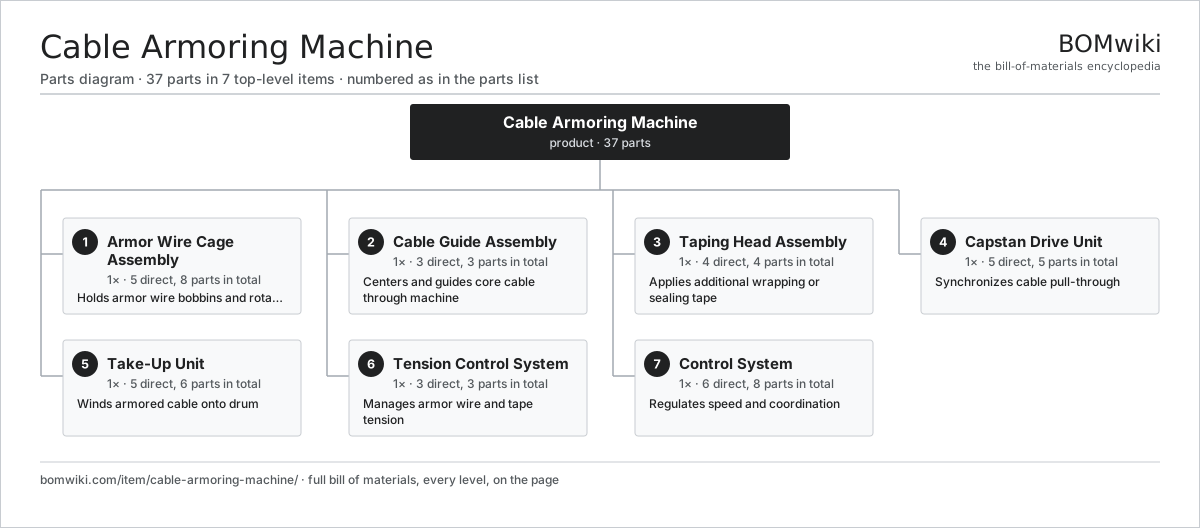
| # | Part | Qty | What it does |
|---|---|---|---|
| 1 | Armor Wire Cage Assembly 5 parts | 1× | Holds armor wire bobbins and rotates |
| 2 | Cable Guide Assembly 3 parts | 1× | Centers and guides core cable through machine |
| 3 | Taping Head Assembly 4 parts | 1× | Applies additional wrapping or sealing tape |
| 4 | Capstan Drive Unit 5 parts | 1× | Synchronizes cable pull-through |
| 5 | Take-Up Unit 5 parts | 1× | Winds armored cable onto drum |
| 6 | Tension Control System 3 parts | 1× | Manages armor wire and tape tension |
| 7 | Control System 6 parts | 1× | Regulates speed and coordination |
3D model
No 3D model yet. Have a CAD file of this? Add a 3D model. STL renders right on this page; STEP, FreeCAD, and OpenSCAD sources are welcome too (openly licensed, like all 3D models on BOMwiki).
Build & assembly graph
expand / collapse · shared sub-assemblies converge · links to related products · est. labourTap an assembly to expand/collapse · tap a part to open it · use “Open page” for any node · drag to pan, scroll to zoom.
Bill of materials for Cable Armoring Machine
7 top-level lines · 38 rows shown · 37 parts total · indented to 3 levels| # | Item / sub-assembly | Part no. | Qty/assy | Ext. qty | Parts | Type |
|---|---|---|---|---|---|---|
| 1 | Armor Wire Cage Assembly 5 parts | cable-armoring-machine-armor-cage | 1× | 1 | 8 | assembly |
| 1.1 | Ball Bearing | ball-bearing | 4× | 4 | · | part |
| 1.2 | Cage Body | cable-armoring-machine-cage-body | 1× | 1 | · | part |
| 1.3 | Armor Bobbin Shafts | cable-armoring-machine-armor-shafts | 1× | 1 | · | part |
| 1.4 | Drive Belt | drive-belt | 1× | 1 | · | part |
| 1.5 | Fastener Set | fastener-set | 1× | 1 | · | part |
| 2 | Cable Guide Assembly 3 parts | cable-armoring-machine-cable-guide | 1× | 1 | 3 | assembly |
| 2.1 | Guide Blocks | cable-armoring-machine-guide-blocks | 1× | 1 | · | part |
| 2.2 | Pressure Sensor | pressure-sensor | 1× | 1 | · | part |
| 2.3 | Fastener Set | fastener-set | 1× | 1 | · | part |
| 3 | Taping Head Assembly 4 parts | cable-armoring-machine-taping-heads | 1× | 1 | 4 | assembly |
| 3.1 | Tape Supply Reels | cable-armoring-machine-tape-reels | 1× | 1 | · | part |
| 3.2 | Tape Guides | cable-armoring-machine-tape-guides | 1× | 1 | · | part |
| 3.3 | Tape Pressure Arm | cable-armoring-machine-tape-pressure-arm | 1× | 1 | · | part |
| 3.4 | Fastener Set | fastener-set | 1× | 1 | · | part |
| 4 | Capstan Drive Unit 5 parts | cable-armoring-machine-capstan-drive | 1× | 1 | 5 | assembly |
| 4.1 | Blower Motor | blower-motor | 1× | 1 | · | part |
| 4.2 | Capstan Wheel | cable-armoring-machine-capstan-wheel | 1× | 1 | · | part |
| 4.3 | Encoder | encoder | 1× | 1 | · | part |
| 4.4 | Drive Belt | drive-belt | 1× | 1 | · | part |
| 4.5 | Fastener Set | fastener-set | 1× | 1 | · | part |
| 5 | Take-Up Unit 5 parts | cable-armoring-machine-take-up-unit | 1× | 1 | 6 | assembly |
| 5.1 | Blower Motor | blower-motor | 1× | 1 | · | part |
| 5.2 | Reel Shaft | cable-armoring-machine-reel-shaft | 1× | 1 | · | part |
| 5.3 | Encoder | encoder | 1× | 1 | · | part |
| 5.4 | Ball Bearing | ball-bearing | 2× | 2 | · | part |
| 5.5 | Fastener Set | fastener-set | 1× | 1 | · | part |
| 6 | Tension Control System 3 parts | cable-armoring-machine-tension-system | 1× | 1 | 3 | assembly |
| 6.1 | Friction Discs | cable-armoring-machine-friction-discs | 1× | 1 | · | part |
| 6.2 | Pressure Sensor | pressure-sensor | 1× | 1 | · | part |
| 6.3 | Fastener Set | fastener-set | 1× | 1 | · | part |
| 7 | Control System 6 parts | cable-armoring-machine-control-system | 1× | 1 | 8 | assembly |
| 7.1 | Microcontroller | mcu | 1× | 1 | · | part |
| 7.2 | SMD Passive (R/C/L) | smd-passives | 1× | 1 | · | part |
| 7.3 | Relay | relay | 2× | 2 | · | part |
| 7.4 | Bare PCB | pcb-bare | 1× | 1 | · | part |
| 7.5 | LCD Panel | lcd-panel | 1× | 1 | · | part |
| 7.6 | Connector | connector | 2× | 2 | · | part |
Something wrong in this list? Report a problem with this BOM.
Related products
same domain, ranked by shared parts Cable Coiling Machine
36 parts · shares 9 with this page
Cable Coiling Machine
36 parts · shares 9 with this page
 Cable Extrusion Line
46 parts · shares 9 with this page
Cable Extrusion Line
46 parts · shares 9 with this page
 Wire Rope Closing Machine
42 parts · shares 9 with this page
Wire Rope Closing Machine
42 parts · shares 9 with this page
 Wire Stranding Machine
45 parts · shares 9 with this page
Hammer Mill
790 parts · shares 8 with this page
Binder Jetting Printer
112 parts · shares 8 with this page
Wire Stranding Machine
45 parts · shares 9 with this page
Hammer Mill
790 parts · shares 8 with this page
Binder Jetting Printer
112 parts · shares 8 with this page
Sourcing: possible vendors
Browse the supplier directory → Prices, MOQ, and lead times are algorithmic estimates, not quotes, and not claims about these companies. Company mappings are curated by keyword; est. price band $5k–$2M. How estimates work| Vendor | HQ | Specialty | MOQ | Lead time |
|---|---|---|---|---|
| atlascopco.com ↗ | Stockholm, SE | Compressors & industrial | 10 units | 12–20 wks |
|
🇦🇹Andritz
andritz.com ↗
|
Graz, AT | Process plants & machinery | 10 units | 12–20 wks |
| buhlergroup.com ↗ | Uzwil, CH | Food & materials processing | 10 units | 12–20 wks |
| gea.com ↗ | Düsseldorf, DE | Process technology | 10 units | 12–20 wks |
| mhi.com ↗ | Tokyo, JP | Heavy machinery | 10 units | 12–20 wks |
1,291-word article