Cable Coiling Machine
ProductOverview
A cable coiling machine automatically winds finished cable into compact, uniform coils for storage, transportation, and sales. The coils are precision-formed to specific diameters and lengths, with integrated length metering ensuring each coil meets specification. Binding units then secure the coil shape with cable ties, strapping tape, or twine, preventing unraveling during handling and shipment.
Cable coiling is the final stage before packaging in most cable manufacturing plants. The coils must be uniform in shape and weight for ease of handling, storage in standard racks, and compatibility with installer equipment (electrical contractors expect consistent coil diameters and lengths). Coils are typically labeled with length, gauge, insulation type, and voltage rating before shipment.
The machine is used universally in power-cable, communications-cable, and automotive-harness manufacturing. Industrial plants operate multiple coiling machines running different cable specifications in parallel, allowing continuous output and rapid changeover between product types. A typical plant serving regional electrical distributors will coil 50–200 km of cable per shift across multiple machines.
How It Works
The cycle is straightforward rotation and metering: (1) Finished cable unwinds from a supply reel mounted on the Payoff Stand, where a Tension Brake maintains constant feed tension (typically 10–50 N, depending on cable stiffness). (2) The cable feeds through a stationary Guide Frame Assembly, whose Guide Rollers ensure the cable approaches the coiling head tangentially without slack or bunching. (3) The Coiling Head Assembly, driven by a constant-speed motor (10–100 rpm), rotates a spindle arm. As the spindle rotates, the cable laid down by the guide frame gradually spirals outward, forming a flat, circular coil. (4) A Length Metering System with a Measuring Wheel tracks the cable length in real-time: as the cable moves through the meter wheel at its surface speed (20–150 m/min), the wheel rotates, and each rotation increments a counter. When the preset length is reached (e.g., 100 m), the counter triggers a relay signal. (5) The operator or automatic control stops the motor, halting the coil formation. (6) The Binding Unit Assembly then wraps plastic cable ties, nylon strapping, or twine around the coil (typically 3–4 wraps at equal intervals around the circumference) to lock the coil geometry. (7) The coil is manually or mechanically unloaded and moved to labeling and packaging stations.
The spindle speed is inversely proportional to the coil diameter. For a fixed cable-feed speed of, say, 60 m/min, a coil diameter of 0.5 m with a spindle radius of 0.25 m means the spindle must rotate at 60 / (2π × 0.25) = 38 rpm. Larger coils require slower spindle speeds; smaller coils rotate faster. The operator selects coil diameter via the Control Interface, and the PLC adjusts spindle speed to maintain constant cable feed rate.
The Measuring Wheel is the critical timing element. Its circumference is precisely machined (e.g., π × 0.1 m = 314.16 mm). As the cable passes over this wheel at 60 m/min = 1000 mm/s, the wheel rotates at 1000 / 314.16 = 3.18 rotations per second. An Encoder mounted on the meter wheel's shaft counts these rotations; when the count reaches (preset length in mm) / (wheel circumference in mm), the signal is sent to stop the spindle motor.
Accuracy is typically ±1 m per coil due to cumulative measurement uncertainty. Some machines use proportional-differential feedback from the encoder to adjust spindle speed slightly (±2–5%) to correct for cable speed drift caused by payoff-reel tension or guide friction variations, achieving ±0.5 m accuracy in production.
Coil Geometry and Pitch
The spiral pitch (axial distance between consecutive cable wraps) depends on the cable diameter and spindle design. A 10 mm cable and a spindle geometry with 0.5 m radius typically produces a pitch of 15–20 mm. The pitch is fixed by the spindle arm geometry and cannot be changed without hardware modification. The coil forms uniformly as long as cable tension and feed rate remain constant; inconsistent tension causes uneven pitch or soft spots where the cable crosses itself.
Coil diameter is operator-selectable within limits: typical machines range 0.3–2.0 m. A utility might specify 1.0 m coils for distribution cable (convenient for carrier racks), while an industrial control-cable distributor might use 0.6 m coils (lighter weight for manual handling).
Length Metering Precision
The Measuring Wheel diameter is typically 80–150 mm (circumference ~250–470 mm). Mechanical wear or contamination on the wheel surface can introduce ±2–5% errors if not recalibrated periodically. Modern machines use optical or magnetic Encoder feedback instead of purely mechanical counting, eliminating surface-friction errors and improving accuracy to ±0.5 m for typical 100–500 m coils.
Some plants implement cross-checks: they weigh the finished coil and compare its weight to the expected weight (cable density × length). A 10 mm power cable at ~100 g/m with a 100 m preset should weigh ~10 kg; any significant deviation indicates a meter error requiring service.
Binding and Coil Security
The Binding Unit Assembly applies 3–4 wraps of tie material at equal intervals (e.g., at 0°, 90°, 180°, 270° around the coil circumference). Tie materials include:
- Plastic Cable Ties: Common, reusable/cuttable, suitable for indoor storage.
- Nylon Strapping Tape: UV-resistant, suitable for outdoor storage; applied with a pneumatic tensioner that pulls the strap, cuts it, and seals the end via a hot-bar press or adhesive.
- Polypropylene Twine: Natural appearance, sometimes preferred for premium products; manually cut and knotted in older machines.
Tie tension is controlled to secure the coil without deforming the cable. Too-tight binding can crimp or flatten the cable, especially if it is soft (insulated, unarmored power cable); too-loose binding risks unraveling. Typical clamping force is 20–50 N applied evenly by the Applicator Head.
Integration with Cable Production
Coiling is a terminal stage in most cable lines. Upstream, cable is either freshly extruded (see Cable Extrusion Line), armored (see Cable Armoring Machine), or coiled from reels that were used for intermediate storage. The incoming supply reel is positioned on the Payoff Stand, and cable is fed directly into coiling without additional handling.
Some plants perform intermediate cutting or test-point insertion before coiling: for instance, a power-cable line might insert insulation-resistance test leads every 100 m to allow in-field verification of dielectric strength. These operations occur between the extrusion or armor stage and the coiling machine.
High-volume plants (utility-grade power cable, telecommunications) often have 4–8 coiling machines running in parallel, with dedicated crew managing payoff reels, unloading finished coils, and transferring coils to labeling and packaging lines. A single shift can produce 100–400 coils (equivalent to 5,000–100,000 m of cable, depending on coil length and cable type).
Coil Handling and Storage
Finished coils are handled by overhead cranes or forklifts using coil-sling spreaders (frames that distribute load evenly across the coil circumference). Coils are stacked on wooden or plastic pallets in open-air or covered warehouses, typically 3–5 coils per pallet. Binding ensures coils retain shape during the weeks or months of warehouse storage before shipment to distributors or contractors.
Labels applied to each coil include:
- Conductor size (mm or AWG)
- Insulation type (PVC, XLPE, etc.)
- Rated voltage (600 V, 1 kV, 5 kV, etc.)
- Length and weight
- Test certificates (if high-voltage power cable)
- Manufacturing date and batch code
This metadata enables installers to verify they are using the correct cable for the intended application (e.g., not using low-voltage 600 V cable in a 5 kV distribution circuit).
Cable Coiling Machine parts and their functions
7 top-level parts · 36 parts in total · full bill of materials below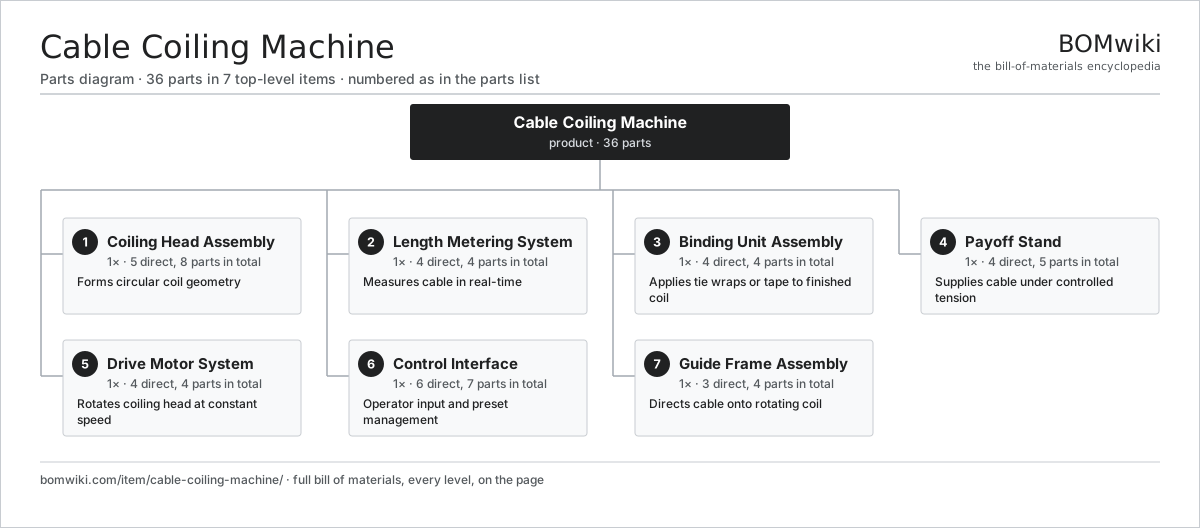
| # | Part | Qty | What it does |
|---|---|---|---|
| 1 | Coiling Head Assembly 5 parts | 1× | Forms circular coil geometry |
| 2 | Length Metering System 4 parts | 1× | Measures cable in real-time |
| 3 | Binding Unit Assembly 4 parts | 1× | Applies tie wraps or tape to finished coil |
| 4 | Payoff Stand 4 parts | 1× | Supplies cable under controlled tension |
| 5 | Drive Motor System 4 parts | 1× | Rotates coiling head at constant speed |
| 6 | Control Interface 6 parts | 1× | Operator input and preset management |
| 7 | Guide Frame Assembly 3 parts | 1× | Directs cable onto rotating coil |
3D model
No 3D model yet. Have a CAD file of this? Add a 3D model. STL renders right on this page; STEP, FreeCAD, and OpenSCAD sources are welcome too (openly licensed, like all 3D models on BOMwiki).
Build & assembly graph
expand / collapse · shared sub-assemblies converge · links to related products · est. labourTap an assembly to expand/collapse · tap a part to open it · use “Open page” for any node · drag to pan, scroll to zoom.
Bill of materials for Cable Coiling Machine
7 top-level lines · 37 rows shown · 36 parts total · indented to 3 levels| # | Item / sub-assembly | Part no. | Qty/assy | Ext. qty | Parts | Type |
|---|---|---|---|---|---|---|
| 1 | Coiling Head Assembly 5 parts | cable-coiling-machine-coiling-head | 1× | 1 | 8 | assembly |
| 1.1 | Ball Bearing | ball-bearing | 4× | 4 | · | part |
| 1.2 | Spindle Shaft | cable-coiling-machine-spindle-shaft | 1× | 1 | · | part |
| 1.3 | Arm Frame Assembly | cable-coiling-machine-arm-frame | 1× | 1 | · | part |
| 1.4 | Drive Belt | drive-belt | 1× | 1 | · | part |
| 1.5 | Fastener Set | fastener-set | 1× | 1 | · | part |
| 2 | Length Metering System 4 parts | cable-coiling-machine-length-counter | 1× | 1 | 4 | assembly |
| 2.1 | Encoder | encoder | 1× | 1 | · | part |
| 2.2 | Measuring Wheel | cable-coiling-machine-meter-wheel | 1× | 1 | · | part |
| 2.3 | Bare PCB | pcb-bare | 1× | 1 | · | part |
| 2.4 | Relay | relay | 1× | 1 | · | part |
| 3 | Binding Unit Assembly 4 parts | cable-coiling-machine-binding-unit | 1× | 1 | 4 | assembly |
| 3.1 | Tie Dispenser | cable-coiling-machine-tie-dispenser | 1× | 1 | · | part |
| 3.2 | Applicator Head | cable-coiling-machine-applicator-head | 1× | 1 | · | part |
| 3.3 | Pressure Sensor | pressure-sensor | 1× | 1 | · | part |
| 3.4 | Fastener Set | fastener-set | 1× | 1 | · | part |
| 4 | Payoff Stand 4 parts | cable-coiling-machine-payoff-stand | 1× | 1 | 5 | assembly |
| 4.1 | Ball Bearing | ball-bearing | 2× | 2 | · | part |
| 4.2 | Tension Brake | cable-coiling-machine-tension-brake | 1× | 1 | · | part |
| 4.3 | Pressure Sensor | pressure-sensor | 1× | 1 | · | part |
| 4.4 | Fastener Set | fastener-set | 1× | 1 | · | part |
| 5 | Drive Motor System 4 parts | cable-coiling-machine-drive-system | 1× | 1 | 4 | assembly |
| 5.1 | Blower Motor | blower-motor | 1× | 1 | · | part |
| 5.2 | Drive Belt | drive-belt | 1× | 1 | · | part |
| 5.3 | Encoder | encoder | 1× | 1 | · | part |
| 5.4 | Fastener Set | fastener-set | 1× | 1 | · | part |
| 6 | Control Interface 6 parts | cable-coiling-machine-control-interface | 1× | 1 | 7 | assembly |
| 6.1 | Microcontroller | mcu | 1× | 1 | · | part |
| 6.2 | LCD Panel | lcd-panel | 1× | 1 | · | part |
| 6.3 | SMD Passive (R/C/L) | smd-passives | 1× | 1 | · | part |
| 6.4 | Relay | relay | 1× | 1 | · | part |
| 6.5 | Bare PCB | pcb-bare | 1× | 1 | · | part |
| 6.6 | Connector | connector | 2× | 2 | · | part |
| 7 | Guide Frame Assembly 3 parts | cable-coiling-machine-guide-frame | 1× | 1 | 4 | assembly |
| 7.1 | Guide Rollers | cable-coiling-machine-guide-rollers | 1× | 1 | · | part |
| 7.2 | Ball Bearing | ball-bearing | 2× | 2 | · | part |
| 7.3 | Fastener Set | fastener-set | 1× | 1 | · | part |
Something wrong in this list? Report a problem with this BOM.
Related products
same domain, ranked by shared parts Cable Extrusion Line
46 parts · shares 9 with this page
Cable Extrusion Line
46 parts · shares 9 with this page
 Wire Rope Closing Machine
42 parts · shares 9 with this page
Wire Rope Closing Machine
42 parts · shares 9 with this page
 Wire Stranding Machine
45 parts · shares 9 with this page
Hammer Mill
790 parts · shares 8 with this page
Binder Jetting Printer
112 parts · shares 8 with this page
Wire Stranding Machine
45 parts · shares 9 with this page
Hammer Mill
790 parts · shares 8 with this page
Binder Jetting Printer
112 parts · shares 8 with this page
Sourcing: possible vendors
Browse the supplier directory → Prices, MOQ, and lead times are algorithmic estimates, not quotes, and not claims about these companies. Company mappings are curated by keyword; est. price band $5k–$2M. How estimates work| Vendor | HQ | Specialty | MOQ | Lead time |
|---|---|---|---|---|
| atlascopco.com ↗ | Stockholm, SE | Compressors & industrial | 10 units | 12–20 wks |
|
🇦🇹Andritz
andritz.com ↗
|
Graz, AT | Process plants & machinery | 10 units | 12–20 wks |
| buhlergroup.com ↗ | Uzwil, CH | Food & materials processing | 10 units | 12–20 wks |
| gea.com ↗ | Düsseldorf, DE | Process technology | 10 units | 12–20 wks |
| mhi.com ↗ | Tokyo, JP | Heavy machinery | 10 units | 12–20 wks |
1,312-word article