Cable Extrusion Line
ProductOverview
A cable extrusion line is an automated production system that applies thermoplastic insulation or sheath coatings onto electrical conductors and multi-strand cables. Used extensively in power distribution, signal transmission, and aerospace harnesses, the line combines controlled heating, precision die design, and real-time quality monitoring to produce coated cables at speeds up to 300 m/min with coating thickness tolerances of ±0.2 mm.
The system operates continuously: raw conductors or stripped cable unwind from a payoff stand, pass through a crosshead extruder where molten polymer is applied concentrically, traverse a water-cooled trough to solidify the coating, and finally wind onto takeup reels for coil storage. A capstan drive unit synchronizes the line speed, while a spark tester verifies coating integrity in real-time, eliminating defective products before they leave the line.
Cable extrusion is foundational to modern electrical distribution. The variety of thermoplastics, polyvinyl chloride (PVC), polyethylene (PE), cross-linked polyethylene (XLPE), and halogen-free flame-retardant compounds, allows specification of insulation for specific voltage classes, temperature ratings, and environmental resistances. Industrial cable plants process tens of thousands of kilometers annually using lines optimized for single-gauge or mixed-conductor inputs.
How It Works
The core cycle is continuous: (1) A conductor unwinds from the Payoff Stand under controlled tension. (2) The Extruder Crosshead heats thermoplastic pellets in a screw-barrel to 200–300 °C, depending on material, then forces molten polymer through a precision die that wraps it concentrically around the moving conductor. (3) The coated cable immediately enters the Cooling Trough, where Spray Nozzles spray chilled water (15–25 °C) to solidify the coating. (4) A Capstan Drive Unit electronically controlled rubber wheel grips and pulls the cable at a constant, programmed speed (typically 100–300 m/min), decoupling the take-up speed from payoff tension. (5) The Take-Up Reel winds the finished product onto spools or drums. (6) A Spark Tester Unit applies high voltage (5–15 kV) between the conductor and newly applied sheath, detecting pinholes, voids, or discontinuities within microseconds and triggering automatic rejection of flawed sections.
Temperature control is critical: too cool and the polymer does not fuse to the conductor; too hot and it degrades chemically, producing off-gas and weak insulation. Modern lines use multi-zone heating (separate zones for feed section, compression section, and metering section of the screw-barrel), with proportional or PID feedback from thermocouples mounted in the barrel. The Control Panel orchestrates all zones via a PLC, monitoring screw back-pressure and melt viscosity to adjust heater power and screw rotational speed dynamically.
Die design is equally precise. The Die Insert must be concentric to better than 0.1 mm to ensure uniform coating thickness around the conductor circumference. Any eccentricity or die swell (the tendency of molten polymer to expand after exiting the die) is compensated by die geometry calibrated to the specific plastic and extrusion speed. Extrusion pressure (measured by the Pressure Gauge) typically ranges 100–300 bar; if pressure spikes above setpoint, the screw slows automatically to prevent die blockage or material degradation.
Cooling is passive evaporation and active spray. The Cooling Circulation System system recirculates chilled water through the Trough Body, with a Chiller Unit maintaining water at 15–25 °C using vapor-compression refrigeration (50–200 kW cooling capacity). The longer the trough (15–30 m typical), the more heat is extracted before the cable winds onto the reel. Inadequate cooling causes "skinning", the polymer surface hardens while the interior remains plastic, resulting in mechanical weakness.
The capstan drive is the heartbeat of synchronization. Unlike simple friction wheels, modern capstans use continuous-duty DC or AC motors driving rubber wheels against the cable with adjustable pressure (typically 20–40 bar hydraulic or pneumatic). An Encoder mounted on the capstan shaft provides constant feedback to the PLC, allowing line speed to be trimmed ±5% in real-time to match material flow rate and prevent slack or excessive tension on the conductor. Capstan pressure is automatically reduced if the cable speed lags, preventing crushing.
Quality assurance via the Spark Tester Unit is non-negotiable in power-distribution cable where insulation failure can cause catastrophic faults. The test electrode applies a high-frequency AC voltage (typically 2–5 kHz, 5–15 kV amplitude), and any spark indicates a defect. Modern spark testers incorporate signal filtering to distinguish true pinholes from transient arcing due to surface moisture, and they trigger a pneumatic cutter or deflector to reject defective cable within a printed distance (typically 100–500 m ahead of the test point, accounting for line speed). Fault counters log defects per shift for statistical process control.
Extrusion Materials and Coating Specifications
Common coating polymers include:
- PVC (Polyvinyl Chloride): 70–90 °C service, low cost, good flame-retardant via additives, standard for building wiring and automotive harnesses.
- PE (Polyethylene): 80–105 °C service, excellent cold-temperature toughness, used in underground and submersed applications.
- XLPE (Cross-linked Polyethylene): 90–120 °C service, superior thermal and chemical resistance via cross-linking, standard for high-voltage distribution cables (33 kV and above).
- Halogen-Free Flame-Retardant (HFFR): 80–100 °C, produces no toxic halogen gases in fire, required in tunnels, aircraft, and ships.
Coating thickness is specified in millimeters and depends on the conductor's rated voltage: 0.5 mm for low-voltage (12 V) automotive wire, 1.0 mm for general-purpose 600 V control cable, 2.5 mm for 33 kV distribution cable. The Die Insert is sized and the extrusion pressure is set to achieve the target thickness; the Flow Meter in the cooling circuit confirms water circulation, preventing pooling or laminar starving that would leave thin spots.
Integration with Cable Manufacturing
Cable extrusion lines are one stage in a multi-stage cable assembly process. Upstream, conductors are drawn from virgin copper or aluminum rod on a wire-drawing line, possibly followed by annealing to restore ductility. Downstream, coated single-conductor cables are often twisted or cabled together (using a Wire Stranding Machine or similar), then sheaths are applied again for multi-conductor bundles. Multi-conductor assemblies may then be armored using a Cable Armoring Machine, coiled on a Cable Coiling Machine, and submitted to dielectric strength tests (high-voltage flashover) before shipment.
Industrial plants operating multiple extrusion lines (often 4–8 in series) maintain continuous output: one line may extrude low-voltage PVC automotive harnesses while another processes high-voltage XLPE power cables, each with its own material hopper, die inventory, and cooling capacity, allowing single-shift transitions between product types without line shutdown.
Cable Extrusion Line parts and their functions
8 top-level parts · 46 parts in total · full bill of materials below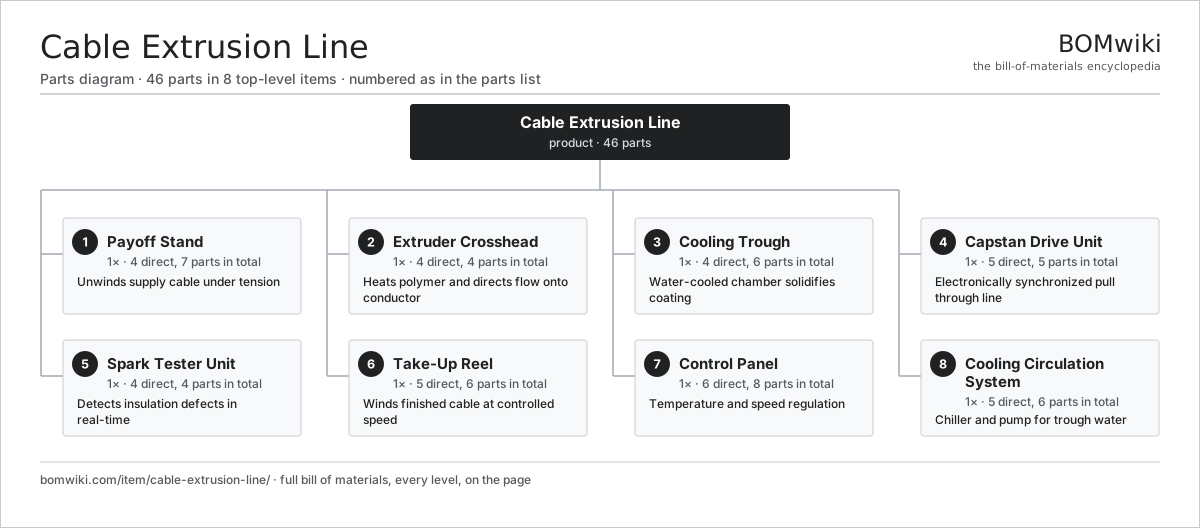
| # | Part | Qty | What it does |
|---|---|---|---|
| 1 | Payoff Stand 4 parts | 1× | Unwinds supply cable under tension |
| 2 | Extruder Crosshead 4 parts | 1× | Heats polymer and directs flow onto conductor |
| 3 | Cooling Trough 4 parts | 1× | Water-cooled chamber solidifies coating |
| 4 | Capstan Drive Unit 5 parts | 1× | Electronically synchronized pull through line |
| 5 | Spark Tester Unit 4 parts | 1× | Detects insulation defects in real-time |
| 6 | Take-Up Reel 5 parts | 1× | Winds finished cable at controlled speed |
| 7 | Control Panel 6 parts | 1× | Temperature and speed regulation |
| 8 | Cooling Circulation System 5 parts | 1× | Chiller and pump for trough water |
3D model
No 3D model yet. Have a CAD file of this? Add a 3D model. STL renders right on this page; STEP, FreeCAD, and OpenSCAD sources are welcome too (openly licensed, like all 3D models on BOMwiki).
Build & assembly graph
expand / collapse · shared sub-assemblies converge · links to related products · est. labourTap an assembly to expand/collapse · tap a part to open it · use “Open page” for any node · drag to pan, scroll to zoom.
Bill of materials for Cable Extrusion Line
8 top-level lines · 45 rows shown · 46 parts total · indented to 3 levels| # | Item / sub-assembly | Part no. | Qty/assy | Ext. qty | Parts | Type |
|---|---|---|---|---|---|---|
| 1 | Payoff Stand 4 parts | cable-extrusion-line-payoff-stand | 1× | 1 | 7 | assembly |
| 1.1 | Ball Bearing | ball-bearing | 4× | 4 | · | part |
| 1.2 | Tension Brake | cable-extrusion-line-tension-brake | 1× | 1 | · | part |
| 1.3 | Motor Housing | motor-housing | 1× | 1 | · | part |
| 1.4 | Fastener Set | fastener-set | 1× | 1 | · | part |
| 2 | Extruder Crosshead 4 parts | cable-extrusion-line-extruder-crosshead | 1× | 1 | 4 | assembly |
| 2.1 | Screw and Barrel Assembly | cable-extrusion-line-screw-barrel | 1× | 1 | · | part |
| 2.2 | Die Insert | cable-extrusion-line-die-insert | 1× | 1 | · | part |
| 2.3 | Heating Element | heating-element | 1× | 1 | · | part |
| 2.4 | Pressure Gauge | cable-extrusion-line-pressure-gauge | 1× | 1 | · | part |
| 3 | Cooling Trough 4 parts | cable-extrusion-line-cooling-trough | 1× | 1 | 6 | assembly |
| 3.1 | Trough Body | cable-extrusion-line-trough-body | 1× | 1 | · | part |
| 3.2 | Spray Nozzles | cable-extrusion-line-spray-nozzles | 3× | 3 | · | part |
| 3.3 | Pressure Sensor | pressure-sensor | 1× | 1 | · | part |
| 3.4 | Fastener Set | fastener-set | 1× | 1 | · | part |
| 4 | Capstan Drive Unit 5 parts | cable-extrusion-line-capstan-drive | 1× | 1 | 5 | assembly |
| 4.1 | Blower Motor | blower-motor | 1× | 1 | · | part |
| 4.2 | Capstan Wheel | cable-extrusion-line-capstan-wheel | 1× | 1 | · | part |
| 4.3 | Encoder | encoder | 1× | 1 | · | part |
| 4.4 | Drive Belt | drive-belt | 1× | 1 | · | part |
| 4.5 | Fastener Set | fastener-set | 1× | 1 | · | part |
| 5 | Spark Tester Unit 4 parts | cable-extrusion-line-spark-tester | 1× | 1 | 4 | assembly |
| 5.1 | High-Voltage Supply | cable-extrusion-line-hv-supply | 1× | 1 | · | part |
| 5.2 | Electrode Ring | cable-extrusion-line-electrode-ring | 1× | 1 | · | part |
| 5.3 | Relay | relay | 1× | 1 | · | part |
| 5.4 | Pressure Sensor | pressure-sensor | 1× | 1 | · | part |
| 6 | Take-Up Reel 5 parts | cable-extrusion-line-take-up-reel | 1× | 1 | 6 | assembly |
| 6.1 | Blower Motor | blower-motor | 1× | 1 | · | part |
| 6.2 | Reel Mandrel | cable-extrusion-line-reel-mandrel | 1× | 1 | · | part |
| 6.3 | Encoder | encoder | 1× | 1 | · | part |
| 6.4 | Ball Bearing | ball-bearing | 2× | 2 | · | part |
| 6.5 | Fastener Set | fastener-set | 1× | 1 | · | part |
| 7 | Control Panel 6 parts | cable-extrusion-line-control-panel | 1× | 1 | 8 | assembly |
| 7.1 | Microcontroller | mcu | 1× | 1 | · | part |
| 7.2 | SMD Passive (R/C/L) | smd-passives | 1× | 1 | · | part |
| 7.3 | Relay | relay | 2× | 2 | · | part |
| 7.4 | Bare PCB | pcb-bare | 1× | 1 | · | part |
| 7.5 | LCD Panel | lcd-panel | 1× | 1 | · | part |
| 7.6 | Connector | connector | 2× | 2 | · | part |
| 8 | Cooling Circulation System 5 parts | cable-extrusion-line-cooling-circulation | 1× | 1 | 6 | assembly |
| 8.1 | Coolant Pump | coolant-pump | 1× | 1 | · | part |
| 8.2 | Chiller Unit | cable-extrusion-line-chiller-unit | 1× | 1 | · | part |
| 8.3 | Pressure Sensor | pressure-sensor | 2× | 2 | · | part |
| 8.4 | Flow Meter | cable-extrusion-line-flow-meter | 1× | 1 | · | part |
| 8.5 | Fastener Set | fastener-set | 1× | 1 | · | part |
Something wrong in this list? Report a problem with this BOM.
Related products
same domain, ranked by shared parts Industrial FDM Printer
98 parts · shares 11 with this page
Electron Beam PBF
128 parts · shares 10 with this page
Industrial FDM Printer
98 parts · shares 11 with this page
Electron Beam PBF
128 parts · shares 10 with this page
 Wire Enamelling Machine
37 parts · shares 8 with this page
Wire Enamelling Machine
37 parts · shares 8 with this page
 Vacuum Casting Machine
39 parts · shares 7 with this page
Vacuum Casting Machine
39 parts · shares 7 with this page
 Industrial SLA Printer
94 parts · shares 9 with this page
Industrial SLA Printer
94 parts · shares 9 with this page
Sourcing: possible vendors
Browse the supplier directory → Prices, MOQ, and lead times are algorithmic estimates, not quotes, and not claims about these companies. Company mappings are curated by keyword; est. price band $5k–$2M. How estimates work| Vendor | HQ | Specialty | MOQ | Lead time |
|---|---|---|---|---|
| atlascopco.com ↗ | Stockholm, SE | Compressors & industrial | 10 units | 12–20 wks |
|
🇦🇹Andritz
andritz.com ↗
|
Graz, AT | Process plants & machinery | 10 units | 12–20 wks |
| buhlergroup.com ↗ | Uzwil, CH | Food & materials processing | 10 units | 12–20 wks |
| gea.com ↗ | Düsseldorf, DE | Process technology | 10 units | 12–20 wks |
| mhi.com ↗ | Tokyo, JP | Heavy machinery | 10 units | 12–20 wks |
1,136-word article