Camera Control Unit
ProductOverview
A camera control unit (CCU) is the command center of a broadcast camera system, particularly in large-format studio productions. The camera itself, whether studio triax or fiber-linked, is purely a capture device: it does not decide how to color-correct the video, adjust focus, or control the iris. All of that intelligence sits in the base station, connected via fiber optic or triax cable. The CCU receives the raw camera signal, processes it through a color processor, and sends back servo commands to adjust the camera's remote focus, iris, and zoom motors. This architecture keeps the camera head compact and cool while centralizing all control and monitoring at the operator's console.
Architecture
The main CPU board boots Linux or a real-time OS and handles all system management. It communicates with the camera via a high-speed fiber transceiver that deserializes the incoming raw video stream and provides a low-latency command channel back to the camera. In parallel, the paint processor FPGA receives the deserialized video and applies color matrix corrections, gamma curves, and detail enhancement on the fly, generating a broadcast-quality output signal.
Motor control is straightforward: the motor driver board contains three independent servo amplifiers that drive the camera's remote focus, iris, and zoom motors based on joystick or dial input from the operator's panel. A tachometer decoder reads back motor speed feedback, allowing the system to adjust acceleration ramps and prevent stalling.
The backplane PCB interconnects all modules on a switched fabric, passing video, control signals, and power. Most modern CCUs are modular: input and output cards slot into the backplane, so a facility can customize the number of cameras and output formats without redesigning the whole unit.
Paint processing
The paint processor is where imaging happens. Raw sensor data from the camera (or a pre-processed Bayer pattern) is converted into RGB or YCbCr. The FPGA then applies:
- Color matrix: Rotates RGB into broadcast-legal YCbCr and adjusts saturation per hue
- Gamma correction: Compensates for display nonlinearity
- Detail enhancement: Sharpens or softens fine detail
- Black crush and white clip: Prevents under/over-saturation of shadows and highlights
- Knee and slope: Graceful rolloff in the highlights to prevent blooming
Most CCUs allow the operator to save and recall "paintbox" presets, e.g., "outdoor daylight," "tungsten indoor," "green screen mode", instantly reconfiguring all color curves and matrices.
Genlock and synchronization
In multi-camera broadcasts, all cameras must produce frames at identical timing intervals. The CCU accepts a blackburst or tri-level sync reference signal (usually from the master clock or switching console). Internally, it locks the clock PLL to this reference, ensuring every frame from every camera starts at the exact same time. This synchronization is critical for seamless cuts and vision mixing.
Power and cooling
Two modular redundant power supplies feed the system. If one fails, the other automatically takes over without interruption. The cooling module monitors internal temperature and adjusts fan speed proportionally, quiet at idle, robust at full load. Venting is designed to exhaust hot air away from the backplane where sensitive electronics live.
Practical workflow
A typical on-air session: the vision engineer is at the CCU, connected via intercom to the camera operator on set. The engineer monitors the paint settings and adjusts color on the fly to match changing studio lighting or to achieve a look. The camera operator focuses via the joystick on the CCU panel; the remote focus motor on the camera responds. The director, at the vision mixing console, sees the output of all cameras on multiviewers and calls for cuts or transitions. The CCU is invisible to the viewer but essential to the production, it is what transforms raw sensor data into broadcast-quality pictures.
Camera Control Unit parts and their functions
10 top-level parts · 156 parts in total · full bill of materials below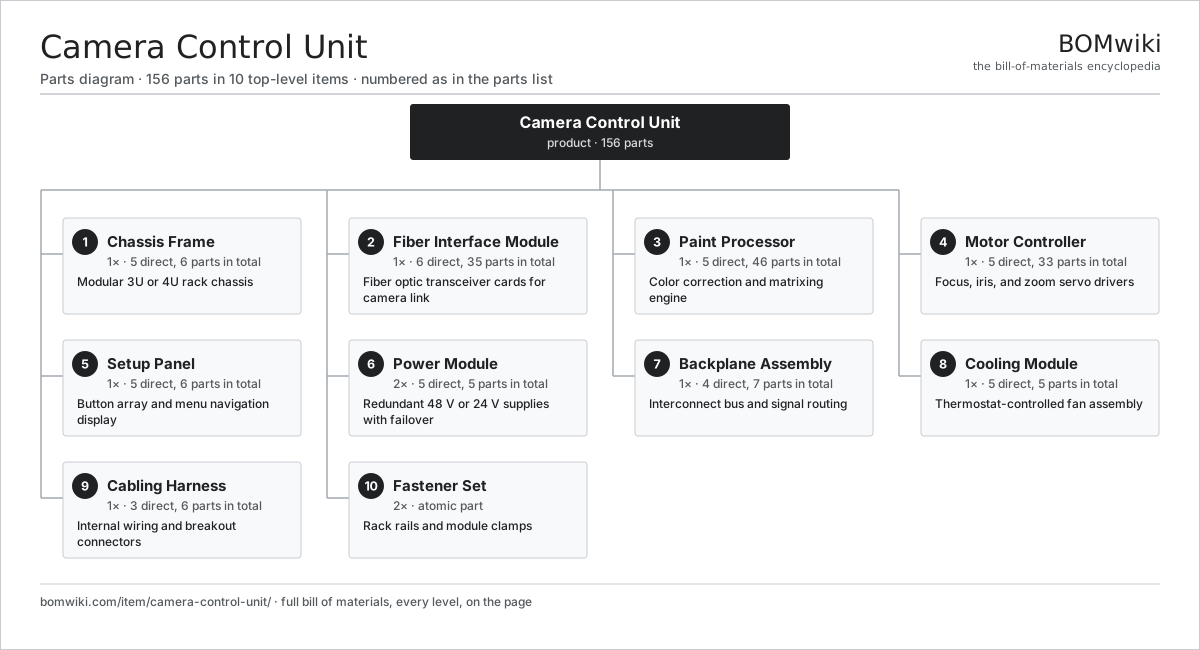
| # | Part | Qty | What it does |
|---|---|---|---|
| 1 | Chassis Frame 5 parts | 1× | Modular 3U or 4U rack chassis |
| 2 | Fiber Interface Module 6 parts | 1× | Fiber optic transceiver cards for camera link |
| 3 | Paint Processor 5 parts | 1× | Color correction and matrixing engine |
| 4 | Motor Controller 5 parts | 1× | Focus, iris, and zoom servo drivers |
| 5 | Setup Panel 5 parts | 1× | Button array and menu navigation display |
| 6 | Power Module 5 parts | 2× | Redundant 48 V or 24 V supplies with failover |
| 7 | Backplane Assembly 4 parts | 1× | Interconnect bus and signal routing |
| 8 | Cooling Module 5 parts | 1× | Thermostat-controlled fan assembly |
| 9 | Cabling Harness 3 parts | 1× | Internal wiring and breakout connectors |
| 10 | Fastener Set | 2× | Rack rails and module clamps |
3D model
No 3D model yet. Have a CAD file of this? Add a 3D model. STL renders right on this page; STEP, FreeCAD, and OpenSCAD sources are welcome too (openly licensed, like all 3D models on BOMwiki).
Build & assembly graph
expand / collapse · shared sub-assemblies converge · links to related products · est. labourTap an assembly to expand/collapse · tap a part to open it · use “Open page” for any node · drag to pan, scroll to zoom.
Bill of materials for Camera Control Unit
10 top-level lines · 53 rows shown · 156 parts total · indented to 3 levels| # | Item / sub-assembly | Part no. | Qty/assy | Ext. qty | Parts | Type |
|---|---|---|---|---|---|---|
| 1 | Chassis Frame 5 parts | camera-control-unit-mainframe | 1× | 1 | 6 | assembly |
| 1.1 | Rack Frame | camera-control-unit-rack-frame | 1× | 1 | · | part |
| 1.2 | Front Panel | camera-control-unit-front-panel | 1× | 1 | · | part |
| 1.3 | Rear Panel | camera-control-unit-rear-panel | 1× | 1 | · | part |
| 1.4 | Side Panels | camera-control-unit-side-panels | 2× | 2 | · | part |
| 1.5 | Fastener Set | fastener-set | 1× | 1 | · | part |
| 2 | Fiber Interface Module 6 parts | camera-control-unit-fiber-module | 1× | 1 | 35 | assembly |
| 2.1 | Fiber Transceiver IC | camera-control-unit-fiber-transceiver-ic | 1× | 1 | · | part |
| 2.2 | Fiber Connector | camera-control-unit-fiber-connector | 1× | 1 | · | part |
| 2.3 | Deserializer IC | camera-control-unit-deserializer-ic | 1× | 1 | · | part |
| 2.4 | Clock PLL | camera-control-unit-clock-pll | 1× | 1 | · | part |
| 2.5 | Bare PCB | pcb-bare | 1× | 1 | · | part |
| 2.6 | SMD Passive (R/C/L) | smd-passives | 30× | 30 | · | part |
| 3 | Paint Processor 5 parts | camera-control-unit-paint-processor | 1× | 1 | 46 | assembly |
| 3.1 | FPGA/DSP Processor | camera-control-unit-fpga-dsp | 1× | 1 | · | part |
| 3.2 | Processing RAM | camera-control-unit-paint-ram | 1× | 1 | · | part |
| 3.3 | Paint Output DAC | camera-control-unit-paint-dac | 3× | 3 | · | part |
| 3.4 | Bare PCB | pcb-bare | 1× | 1 | · | part |
| 3.5 | SMD Passive (R/C/L) | smd-passives | 40× | 40 | · | part |
| 4 | Motor Controller 5 parts | camera-control-unit-motor-controller | 1× | 1 | 33 | assembly |
| 4.1 | Servo Driver IC | camera-control-unit-motor-ic | 3× | 3 | · | part |
| 4.2 | Motor H-Bridge | camera-control-unit-h-bridge | 3× | 3 | · | part |
| 4.3 | Tachometer Decoder | camera-control-unit-tach-decoder | 1× | 1 | · | part |
| 4.4 | Bare PCB | pcb-bare | 1× | 1 | · | part |
| 4.5 | SMD Passive (R/C/L) | smd-passives | 25× | 25 | · | part |
| 5 | Setup Panel 5 parts | camera-control-unit-setup-panel | 1× | 1 | 6 | assembly |
| 5.1 | Button Array | camera-control-unit-panel-buttons | 1× | 1 | · | part |
| 5.2 | Rotary Encoder | camera-control-unit-rotary-encoder | 2× | 2 | · | part |
| 5.3 | LCD Panel | lcd-panel | 1× | 1 | · | part |
| 5.4 | Panel PCB | camera-control-unit-panel-pcb | 1× | 1 | · | part |
| 5.5 | Connector | connector | 1× | 1 | · | part |
| 6 | Power Module 5 parts | camera-control-unit-power-supply | 2× | 2 | 5 | assembly |
| 6.1 | PFC Stage | camera-control-unit-pfc-stage | 1× | 2 | · | part |
| 6.2 | Transformer | camera-control-unit-transformer | 1× | 2 | · | part |
| 6.3 | Secondary Rectifier | camera-control-unit-secondary-rectifier | 1× | 2 | · | part |
| 6.4 | Output Filter | camera-control-unit-output-filter | 1× | 2 | · | part |
| 6.5 | Connector | connector | 1× | 2 | · | part |
| 7 | Backplane Assembly 4 parts | camera-control-unit-backplane | 1× | 1 | 7 | assembly |
| 7.1 | Backplane PCB | camera-control-unit-backplane-pcb | 1× | 1 | · | part |
| 7.2 | Module Slot Connector | camera-control-unit-slot-connectors | 4× | 4 | · | part |
| 7.3 | Power Bus | camera-control-unit-power-bus | 1× | 1 | · | part |
| 7.4 | Fastener Set | fastener-set | 1× | 1 | · | part |
| 8 | Cooling Module 5 parts | camera-control-unit-cooling-module | 1× | 1 | 5 | assembly |
| 8.1 | Blower Motor | blower-motor | 1× | 1 | · | part |
| 8.2 | Thermal Sensor | camera-control-unit-thermal-sensor | 1× | 1 | · | part |
| 8.3 | Fan Controller | camera-control-unit-fan-controller | 1× | 1 | · | part |
| 8.4 | Air Filter | camera-control-unit-air-filter | 1× | 1 | · | part |
| 8.5 | Fastener Set | fastener-set | 1× | 1 | · | part |
| 9 | Cabling Harness 3 parts | camera-control-unit-cabling-harness | 1× | 1 | 6 | assembly |
| 9.1 | Wire Bundle | wire-bundle | 1× | 1 | · | part |
| 9.2 | Connector Boot | camera-control-unit-connector-boots | 4× | 4 | · | part |
| 9.3 | Fastener Set | fastener-set | 1× | 1 | · | part |
| 10 | Fastener Set | fastener-set | 2× | 2 | · | part |
Something wrong in this list? Report a problem with this BOM.
Related products
same domain, ranked by shared parts AV Receiver
1,097 parts · shares 3 with this page
AV Receiver
1,097 parts · shares 3 with this page
 Loudspeaker Management Processor
42 parts · shares 3 with this page
Loudspeaker Management Processor
42 parts · shares 3 with this page
 Video Production Switcher
3,640 parts · shares 3 with this page
Cinema Sound Processor
839 parts · shares 2 with this page
Video Production Switcher
3,640 parts · shares 3 with this page
Cinema Sound Processor
839 parts · shares 2 with this page
 LED Video Wall
2,795 parts · shares 2 with this page
LED Video Wall
2,795 parts · shares 2 with this page
 Broadcast Studio Camera
287 parts · shares 2 with this page
Broadcast Studio Camera
287 parts · shares 2 with this page
Sourcing: possible vendors
Browse the supplier directory → Prices, MOQ, and lead times are algorithmic estimates, not quotes, and not claims about these companies. Company mappings are curated by keyword; est. price band $50–$3k. How estimates work| Vendor | HQ | Specialty | MOQ | Lead time |
|---|---|---|---|---|
|
🇯🇵Sony
sony.com ↗
|
Tokyo, JP | Consumer electronics | 1,000 units | 8–12 wks |
| samsung.com ↗ | Suwon, KR | Electronics & displays | 1,000 units | 8–12 wks |
|
🇺🇸Harman
harman.com ↗
|
Stamford, US | Audio (JBL, AKG) | 1,000 units | 8–12 wks |
|
🇺🇸Bose
bose.com ↗
|
Framingham, US | Audio | 1,000 units | 8–12 wks |
| yamaha.com ↗ | Hamamatsu, JP | Audio & instruments | 1,000 units | 8–12 wks |
709-word article