Candle Making Machine
ProductOverview
A candle-making machine automates the production of pillar and votive candles by integrating wax melting, mold filling, and accelerated cooling into a single continuous-duty system. The machine is designed for small-to-mid-scale boutique and artisanal candle manufacturers, ceramics studios, and cosmetic contract producers seeking faster throughput than hand-pour methods while maintaining consistent cavity fill and uniform color distribution.
Core operation cycles through three stages: (1) bulk wax melting and temperature stabilization, (2) synchronized multi-cavity injection with wick feeding, and (3) chilled solidification under controlled cooling ramps to prevent stress cracking.
How It Works
The Wax Melting Tank maintains a 150-liter pool of liquefied wax at 70–85 °C using dual immersion heaters and a paddle stirrer. Precise temperature control prevents wax oxidation and ensures consistent viscosity. The tank outlet feeds a gear pump housed in the Drive System, which pressurizes wax to 40 bar and distributes it through a proportional flow-divider valve.
The Piston Injection Table is the machine's indexing heart. Twelve aluminum cavity mold blocks are mounted on a stepper-driven carousel that rotates in 30° increments (one mold position per index). As each cavity aligns with the fill station, a Injection Piston (one per cavity) extends its rod under proportional solenoid control, delivering metered wax at approximately 2–3 seconds per fill. Pressure relief prevents overfilling and mold damage.
Before wax injection begins, the Wick Feeder threads precut wick strands through each cavity. A NEMA 23 stepper motor feeds wick from a supply spool at a controlled rate, while a small pneumatic vibrator taps the wick guide to settle it vertically in the mold cavity without slack or entanglement.
Once a cavity is filled, the carousel rotates to the next position, and the newly filled mold moves into the Cooling Module. This is an insulated chamber maintained at 8–12 °C by a dedicated 5 kW chiller with a reciprocating compressor. Coolant (typically a 40/60 glycol-water mix) circulates through a jacket surrounding the mold block at approximately 20 m³/h, pulling heat from the molten wax rapidly without inducing thermal shock.
After 45–60 minutes in the cooling chamber, the solidified candle is ejected manually or via a pneumatic pop-rod, and a fresh mold cavity returns to the fill station. The entire carousel completes one full rotation every 5–8 minutes depending on cooling time and cavity count.
The Electrical Control Panel houses a programmable logic controller (PLC) that orchestrates all timing: index stepping, solenoid valve sequencing, heater proportional control, and sensor monitoring. Temperature feedback from the Wax Melting Tank and cooling reservoir informs closed-loop heater and chiller modulation. Emergency stops and fault interlocks ensure operator safety; if any subsystem exceeds limits (overpressure, overtemp, coolant loss), the machine shuts down automatically.
Key Design Principles
Thermal Consistency: The combination of careful heating profile and refrigerated cooling produces uniform hardness throughout each cavity. Slow cooling curves (5–8 °C per hour in the final stage) minimize shrinkage cavities and internal stress.
Wick Placement: Pre-seating wicks before fill eliminates the need for post-cooling wick insertion, which can damage surface finish. Vibration assist keeps wicks centered and prevents floating.
Modularity: Cavity blocks are interchangeable; different mold inserts for different candle diameters or shapes can be swapped in minutes. The same machine can produce 80 mm pillars, votives, or container wicks.
Safety Margins: Pneumatic systems operate at 10 bar ambient; injection pressure relief is set 10% above nominal 40 bar to protect molds and seals from accidental overpressure spikes.
Related Subsystems
- Wax Melting Tank melts and conditions raw wax.
- Piston Injection Table indexes and fills molds.
- Cooling Module solidifies candles rapidly.
- Wick Feeder automates wick insertion.
- Drive System powers both pneumatic and hydraulic actuation.
- Electrical Control Panel coordinates all processes via PLC.
- Machine Frame provides structural rigidity and vibration isolation.
Typical Operational Workflow
- Load mold cavities with wick spools.
- Start wax heating cycle; allow tank 30 minutes to reach 75 °C steady-state.
- Prime the pump and open proportional valve; set desired fill time (2–3 seconds).
- Enable the carousel; it rotates automatically through the 12-position cycle.
- Monitor coolant temperature and heater status via the PLC display.
- After 4–6 rotations, the first batch reaches the cooling chamber exit and is ready to eject.
- Continuous operation requires restocking wick spools and removing finished candles.
Maintenance cycles (8-hour runs) include draining and refilling the coolant loop, checking piston rod seals, and verifying pump intake strainers.
Candle Making Machine parts and their functions
7 top-level parts · 73 parts in total · full bill of materials below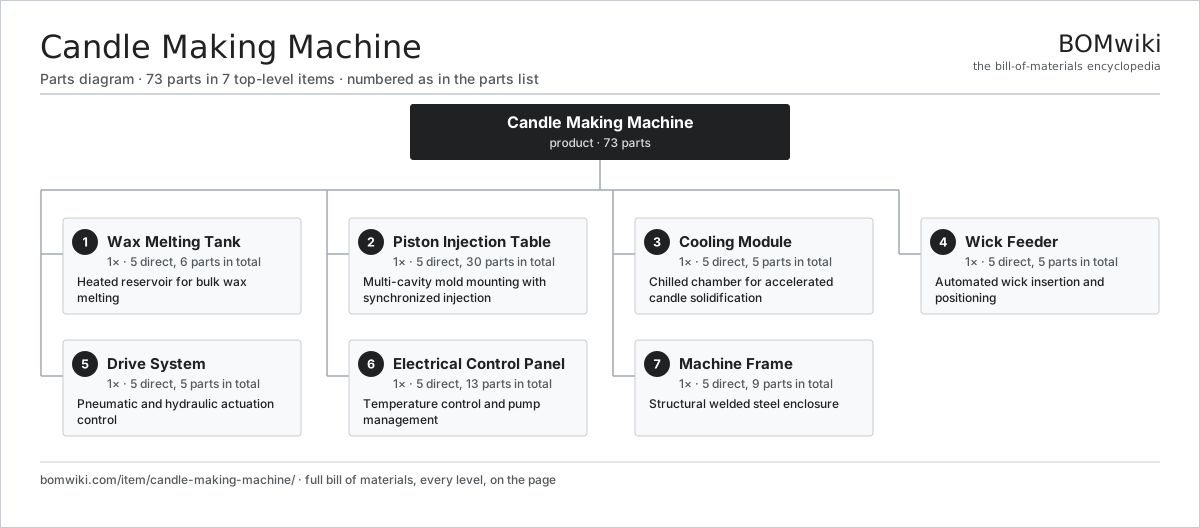
| # | Part | Qty | What it does |
|---|---|---|---|
| 1 | Wax Melting Tank 5 parts | 1× | Heated reservoir for bulk wax melting |
| 2 | Piston Injection Table 5 parts | 1× | Multi-cavity mold mounting with synchronized injection |
| 3 | Cooling Module 5 parts | 1× | Chilled chamber for accelerated candle solidification |
| 4 | Wick Feeder 5 parts | 1× | Automated wick insertion and positioning |
| 5 | Drive System 5 parts | 1× | Pneumatic and hydraulic actuation control |
| 6 | Electrical Control Panel 5 parts | 1× | Temperature control and pump management |
| 7 | Machine Frame 5 parts | 1× | Structural welded steel enclosure |
3D model
No 3D model yet. Have a CAD file of this? Add a 3D model. STL renders right on this page; STEP, FreeCAD, and OpenSCAD sources are welcome too (openly licensed, like all 3D models on BOMwiki).
Build & assembly graph
expand / collapse · shared sub-assemblies converge · links to related products · est. labourTap an assembly to expand/collapse · tap a part to open it · use “Open page” for any node · drag to pan, scroll to zoom.
Bill of materials for Candle Making Machine
7 top-level lines · 42 rows shown · 73 parts total · indented to 3 levels| # | Item / sub-assembly | Part no. | Qty/assy | Ext. qty | Parts | Type |
|---|---|---|---|---|---|---|
| 1 | Wax Melting Tank 5 parts | candle-making-machine-wax-tank | 1× | 1 | 6 | assembly |
| 1.1 | Tank Body | candle-making-machine-tank-body | 1× | 1 | · | part |
| 1.2 | Heating Element | heating-element | 2× | 2 | · | part |
| 1.3 | Stirrer Motor | candle-making-machine-stirrer-motor | 1× | 1 | · | part |
| 1.4 | Pressure Sensor | pressure-sensor | 1× | 1 | · | part |
| 1.5 | Outlet Valve | candle-making-machine-outlet-valve | 1× | 1 | · | part |
| 2 | Piston Injection Table 5 parts | candle-making-machine-piston-table | 1× | 1 | 30 | assembly |
| 2.1 | Rotary Index | candle-making-machine-rotary-index | 1× | 1 | · | part |
| 2.2 | Mold Cavity Block | candle-making-machine-mold-cavity-block | 12× | 12 | · | part |
| 2.3 | Injection Piston | candle-making-machine-injection-piston | 12× | 12 | · | part |
| 2.4 | Solenoid Valve Block | candle-making-machine-solenoid-valve-block | 4× | 4 | · | part |
| 2.5 | O-Ring Set | oring-set | 1× | 1 | · | part |
| 3 | Cooling Module 5 parts | candle-making-machine-cooling-module | 1× | 1 | 5 | assembly |
| 3.1 | Chiller Unit | candle-making-machine-chiller-unit | 1× | 1 | · | part |
| 3.2 | Cooling Reservoir | candle-making-machine-cooling-reservoir | 1× | 1 | · | part |
| 3.3 | Circulation Pump | candle-making-machine-circulation-pump | 1× | 1 | · | part |
| 3.4 | Chamber Insulation | candle-making-machine-chamber-insulation | 1× | 1 | · | part |
| 3.5 | Pressure Sensor | pressure-sensor | 1× | 1 | · | part |
| 4 | Wick Feeder 5 parts | candle-making-machine-wick-feeder | 1× | 1 | 5 | assembly |
| 4.1 | Spool Motor | candle-making-machine-spool-motor | 1× | 1 | · | part |
| 4.2 | Wick Guide Tube | candle-making-machine-wick-guide-tube | 1× | 1 | · | part |
| 4.3 | Vibration Actuator | candle-making-machine-vibration-actuator | 1× | 1 | · | part |
| 4.4 | Tension Spring | candle-making-machine-tension-spring | 1× | 1 | · | part |
| 4.5 | Microcontroller | mcu | 1× | 1 | · | part |
| 5 | Drive System 5 parts | candle-making-machine-drive-system | 1× | 1 | 5 | assembly |
| 5.1 | Air Compressor | candle-making-machine-air-compressor | 1× | 1 | · | part |
| 5.2 | Hydraulic Pump | candle-making-machine-hydraulic-pump | 1× | 1 | · | part |
| 5.3 | Pump Motor | candle-making-machine-pump-motor | 1× | 1 | · | part |
| 5.4 | Flow Divider | candle-making-machine-flow-divider | 1× | 1 | · | part |
| 5.5 | Wire Bundle | wire-bundle | 1× | 1 | · | part |
| 6 | Electrical Control Panel 5 parts | candle-making-machine-electrical-panel | 1× | 1 | 13 | assembly |
| 6.1 | Microcontroller | mcu | 1× | 1 | · | part |
| 6.2 | Relay | relay | 8× | 8 | · | part |
| 6.3 | Temperature Controller | candle-making-machine-temp-controller | 2× | 2 | · | part |
| 6.4 | Bare PCB | pcb-bare | 1× | 1 | · | part |
| 6.5 | Power Supply | power-supply | 1× | 1 | · | part |
| 7 | Machine Frame 5 parts | candle-making-machine-frame | 1× | 1 | 9 | assembly |
| 7.1 | Structural Tubing | candle-making-machine-structural-tubing | 1× | 1 | · | part |
| 7.2 | Isolation Feet | candle-making-machine-isolation-feet | 4× | 4 | · | part |
| 7.3 | Fastener Set | fastener-set | 1× | 1 | · | part |
| 7.4 | Sheet Metal Panel | sheet-panel | 2× | 2 | · | part |
| 7.5 | Cable Tray | candle-making-machine-cable-tray | 1× | 1 | · | part |
Something wrong in this list? Report a problem with this BOM.
Related products
same domain, ranked by shared parts Continuous Galvanizing Line
1,296 parts · shares 7 with this page
Electrocoating Line
2,977 parts · shares 7 with this page
Horizontal Injection Molding Machine
301 parts · shares 7 with this page
Continuous Galvanizing Line
1,296 parts · shares 7 with this page
Electrocoating Line
2,977 parts · shares 7 with this page
Horizontal Injection Molding Machine
301 parts · shares 7 with this page
Sourcing: possible vendors
Browse the supplier directory → Prices, MOQ, and lead times are algorithmic estimates, not quotes, and not claims about these companies. Company mappings are curated by keyword; est. price band $5k–$2M. How estimates work| Vendor | HQ | Specialty | MOQ | Lead time |
|---|---|---|---|---|
| atlascopco.com ↗ | Stockholm, SE | Compressors & industrial | 10 units | 12–20 wks |
|
🇦🇹Andritz
andritz.com ↗
|
Graz, AT | Process plants & machinery | 10 units | 12–20 wks |
| buhlergroup.com ↗ | Uzwil, CH | Food & materials processing | 10 units | 12–20 wks |
| gea.com ↗ | Düsseldorf, DE | Process technology | 10 units | 12–20 wks |
| mhi.com ↗ | Tokyo, JP | Heavy machinery | 10 units | 12–20 wks |
793-word article