Orthopedic Cast Saw
ProductOverview
An orthopedic cast saw removes the rigid plaster or fiberglass casts used to immobilise broken bones. Its defining feature is that, despite the alarming sound, it cannot easily cut skin. The blade does not spin like a circular saw; it oscillates, swinging back and forth through a tiny arc thousands of times a minute. Hard, brittle cast material is gripped by the teeth and abraded away, but soft, mobile skin simply moves with the blade instead of being cut. This oscillating principle, introduced by Homer Stryker in the 1940s, is what makes the tool safe against a patient's limb.
The saw is built around a Drive Motor, a Oscillating Drive Mechanism that converts its rotation into oscillation, the Blade System, and a Vacuum Attachment to manage dust, all in a handheld Housing.
How the oscillation works
The Drive Motor is a brushless DC motor that rotates continuously. On its shaft sits the Eccentric Cam, an offset lobe. As the cam turns, the Oscillation Yoke that straddles it is pushed from side to side, and this side-to-side motion is transferred to the Output Spindle as a small rotary oscillation, the spindle and its blade swing through only a few degrees, perhaps ±2 to 5°, but they do so 16,000 to 20,000 times a minute. The Bearing Block locates the spindle and absorbs the cutting reaction.
Because the blade's edge travels only a few millimetres in each direction, it behaves very differently from a rotating saw. When the moving teeth meet rigid cast, the material is too stiff to follow and is ground away. When they meet skin, the skin flexes back and forth with the blade and is not cut. The risk is not zero, friction can cause heat, and a dull blade or heavy pressure can abrade skin, so the operator keeps the blade moving and uses the cast's seams. The Depth Guard limits how deep the blade can reach, adding a margin of safety over the soft tissue beneath the cast.
Blade and changes
The Blade System uses a toothed steel disc 50–65 mm across, clamped between two Blade Flanges and held by the Blade Nut. Cast saws bottom out their teeth deliberately blunt at the very edge for skin safety while keeping the sides aggressive. Blades dull quickly cutting fiberglass, so the Quick-Release Mechanism lets staff swap them without tools between patients, both for cutting performance and infection control.
Dust extraction
Cutting a cast throws off a great deal of fine plaster or fiberglass dust, which is unpleasant to breathe and irritating to the patient's healing skin. The Vacuum Attachment addresses this. A Dust Shroud surrounds the blade and a Suction Port draws the dust away at the point of cutting, either through an integral Blower Motor fan and Dust Filter or, on larger units, through a Hose Adapter to a central vacuum. Capturing dust at the blade also keeps the operator's view of the cut line clear.
Body, control, and power
The Housing is an insulating clamshell of two Handle Shell halves with an overmolded Grip that damps the vibration the oscillating mechanism inevitably produces. A variable Trigger Switch sets the speed, feeding the Control Electronics: a Motor Controller that electronically commutates the brushless motor, provides a soft start so the blade does not jump on contact, and limits current to protect against overload and stall. Power comes either from mains through the Power Cord and an internal Power Supply, or, in the now-common cordless form, from a removable Battery Pack of Li-ion Cell, 18650 cells managed by a BMS Board, freeing the clinician from a trailing cord while working around a patient.
Orthopedic Cast Saw parts and their functions
7 top-level parts · 73 parts in total · full bill of materials below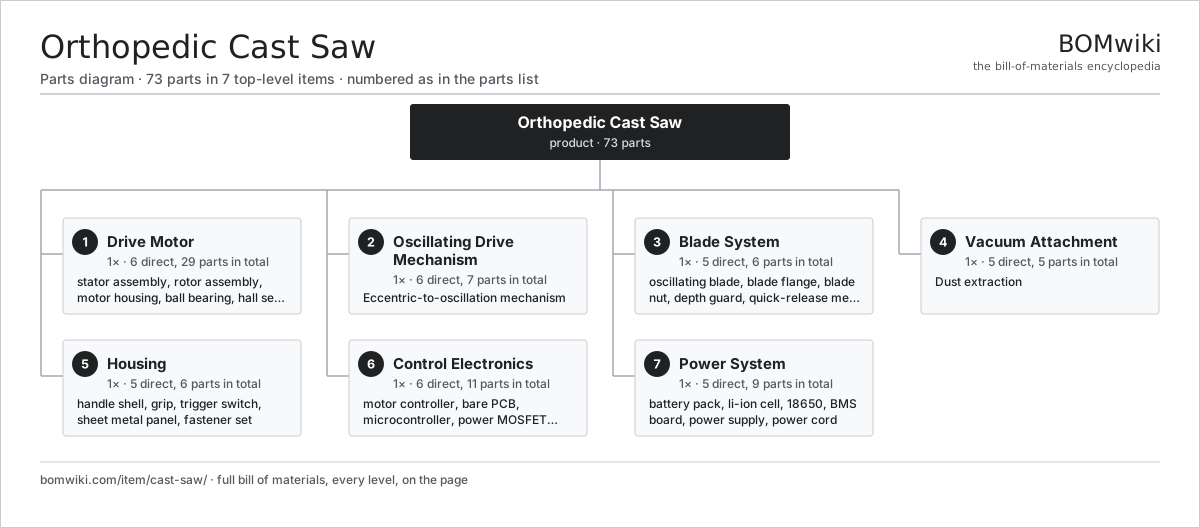
| # | Part | Qty | What it does |
|---|---|---|---|
| 1 | Drive Motor 6 parts | 1× | Brushless DC motor spinning the eccentric that produces the blade oscillation. |
| 2 | Oscillating Drive Mechanism 6 parts | 1× | Eccentric-to-oscillation mechanism |
| 3 | Blade System 5 parts | 1× | Toothed circular blade and quick-change mount; the blade oscillates so it cuts hard cast but not pliable skin. |
| 4 | Vacuum Attachment 5 parts | 1× | Dust extraction |
| 5 | Housing 5 parts | 1× | Insulated handheld body holding the motor and drive, with grip, switch, and air vents. |
| 6 | Control Electronics 6 parts | 1× | Motor controller regulating speed, soft-start, and overload protection. |
| 7 | Power System 5 parts | 1× | Either a mains lead or a removable battery pack powering the saw. |
3D model
No 3D model yet. Have a CAD file of this? Add a 3D model. STL renders right on this page; STEP, FreeCAD, and OpenSCAD sources are welcome too (openly licensed, like all 3D models on BOMwiki).
Build & assembly graph
expand / collapse · shared sub-assemblies converge · links to related products · est. labourTap an assembly to expand/collapse · tap a part to open it · use “Open page” for any node · drag to pan, scroll to zoom.
Bill of materials for Orthopedic Cast Saw
7 top-level lines · 52 rows shown · 73 parts total · indented to 3 levels| # | Item / sub-assembly | Part no. | Qty/assy | Ext. qty | Parts | Type |
|---|---|---|---|---|---|---|
| 1 | Drive Motor 6 parts | cast-saw-motor | 1× | 1 | 29 | assembly |
| 1.1 | Stator Assembly 3 parts | stator-assembly | 1× | 1 | 3 | assembly |
| 1.1.1 | Stator Core (laminations) | stator-core | 1× | 1 | · | part |
| 1.1.2 | Copper Winding | copper-winding | 1× | 1 | · | part |
| 1.1.3 | Slot Insulation | stator-insulation | 1× | 1 | · | part |
| 1.2 | Rotor Assembly 4 parts | rotor-assembly | 1× | 1 | 19 | assembly |
| 1.2.1 | Rotor Shaft | rotor-shaft | 1× | 1 | · | part |
| 1.2.2 | Rotor Core | rotor-core | 1× | 1 | · | part |
| 1.2.3 | Neodymium Magnet | neodymium-magnet | 16× | 16 | · | part |
| 1.2.4 | Ball Bearing | ball-bearing | 1× | 1 | · | part |
| 1.3 | Motor Housing | motor-housing | 1× | 1 | · | part |
| 1.4 | Ball Bearing | ball-bearing | 2× | 2 | · | part |
| 1.5 | Hall Sensor | hall-sensor | 3× | 3 | · | part |
| 1.6 | Motor Cooling Fan | cast-saw-cooling-fan | 1× | 1 | · | part |
| 2 | Oscillating Drive Mechanism 6 parts | cast-saw-oscillating-drive | 1× | 1 | 7 | assembly |
| 2.1 | Eccentric Cam | cast-saw-eccentric-cam | 1× | 1 | · | part |
| 2.2 | Oscillation Yoke | cast-saw-oscillation-yoke | 1× | 1 | · | part |
| 2.3 | Output Spindle | cast-saw-output-spindle | 1× | 1 | · | part |
| 2.4 | Bearing Block | cast-saw-bearing-block | 1× | 1 | · | part |
| 2.5 | Ball Bearing | ball-bearing | 2× | 2 | · | part |
| 2.6 | O-Ring Set | oring-set | 1× | 1 | · | part |
| 3 | Blade System 5 parts | cast-saw-blade-system | 1× | 1 | 6 | assembly |
| 3.1 | Oscillating Blade | cast-saw-blade | 1× | 1 | · | part |
| 3.2 | Blade Flange | cast-saw-blade-flange | 2× | 2 | · | part |
| 3.3 | Blade Nut | cast-saw-blade-nut | 1× | 1 | · | part |
| 3.4 | Depth Guard | cast-saw-depth-guard | 1× | 1 | · | part |
| 3.5 | Quick-Release Mechanism | cast-saw-quick-release | 1× | 1 | · | part |
| 4 | Vacuum Attachment 5 parts | cast-saw-vacuum-attachment | 1× | 1 | 5 | assembly |
| 4.1 | Dust Shroud | cast-saw-dust-shroud | 1× | 1 | · | part |
| 4.2 | Suction Port | cast-saw-suction-port | 1× | 1 | · | part |
| 4.3 | Dust Filter | cast-saw-dust-filter | 1× | 1 | · | part |
| 4.4 | Blower Motor | blower-motor | 1× | 1 | · | part |
| 4.5 | Hose Adapter | cast-saw-hose-adapter | 1× | 1 | · | part |
| 5 | Housing 5 parts | cast-saw-housing | 1× | 1 | 6 | assembly |
| 5.1 | Handle Shell | cast-saw-handle-shell | 2× | 2 | · | part |
| 5.2 | Grip | cast-saw-grip | 1× | 1 | · | part |
| 5.3 | Trigger Switch | cast-saw-trigger-switch | 1× | 1 | · | part |
| 5.4 | Sheet Metal Panel | sheet-panel | 1× | 1 | · | part |
| 5.5 | Fastener Set | fastener-set | 1× | 1 | · | part |
| 6 | Control Electronics 6 parts | cast-saw-control-electronics | 1× | 1 | 11 | assembly |
| 6.1 | Motor Controller | cast-saw-motor-controller | 1× | 1 | · | part |
| 6.2 | Bare PCB | pcb-bare | 1× | 1 | · | part |
| 6.3 | Microcontroller | mcu | 1× | 1 | · | part |
| 6.4 | Power MOSFET | mosfet | 6× | 6 | · | part |
| 6.5 | SMD Passive (R/C/L) | smd-passives | 1× | 1 | · | part |
| 6.6 | Thermal Fuse | thermal-fuse | 1× | 1 | · | part |
| 7 | Power System 5 parts | cast-saw-power-system | 1× | 1 | 9 | assembly |
| 7.1 | Battery Pack | cast-saw-battery-pack | 1× | 1 | · | part |
| 7.2 | Li-ion Cell, 18650 | li-cell-18650 | 5× | 5 | · | part |
| 7.3 | BMS Board | bms-board | 1× | 1 | · | part |
| 7.4 | Power Supply | power-supply | 1× | 1 | · | part |
| 7.5 | Power Cord | cast-saw-power-cord | 1× | 1 | · | part |
Something wrong in this list? Report a problem with this BOM.
Related products
same domain, ranked by shared parts ECMO Machine
142 parts · shares 16 with this page
ECMO Machine
142 parts · shares 16 with this page
 Ophthalmic Tonometer
505 parts · shares 15 with this page
Surgical Suction Unit
232 parts · shares 15 with this page
Ophthalmic Tonometer
505 parts · shares 15 with this page
Surgical Suction Unit
232 parts · shares 15 with this page
 Infusion Pump
341 parts · shares 14 with this page
Bladder Scanner
483 parts · shares 15 with this page
Infusion Pump
341 parts · shares 14 with this page
Bladder Scanner
483 parts · shares 15 with this page
Sourcing: possible vendors
Browse the supplier directory → Prices, MOQ, and lead times are algorithmic estimates, not quotes, and not claims about these companies. Company mappings are curated by keyword; est. price band $500–$3M. How estimates work| Vendor | HQ | Specialty | MOQ | Lead time |
|---|---|---|---|---|
| gehealthcare.com ↗ | Chicago, US | Medical imaging & devices | 100 units | 12–20 wks |
| siemens-healthineers.com ↗ | Erlangen, DE | Medical systems | 100 units | 12–20 wks |
|
🇳🇱Philips
philips.com ↗
|
Amsterdam, NL | Health technology | 100 units | 12–20 wks |
| medtronic.com ↗ | Minneapolis, US | Medical devices | 100 units | 12–20 wks |
|
🇨🇳Mindray
mindray.com ↗
|
Shenzhen, CN | Medical devices | 100 units | 12–20 wks |
672-word article