CD Player
ProductOverview
The CD player, introduced by Sony and Philips in 1982, reads digital audio from a 120 mm polycarbonate disc carrying up to about 80 minutes of stereo PCM at 16 bits and 44.1 kHz. The data is physically a spiral of pits, each about 0.5 µm wide on a 1.6 µm track pitch, a track over five kilometers long read without contact by a focused laser. The player's job divides cleanly: the Disc Transport spins the disc and positions the Optical Pickup, the Servo and Decoder Board keeps the laser on track and decodes the data, and the DAC Board converts the recovered samples to an analog signal.
Reading the disc
The Laser Diode emits at 780 nm. The beam passes a Diffraction Grating that splits off two side spots, then a Beam Splitter, and the Objective Lens focuses it through the disc's transparent substrate to a 1.7 µm spot on the reflective data layer. Pits are one quarter-wavelength deep: light reflected from a pit travels half a wavelength further than light from the surrounding land, interfering destructively, so the pit edges read as intensity transitions at the Photodiode Array.
Nothing about the disc is precise enough to read passively. A disc may wobble half a millimeter vertically while focus depth is about ±2 µm, and its eccentricity dwarfs the 1.6 µm track pitch. The Actuator Coils therefore move the objective lens continuously, commanded by the Servo DSP. Focus error comes from an astigmatic lens that distorts the spot shape on the quadrant detector as focus drifts; tracking error comes from comparing the two side spots straddling the track. The Sled Motor follows with coarse radial motion as the spiral progresses, through a Helical Gear Pair reduction, while the Spindle Motor varies between roughly 500 and 200 rpm to hold constant linear velocity, the data rate, not the rotation rate, is what the format fixes.
From pits to PCM
The RF Amplifier shapes the photodiode signals into the RF eye pattern. Bits on disc are EFM-coded, each 8-bit symbol stored as 14 channel bits chosen so transitions are never too close together for the optics nor so far apart that the clock recovery loses lock. The EFM Decoder demodulates this and applies the Cross-Interleaved Reed-Solomon Code: data is interleaved across a span of the spiral, so a scratch destroying thousands of consecutive channel bits becomes many small, correctable errors after de-interleaving. CIRC fully corrects burst errors up to about 4,000 bits (a 2.5 mm scratch); beyond that the player interpolates, and only gross damage produces audible artifacts. An Microcontroller supervises the whole mechanism, runs the table of contents, and handles track seeks.
Conversion to analog
The recovered 44.1 kHz samples pass through the Oversampling Filter, which interpolates to typically eight times the sample rate. This moves the spectral images that conversion produces from just above 22 kHz to far above the audio band, so the analog reconstruction filter in the Analog Output Stage can be gentle, with benign phase behavior. The DAC Chip performs the conversion with more than 96 dB of dynamic range, clocked from the Crystal Oscillator, 16.9344 MHz divides exactly to 44.1 kHz. The output stage buffers the result to the standard 2 V RMS at the rear Connectors, and a Mute Relay silences the output during seeks and power transitions. Most players also pass the raw bitstream out as S/PDIF for an external DAC.
Mechanics and power
The Loading Tray, driven by a Drive Belt from a small motor, carries the disc in and lowers it onto the Turntable Hub; the magnetic Disc Clamp presses it flat. The whole transport sits on Isolation Mounts inside the Chassis so footfalls and cabinet vibration do not disturb tracking. The Power Supply keeps the analog rails separate: a Regulator Bank derives quiet supplies for the DAC Board away from the motor and logic rails, since spindle current pulses would otherwise appear in the output as noise. The Vacuum Fluorescent Display on the front panel shows track and time, with commands arriving from the Front Panel Buttons or through the IR Receiver.
CD Player parts and their functions
7 top-level parts · 47 parts in total · full bill of materials below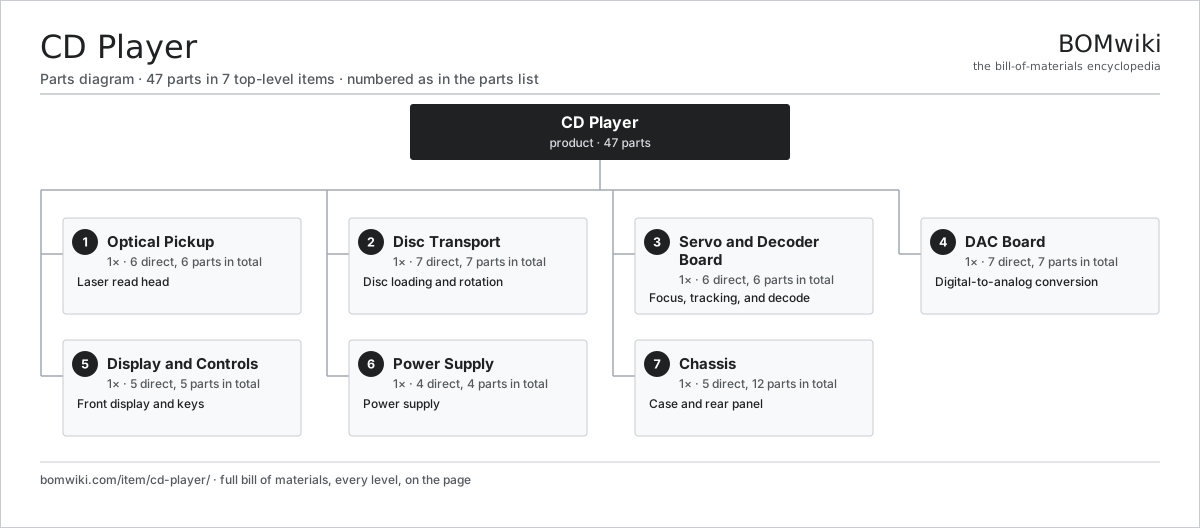
| # | Part | Qty | What it does |
|---|---|---|---|
| 1 | Optical Pickup 6 parts | 1× | Laser read head |
| 2 | Disc Transport 7 parts | 1× | Disc loading and rotation |
| 3 | Servo and Decoder Board 6 parts | 1× | Focus, tracking, and decode |
| 4 | DAC Board 7 parts | 1× | Digital-to-analog conversion |
| 5 | Display and Controls 5 parts | 1× | Front display and keys |
| 6 | Power Supply 4 parts | 1× | Power supply |
| 7 | Chassis 5 parts | 1× | Case and rear panel |
3D model
No 3D model yet. Have a CAD file of this? Add a 3D model. STL renders right on this page; STEP, FreeCAD, and OpenSCAD sources are welcome too (openly licensed, like all 3D models on BOMwiki).
Build & assembly graph
expand / collapse · shared sub-assemblies converge · links to related products · est. labourTap an assembly to expand/collapse · tap a part to open it · use “Open page” for any node · drag to pan, scroll to zoom.
Bill of materials for CD Player
7 top-level lines · 47 rows shown · 47 parts total · indented to 3 levels| # | Item / sub-assembly | Part no. | Qty/assy | Ext. qty | Parts | Type |
|---|---|---|---|---|---|---|
| 1 | Optical Pickup 6 parts | cd-player-optical-pickup | 1× | 1 | 6 | assembly |
| 1.1 | Laser Diode | cd-player-laser-diode | 1× | 1 | · | part |
| 1.2 | Objective Lens | cd-player-objective-lens | 1× | 1 | · | part |
| 1.3 | Actuator Coils | cd-player-actuator-coils | 1× | 1 | · | part |
| 1.4 | Photodiode Array | cd-player-photodiode-array | 1× | 1 | · | part |
| 1.5 | Beam Splitter | cd-player-beam-splitter | 1× | 1 | · | part |
| 1.6 | Diffraction Grating | cd-player-diffraction-grating | 1× | 1 | · | part |
| 2 | Disc Transport 7 parts | cd-player-transport | 1× | 1 | 7 | assembly |
| 2.1 | Spindle Motor | cd-player-spindle-motor | 1× | 1 | · | part |
| 2.2 | Sled Motor | cd-player-sled-motor | 1× | 1 | · | part |
| 2.3 | Disc Clamp | cd-player-disc-clamp | 1× | 1 | · | part |
| 2.4 | Loading Tray | cd-player-loading-tray | 1× | 1 | · | part |
| 2.5 | Drive Belt | drive-belt | 1× | 1 | · | part |
| 2.6 | Helical Gear Pair | gear-pair | 1× | 1 | · | part |
| 2.7 | Turntable Hub | cd-player-turntable | 1× | 1 | · | part |
| 3 | Servo and Decoder Board 6 parts | cd-player-servo-board | 1× | 1 | 6 | assembly |
| 3.1 | Servo DSP | cd-player-servo-dsp | 1× | 1 | · | part |
| 3.2 | EFM Decoder | cd-player-efm-decoder | 1× | 1 | · | part |
| 3.3 | RF Amplifier | cd-player-rf-amplifier | 1× | 1 | · | part |
| 3.4 | Microcontroller | mcu | 1× | 1 | · | part |
| 3.5 | Bare PCB | pcb-bare | 1× | 1 | · | part |
| 3.6 | SMD Passive (R/C/L) | smd-passives | 1× | 1 | · | part |
| 4 | DAC Board 7 parts | cd-player-dac-board | 1× | 1 | 7 | assembly |
| 4.1 | DAC Chip | cd-player-dac-chip | 1× | 1 | · | part |
| 4.2 | Oversampling Filter | cd-player-oversampling-filter | 1× | 1 | · | part |
| 4.3 | Analog Output Stage | cd-player-output-stage | 1× | 1 | · | part |
| 4.4 | Crystal Oscillator | cd-player-crystal | 1× | 1 | · | part |
| 4.5 | Mute Relay | cd-player-mute-relay | 1× | 1 | · | part |
| 4.6 | Bare PCB | pcb-bare | 1× | 1 | · | part |
| 4.7 | SMD Passive (R/C/L) | smd-passives | 1× | 1 | · | part |
| 5 | Display and Controls 5 parts | cd-player-display-section | 1× | 1 | 5 | assembly |
| 5.1 | Vacuum Fluorescent Display | cd-player-vfd | 1× | 1 | · | part |
| 5.2 | Front Panel Buttons | cd-player-front-buttons | 1× | 1 | · | part |
| 5.3 | IR Receiver | cd-player-ir-receiver | 1× | 1 | · | part |
| 5.4 | Bare PCB | pcb-bare | 1× | 1 | · | part |
| 5.5 | Wire Bundle | wire-bundle | 1× | 1 | · | part |
| 6 | Power Supply 4 parts | cd-player-psu | 1× | 1 | 4 | assembly |
| 6.1 | Power Supply | power-supply | 1× | 1 | · | part |
| 6.2 | Regulator Bank | cd-player-regulator-bank | 1× | 1 | · | part |
| 6.3 | Thermal Fuse | thermal-fuse | 1× | 1 | · | part |
| 6.4 | Wire Bundle | wire-bundle | 1× | 1 | · | part |
| 7 | Chassis 5 parts | cd-player-chassis | 1× | 1 | 12 | assembly |
| 7.1 | Sheet Metal Panel | sheet-panel | 3× | 3 | · | part |
| 7.2 | Front Fascia | cd-player-front-fascia | 1× | 1 | · | part |
| 7.3 | Isolation Mounts | cd-player-isolation-mounts | 4× | 4 | · | part |
| 7.4 | Connector | connector | 3× | 3 | · | part |
| 7.5 | Fastener Set | fastener-set | 1× | 1 | · | part |
Something wrong in this list? Report a problem with this BOM.
Related products
same domain, ranked by shared parts Record Player
215 parts · shares 2 with this page
Film Wind Machine
102 parts · shares 2 with this page
Record Player
215 parts · shares 2 with this page
Film Wind Machine
102 parts · shares 2 with this page
 Channel Strip
55 parts · shares 4 with this page
Channel Strip
55 parts · shares 4 with this page
 DJ Mixer
86 parts · shares 4 with this page
DJ Mixer
86 parts · shares 4 with this page
 Studio Monitor Speaker
53 parts · shares 4 with this page
Studio Monitor Speaker
53 parts · shares 4 with this page
Sourcing: possible vendors
Browse the supplier directory → Prices, MOQ, and lead times are algorithmic estimates, not quotes, and not claims about these companies. Company mappings are curated by keyword; est. price band $50–$3k. How estimates work| Vendor | HQ | Specialty | MOQ | Lead time |
|---|---|---|---|---|
|
🇯🇵Sony
sony.com ↗
|
Tokyo, JP | Consumer electronics | 1,000 units | 8–12 wks |
| samsung.com ↗ | Suwon, KR | Electronics & displays | 1,000 units | 8–12 wks |
|
🇺🇸Harman
harman.com ↗
|
Stamford, US | Audio (JBL, AKG) | 1,000 units | 8–12 wks |
|
🇺🇸Bose
bose.com ↗
|
Framingham, US | Audio | 1,000 units | 8–12 wks |
| yamaha.com ↗ | Hamamatsu, JP | Audio & instruments | 1,000 units | 8–12 wks |
754-word article