Cell Grading Machine
ProductOverview
A cell grading machine is a high-throughput automated test system that measures individual cell capacity (via open-circuit voltage and pulse discharge) and internal impedance, then sorts cells into quality grades (A/B/C) based on predefined thresholds. This system bridges the gap between cell formation (Battery Formation System) and module assembly, it quickly identifies high-performing cells for premium applications and directs lower-grade cells to less demanding uses (or scrap).
Purpose: Cells exiting formation may have capacity spread ±5–10% due to manufacturing variation. Grading enables:
- Matched sets: Selecting cells with similar capacity/impedance for a pack (improves balance and cycle life).
- Cost optimization: Sorting allows premium and standard grades at different price points.
- Scrap detection: Catching cells with shorts or low capacity before assembly.
Typical throughput: 1000–5000 cells per hour (8–16 parallel test stations, 0.5–3 seconds per cell).
How It Works
Cells are bulk-loaded into the Cell Singulation Conveyor vibratory feeder. Vibration at 50–60 Hz causes cells to tumble down a guide track, singulating into a steady stream, one cell every 1–2 seconds.
The Cell ID Camera & Barcode camera scans each incoming cell's label (barcode or laser-printed serial number). Software decodes the barcode and sends a station assignment to the motion controller.
The cell is positioned against the Multi-Station Test Head contact array. Spring-loaded pogo pins or magnetic contacts grip the cell's top and bottom terminals, establishing electrical connection.
The Impedance Calculation Engine sequences a test:
- Rest period (100 ms): Allow voltage to stabilize. Measure open-circuit voltage (OCV).
- Load pulse (200 ms): Activate a Load Solenoid Relay solenoid to connect a precision load resistor (typically 0.1–1 Ω) across the cell. Measure voltage under load (V_loaded).
- Impedance calculation: R_internal = (OCV – V_loaded) / I_load. The ADC has 16+ channels, so 8–16 cells are tested in parallel.
The impedance reflects the cell's internal resistance and aging state. A fresh, high-capacity cell has impedance ~5–20 mΩ. Aged cells or those with manufacturing defects can have impedance >100 mΩ.
Results are compared to grade thresholds:
- Grade A: OCV 4.15–4.25V, impedance <15 mΩ
- Grade B: OCV 4.05–4.15V, impedance 15–30 mΩ
- Grade C: OCV 3.8–4.05V, impedance 30–100 mΩ
- Reject: OCV <3.8V or >4.3V, impedance >100 mΩ
The Network & MES Gateway uploads the cell's barcode, OCV, impedance, grade, and timestamp to the MES database via Ethernet or CAN.
Based on the grade, the Pneumatic Sorting Deflector pneumatic deflector activates. A solenoid air valve pressurizes a cylinder, pushing a blade that deflects the cell into the appropriate chute (Grade A, B, C, or Reject bin).
Voltage and Impedance as Performance Metrics
Open-Circuit Voltage (OCV): A cell's intrinsic electrochemical potential, determined by the anode and cathode half-cell potentials. OCV is a proxy for state-of-charge (SOC) but also indicates cell health:
- Fresh cell: 4.20–4.25V (100% SOC if fully charged).
- Aged cell or with internal short: lower OCV at same SOC.
Internal Impedance: Includes:
- Ohmic resistance (R_contact + R_electrolyte + R_wiring) ~5–10 mΩ.
- Charge-transfer resistance (cathode and anode kinetics) ~10–30 mΩ.
- Diffusion impedance (ion transport through solid electrode) ~variable.
High impedance indicates:
- Manufacturing defect: poor current-collector contact, unwet electrodes.
- Separator damage or electrolyte depletion.
- Cell aging (solid-electrolyte interface resistance growth).
Pulse Discharge and Capacity Estimation
A more advanced grading system measures discharge capacity by applying a constant load for a fixed time (e.g., 1 Ω for 2 seconds, discharging ~1% of cell capacity) and integrating the current:
Capacity ≈ ∫(I dt) = I_avg × t
This is faster than full discharge but less accurate. Full discharge grading (1–3 hours per cell) is impractical for high-throughput lines.
Barcode Traceability and Data Management
Each cell receives a barcode during assembly. The barcode encodes:
- Lot number
- Anode/cathode batch codes
- Manufacturing date
- Unique serial number
The Cell ID Camera & Barcode camera reads the barcode and logs it alongside test results. This creates a traceability trail: if a failed pack is reported in the field, engineers can query the database and locate all cells from that lot, then perform root-cause analysis.
Sorting and Bin Management
The Pneumatic Sorting Deflector deflector typically has 4 outputs:
- Grade A bin: Matched-set cells for premium packs.
- Grade B bin: Standard-grade cells for mid-range packs.
- Grade C bin: Lower-grade or aged cells for low-performance applications.
- Reject bin: Defective cells (open-circuit, short, extreme impedance).
Reject cells are either re-tested (sometimes a test failure is transient, due to poor contact), sent to a rework station (clean, re-contact), or recycled.
Real-Time MES Integration
The Network & MES Gateway Ethernet or CAN gateway pushes results to the MES in real-time:
''' Cell_ID: 20250611-LOT-A-001234 Grade: A OCV [V]: 4.22 Impedance [mΩ]: 12.3 Timestamp: 2025-06-11 14:35:42 Destination: Bin_A '''
The MES aggregates grading results and can match cells for pack assembly: "Select 8 Grade-A cells with OCV within ±10 mV" ensures balanced packs.
Maintenance and Calibration
The pogo-pin contacts wear and corrode from repeated cell cycling. Cleaning with isopropyl alcohol every 1000 cells extends contact life. Replacement contacts are ~$50 each; a full test head rebuild is ~$2000.
The load resistors drift due to heating. Quarterly recalibration (comparing measured impedance to a reference cell) ensures ±5% accuracy.
The Multi-Channel ADC IC reference voltage must be stable (±0.1% per day). A precision voltage reference (10 ppm/°C) with low-ESR supply decoupling is mandatory.
High-Throughput Scaling
Single grading machines achieve ~1000 cells/hour (8 stations, 2.5 seconds per cell). To reach 5000+ cells/hour:
- Chain 4–5 machines in series, load-balanced.
- Use 16+ parallel test stations per machine.
- Reduce test dwell (single-pulse impedance measurement, 0.5 second) instead of full discharge.
High-volume battery manufacturing lines integrate cell grading as a continuous-flow operation between formation and module assembly.
Alternative: AC Impedance Spectroscopy
Premium grading systems measure AC impedance at multiple frequencies (0.01–10 kHz) using lock-in detection or FFT. This yields:
- Ohmic resistance (high-frequency impedance).
- Charge-transfer resistance (mid-frequency feature).
- Diffusion impedance (low-frequency tail).
Spectroscopy is more accurate for diagnostics but requires 10–30 seconds per cell, limiting throughput. It's used in R&D, not high-volume production.
Cost and ROI
A cell grading machine costs ~100–300 kEUR. For a 10 Ah cell factory producing 100,000 cells/day:
- Grading cost: ~$0.10–0.20 per cell.
- Grade-A price premium: +$0.50–1.00 vs. Grade-C.
- Payback: < 6 months if 60%+ of cells reach Grade A (typical).
Grading also reduces downstream warranty costs (fewer premature failures from mixed-grade packs).
Cell Grading Machine parts and their functions
8 top-level parts · 61 parts in total · full bill of materials below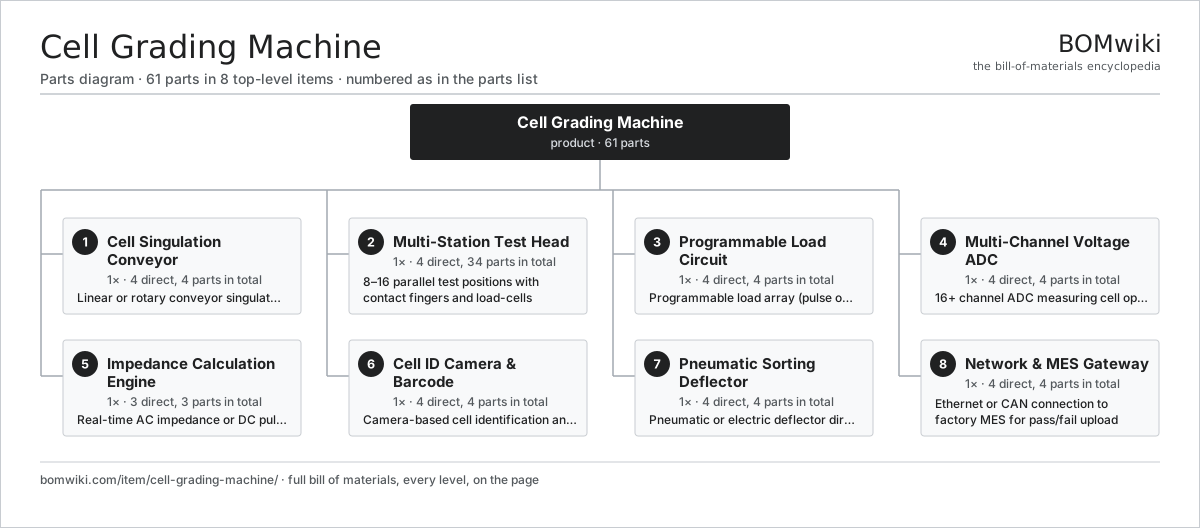
| # | Part | Qty | What it does |
|---|---|---|---|
| 1 | Cell Singulation Conveyor 4 parts | 1× | Linear or rotary conveyor singulating cells from bulk bin |
| 2 | Multi-Station Test Head 4 parts | 1× | 8–16 parallel test positions with contact fingers and load-cells |
| 3 | Programmable Load Circuit 4 parts | 1× | Programmable load array (pulse or constant discharge) |
| 4 | Multi-Channel Voltage ADC 4 parts | 1× | 16+ channel ADC measuring cell open-circuit and under-load voltage |
| 5 | Impedance Calculation Engine 3 parts | 1× | Real-time AC impedance or DC pulse resistance estimation |
| 6 | Cell ID Camera & Barcode 4 parts | 1× | Camera-based cell identification and sorting gate trigger |
| 7 | Pneumatic Sorting Deflector 4 parts | 1× | Pneumatic or electric deflector directing cells to grade bins |
| 8 | Network & MES Gateway 4 parts | 1× | Ethernet or CAN connection to factory MES for pass/fail upload |
3D model
No 3D model yet. Have a CAD file of this? Add a 3D model. STL renders right on this page; STEP, FreeCAD, and OpenSCAD sources are welcome too (openly licensed, like all 3D models on BOMwiki).
Build & assembly graph
expand / collapse · shared sub-assemblies converge · links to related products · est. labourTap an assembly to expand/collapse · tap a part to open it · use “Open page” for any node · drag to pan, scroll to zoom.
Bill of materials for Cell Grading Machine
8 top-level lines · 39 rows shown · 61 parts total · indented to 3 levels| # | Item / sub-assembly | Part no. | Qty/assy | Ext. qty | Parts | Type |
|---|---|---|---|---|---|---|
| 1 | Cell Singulation Conveyor 4 parts | cell-grading-machine-infeed-conveyor | 1× | 1 | 4 | assembly |
| 1.1 | Vibrating Feeder Bowl | cell-grading-machine-vibratory-bowl | 1× | 1 | · | part |
| 1.2 | Vibrator Drive Motor | cell-grading-machine-feeder-motor | 1× | 1 | · | part |
| 1.3 | Feeder Guide Track | cell-grading-machine-guide-track | 1× | 1 | · | part |
| 1.4 | Connector | connector | 1× | 1 | · | part |
| 2 | Multi-Station Test Head 4 parts | cell-grading-machine-test-stations | 1× | 1 | 34 | assembly |
| 2.1 | Test Contact Pogo Pin | cell-grading-machine-contact-socket | 16× | 16 | · | part |
| 2.2 | Contact Test Frame | cell-grading-machine-contact-frame | 1× | 1 | · | part |
| 2.3 | Resistor Load Array | cell-grading-machine-load-array | 1× | 1 | · | part |
| 2.4 | Load Solenoid Relay | cell-grading-machine-load-relay | 16× | 16 | · | part |
| 3 | Programmable Load Circuit 4 parts | cell-grading-machine-discharge-load | 1× | 1 | 4 | assembly |
| 3.1 | Precision Resistor Bank | cell-grading-machine-resistor-array | 1× | 1 | · | part |
| 3.2 | Relay Driver PCB | cell-grading-machine-load-relay-driver | 1× | 1 | · | part |
| 3.3 | Bare PCB | pcb-bare | 1× | 1 | · | part |
| 3.4 | Connector | connector | 1× | 1 | · | part |
| 4 | Multi-Channel Voltage ADC 4 parts | cell-grading-machine-voltage-measurement | 1× | 1 | 4 | assembly |
| 4.1 | Multi-Channel ADC IC | cell-grading-machine-adc-chip | 1× | 1 | · | part |
| 4.2 | Bare PCB | pcb-bare | 1× | 1 | · | part |
| 4.3 | SMD Passive (R/C/L) | smd-passives | 1× | 1 | · | part |
| 4.4 | Connector | connector | 1× | 1 | · | part |
| 5 | Impedance Calculation Engine 3 parts | cell-grading-machine-impedance-calculator | 1× | 1 | 3 | assembly |
| 5.1 | Microcontroller | mcu | 1× | 1 | · | part |
| 5.2 | Bare PCB | pcb-bare | 1× | 1 | · | part |
| 5.3 | Power Supply | power-supply | 1× | 1 | · | part |
| 6 | Cell ID Camera & Barcode 4 parts | cell-grading-machine-vision-barcode | 1× | 1 | 4 | assembly |
| 6.1 | CMOS Image Sensor | image-sensor | 1× | 1 | · | part |
| 6.2 | Lens Assembly | camera-lens | 1× | 1 | · | part |
| 6.3 | LED Illuminator | cell-grading-machine-led-light | 1× | 1 | · | part |
| 6.4 | Bare PCB | pcb-bare | 1× | 1 | · | part |
| 7 | Pneumatic Sorting Deflector 4 parts | cell-grading-machine-sorting-gate | 1× | 1 | 4 | assembly |
| 7.1 | Solenoid Air Valve | cell-grading-machine-air-valve | 1× | 1 | · | part |
| 7.2 | Pneumatic Pusher Rod | cell-grading-machine-pusher-rod | 1× | 1 | · | part |
| 7.3 | Sorting Deflector Blade | cell-grading-machine-deflector-blade | 1× | 1 | · | part |
| 7.4 | Connector | connector | 1× | 1 | · | part |
| 8 | Network & MES Gateway 4 parts | cell-grading-machine-data-interface | 1× | 1 | 4 | assembly |
| 8.1 | CAN/Ethernet Gateway | cell-grading-machine-can-gateway | 1× | 1 | · | part |
| 8.2 | Industrial Ethernet Router | cell-grading-machine-router | 1× | 1 | · | part |
| 8.3 | Bare PCB | pcb-bare | 1× | 1 | · | part |
| 8.4 | Connector | connector | 1× | 1 | · | part |
Something wrong in this list? Report a problem with this BOM.
Related products
same domain, ranked by shared parts Pouch Sealing Machine
38 parts · shares 4 with this page
Pouch Sealing Machine
38 parts · shares 4 with this page
Sourcing: possible vendors
Browse the supplier directory → Prices, MOQ, and lead times are algorithmic estimates, not quotes, and not claims about these companies. Company mappings are curated by keyword; est. price band $5k–$2M. How estimates work| Vendor | HQ | Specialty | MOQ | Lead time |
|---|---|---|---|---|
| atlascopco.com ↗ | Stockholm, SE | Compressors & industrial | 10 units | 12–20 wks |
|
🇦🇹Andritz
andritz.com ↗
|
Graz, AT | Process plants & machinery | 10 units | 12–20 wks |
| buhlergroup.com ↗ | Uzwil, CH | Food & materials processing | 10 units | 12–20 wks |
| gea.com ↗ | Düsseldorf, DE | Process technology | 10 units | 12–20 wks |
| mhi.com ↗ | Tokyo, JP | Heavy machinery | 10 units | 12–20 wks |
1,157-word article