Cell Stacking Machine
ProductOverview
A cell stacking machine is a precision automated assembly system that orients individual pouch cells and stacks them in a defined order within a magazine, interleaving separator layers between cells. This is a critical intermediate step between individual cell Battery Formation System grading and battery pack assembly Battery Pack Tester.
Purpose: Stacking cells in a magazine is more efficient than handling individual cells downstream. The magazine (holding 10–50 cells with separators) becomes a unit of handling, moved as one to the next process station (typically a thermal pressing and sealing operation before integration into a pack).
The machine uses a gantry or robot arm with vacuum gripper, high-speed vision system, and vibratory feeder to:
- Singulate cells from bulk supply.
- Detect cell orientation (tab position) via vision.
- Rotate cells if needed to align tabs consistently.
- Pick and place each cell into the magazine.
- Dispense separator sheets between layers.
- Eject a full magazine to the next station.
Typical throughput is 500–900 cells per hour (depending on stack height and separator thickness). The system is fully autonomous once cells and separator sheets are loaded into supply hoppers.
How It Works
Bulk cells are dumped into the Cell Infeed Conveyor Vibratory Feeder Bowl, which vibrates at 50–60 Hz. Vibration singulates cells, feeding one cell per cycle down a guide track toward the Cell Pick & Place Head.
Before pickup, the Cell Orientation Detector high-speed camera captures an image of the cell. Software detects the cell tab position (typically marked or visually distinct) and determines if the cell is oriented correctly (tab at a reference position). If orientation is wrong, the Robot or Gantry Stage gantry rotates the cell 90, 180, or 270 degrees on the conveyor before pickup.
Once properly oriented, the Cell Pick & Place Head vacuum gripper (2–5 cups) descends and engages the cell's top face. A Vacuum Pump venturi or pump creates suction, holding the cell firmly. The picker retracts vertically, lifting the cell off the conveyor.
The gantry XYZ stage moves the gripper to above the Stack Assembly Magazine, positioning the cell directly above the last cell in the growing stack. The Alignment Vision System high-speed camera views the stack from above, measuring the current topmost cell's edge position. Vision-based closed-loop control adjusts the gripper XY position to center the new cell ±2 mm.
Once aligned, the picker descends and releases the cell onto the stack. The Separator Sheet Feeder then advances, a vacuum cup picks a single separator sheet from the Separator Feeder Magazine and places it on top of the cell. The stack height increases by ~1.5 mm (1 mm cell plus 0.5 mm separator).
This cycle repeats: pick cell → orient → move to magazine → align → place → dispense separator. After 10–50 cells are stacked, the Stack Assembly Magazine frame is full. A motorized or manual eject mechanism slides the magazine out and a new empty magazine is inserted. The system continues cycling.
Cell Orientation and Rotation
Pouch cells have a distinctive tab (aluminum conductor connected to the active material). Consistent tab position is important for downstream tab-to-terminal welding (Tab Welding Machine) and cell-to-pack electrical connection.
If a cell emerges from the vibratory feeder tab-up or tab-down (random orientation), the Cell Orientation Detector barcode reader or vision-based tab detector signals the gantry to rotate the cell on the conveyor before pickup. Rotation can be achieved by:
- Air jet rotation: Pulsing an air jet against the cell edge, rolling it.
- Mechanical roller rotation: A small motorized roller engaging the cell and spinning it.
- Vision-triggered pick-and-place: The gripper picks the cell, rotates it in mid-air, and places it back, then re-picks in correct orientation.
Most systems use air-jet or roller rotation for speed (<0.5 second per rotation).
Stacking Precision and Alignment
The Alignment Vision System high-speed camera (100+ fps) is mounted above the magazine, looking straight down. Before each cell is placed, it measures the X and Y position of the topmost cell's edges. The Motion & Vision Controller compares measured position to a reference centerline, and adjusts the gripper's XY offset (via X-Axis Motor and Y-Axis Motor) to within ±2 mm.
Without vision feedback, cell placement would drift due to mechanical play and accumulate skew over 50 cells, the bottom cell and top cell could differ by ±20 mm. Vision-based correction eliminates this drift, ensuring the stack is perpendicular and cells are centered.
Separator Sheet Handling
Separators (paper, plastic, or silicone) are 0.5–1 mm thick and fragile. The Separator Sheet Feeder uses a gentle vacuum cup (30–50 mm diameter, lower suction ~0.3 bar to avoid tearing) to extract a single sheet from the magazine. A spring-loaded Separator Guide Rail prevents the sheet from skewing or bending during transfer.
Separator material choice depends on downstream process:
- Paper: Biodegradable, used in some lab/prototype builds.
- Plastic (PP, PE): Insulating, prevents accidental short-circuit between stacked cells.
- Silicone: Low friction, easier to remove if stack needs disassembly.
Magazine Design and Modularity
The Stack Assembly Magazine is a reusable aluminum or stainless frame, 150×250×300 mm typical. It features:
- Four vertical Magazine Guide Post rods (ø6–8 mm) that keep the stack aligned and separate.
- A Magazine Base Plate with datum pins for alignment to the next station.
- Spring-loaded or bolted corners for stiffness.
Magazines are interchangeable across multiple stacking machines, allowing batch processing: while one machine fills a magazine, the previous magazine is transported to the next station (thermal press, pouch sealing, or dry oven).
Full magazines (50 cells + 49 separators = ~75 mm height) weigh ~1.5–2 kg. Manual extraction is feasible for low-volume operations; high-volume lines use motorized magazine changers (carousel feeders or linear indexers).
Integration with Upstream (Formation) and Downstream (Pressing/Sealing)
Cells arrive from the Battery Formation System already cycled, graded, and tested. The Motion & Vision Controller can accept pass/fail signals from formation data (via CAN or Ethernet), rejecting low-capacity or high-impedance cells and bypassing them. This prevents stacking of defective cells into a module that might later need full disassembly.
Downstream, stacked magazines feed a Cell Grading Machine or a thermal press (not shown in product list, but typically follows stacking). The press applies 10–50 bar pressure to compact the stack and improve cell-to-cell electrical contact before pouch sealing or final assembly.
Safety and Maintenance
Vacuum gripper failure is the most common failure mode. The Vacuum Pump must run continuously and be monitored for pressure drop (clogged filter). A vacuum pressure transducer triggers an alarm if vacuum drops below setpoint.
Vision system (camera, LED) requires periodic cleaning (dust on lens), especially in manufacturing environments with residual electrolyte vapor. The Vibrator Motor bearing wears; replacement every 1–2 years is typical.
Gantry ball-screws and linear bearings are lubricated on installation and require no additional maintenance beyond annual inspection. Stepper motors (if used) run indefinitely; servo motors may accumulate bearing wear over 10,000+ operating hours.
Emergency stop on the Motion & Vision Controller halts all motion within <100 ms.
Production Variants
Lab-scale systems (single-cell, manual magazine): 20–50 cells/hour, <100 kEUR cost.
Semi-automated (vibratory feeder + manual placement + vision alignment): 100–300 cells/hour, ~200 kEUR.
Fully automated (multi-axis gantry + vision + separator dispenser): 500–900 cells/hour, ~400–600 kEUR.
High-volume lines (>1000 cells/hour) use parallel multi-head stackers or integrated press-stack-seal in-line systems.
Cell Stacking Machine parts and their functions
8 top-level parts · 47 parts in total · full bill of materials below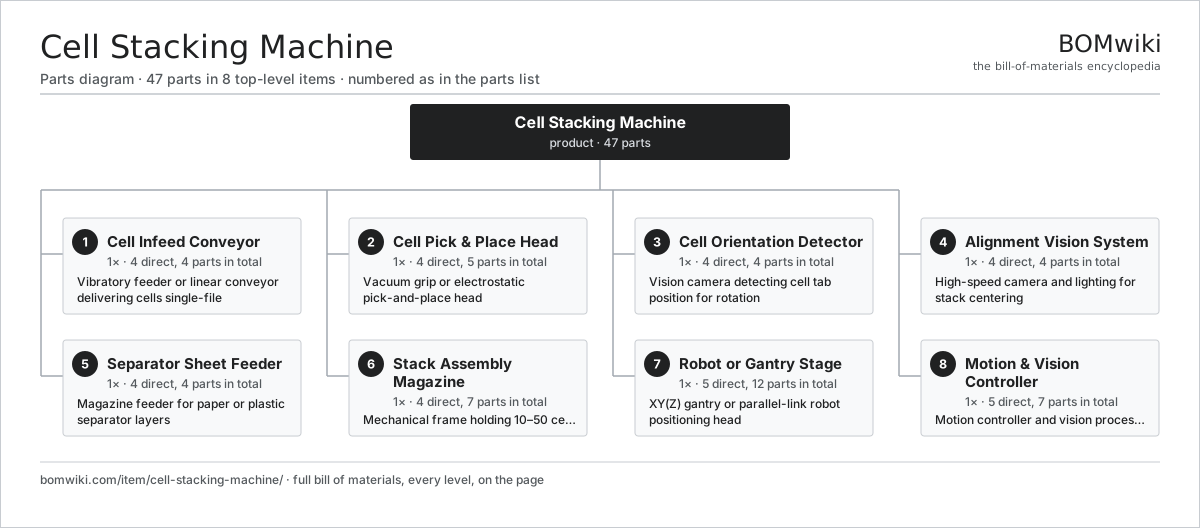
| # | Part | Qty | What it does |
|---|---|---|---|
| 1 | Cell Infeed Conveyor 4 parts | 1× | Vibratory feeder or linear conveyor delivering cells single-file |
| 2 | Cell Pick & Place Head 4 parts | 1× | Vacuum grip or electrostatic pick-and-place head |
| 3 | Cell Orientation Detector 4 parts | 1× | Vision camera detecting cell tab position for rotation |
| 4 | Alignment Vision System 4 parts | 1× | High-speed camera and lighting for stack centering |
| 5 | Separator Sheet Feeder 4 parts | 1× | Magazine feeder for paper or plastic separator layers |
| 6 | Stack Assembly Magazine 4 parts | 1× | Mechanical frame holding 10–50 cells and separators |
| 7 | Robot or Gantry Stage 5 parts | 1× | XY(Z) gantry or parallel-link robot positioning head |
| 8 | Motion & Vision Controller 5 parts | 1× | Motion controller and vision processor integrating feeder and stacker |
3D model
No 3D model yet. Have a CAD file of this? Add a 3D model. STL renders right on this page; STEP, FreeCAD, and OpenSCAD sources are welcome too (openly licensed, like all 3D models on BOMwiki).
Build & assembly graph
expand / collapse · shared sub-assemblies converge · links to related products · est. labourTap an assembly to expand/collapse · tap a part to open it · use “Open page” for any node · drag to pan, scroll to zoom.
Bill of materials for Cell Stacking Machine
8 top-level lines · 42 rows shown · 47 parts total · indented to 3 levels| # | Item / sub-assembly | Part no. | Qty/assy | Ext. qty | Parts | Type |
|---|---|---|---|---|---|---|
| 1 | Cell Infeed Conveyor 4 parts | cell-stacking-machine-cell-infeed | 1× | 1 | 4 | assembly |
| 1.1 | Vibratory Feeder Bowl | cell-stacking-machine-vibratory-bowl | 1× | 1 | · | part |
| 1.2 | Vibrator Motor | cell-stacking-machine-vibrator-motor | 1× | 1 | · | part |
| 1.3 | Feeder Guide Rails | cell-stacking-machine-guide-rails | 1× | 1 | · | part |
| 1.4 | Connector | connector | 1× | 1 | · | part |
| 2 | Cell Pick & Place Head 4 parts | cell-stacking-machine-cell-picker | 1× | 1 | 5 | assembly |
| 2.1 | Vacuum Gripper Cup | cell-stacking-machine-vacuum-cup | 2× | 2 | · | part |
| 2.2 | Vacuum Pump | cell-stacking-machine-vacuum-generator | 1× | 1 | · | part |
| 2.3 | Gripper Actuator | cell-stacking-machine-gripper-actuator | 1× | 1 | · | part |
| 2.4 | Connector | connector | 1× | 1 | · | part |
| 3 | Cell Orientation Detector 4 parts | cell-stacking-machine-orientation-sensor | 1× | 1 | 4 | assembly |
| 3.1 | CMOS Image Sensor | image-sensor | 1× | 1 | · | part |
| 3.2 | Lens Assembly | camera-lens | 1× | 1 | · | part |
| 3.3 | LED Ring Illuminator | cell-stacking-machine-ring-light | 1× | 1 | · | part |
| 3.4 | Bare PCB | pcb-bare | 1× | 1 | · | part |
| 4 | Alignment Vision System 4 parts | cell-stacking-machine-vision-alignment | 1× | 1 | 4 | assembly |
| 4.1 | CMOS Image Sensor | image-sensor | 1× | 1 | · | part |
| 4.2 | Lens Assembly | camera-lens | 1× | 1 | · | part |
| 4.3 | Coaxial Illuminator | cell-stacking-machine-coaxial-light | 1× | 1 | · | part |
| 4.4 | Bare PCB | pcb-bare | 1× | 1 | · | part |
| 5 | Separator Sheet Feeder 4 parts | cell-stacking-machine-separator-dispenser | 1× | 1 | 4 | assembly |
| 5.1 | Separator Feeder Magazine | cell-stacking-machine-separator-magazine | 1× | 1 | · | part |
| 5.2 | Sheet Pickup Vacuum Cup | cell-stacking-machine-sheet-pick-vacuum | 1× | 1 | · | part |
| 5.3 | Separator Guide Rail | cell-stacking-machine-sheet-guide | 1× | 1 | · | part |
| 5.4 | Connector | connector | 1× | 1 | · | part |
| 6 | Stack Assembly Magazine 4 parts | cell-stacking-machine-stack-magazine | 1× | 1 | 7 | assembly |
| 6.1 | Magazine Frame | cell-stacking-machine-magazine-frame | 1× | 1 | · | part |
| 6.2 | Magazine Guide Post | cell-stacking-machine-guide-post | 4× | 4 | · | part |
| 6.3 | Magazine Base Plate | cell-stacking-machine-magazine-base | 1× | 1 | · | part |
| 6.4 | Fastener Set | fastener-set | 1× | 1 | · | part |
| 7 | Robot or Gantry Stage 5 parts | cell-stacking-machine-actuation-stage | 1× | 1 | 12 | assembly |
| 7.1 | X-Axis Motor | cell-stacking-machine-gantry-x-motor | 1× | 1 | · | part |
| 7.2 | Y-Axis Motor | cell-stacking-machine-gantry-y-motor | 1× | 1 | · | part |
| 7.3 | Z-Axis Motor | cell-stacking-machine-gantry-z-motor | 1× | 1 | · | part |
| 7.4 | Ball-Screw Assembly | cell-stacking-machine-ball-screw | 3× | 3 | · | part |
| 7.5 | Linear Rolling Bearing | cell-stacking-machine-linear-bearing | 6× | 6 | · | part |
| 8 | Motion & Vision Controller 5 parts | cell-stacking-machine-control-system | 1× | 1 | 7 | assembly |
| 8.1 | Microcontroller | mcu | 1× | 1 | · | part |
| 8.2 | Motion Control Card | cell-stacking-machine-motion-card | 1× | 1 | · | part |
| 8.3 | HMI Touchscreen | cell-stacking-machine-hmi-screen | 1× | 1 | · | part |
| 8.4 | Power Supply | power-supply | 2× | 2 | · | part |
| 8.5 | Relay | relay | 2× | 2 | · | part |
Something wrong in this list? Report a problem with this BOM.
Related products
same domain, ranked by shared parts Pouch Sealing Machine
38 parts · shares 4 with this page
Tab Welding Machine
32 parts · shares 4 with this page
Pouch Sealing Machine
38 parts · shares 4 with this page
Tab Welding Machine
32 parts · shares 4 with this page
Sourcing: possible vendors
Browse the supplier directory → Prices, MOQ, and lead times are algorithmic estimates, not quotes, and not claims about these companies. Company mappings are curated by keyword; est. price band $5k–$2M. How estimates work| Vendor | HQ | Specialty | MOQ | Lead time |
|---|---|---|---|---|
| atlascopco.com ↗ | Stockholm, SE | Compressors & industrial | 10 units | 12–20 wks |
|
🇦🇹Andritz
andritz.com ↗
|
Graz, AT | Process plants & machinery | 10 units | 12–20 wks |
| buhlergroup.com ↗ | Uzwil, CH | Food & materials processing | 10 units | 12–20 wks |
| gea.com ↗ | Düsseldorf, DE | Process technology | 10 units | 12–20 wks |
| mhi.com ↗ | Tokyo, JP | Heavy machinery | 10 units | 12–20 wks |
1,320-word article