Cell Winding Machine
ProductOverview
A cell winding machine is a precision electromechanical system that assembles the core energy-storage sandwich of a pouch or cylindrical battery cell: the jelly-roll. Thin webs of anode and cathode electrode material (coated aluminum and copper foil) are drawn from unwinding stations, interleaved with a porous polyolefin separator, and wound layer-by-layer onto a rotating mandrel under controlled tension. The resulting spiral is known as a jelly-roll.
Aluminum or nickel tabs are spot-welded or glued to the outermost anode and cathode layers before the webs are cut and the roll is ejected. The completed jelly-roll is subsequently placed into a pouch, filled with electrolyte, and sealed, becoming a finished cell.
Precision is critical: variations in wrap tension cause uneven current distribution and thermal hot-spots during charge/discharge. Web misalignment or separator wrinkles induce cell-to-foil shorts. Tab positioning errors complicate tab-to-terminal welding in the next assembly stage.
How It Works
Three independent Web Unwinding Station stations unwind anode, cathode, and separator webs in parallel. Each stream has its own Unwinding Servo Motor, Tension Dancer Assembly, and Edge Alignment Actuator. Dancers maintain web tension within ±5% using Pressure Sensor load-cells feeding back to Tension Regulator System servo loops.
The anode, cathode, and separator webs converge at a fixed guide point and are directed downward onto a rotating Winding Head & Mandrel. The head is driven by a high-torque Mandrel Winding Motor (2–5 kW, 0–60 rpm). A Quick-Change Mandrel Holder holds a hollow Precision Mandrel Spindle. As the mandrel rotates, the three webs wrap around it in alternating sequence, anode, separator, cathode, anode, separator, cathode, building up 25–75 spiral layers depending on foil thickness and desired cell capacity.
A Web Laydown Guide Shoe (fixed or oscillating) shoe controls the wrap angle and ensures even stacking. Vision & Alignment Camera cameras monitor the web edges in real-time, triggering Edge Alignment Actuator servo corrections to hold centerline position within ±2 mm.
At programmed intervals (or once a target wrap diameter is reached), the winding speed is reduced and a Tab Applicator Head actuates. A Tab X-Y Positioner stepper motor moves aluminum or nickel tabs into position. An Ultrasonic Transducer Module at 20–40 kHz ultrasonic frequency bonds the tab to the anode or cathode web edge. Alternatively, an adhesive nozzle applies a thin bead of conductive epoxy.
Once tab bonding is complete, the three webs are severed by a Web Cutter Assembly. A Cutting Blade (hardened steel or ceramic) or CO2 laser cuts the foil cleanly, leaving ±1 mm edge.
The Roll Unload & Transfer then actuates: a pneumatic Mandrel Ejection Cylinder retracts the Quick-Change Mandrel Holder, and a Ejector Push Rod ejects the mandrel. The completed jelly-roll falls freely or rolls down a Roll Transfer Ramp to a collection tray or next station (press, drying oven, or pouch filling).
All motion is choreographed by a Motion Control & HMI, a motion controller managing servo drives, tension loops, vision feedback, and tab timing. An HMI touchscreen allows operators to input roll diameter, tab spacing, speed, and tension setpoints.
Jelly-Roll Structure and Capacity
A jelly-roll is a spiral sandwich. For a typical 18650-sized cylindrical cell or small pouch, the structure is:
- Anode foil: 10 microns thick, 50–100 mg/cm² coating
- Separator: 25 microns polyethylene or polypropylene
- Cathode foil: 10 microns thick, 100–180 mg/cm² coating
Layer counts vary: a 20–30 layer roll (10–15 full anode-separator-cathode triplets) yields ~3.0–4.0 Ah capacity at standard loadings. Thicker or wider foils produce lower layer counts but higher capacity per cell.
Finished roll diameter is typically 5–15 mm; height (web width) is 600–3000 mm depending on cell form factor.
Tension Control and Wrap Quality
Wrapping tension must be uniform across all layers. If outer layers are loose while inner layers are tight, current distribution becomes uneven, causing localized heating and accelerated degradation. Tension targets are 5–20 N depending on foil thickness, tighter tension (10–20 N) for thin foil, lighter (5–10 N) for thick foil.
The Tension Regulator System system compares each dancer load-cell signal to a setpoint and adjusts unwinding motor torque in real-time. Proportional-integral-derivative (PID) closed-loop tuning is essential to avoid oscillation (hunting).
Uneven tension across the web width (edge vs. center) is mitigated by the Web Laydown Guide Shoe shoe geometry. A convex shoe naturally distributes tension, while a flat shoe may concentrate load at edges. Some designs oscillate the shoe as the roll builds, preventing preferential deposition.
Tab Application and Welding
Aluminum or nickel tabs (0.1–0.3 mm thick, 5–10 mm wide) are bonded to the outermost anode and cathode layers. Two methods prevail:
- Ultrasonic Welding: The Ultrasonic Sonotrode or Nozzle vibrates at 20–40 kHz, generating friction that welds aluminum-to-foil in 0.5–2 seconds. No solder or flux needed; cold-weld process. Common for high-speed lines.
- Adhesive Bonding: A conductive epoxy or silver-filled glue is dispensed and allowed to cure, bonding tab to foil. Slower but simpler; lower cost tooling.
Tab positioning accuracy (±0.5 mm) is critical for subsequent terminal welding in the Battery Pack Tester or external weld station.
Web Edge Alignment and Vision
The Vision & Alignment Camera camera (5–10 MP GigE) monitors web edges at a fixed standoff. Software detects edge position via image processing and sends correction signals to the Edge Alignment Actuator stepper motors. Feedback loops close at ~1 Hz, correcting lateral drift before it compounds.
Wrinkles or folds in the separator are also detected visually and trigger alarms. Wrinkled separator can lead to shorts; severe folds require restart.
Production Cadence
A single winding cycle (unwinding three webs, wrapping 25–75 layers, applying tabs, cutting, and ejecting) takes 3–8 minutes depending on jelly-roll size and wrap speed. Lines produce 100–200 completed rolls per 8-hour shift, each destined for one or two finished cells (depending on pouch size).
Downstream Integration
Ejected jelly-rolls proceed to a Cell Grading Machine or Electrolyte Filling Machine. Some lines include an inline press (not shown) to flatten the spiral slightly before pouch filling, improving contact with electrolyte.
Reliability and Maintenance
Mandrels wear at the wrap-contact surface after 500–1000 cycles; they are replaced periodically. Ultrasonic sonotrode tips degrade and require resurfacing or replacement quarterly. Servo motor seal-life is 2–5 years depending on duty cycle. Downtime for maintenance is typically 2–4 hours monthly.
Cell Winding Machine parts and their functions
8 top-level parts · 49 parts in total · full bill of materials below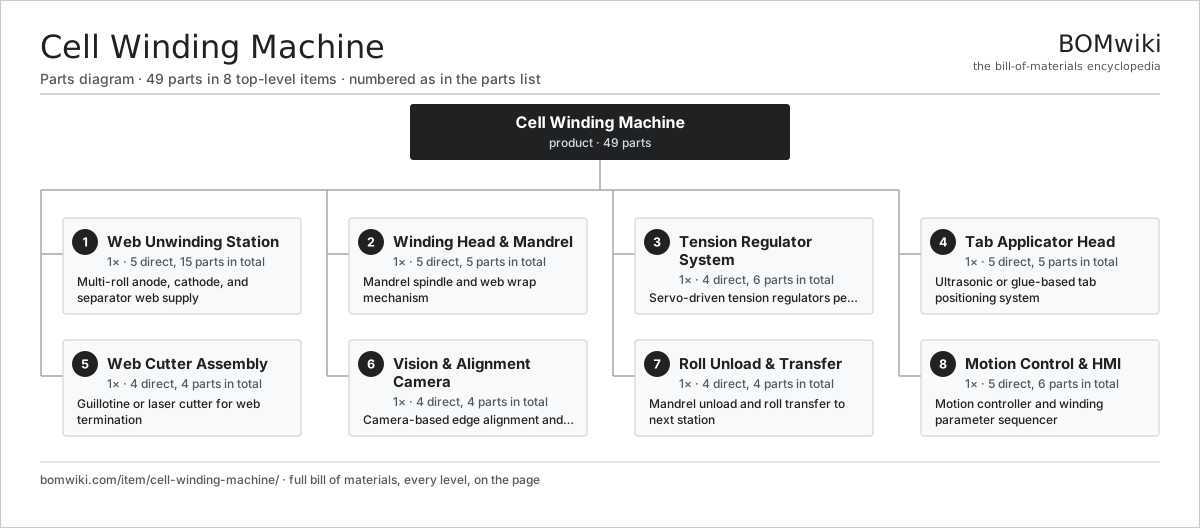
| # | Part | Qty | What it does |
|---|---|---|---|
| 1 | Web Unwinding Station 5 parts | 1× | Multi-roll anode, cathode, and separator web supply |
| 2 | Winding Head & Mandrel 5 parts | 1× | Mandrel spindle and web wrap mechanism |
| 3 | Tension Regulator System 4 parts | 1× | Servo-driven tension regulators per web stream |
| 4 | Tab Applicator Head 5 parts | 1× | Ultrasonic or glue-based tab positioning system |
| 5 | Web Cutter Assembly 4 parts | 1× | Guillotine or laser cutter for web termination |
| 6 | Vision & Alignment Camera 4 parts | 1× | Camera-based edge alignment and defect detection |
| 7 | Roll Unload & Transfer 4 parts | 1× | Mandrel unload and roll transfer to next station |
| 8 | Motion Control & HMI 5 parts | 1× | Motion controller and winding parameter sequencer |
3D model
No 3D model yet. Have a CAD file of this? Add a 3D model. STL renders right on this page; STEP, FreeCAD, and OpenSCAD sources are welcome too (openly licensed, like all 3D models on BOMwiki).
Build & assembly graph
expand / collapse · shared sub-assemblies converge · links to related products · est. labourTap an assembly to expand/collapse · tap a part to open it · use “Open page” for any node · drag to pan, scroll to zoom.
Bill of materials for Cell Winding Machine
8 top-level lines · 44 rows shown · 49 parts total · indented to 3 levels| # | Item / sub-assembly | Part no. | Qty/assy | Ext. qty | Parts | Type |
|---|---|---|---|---|---|---|
| 1 | Web Unwinding Station 5 parts | cell-winding-machine-unwinding-station | 1× | 1 | 15 | assembly |
| 1.1 | Unwinding Servo Motor | cell-winding-machine-unwinding-motor | 3× | 3 | · | part |
| 1.2 | Tension Dancer Assembly | cell-winding-machine-dancer-module | 3× | 3 | · | part |
| 1.3 | Edge Alignment Actuator | cell-winding-machine-edge-guide | 3× | 3 | · | part |
| 1.4 | Pressure Sensor | pressure-sensor | 3× | 3 | · | part |
| 1.5 | Encoder | encoder | 3× | 3 | · | part |
| 2 | Winding Head & Mandrel 5 parts | cell-winding-machine-winding-head | 1× | 1 | 5 | assembly |
| 2.1 | Mandrel Winding Motor | cell-winding-machine-spindle-motor | 1× | 1 | · | part |
| 2.2 | Precision Mandrel Spindle | cell-winding-machine-mandrel-spindle | 1× | 1 | · | part |
| 2.3 | Quick-Change Mandrel Holder | cell-winding-machine-mandrel-chuck | 1× | 1 | · | part |
| 2.4 | Web Laydown Guide Shoe | cell-winding-machine-wrap-guide | 1× | 1 | · | part |
| 2.5 | Pressure Sensor | pressure-sensor | 1× | 1 | · | part |
| 3 | Tension Regulator System 4 parts | cell-winding-machine-tension-control | 1× | 1 | 6 | assembly |
| 3.1 | Microcontroller | mcu | 1× | 1 | · | part |
| 3.2 | Tension Servo Amplifier | cell-winding-machine-tension-servo | 3× | 3 | · | part |
| 3.3 | Bare PCB | pcb-bare | 1× | 1 | · | part |
| 3.4 | SMD Passive (R/C/L) | smd-passives | 1× | 1 | · | part |
| 4 | Tab Applicator Head 5 parts | cell-winding-machine-tab-applicator | 1× | 1 | 5 | assembly |
| 4.1 | Tab Magazine Feeder | cell-winding-machine-tab-hopper | 1× | 1 | · | part |
| 4.2 | Tab X-Y Positioner | cell-winding-machine-tab-positioner | 1× | 1 | · | part |
| 4.3 | Ultrasonic Sonotrode or Nozzle | cell-winding-machine-sonotrode-head | 1× | 1 | · | part |
| 4.4 | Ultrasonic Transducer Module | cell-winding-machine-sonotrode-transducer | 1× | 1 | · | part |
| 4.5 | Connector | connector | 1× | 1 | · | part |
| 5 | Web Cutter Assembly 4 parts | cell-winding-machine-cutter-module | 1× | 1 | 4 | assembly |
| 5.1 | Cutting Blade | cell-winding-machine-cutter-blade | 1× | 1 | · | part |
| 5.2 | Cutter Drive Motor | cell-winding-machine-cutter-motor | 1× | 1 | · | part |
| 5.3 | Blade Guide Block | cell-winding-machine-blade-holder | 1× | 1 | · | part |
| 5.4 | Pressure Sensor | pressure-sensor | 1× | 1 | · | part |
| 6 | Vision & Alignment Camera 4 parts | cell-winding-machine-vision-system | 1× | 1 | 4 | assembly |
| 6.1 | CMOS Image Sensor | image-sensor | 1× | 1 | · | part |
| 6.2 | Lens Assembly | camera-lens | 1× | 1 | · | part |
| 6.3 | LED Coaxial Illuminator | cell-winding-machine-lighting-unit | 1× | 1 | · | part |
| 6.4 | Bare PCB | pcb-bare | 1× | 1 | · | part |
| 7 | Roll Unload & Transfer 4 parts | cell-winding-machine-ejection-mechanism | 1× | 1 | 4 | assembly |
| 7.1 | Mandrel Ejection Cylinder | cell-winding-machine-puller-actuator | 1× | 1 | · | part |
| 7.2 | Ejector Push Rod | cell-winding-machine-pusher-rod | 1× | 1 | · | part |
| 7.3 | Roll Transfer Ramp | cell-winding-machine-gravity-chute | 1× | 1 | · | part |
| 7.4 | Connector | connector | 1× | 1 | · | part |
| 8 | Motion Control & HMI 5 parts | cell-winding-machine-control-unit | 1× | 1 | 6 | assembly |
| 8.1 | Microcontroller | mcu | 1× | 1 | · | part |
| 8.2 | Multi-Axis Servo Amplifier Card | cell-winding-machine-servo-drive-stack | 1× | 1 | · | part |
| 8.3 | Industrial Touchscreen Display | cell-winding-machine-hmi-panel | 1× | 1 | · | part |
| 8.4 | Power Supply | power-supply | 1× | 1 | · | part |
| 8.5 | Relay | relay | 2× | 2 | · | part |
Something wrong in this list? Report a problem with this BOM.
Related products
same domain, ranked by shared parts Wafer Dicing Saw
44 parts · shares 5 with this page
Wafer Dicing Saw
44 parts · shares 5 with this page
 Wire Bonder
44 parts · shares 5 with this page
Wire Bonder
44 parts · shares 5 with this page
Sourcing: possible vendors
Browse the supplier directory → Prices, MOQ, and lead times are algorithmic estimates, not quotes, and not claims about these companies. Company mappings are curated by keyword; est. price band $5k–$2M. How estimates work| Vendor | HQ | Specialty | MOQ | Lead time |
|---|---|---|---|---|
| atlascopco.com ↗ | Stockholm, SE | Compressors & industrial | 10 units | 12–20 wks |
|
🇦🇹Andritz
andritz.com ↗
|
Graz, AT | Process plants & machinery | 10 units | 12–20 wks |
| buhlergroup.com ↗ | Uzwil, CH | Food & materials processing | 10 units | 12–20 wks |
| gea.com ↗ | Düsseldorf, DE | Process technology | 10 units | 12–20 wks |
| mhi.com ↗ | Tokyo, JP | Heavy machinery | 10 units | 12–20 wks |
1,145-word article