Chalk Extrusion Machine
ProductOverview
Chalk extrusion machines produce school chalk sticks and industrial marking chalk by continuously mixing calcium carbonate powder with water and binder into a slurry, extruding the paste through precision die holes into cylindrical sticks, cutting to length, and drying. These machines combine wet-mix chemistry, positive-displacement pumping, precision extrusion, and controlled drying to achieve 300–600 chalk sticks per minute with consistent diameter, length, and hardness. The process is fundamentally different from dry-pressing; extrusion allows for rapid production and excellent stick integrity, though it requires careful management of slurry viscosity, drying kinetics, and product hardening to avoid warping or cracking.
How It Works
Slurry Preparation and Mixing
The process begins at the Slurry Mixing Vessel vessel, a double-jacketed stainless steel tank (50–200 L capacity). Calcium carbonate powder (precipitated or ground limestone) is charged into the tank along with water and an organic binder (typically gum arabic, carboxymethyl cellulose, or synthetic polymer). A Mixer Drive Motor (variable-speed, 10–50 rpm) drives a High-Shear Mixer Blade (dual-stage turbine blade), generating high shear forces that homogenize the powder and water into a uniform paste. The Temperature Sensor monitors slurry temperature; mild exothermic mixing heat is managed by the jacket, which can be cooled with chilled water if needed. A Pressure Sensor relief valve prevents over-pressurization.
Typical slurry composition is 70–80% calcium carbonate, 15–25% water, and 2–5% binder. The viscosity is 500–2000 cP, highly shear-thinning paste that flows smoothly under pressure but resists sagging when stationary.
Slurry Feeding and Pressurization
The Slurry Feed Pump (gear pump or progressive-cavity screw pump) draws slurry from the mixer tank via suction and meters it to the extrusion head at controlled volumetric flow rate. A Pressure Sensor downstream monitors back-pressure; a relief valve prevents system pressure from exceeding 50 bar. The Encoder senses pump displacement or motor speed, providing flow-rate feedback to the controller for synchronization.
Extrusion and Stick Formation
At the extrusion head, the Extrusion Head Assembly assembly forces slurry through a Extrusion Die Plate under 20–50 bar pressure. The die plate is hardened tool steel with 6–12 precision-drilled cylindrical orifices (6–12 mm diameter, 50–100 mm depth). As slurry exits the orifices, it forms continuous cylindrical sticks. A Die Jacket Heater maintains die temperature at 25–35 °C; warmer dies reduce slurry viscosity (faster flow, thinner walls), while cooler dies increase viscosity (slower flow, thicker sticks).
Immediately below the die plate, freshly extruded chalk sticks fall or are guided onto the discharge conveyor.
Stick Cutting to Length
The Length Cutting Station station cuts the continuous chalk strands into individual sticks. A Cutting Blade Actuator (pneumatic or motor-driven linear actuator) drives a Cutting Blade with 1–5 Hz cutting frequency. A Cut Length Stop precision fence controls stick length to ±2 mm tolerance (typically 70–100 mm). The Encoder counts blade strokes, confirming consistent cut rate and detecting blade wear or stalling.
Drying and Moisture Removal
The most critical process step is the Drying Conveyor System conveyor system. Freshly cut chalk contains 15–25% moisture and is soft; it must be dried to 2–4% moisture over 4–8 hours to achieve final hardness and prevent warping. The Drying Conveyor Belt (stainless steel mesh) transports chalk at 2–10 m/hour through a heated drying chamber maintained at 40–60 °C.
Two Heating Element banks and a Blower Motor circulation fan distribute uniform heat across the chalk bed. Two Temperature Sensor probes (inlet and outlet air) feed back to the Control and Synchronization PLC, which adjusts heater output via PID control to maintain setpoint. Under-drying (moisture >5%) leaves chalk brittle and prone to mold; over-drying (moisture <1%) embrittles chalk and may cause cracking due to differential shrinkage stress.
Cooling and Hardening
After exiting the drying chamber, chalk proceeds to the Cooling and Hardening Zone zone, a Cooling and Vibration Table vibration table at room temperature. Here chalk cools gradually, hardens further, and equilibrates its internal moisture distribution. Vibration helps settle chalk and prevent sticking. A Defect Detection Sorter (optical or mechanical sensor) inspects each stick, rejecting cracked, warped, or undersized pieces by diverting them to a scrap chute.
Discharge and Packaging
Good chalk is transferred to the Discharge and Collection system, a low-friction discharge belt conveyor directing chalk into collection bins or directly into box-filling equipment. A Collection Bin or Chute chute routes chalk into boxes for immediate secondary packaging or into bulk storage for later wrapping and cartoning.
Process Synchronization
All operations are coordinated by the Control and Synchronization PLC:
- Mixer speed: Maintained at constant rpm to ensure consistent slurry viscosity and binder dispersion
- Pump flow rate: Adjusted via VFD to match extrusion demand and maintain die pressure at setpoint
- Cutter frequency: Pulsed to deliver pre-set stick length based on conveyor speed
- Drying temperature: PID-controlled via heater modulation to maintain ±3 °C accuracy
- Conveyor speed: Driven by VFD and synchronized to cutter frequency
Encoder feedback from pump, conveyor, and blade enables closed-loop control. If flow rate drops (cutter blade dull or extrusion line blockage), pressure rises and the controller alerts the operator.
Engineering Considerations
Slurry Viscosity Management: Viscosity is highly temperature- and shear-dependent. A 5 °C change in die temperature can shift extrusion rate by 10–20%. Precise temperature control and feedback are essential for consistent stick diameter.
Binder Chemistry: Binder choice affects chalk hardness, water solubility, and dust production. Gum arabic produces soft chalk; synthetic binders (carboxymethyl cellulose) yield harder chalk. Over-binder (>5%) causes sticky extrusion; under-binder (<2%) produces friable, weak sticks.
Drying Kinetics: Chalk drying follows a parabolic (diffusion-limited) curve. Initial moisture loss is rapid (first 1–2 hours), then slows. Uneven drying causes warping; the center of a thick stick dries slower than edges, creating internal stress.
Die Clogging: Calcium carbonate precipitation or binder agglomeration can block die orifices. Regular flushing with water and periodic die disassembly (every 8–12 hours) prevent blockages.
Stick Cracking: Over-drying, rapid cooling, or high internal stress from uneven drying cause longitudinal cracks. Moisture content target of 2–4% and slow cooling (24-hour ambient equilibration after drying) minimize defects.
Production Metrics
A typical machine with 8 extrusion orifices and 2-second cycle time produces 240 chalk sticks per minute (14,400/hour). At 5 grams per stick, this equals 72 kg/hour or 4 tons/day. Power consumption is 7–15 kW, with drying heater accounting for 60% of demand. Extrusion die wear requires replacement every 500,000–2,000,000 sticks depending on wear rate and slurry abrasiveness. Slurry batch life is typically 8–16 hours; after which binder breakdown and moisture creep reduce extrusion quality.
Chalk Extrusion Machine parts and their functions
8 top-level parts · 47 parts in total · full bill of materials below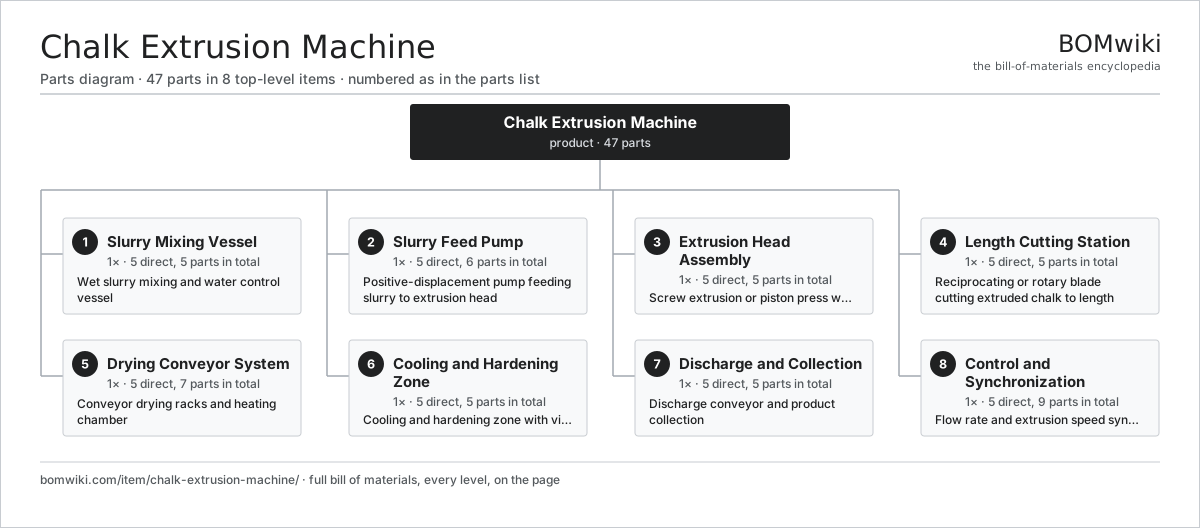
| # | Part | Qty | What it does |
|---|---|---|---|
| 1 | Slurry Mixing Vessel 5 parts | 1× | Wet slurry mixing and water control vessel |
| 2 | Slurry Feed Pump 5 parts | 1× | Positive-displacement pump feeding slurry to extrusion head |
| 3 | Extrusion Head Assembly 5 parts | 1× | Screw extrusion or piston press with die plate |
| 4 | Length Cutting Station 5 parts | 1× | Reciprocating or rotary blade cutting extruded chalk to length |
| 5 | Drying Conveyor System 5 parts | 1× | Conveyor drying racks and heating chamber |
| 6 | Cooling and Hardening Zone 5 parts | 1× | Cooling and hardening zone with vibration settling |
| 7 | Discharge and Collection 5 parts | 1× | Discharge conveyor and product collection |
| 8 | Control and Synchronization 5 parts | 1× | Flow rate and extrusion speed synchronization |
3D model
No 3D model yet. Have a CAD file of this? Add a 3D model. STL renders right on this page; STEP, FreeCAD, and OpenSCAD sources are welcome too (openly licensed, like all 3D models on BOMwiki).
Build & assembly graph
expand / collapse · shared sub-assemblies converge · links to related products · est. labourTap an assembly to expand/collapse · tap a part to open it · use “Open page” for any node · drag to pan, scroll to zoom.
Bill of materials for Chalk Extrusion Machine
8 top-level lines · 48 rows shown · 47 parts total · indented to 3 levels| # | Item / sub-assembly | Part no. | Qty/assy | Ext. qty | Parts | Type |
|---|---|---|---|---|---|---|
| 1 | Slurry Mixing Vessel 5 parts | chalk-extrusion-machine-mixer | 1× | 1 | 5 | assembly |
| 1.1 | Jacketed Mixing Tank | chalk-extrusion-machine-tank | 1× | 1 | · | part |
| 1.2 | Mixer Drive Motor | chalk-extrusion-machine-mixer-motor | 1× | 1 | · | part |
| 1.3 | High-Shear Mixer Blade | chalk-extrusion-machine-impeller | 1× | 1 | · | part |
| 1.4 | Temperature Sensor | temperature-sensor | 1× | 1 | · | part |
| 1.5 | Pressure Sensor | pressure-sensor | 1× | 1 | · | part |
| 2 | Slurry Feed Pump 5 parts | chalk-extrusion-machine-pump | 1× | 1 | 6 | assembly |
| 2.1 | Gear or Screw Pump | chalk-extrusion-machine-feed-pump | 1× | 1 | · | part |
| 2.2 | Pressure Sensor | pressure-sensor | 1× | 1 | · | part |
| 2.3 | Encoder | encoder | 1× | 1 | · | part |
| 2.4 | Connector | connector | 2× | 2 | · | part |
| 2.5 | O-Ring Set | oring-set | 1× | 1 | · | part |
| 3 | Extrusion Head Assembly 5 parts | chalk-extrusion-machine-extrude | 1× | 1 | 5 | assembly |
| 3.1 | Extrusion Screw or Piston | chalk-extrusion-machine-screw-barrel | 1× | 1 | · | part |
| 3.2 | Extrusion Die Plate | chalk-extrusion-machine-die-plate | 1× | 1 | · | part |
| 3.3 | Die Jacket Heater | chalk-extrusion-machine-die-heater | 1× | 1 | · | part |
| 3.4 | Pressure Sensor | pressure-sensor | 1× | 1 | · | part |
| 3.5 | Fastener Set | fastener-set | 1× | 1 | · | part |
| 4 | Length Cutting Station 5 parts | chalk-extrusion-machine-cutter | 1× | 1 | 5 | assembly |
| 4.1 | Cutting Blade Actuator | chalk-extrusion-machine-blade-head | 1× | 1 | · | part |
| 4.2 | Cutting Blade | chalk-extrusion-machine-cutting-blade | 1× | 1 | · | part |
| 4.3 | Cut Length Stop | chalk-extrusion-machine-cut-guide | 1× | 1 | · | part |
| 4.4 | Encoder | encoder | 1× | 1 | · | part |
| 4.5 | Connector | connector | 1× | 1 | · | part |
| 5 | Drying Conveyor System 5 parts | chalk-extrusion-machine-drying | 1× | 1 | 7 | assembly |
| 5.1 | Drying Conveyor Belt | chalk-extrusion-machine-conveyor-tray | 1× | 1 | · | part |
| 5.2 | Drive Belt | drive-belt | 1× | 1 | · | part |
| 5.3 | Heating Element | heating-element | 2× | 2 | · | part |
| 5.4 | Temperature Sensor | temperature-sensor | 2× | 2 | · | part |
| 5.5 | Blower Motor | blower-motor | 1× | 1 | · | part |
| 6 | Cooling and Hardening Zone 5 parts | chalk-extrusion-machine-cooler | 1× | 1 | 5 | assembly |
| 6.1 | Cooling and Vibration Table | chalk-extrusion-machine-cooling-table | 1× | 1 | · | part |
| 6.2 | Cool Fan | chalk-extrusion-machine-cool-fan | 1× | 1 | · | part |
| 6.3 | Defect Detection Sorter | chalk-extrusion-machine-sorter | 1× | 1 | · | part |
| 6.4 | Encoder | encoder | 1× | 1 | · | part |
| 6.5 | Fastener Set | fastener-set | 1× | 1 | · | part |
| 7 | Discharge and Collection 5 parts | chalk-extrusion-machine-collect | 1× | 1 | 5 | assembly |
| 7.1 | Discharge Conveyor | chalk-extrusion-machine-discharge-belt | 1× | 1 | · | part |
| 7.2 | Collection Bin or Chute | chalk-extrusion-machine-bin-hopper | 1× | 1 | · | part |
| 7.3 | Encoder | encoder | 1× | 1 | · | part |
| 7.4 | Blower Motor | blower-motor | 1× | 1 | · | part |
| 7.5 | Fastener Set | fastener-set | 1× | 1 | · | part |
| 8 | Control and Synchronization 5 parts | chalk-extrusion-machine-control | 1× | 1 | 9 | assembly |
| 8.1 | Microcontroller | mcu | 1× | 1 | · | part |
| 8.2 | Bare PCB | pcb-bare | 1× | 1 | · | part |
| 8.3 | Relay | relay | 4× | 4 | · | part |
| 8.4 | Power Supply | power-supply | 1× | 1 | · | part |
| 8.5 | Encoder | encoder | 2× | 2 | · | part |
Something wrong in this list? Report a problem with this BOM.
Related products
same domain, ranked by shared parts Vacuum Casting Machine
39 parts · shares 7 with this page
Marker Filling Machine
45 parts · shares 8 with this page
Vacuum Casting Machine
39 parts · shares 7 with this page
Marker Filling Machine
45 parts · shares 8 with this page
 Exercise Book Machine
53 parts · shares 7 with this page
Ballpoint Pen Assembly Machine
51 parts · shares 7 with this page
Exercise Book Machine
53 parts · shares 7 with this page
Ballpoint Pen Assembly Machine
51 parts · shares 7 with this page
Sourcing: possible vendors
Browse the supplier directory → Prices, MOQ, and lead times are algorithmic estimates, not quotes, and not claims about these companies. Company mappings are curated by keyword; est. price band $5k–$2M. How estimates work| Vendor | HQ | Specialty | MOQ | Lead time |
|---|---|---|---|---|
| atlascopco.com ↗ | Stockholm, SE | Compressors & industrial | 10 units | 12–20 wks |
|
🇦🇹Andritz
andritz.com ↗
|
Graz, AT | Process plants & machinery | 10 units | 12–20 wks |
| buhlergroup.com ↗ | Uzwil, CH | Food & materials processing | 10 units | 12–20 wks |
| gea.com ↗ | Düsseldorf, DE | Process technology | 10 units | 12–20 wks |
| mhi.com ↗ | Tokyo, JP | Heavy machinery | 10 units | 12–20 wks |
1,150-word article